What If Gilgamesh Became Immortal? Mesopotamian Myth Reimagined
If Gilgamesh had truly found immortality, the ending and the meaning of his epic would change completely. His quest begins with fear after the death of Enkidu, but the story ultimately forces him to accept that even the greatest king cannot escape the fate of ordinary humans.
True immortality would break that lesson. Gilgamesh could return to Uruk not simply wiser, but as a ruler who might outlive every subject, dynasty, and political rival. His city could gain extraordinary continuity, yet an immortal king could just as easily become a permanent obstacle to succession and change.
The gods would face an even larger problem. In Mesopotamian tradition, eternal life belongs primarily to the divine world, with Utnapishtim standing as a rare exception. Gilgamesh becoming genuinely immortal would therefore cross a boundary the gods had largely kept closed to humanity.
Yet immortality would not undo the loss that drove his journey. Enkidu would still be dead, and everyone Gilgamesh loved would continue to age around him. His greatest victory might therefore become a new burden: escaping death without escaping grief, loneliness, or the consequences of ruling forever.
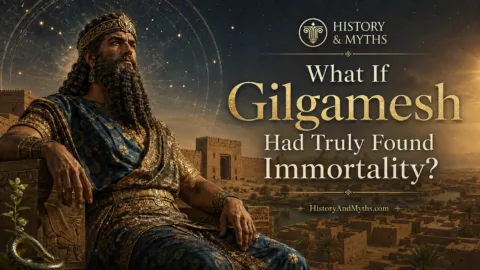
The Mythic Turning Point
Gilgamesh’s search for immortality begins after Enkidu’s death forces him to confront something his strength and royal status cannot defeat: his own mortality.
His journey eventually leads him to Utnapishtim, the survivor of the great flood who was granted eternal life by the gods. Gilgamesh fails the test that might have proved him capable of escaping the human condition, but he is later told about a plant that can restore youth.
The plant is important, but it does not clearly grant permanent immortality. Gilgamesh loses it when a serpent steals it while he is returning to Uruk, leaving him with neither eternal life nor renewed youth.
For this alternate scenario, the turning point goes further than simply saving the plant. Gilgamesh somehow gains true immortality the kind of existence normally reserved for the gods and exceptional figures such as Utnapishtim.
That single change removes the limit the epic ultimately teaches him to accept and creates a much larger problem: what happens when a mortal king succeeds in crossing a boundary the gods never intended humans to cross?
The Scenario Used in This Article
This is a hypothetical scenario, not part of the original Epic of Gilgamesh. It assumes that Gilgamesh gains genuine immortality rather than simply recovering his youth. He no longer ages and cannot die from natural causes, placing him closer to the exceptional state granted to Utnapishtim than to an ordinary human king.
It does not assume that immortality makes Gilgamesh invincible, all-powerful, or equal to the gods. He can still suffer, lose those around him, face political resistance, and provoke divine hostility.
The analysis follows the consequences of one change only: Gilgamesh returns to Uruk as an immortal ruler. From there, the key questions are how long he could remain king, whether the gods would tolerate him, what happens to succession, and whether endless life would ultimately become a gift or a burden.
What Does “True Immortality” Mean Here?
In the Epic of Gilgamesh, immortality is not simply endless youth. Utnapishtim survives the flood and is granted a permanent existence outside the normal human condition, while the plant Gilgamesh later obtains is better understood as restoring youth rather than making its user unable to die.
For this scenario, Gilgamesh receives the stronger form: he stops aging and is no longer subject to natural death.
That distinction matters because an ageless king would still be human in many other ways. Gilgamesh could feel pain, grief, fear, and loneliness. He could also lose political power or face punishment from the gods.
True immortality therefore removes death as his final limit, but it does not remove every other limit on his life or rule.
How Would Gilgamesh Change as a King?
Immortality would not return Gilgamesh to the ruler he was at the beginning of the epic. Enkidu’s death and the failed search for eternal life had already forced him to confront grief, fear, and the limits of power.
An immortal Gilgamesh could therefore return to Uruk as a more experienced and restrained king. He would have time to learn from mistakes, oversee projects across generations, and preserve political knowledge no ordinary ruler could accumulate.
But endless life would create a new danger. A king who never expects to die has little reason to surrender authority. Over time, the wisdom gained through experience could harden into certainty that no successor was needed.
Immortality might make Gilgamesh a better ruler at first. Whether he remained one after centuries of unchecked power would be far less certain.
Would an Immortal Gilgamesh Rule Uruk Forever?
If Gilgamesh remained physically immortal, Uruk would face a political situation no normal monarchy was designed to handle: a king who never reached the end of his reign.
At first, this could bring unusual stability. Gilgamesh could oversee long-term building projects, preserve alliances, and accumulate generations of military and administrative experience without the disruption of succession.
But permanent rule would also freeze the normal transfer of power. Heirs could never inherit, ambitious elites would have no natural path to the throne, and political frustration could build around a ruler who outlived everyone around him.
Gilgamesh might eventually choose to step aside, but nothing in immortality would force him to do so. If he refused, Uruk could become extraordinarily stable or increasingly dependent on a single ruler whose authority no longer had a natural endpoint.
Would the Gods Accept an Immortal Human?
Gilgamesh’s immortality would create a problem for the gods because it would blur a boundary the epic treats as fundamental. Humans may possess strength, wisdom, and even divine ancestry, but death still separates them from the gods.
Utnapishtim is the exception because his immortality is granted by divine decision after the flood. Gilgamesh becoming immortal without similar approval would be far more threatening.
The gods might tolerate him if his new condition served their purposes, but they could also try to limit his power, remove his immortality, or force him away from ordinary human society.
The real conflict would not be over whether Gilgamesh could live forever. It would be over whether a human king could remain inside the mortal world after gaining a privilege the gods had largely reserved for themselves.
What Happens to Enkidu’s Memory?
Immortality would not give Gilgamesh the one thing he originally wanted most: Enkidu back.
That loss could become even more painful over time. Gilgamesh would continue living while the friend who changed him remained dead, turning Enkidu into a permanent reminder that escaping death does not erase grief.
His memory might also shape Gilgamesh’s rule. A wiser king could preserve Enkidu’s story, honor him through monuments or ritual, and use that loss as a warning against arrogance.
But centuries of survival could change the meaning of the friendship. Enkidu might become less a personal memory and more a sacred part of Gilgamesh’s own legend the mortal companion whose death began the journey that ultimately made the king immortal.
Would Gilgamesh Become a Living God?
Gilgamesh was already more than an ordinary man in Mesopotamian tradition. The epic presents him as partly divine, and later traditions could treat him as a divine figure after death.
True immortality would blur that distinction even further. A king who never aged and survived generation after generation would almost certainly acquire a sacred status far beyond normal kingship.
That would not automatically make him equal to the great gods. Mesopotamian divinity involved more than endless life; it also depended on cosmic authority, cult, and divine function.
Still, an immortal Gilgamesh could become something unprecedented: a permanently living king worshipped by subjects who regarded his survival as proof of supernatural favor.
Instead of becoming a divine figure associated with the world of the dead, he might develop into a living focus of royal cult and become increasingly difficult to separate from the gods he once challenged.
How Would Mesopotamian Ideas About Death Change?
Gilgamesh’s immortality would challenge one of the strongest ideas in Mesopotamian literature: that death is the unavoidable fate of humanity.
That would not erase the underworld or mortal fear of death. Most people would still age and die, and funerary beliefs would continue to shape how families understood the fate of the dead.
What changes is the certainty of the boundary. If one human king could cross it, immortality would no longer appear completely closed to mortals.
Gilgamesh could become proof that the human condition had exceptions beyond Utnapishtim. That would make his survival religiously significant, raising a dangerous question for both gods and humans: if one mortal escaped death, why should others accept that death was permanent?
Could Immortality Become Available to Other Humans?
Gilgamesh’s success would immediately raise a question the epic never has to answer: could another human follow the same path?
If his immortality came from a unique divine exception, the gods could simply refuse to repeat it. But if Gilgamesh discovered a method, object, or place that remained accessible, other rulers would eventually seek it.
That could make immortality a source of political and religious conflict. Kings might compete for access, priests could try to control the knowledge, and the gods would have strong reasons to prevent a mortal privilege from becoming widely available.
The most plausible outcome is that Gilgamesh remains exceptional. A world filled with immortal humans would collapse the distinction between gods and mortals too completely, making divine intervention almost inevitable.
“`html id=”gilgamesh-read-more”
Explore Related Mesopotamian Mythology
“`
What Would Probably Not Change
Gilgamesh’s immortality would not make death disappear from Mesopotamian mythology. Ordinary humans would still age, die, and enter the underworld, while the gods retained authority over life, fate, and the boundaries of the human condition.
Uruk would also remain vulnerable to war, famine, political unrest, and changes beyond the king’s control. An immortal ruler could survive these crises, but he could not prevent every disaster or keep the wider world permanently stable.
Most importantly, Gilgamesh would still carry the memory of Enkidu and the experience that transformed him. Immortality could change his future, but it would not erase the grief, fear, and lessons that led him to seek eternal life in the first place.
Most Likely
Gilgamesh returns to Uruk with true immortality and remains king far beyond a normal human lifespan. His experience and accumulated knowledge could make his rule unusually stable, but succession would become an unresolved political problem.
The gods would likely tolerate him only as a unique exception rather than allow immortality to spread among humans. Over time, Gilgamesh could acquire a semi-divine status while still remaining distinct from the great gods.
His greatest burden would be personal rather than political. Enkidu would remain dead, generations would pass around him, and immortality would gradually reveal itself as freedom from death without freedom from loss.
Plausible but Uncertain
Gilgamesh might eventually step away from direct rule and become a sacred guardian of Uruk rather than its permanent king. That would reduce the succession problem while preserving his extraordinary status.
The gods could also impose conditions on his immortality, limiting where he could live, how much power he could exercise, or whether he could pass the gift to others.
A darker possibility is that centuries of survival gradually isolate him from ordinary human life. The wisdom gained through endless experience could make him an exceptional protector—or a ruler increasingly detached from the people whose lives remain brief.
Highly Unlikely
It is highly unlikely that Gilgamesh’s immortality would make humanity immortal as a whole or allow him to rival the gods without consequence. Mesopotamian myth treats eternal life as an exceptional privilege, not a condition meant to become normal for humans.
It is equally unlikely that endless life would guarantee perfect rule. Gilgamesh could still face rebellion, divine punishment, political isolation, and the loss of everyone around him.
The least plausible outcome is therefore an immortal king who simply rules Uruk happily forever. His survival would solve the problem of death, but create new problems of succession, authority, and separation from ordinary human life.
Final Verdict: Immortality Would Change Gilgamesh More Than It Changed Death
If Gilgamesh truly found immortality, he would overturn one of the central lessons of his epic: that even the greatest king must accept the limits of human life.
Uruk could gain an extraordinarily experienced ruler, but permanent kingship would create new problems of succession, political dependence, and isolation. The gods would also have to confront a human who had crossed a boundary usually reserved for the divine.
Yet Gilgamesh’s victory would remain incomplete. Enkidu would still be dead, ordinary people would still age, and loss would continue around him.
The most plausible outcome is not a perfect immortal kingdom, but a ruler who escapes death only to discover that immortality cannot remove grief, change, or responsibility. In that sense, finding eternal life might solve Gilgamesh’s greatest fear while creating a harder question: what gives life meaning when it no longer has an end?