How Greek Students Learned in Ancient Greece Step by Step
Greek students learned step by step through memorization, repetition, reading exercises, writing practice, and spoken recitation rather than through textbooks or formal classrooms in the modern sense. Young children usually began by listening and repeating aloud before learning letters and copying texts onto wax tablets. As students grew older, education shifted from basic literacy toward rhetoric, debate, music, and public speaking skills that prepared some boys for political and civic life.
Learning depended heavily on constant practice. Students repeated passages from poets such as Homer, copied letters by hand, recited texts aloud, and trained their memory long before advanced discussion became part of their education. The process was gradual, disciplined, and closely tied to performance, speech, and social status inside Ancient Greek society.
Early Learning Began With Listening and Memorization
Greek education usually began with listening rather than reading. Young children first learned by hearing words repeated aloud inside the home or during early instruction. Before most students could write properly, they were expected to memorize sounds, short passages, poems, and moral sayings through repetition.
Memory mattered because books were expensive and handwritten texts were limited. Education therefore depended heavily on oral practice. Students repeated lines again and again until they could recite them without assistance, especially passages connected to poets such as Homer. Pronunciation, rhythm, and recall were treated as core learning skills rather than secondary exercises.
The process was highly structured. A teacher or assistant would read aloud while students copied the sounds verbally before moving to letters or written exercises. Mistakes were corrected through repetition, and younger students often spent long periods practicing the same material until it became automatic.
This early focus on memorization shaped the rest of Greek education. Students who could accurately repeat and retain information found it easier to advance into reading, rhetoric, music, and public speaking later in life.
| Learning Stage | How Greek Students Learned |
|---|---|
| Early Childhood | Listening, memorization, and oral repetition. |
| Basic Literacy | Tracing letters, copying texts, and reading aloud. |
| Memory Training | Reciting poetry and repeating passages from memory. |
| Intermediate Study | Analyzing texts, improving fluency, and practicing performance. |
| Advanced Education | Rhetoric, debate, philosophy, and public speaking. |
How Greek Students Learned Reading and Writing
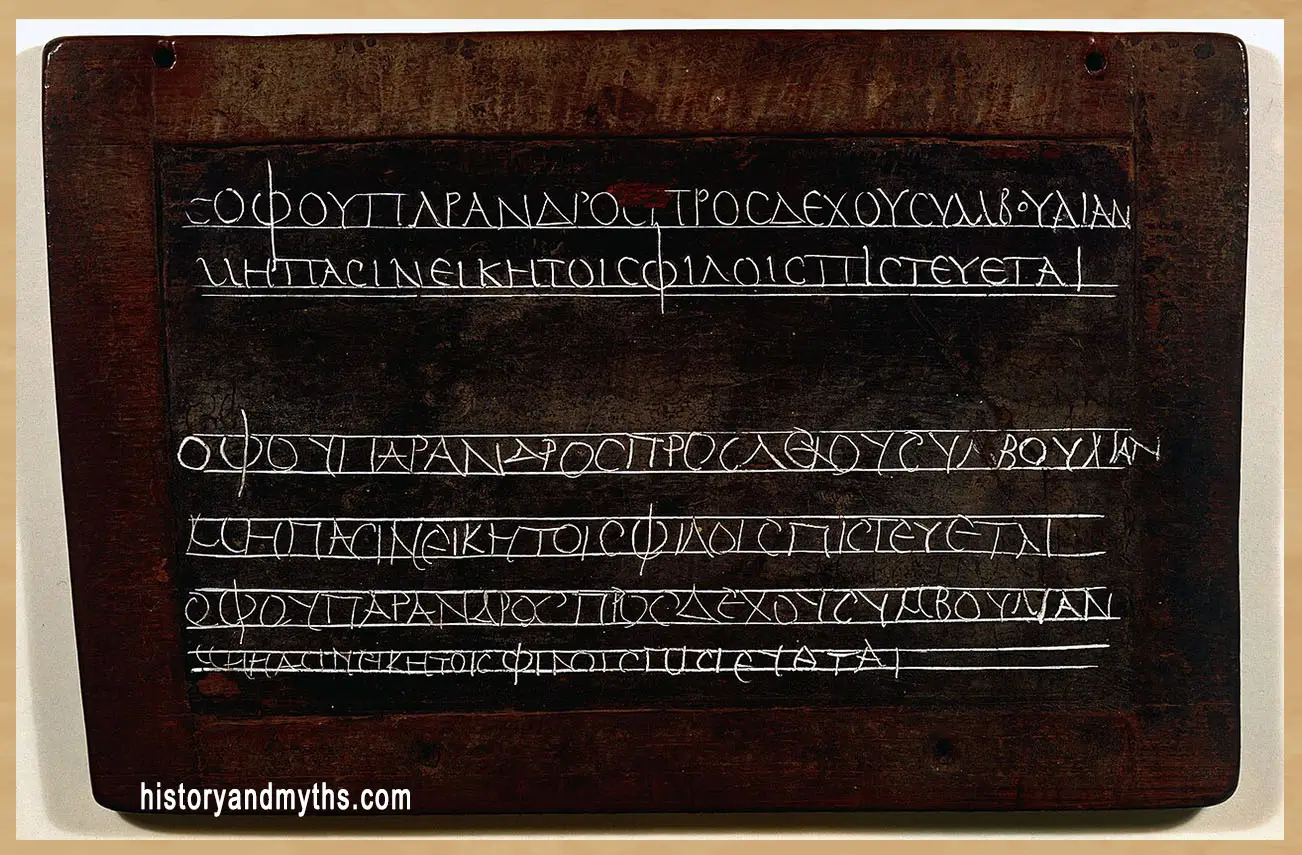
After memorization exercises, students moved into basic reading and writing practice. Letters were usually learned in sequence through repetition and copying rather than independent reading. Teachers demonstrated characters first, and students traced or copied them onto wax tablets using a stylus.
Reading was commonly performed aloud. Students sounded out words repeatedly until pronunciation and recognition became familiar. Silent reading existed but was far less important in early education than vocal recitation and listening.
Writing lessons focused on imitation. Children copied short phrases, poetic lines, and simple passages multiple times to improve letter control and memory at the same time. Wax tablets allowed mistakes to be erased and reused, making them practical for repeated exercises.
As literacy improved, students progressed to longer texts and more difficult language. Poetry became especially important because rhythm and structure helped students remember material while strengthening reading fluency.
Learning Through Repetition and Recitation
Repetition remained central even after students learned basic literacy. Greek education depended on continuous practice rather than fast progression through subjects. Students reread passages, repeated lines aloud, and copied texts many times to strengthen memory and accuracy.
Recitation was especially important because education prepared students for spoken communication in public life. Reading correctly was not enough. Students were expected to pronounce words clearly, control rhythm, and deliver passages confidently in front of others.
Poetry played a major role in this process. Works connected to Homer and other poets trained students to handle complex language patterns while improving recall. The structure of verse made long passages easier to memorize than ordinary prose.
Correction happened constantly during practice. Teachers interrupted mistakes, required passages to be repeated, and pushed students to perform material accurately from memory. Learning was built through disciplined repetition rather than private study alone.
How Greek Learning Actually Worked
Ancient Greek education developed through repetition, memorization, oral performance, and gradual literacy training rather than modern classroom instruction. Students first learned through listening and recitation before progressing into reading, writing, rhetoric, and advanced intellectual study. The process emphasized memory, discipline, and spoken communication as much as literacy itself.
© historyandmyths.com — Educational use
From Basic Literacy to Advanced Study
Students who mastered reading and writing could continue into more advanced forms of education. At this stage, learning shifted away from simple repetition toward interpretation, discussion, music, mathematics, and rhetorical training.
Advanced students studied longer literary works and practiced analyzing language rather than only memorizing it. Teachers asked questions about meaning, style, and moral lessons inside poems and speeches. This changed education from mechanical literacy into intellectual training.
Rhetoric became increasingly important for older students, especially in cities such as Athens where political participation and public speaking carried social value. Students learned how to organize arguments, respond to opponents, and speak persuasively before an audience.
Not every student reached this level. Advanced instruction required time, money, and social status, which meant higher education remained concentrated among wealthier male citizens rather than the population as a whole.
The Daily Routine of a Greek Student
A Greek student’s day often began early in the morning under the supervision of a paidagogos, a household servant or attendant responsible for guiding the child to lessons and monitoring behavior. Education usually took place in small teaching spaces rather than large formal schools.
Lessons focused on repetition, reading aloud, writing exercises, and memorization. Students copied letters onto wax tablets, recited poetry, practiced music, or listened while teachers corrected mistakes directly during instruction.
Discipline was strict in many learning environments. Students who ignored lessons or performed poorly could face punishment, especially during early literacy training where accuracy and obedience were considered essential parts of education.
As students grew older, daily learning became more specialized. Some continued into rhetoric, philosophy, or advanced literary study, while others ended formal education earlier and moved into work, military preparation, or household responsibilities.
Who Had Access to Advanced Learning?
Advanced education in Ancient Greece was mostly limited to free male citizens from wealthier families. Higher instruction required payment, free time, and access to teachers, which excluded much of the population from formal study beyond basic literacy.
Girls usually received domestic education inside the household rather than advanced rhetorical or philosophical training, especially in many Greek city-states outside a few elite circles. Enslaved people and poorer laboring families also had limited educational opportunities because daily work took priority over long-term study.
Access varied between regions and social classes. Urban centers with stronger intellectual traditions offered more opportunities for advanced learning than smaller or rural communities. Even so, higher education remained a social privilege rather than a universal system available to everyone.
Greek students learned through a gradual process built on memorization, repetition, reading aloud, writing practice, and spoken performance. Education began with listening and recall before moving into literacy, analysis, rhetoric, and advanced discussion.
The system relied less on textbooks or formal classrooms and more on constant practice directed by teachers and oral instruction. Students repeated material until it became familiar, then used those skills to handle more difficult texts and public speaking exercises later in life.
Although advanced education remained limited to a small part of society, the learning process itself shaped how Greek culture transmitted literature, rhetoric, and intellectual traditions across generations.
Key Takeaways
- Greek students began learning through listening and memorization before formal literacy training.
- Reading and writing were taught through copying, tracing letters, and oral repetition.
- Poetry and recitation played a central role in strengthening memory and pronunciation.
- Advanced education focused on rhetoric, debate, and public speaking skills.
- Most higher education remained limited to wealthy male citizens.
- Greek learning depended heavily on constant practice rather than independent study.
FAQ
How did Greek students learn in Ancient Greece?
Greek students learned through memorization, oral repetition, reading aloud, copying texts, and gradual rhetorical training.
What did Greek children learn first?
Most children began with listening exercises, memorization, and basic letter recognition before advanced reading and writing.
Did Ancient Greek students use books?
Books existed but were limited and expensive, so education relied heavily on oral instruction and repeated recitation.
How did Greek students practice writing?
Students commonly used wax tablets and styluses to trace letters and copy short passages repeatedly.
Why was memorization important in Greek education?
Memorization helped students preserve poetry, improve recall, and strengthen speaking skills in an oral learning culture.
What subjects did advanced Greek students study?
Advanced students often studied rhetoric, philosophy, literature, music, and public speaking.
Who had access to higher education in Ancient Greece?
Higher education was mostly limited to wealthy free male citizens with enough time and resources for extended study.
Did Greek students read silently?
Most early reading was performed aloud because pronunciation and spoken delivery were central parts of education.
Sources & Rights
- Marrou, Henri-Irénée. A History of Education in Antiquity. Madison: University of Wisconsin Press, 1982.
- Beck, Frederick A. G. Greek Education 450–350 B.C. London: Methuen, 1964.
- Too, Yun Lee. Education in Greek and Roman Antiquity. Leiden: Brill, 2001.
- Morgan, Teresa. Literate Education in the Hellenistic and Roman Worlds. Cambridge: Cambridge University Press, 1998.
- Bonner, Stanley F. Education in Ancient Rome: From the Elder Cato to the Younger Pliny. Berkeley: University of California Press, 1977.
- Jaeger, Werner. Paideia: The Ideals of Greek Culture. Oxford: Oxford University Press, 1945.
- Golden, Mark. Children and Childhood in Classical Athens. Baltimore: Johns Hopkins University Press, 1990.
- Kennedy, George A. Classical Rhetoric and Its Christian and Secular Tradition. Chapel Hill: University of North Carolina Press, 1999.
- Havelock, Eric A. Preface to Plato. Cambridge: Harvard University Press, 1963.
- Thomas, Rosalind. Literacy and Orality in Ancient Greece. Cambridge: Cambridge University Press, 1992.
- Cartledge, Paul. Ancient Greece: A History in Eleven Cities. Oxford: Oxford University Press, 2009.
- Ober, Josiah. Mass and Elite in Democratic Athens. Princeton: Princeton University Press, 1989.
- Dover, K. J. Greek Popular Morality in the Time of Plato and Aristotle. Berkeley: University of California Press, 1974.
- Neils, Jenifer, and John H. Oakley. Coming of Age in Ancient Greece. New Haven: Yale University Press, 2003.
- Rihll, Tracy. Greek Science. Oxford: Oxford University Press, 1999.
- Pomeroy, Sarah B. Families in Classical and Hellenistic Greece. Oxford: Oxford University Press, 1997.
- Too, Yun Lee, ed. The Pedagogue’s Voice: Teaching and Learning in Greek and Roman Antiquity. Princeton: Princeton University Press, 2010.
- Ford, Andrew. The Origins of Criticism: Literary Culture and Poetic Theory in Classical Greece. Princeton: Princeton University Press, 2002.
- Nightingale, Andrea Wilson. Genres in Dialogue: Plato and the Construct of Philosophy. Cambridge: Cambridge University Press, 1995.
- Robb, Kevin. Literacy and Paideia in Ancient Greece. Oxford: Oxford University Press, 1994.
Written by H. Moses — All rights reserved © Mythology and History