Ancient Egyptian Police: Guards, Patrols, and Law Enforcement
Law enforcement in Ancient Egypt was not one “police force,” but a layered security system built to protect grain stores, temples, streets, and royal tombs. Guards controlled access at gates, patrolled key routes, and enforced official orders through local authority and written reporting. It was practical, administrative, and focused on preventing disruption before it spread.
The Security System Was Layered (Not One Police Department)
Ancient Egypt enforced law through a network, not a single uniformed agency. The state cared less about “policing” as a modern institution and more about controlling risks: theft, disorder, tax loss, and threats to sacred or royal property. That is why enforcement was built in layers, each one assigned to a specific space.
At the local level, communities relied on watchmen and guards who knew the people they monitored. Their power came from familiarity: they could identify outsiders, track suspicious movement, and recognize who was missing or hiding. This made basic enforcement fast and efficient, because investigation often began with local knowledge rather than complex evidence.
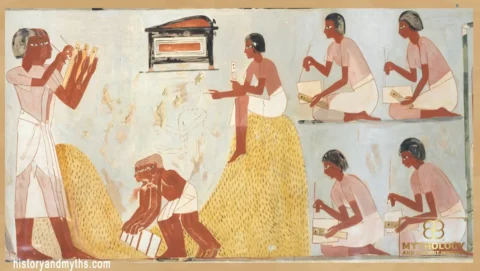
Around major assets, security became stricter. Granaries, storehouses, and temples needed controlled access because they held food, wealth, and offerings. Guards at these locations did not just “stand there.” They regulated entry, watched deliveries, and protected inventories that supported the economy and religious order.
At the highest level, the state focused on strategic zones: royal tombs, necropolis areas, and transport routes. These required patrols and site protection because the loss was not only economic, but political. A robbed tomb or disrupted supply route was a visible failure of authority. Egyptian law enforcement existed to prevent those failures, using layers of control rather than constant force.
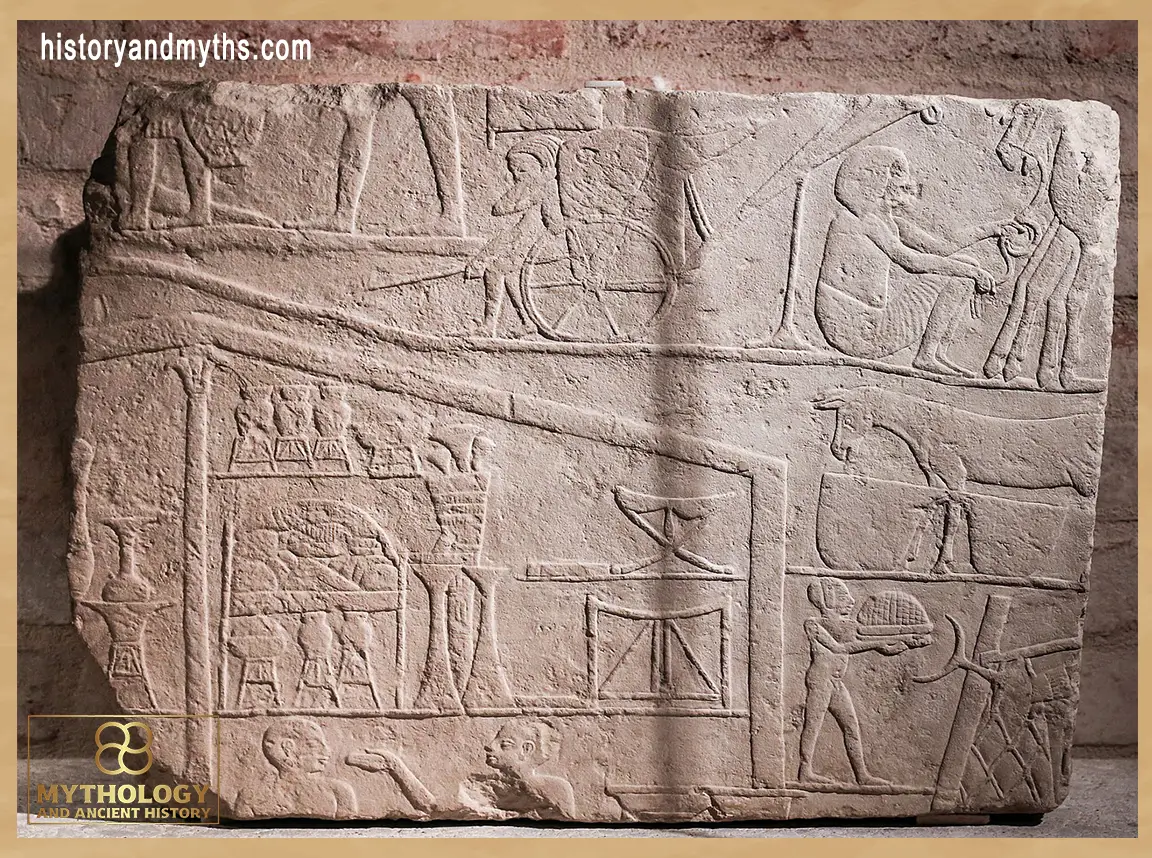
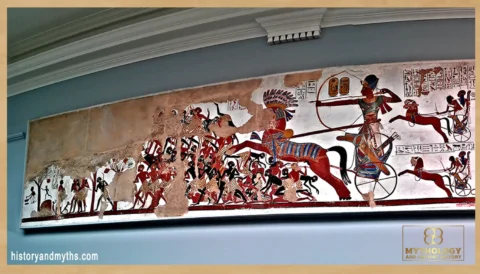
Image: Wall fragment from the tomb of Horemheb (Saqqara), scenes in a military camp, limestone relief, late 18th Dynasty (Neues Museum Berlin, ÄM 20363) — Source: Wikimedia Commons (CC BY-SA 4.0), photo by ArchaiOptix
| Security Layer | Main Role | Where It Operated | What It Prevented |
|---|---|---|---|
| Gatekeepers | Control access and entry | Storehouses, temples, workshops | Unauthorized movement and theft |
| Granary guards | Protect state resources | Granaries, magazines, depots | Tax loss and food insecurity |
| Temple guards | Protect sacred wealth and order | Temples and ritual precincts | Theft, disruption, infiltration |
| Necropolis security | Site protection and patrol | Tombs and burial zones | Tomb robbery and sabotage |
| Patrols and checkpoints | Control routes and movement | Roads, river traffic, crossings | Smuggling and escape |
| Escort enforcement | Move detainees and enforce orders | Courts, councils, official summons | Evasion, intimidation, instability |
Who the Guards Were (And What They Actually Did All Day)
Guards in Ancient Egypt were not just symbolic figures. They had measurable responsibilities tied to movement, access, and control. Their job was simple in principle: make sure people, goods, and spaces stayed where they were supposed to be. In practice, that meant enforcing boundaries every day.
The most basic role was gatekeeping. Guards controlled entry into courtyards, storehouses, workshops, and temple areas. They monitored who came in, who left, and what was carried. In an economy where value often moved as physical goods—grain, tools, linen, copper—control of entrances was the first line of law enforcement.
Another major role was protecting state storage. Granaries and administrative magazines were sensitive targets because stealing from them was not petty crime—it threatened supply, taxation, and redistribution. Guards were stationed to prevent internal theft, limit unauthorized withdrawals, and enforce accountability by watching transactions that might later become disputes.
Guards also served as escorts and transport security. If someone was detained, summoned, or ordered to appear, enforcement required safe movement. Escorts were the practical link between courts, officials, and the accused. They reduced the chance of escape, intimidation, or disruption during legal proceedings.
Finally, there was site protection: tomb areas, desert edges, and controlled zones where movement itself was suspicious. In those spaces, a guard was not waiting for crime to happen. He was actively preventing access, checking presence, and making enforcement visible.
The Medjay: From Desert People to State Security
The Medjay are often described as “the police of Ancient Egypt,” but the truth is more specific—and more interesting. “Medjay” started as a term linked to people from Nubian regions, but over time it became strongly associated with a security function, especially in guarding sensitive areas and enforcing order where the state needed reliable protection.
Their role fits the logic of Egyptian enforcement: the most important security work was not chasing criminals through cities. It was protecting strategic zones—royal tombs, necropolis regions, desert routes, and valuable state assets. Those locations required toughness, mobility, and local knowledge of terrain. In that environment, a specialized guard force made sense.
The Medjay also represent how Egyptian law enforcement blended into state authority. They were not separate from administration; they were part of the system that made orders real. When officials needed patrols, escorts, or security presence, forces like the Medjay were the tools that turned written decisions into physical control.
So the Medjay are best understood as a security layer within the Egyptian state—one designed for prevention, deterrence, and controlled movement, not modern “policing” in the street sense.
How Investigations Worked Without Modern Forensics
Egyptian investigations did not depend on scientific tests. They depended on control of people, control of movement, and control of narratives. The state’s advantage was not technology—it was administration. When something went wrong, officials and guards used practical steps to isolate the problem and force it into a form the system could judge.
The first step was often containment. If theft or disorder was suspected, guards focused on gates, storehouses, and routes. The goal was to stop goods from disappearing further and to limit who could leave, enter, or access the area. That is already “investigation,” because restricting movement immediately narrows responsibility.
Next came identification through local knowledge. In small communities, enforcement worked because people knew each other. Guards did not need fingerprints to know who was missing, who had access, and who had motive. Suspicion formed quickly around proximity and opportunity.
Then came questioning and comparison. Officials pressed for consistent statements, checked stories against known routines, and compared what different people claimed. A lie in this environment was risky because it had to survive repetition and match the social reality of who was where and when.
Finally, the process created written reporting. Once a case became documented, it stopped being rumor and became a legal object. That shift mattered: a written investigation could be reviewed, escalated, and enforced. Egyptian enforcement worked by converting disruption into paperwork—and paperwork into authority.
Checkpoints, Patrols, and the Control of Movement
A large part of Egyptian law enforcement was not chasing criminals after the fact. It was controlling movement so crime became harder to commit in the first place. If you can regulate who enters a zone, who carries goods, and who travels certain routes, you reduce theft and disorder without constant violence.
This is why checkpoints mattered. Temple precincts, storage areas, work zones, and necropolis regions were all spaces where access could be restricted. A guard at a gate was not just watching a door. He was controlling an economic and legal boundary: inside that boundary, goods were accountable, and outsiders were suspicious by default.
Patrols served the same purpose on a wider scale. Routes along the Nile, desert tracks, and the edges of controlled territories needed enforcement presence because they were the pathways of trade and escape. Patrol work was less about heroic confrontation and more about deterrence—making the risk of being seen higher than the reward of stealing.
This is also where enforcement becomes political. Movement control is a form of authority. The more the state can regulate access and travel, the more it can shape security, taxation, and obedience. Egyptian law enforcement was effective because it treated geography as part of the legal system.
Why Guards Protected Temples, Storehouses, and Tombs More Than Streets
Modern readers often imagine law enforcement as street policing, but Egyptian priorities were different. The state focused security where the damage from crime was highest: religious wealth, state resources, and royal legitimacy. Temples, storage facilities, and tombs were not just “important places.” They were pillars of power.
Temples held offerings, precious materials, and ritual equipment. A theft there was not only economic. It attacked sacred order and threatened the credibility of the institutions that connected gods, kingship, and society. That made temple security a political necessity, not a luxury.
Storehouses and granaries mattered for a harder reason: food is stability. Grain storage supported taxation, redistribution, and survival during shortages. Theft or corruption inside storage systems could weaken the economy and trigger unrest. Guards protected these spaces because protecting grain meant protecting control.
Royal tombs and necropolis regions carried a different kind of value: legitimacy. The king’s afterlife was part of state ideology, and royal burials represented authority across time. A robbed tomb was a public sign that the state failed to defend what it claimed to be sacred and untouchable.
So Egyptian law enforcement was strategic. It protected the assets that held society together, not the places where crime looked dramatic. That is why guards were concentrated around sacred and administrative centers—because that is where the state’s power actually lived.
Corruption, Abuse, and the Limits of Enforcement
No enforcement system is immune to misuse, and Ancient Egypt was no exception. Guards controlled access, movement, and detention—three powers that can easily become tools for intimidation or private gain. The system depended on enforcement being trusted. When that trust broke, “law” could turn into leverage.
The most common weakness was gate power. If a guard controlled who entered a storehouse, who passed a checkpoint, or who received access to goods, he could demand favors or quietly bend rules. Small corruption can thrive in exactly these spaces because it looks like routine. A missing item can be blamed on confusion, and delayed access can be disguised as procedure.
Abuse also appeared through detention and escort authority. A guard who could bring someone in for questioning, hold them temporarily, or escort them under pressure could easily weaponize the process. Even without formal punishment, the experience could break reputations and force concessions.
This is why enforcement had limits. Egypt could build strong security layers, but it still relied on human decisions inside local networks. The state’s solution was oversight through administration: written records, reporting chains, and accountability structures. The more enforcement became documented, the harder it was to hide misconduct. In Egyptian terms, paperwork was not just bureaucracy—it was anti-corruption infrastructure.
- Ancient Egypt enforced law through layers of guards, not a single police department.
- Gatekeeping and access control were the first line of security.
- Temples, granaries, and tombs were protected because they were pillars of power.
- Investigations relied on containment, questioning, and written reporting.
- Corruption existed, and paperwork was one of the state’s main tools of control.
Did Ancient Egypt have a real police force?
Egypt had enforcement structures and guards, but not a modern centralized police department. Security operated through layered local and state protection.
Were the Medjay soldiers or police?
They functioned as state security, especially in sensitive zones, and their role overlapped with policing rather than battlefield warfare.
How did guards stop theft in storehouses?
They controlled entry, monitored movement of goods, and enforced accountability through supervision and reporting.
What places were guarded the most?
Temples, granaries, and tomb areas received heavy protection because they held wealth, food security, and royal legitimacy.
How were suspects handled before court?
Guards could detain, escort, and restrict movement while officials questioned and documented statements for legal review.
Could guards abuse their authority?
Yes. Access control and detention powers could be exploited, which is why documentation and oversight mattered.
Why was movement control so important?
Because checkpoints and patrols reduced crime by limiting access to valuable zones and making escape harder.
Sources & Rights
- Černý, Jaroslav. A Community of Workmen at Thebes in the Ramesside Period. Cairo: Institut Français d’Archéologie Orientale, 1973.
- Davies, W. V. “The Law in Ancient Egypt.” In The Oxford Encyclopedia of Ancient Egypt, edited by Donald B. Redford. Oxford: Oxford University Press, 2001.
- Gardiner, Alan H. Egypt of the Pharaohs. Oxford: Oxford University Press, 1961.
- Haring, Ben J. J. Divine Households: Administrative and Economic Aspects of the New Kingdom Royal Memorial Temples in Western Thebes. Leiden: Nederlands Instituut voor het Nabije Oosten, 1997.
- Kemp, Barry J. Ancient Egypt: Anatomy of a Civilization. 2nd ed. London: Routledge, 2006.
- Lippert, Sandra. “Law Courts.” In UCLA Encyclopedia of Egyptology. Los Angeles: University of California, Los Angeles, 2012.
- Meskell, Lynn. Private Life in New Kingdom Egypt. Princeton: Princeton University Press, 2002.
- Peet, T. Eric. The Great Tomb-Robberies of the Twentieth Egyptian Dynasty. Oxford: Clarendon Press, 1930.
- Shaw, Ian, ed. The Oxford History of Ancient Egypt. Oxford: Oxford University Press, 2000.
- Teeter, Emily. Religion and Ritual in Ancient Egypt. Cambridge: Cambridge University Press, 2011.
- Van De Mieroop, Marc. A History of Ancient Egypt. Malden, MA: Wiley-Blackwell, 2011.
- VerSteeg, Russ. “Legal Procedure and the Law of Evidence in Ancient Egypt.” Tulane Journal of International and Comparative Law 10, no. 1 (2001): 1–32.
- Widson, Martha R. “The Oath in Ancient Egypt.” Journal of Near Eastern Studies 7, no. 4 (1948): 220–232.
- Wendrich, Willeke, ed. UCLA Encyclopedia of Egyptology. Los Angeles: University of California, Los Angeles, 2008–.
- Wilson, Penelope. “Medjay.” In UCLA Encyclopedia of Egyptology. Los Angeles: University of California, Los Angeles, 2008–.
- World History Encyclopedia. “Police in Ancient Egypt.” Accessed 2026.
Written by H. Moses — All rights reserved © Mythology and History