Pets and Domestic Animals in Ancient Egyptian Daily Life
Animals in ancient Egypt were not symbols floating in myth alone; they were present, physical companions and tools within daily life. Inside houses, courtyards, farms, and workshops, animals shaped how people worked, moved, and lived. The relationship between Egyptians and animals was practical first, emotional second, and symbolic only in specific contexts never all at once.
Modern writing often blurs this distinction, portraying every animal as sacred or universally adored. In reality, ancient Egyptians drew clear lines between pets kept for companionship, domestic animals raised for labor and food, and animals associated with religious spaces. Understanding these boundaries is essential to understanding daily Egyptian society as it truly functioned, rather than as it is romantically imagined.
This article examines pets and domestic animals as part of ordinary household and social life, not temple ritual. It explores which animals lived alongside humans, how they were used, who could afford to keep them, and where emotional attachment ended and economic necessity began. By focusing on evidence from homes, tomb scenes, and settlement remains, the goal is to reveal how animals fit into the rhythms of everyday life across different social classes in ancient Egypt.
Distinguishing Pets from Domestic Animals
Ancient Egyptians did not treat all animals the same way, nor did they collapse emotional, economic, and symbolic roles into a single category. A clear distinction existed between pets kept for companionship and domestic animals raised for work, food, or production. Understanding this separation is critical, because it reflects how households actually functioned rather than how animals are later portrayed in religious or symbolic contexts.
Pets such as cats, dogs, and certain birds were primarily associated with proximity to human living space. They appear in household scenes, under chairs, beside owners, or within private courtyards. Their value was not measured in output but in presence: guarding, pest control, companionship, and social status. Keeping a pet required surplus resources, which meant that true pets were more common among urban households and the middle and upper classes than among subsistence farmers.
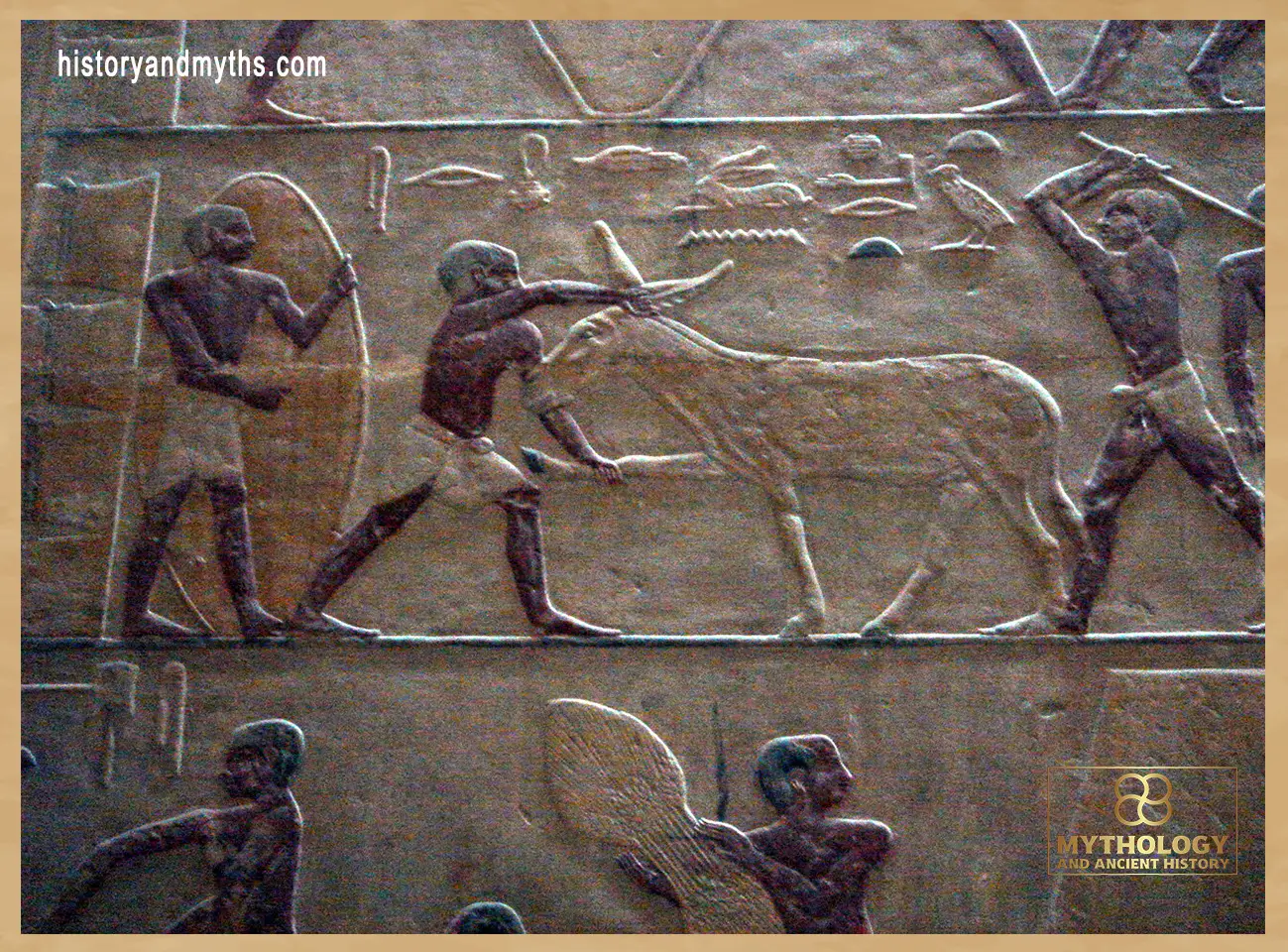
Domestic animals, by contrast, were defined by utility. Cattle, donkeys, sheep, goats, and poultry were integral to survival and productivity. They provided labor, transport, meat, milk, hides, and secondary products essential to household and state economy. These animals were managed, counted, taxed, and culled. Emotional attachment may have existed, but it was secondary to function.
The distinction was not moral but practical. An animal could be respected without being sentimentalized, and valued without being anthropomorphized. This pragmatic classification allowed Egyptian households to balance affection, necessity, and economic reality without confusion. Pets occupied social space; domestic animals occupied productive space. Mixing the two was rare and usually limited to symbolic or exceptional cases.
| Aspect | Role in Daily Egyptian Life |
|---|---|
| Pets | Animals kept primarily for companionship, pest control, guarding, or status rather than direct economic output. |
| Domestic Animals | Animals raised for labor, food production, transport, and economic sustainability. |
| Common Household Animals | Cats, dogs, birds, poultry, goats, sheep, donkeys, and cattle depending on space and resources. |
| Primary Functions | Pest control, guarding, transport, plowing, food supply, and secondary products. |
| Emotional Attachment | Present but selective, shaped by proximity, surplus, and individual household circumstances. |
| Social Class Influence | Wealthier households could afford non-essential pets; lower classes focused on utility animals. |
| Religious Association | Symbolic or ritual in specific contexts, but largely separate from everyday household practice. |
| Limits of Care | Animals were controlled, disciplined, culled, or sold when survival and economy required it. |
Animals Inside the Egyptian Household
Animals that lived within or directly around Egyptian homes were not accidental presences. Their inclusion reflected household structure, available space, and social status. Urban houses, village compounds, and rural dwellings each allowed different degrees of proximity between humans and animals, shaping daily interaction in practical ways.
Cats were among the most common animals found inside living spaces. Beyond later religious associations, their everyday role was clear: pest control. Grain storage areas and kitchens attracted rodents, and cats reduced loss of food in both urban and rural settings. Their presence inside houses was tolerated and often encouraged because it protected household resources.
Dogs occupied a more variable position. In some households, they lived near entrances or courtyards, serving as guards and companions. In others, they were kept at the edges of domestic space, particularly in denser settlements. Their role depended largely on function rather than affection, though burial evidence suggests that some dogs were personally valued by their owners.
Birds, especially small songbirds and waterfowl, appear in domestic scenes as well. These animals were often kept in cages or enclosed spaces, providing companionship, status display, or controlled food sources. Their presence required time and resources, which again suggests that keeping birds was more common among households above subsistence level.
Importantly, not every household kept animals indoors. Space limitations, hygiene concerns, and economic priorities shaped decisions. For many families, animals remained in courtyards, outbuildings, or shared village spaces rather than inside living rooms. The domestic presence of animals was therefore selective, not universal.
This selective integration shows that animals inside Egyptian homes were neither chaotic nor sentimental additions. They were managed presences, carefully balanced against cleanliness, function, and available resources. Domestic life accommodated animals where they served a clear purpose or social role and excluded them where they did not.
Animals as Tools of Daily Work
Beyond household companionship, animals were fundamental to daily labor and survival in ancient Egypt. Their value was measured in effort saved, productivity increased, and reliability over time. For most families especially outside urban centers animals were not optional; they were essential working assets.
Donkeys were among the most important labor animals. They transported water, grain, firewood, and goods between villages, fields, and markets. Their endurance and ability to move across uneven terrain made them indispensable for both rural households and small-scale trade. Ownership of a donkey often marked the difference between subsistence and relative economic stability.
Cattle played a different role. Oxen were used for plowing fields and preparing land for cultivation, tying animal labor directly to agricultural output. Beyond work, cattle represented wealth. They were counted, taxed, and recorded, forming part of a household’s economic identity. Their presence signaled status as much as productivity.
Sheep and goats supported daily life through secondary products. Milk, wool, and hides were renewable resources that sustained households over time. These animals required less space and investment than cattle, making them accessible to a broader segment of society. Poultry, particularly ducks and geese, supplemented diet and could be raised within or near domestic compounds.
Crucially, these animals were managed collectively within families and communities. Feeding, breeding, and protection were shared responsibilities, and loss of an animal could have immediate economic consequences. Emotional attachment may have existed, but it was framed by necessity. Animals were valued partners in labor, not companions in sentiment.
This reliance on animal labor reveals a society deeply attuned to practical efficiency. Daily work was structured around what animals could provide, and households organized themselves to maximize that contribution. In this context, animals were not background figures—they were active participants in sustaining everyday life.
Who Cared for Animals Every Day?
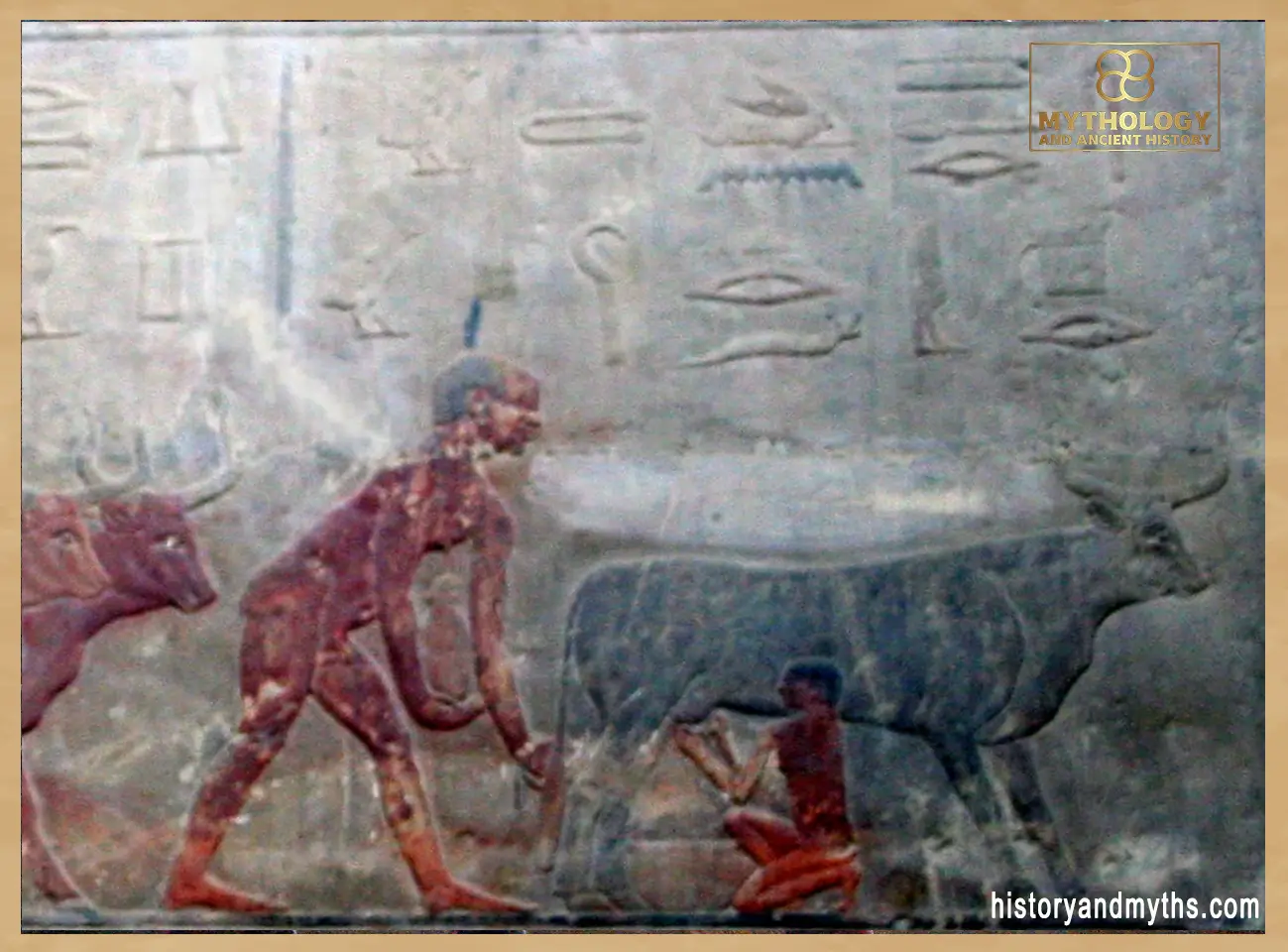
In farming communities, men often handled large livestock used for plowing and transport, while women frequently managed poultry, small livestock, and food preparation involving animal products. Children also contributed by watching goats, collecting fodder, gathering eggs, or helping move smaller animals around the household. These everyday tasks introduced younger family members to agricultural responsibilities from an early age. Larger estates employed herdsmen, stable workers, and specialized animal keepers whose responsibilities included breeding, feeding, and protecting valuable livestock.
Tomb scenes frequently depict these workers leading cattle, milking cows, tending donkeys, or counting herds as part of estate administration. Daily animal care therefore reflected the broader organization of Egyptian society. Caring for animals was not merely an agricultural necessity it was a routine that connected family life, labor organization, and economic survival. The relationship between humans and animals was maintained through continuous work rather than occasional interaction.
Emotional Bonds and Evidence of Affection
Although practicality defined most human–animal relationships in ancient Egypt, evidence suggests that emotional bonds did exist in certain contexts. These bonds, however, were selective and personal rather than universal. Affection toward animals emerged where daily proximity, long-term interaction, and surplus resources allowed it not as a cultural rule, but as individual experience.
Some animals appear in tomb scenes positioned close to their owners, often beneath chairs or beside family members. In a few cases, animals are shown with collars or names, indicating recognition beyond utility. Such depictions suggest companionship, especially among households that could afford to maintain animals without relying on them solely for labor or food.
Burials provide additional insight. While most animals were not buried formally, a limited number received individual interments or were included in human tomb contexts. These instances are rare and should not be overgeneralized, but they demonstrate that emotional attachment was possible, particularly for pets such as dogs and cats. These acts reflect personal loss rather than ritual obligation.
Importantly, affection did not override function. An animal could be cared for and still culled, sold, or replaced if circumstances required it. Emotional bonds existed within boundaries set by economic reality. Egyptians did not romanticize animals as equals; they acknowledged attachment while maintaining clear human control.
This restrained emotional framework is significant. It shows a society capable of affection without sentimentality, and care without illusion. Animals could be companions, but they remained part of a structured social and economic order. Affection was genuine but never allowed to disrupt daily survival.
Animals, Social Class, and Daily Inequality
Access to animals in ancient Egypt was shaped strongly by social class and economic capacity. Not all households could keep animals in the same way, nor for the same reasons. The presence, type, and treatment of animals reflected broader inequalities embedded in daily life.
Elite and upper-middle households were more likely to keep animals beyond strict necessity. Pets kept for companionship, birds housed in cages, or dogs maintained primarily for guarding and status were markers of economic surplus. These households had space, labor, and resources to support animals whose immediate utility was limited or indirect.
By contrast, lower-status households interacted with animals almost exclusively through work and survival. Donkeys, goats, poultry, and occasionally cattle were kept because they directly supported food production or income. In such contexts, animals were rarely separated from their economic function. Space constraints and resource pressure left little room for non-essential animals.
Urban and rural differences further shaped these patterns. Urban dwellers often had limited space, encouraging selective animal keeping, while rural households integrated animals into daily routines through fields, pens, and shared village areas. Even so, wealth remained the decisive factor. A wealthy urban household could afford a pet; a poor rural family often could not afford anything beyond essential livestock.
These distinctions reveal that animal keeping was never culturally uniform. It was conditioned by class, location, and household structure. Animals mirrored inequality: who owned them, how they were treated, and why they were kept all reflected a household’s position within society.
Understanding this social dimension prevents idealized interpretations. Ancient Egyptians did not share a single, harmonious relationship with animals. Their interactions varied as widely as their social circumstances and animals occupied different roles depending on who owned them and why.
Were Animals Considered Sacred in Daily Life?
The idea that animals in ancient Egypt were universally sacred is one of the most persistent modern misconceptions. While animals played symbolic and religious roles in specific contexts, daily life operated under a different logic. Sacred status was situational, not automatic, and most animals encountered in homes, fields, and streets were treated pragmatically rather than ritually.
Religious associations were typically context-bound. An animal could be sacred within a temple, cult center, or ritual setting, yet entirely ordinary outside that space. The same species might be revered symbolically in one location and slaughtered, worked, or sold in another. Sacredness did not follow the animal everywhere; it followed the setting and purpose.
In everyday households, animals were rarely treated as divine representatives. Cats controlled pests, donkeys carried loads, cattle plowed fields, and poultry provided food. These activities required management, discipline, and sometimes killing actions incompatible with universal sacredness. Practical necessity governed behavior far more than religious symbolism.
Even animals associated with major deities were not exempt from this separation. Reverence toward a god did not translate into untouchable status for all animals of that type. Egyptians distinguished clearly between symbolic representation and living utility. Failing to recognize this distinction leads to romanticized interpretations that ignore economic and social reality.
Understanding this boundary clarifies how religion and daily life coexisted without constant conflict. Sacred animals existed—but primarily within controlled religious frameworks. In homes and villages, animals were part of a working environment shaped by survival, labor, and social structure rather than ritual devotion.
Pets and Domestic Animals — At a Glance
- Clear Distinction: Egyptians separated pets kept for proximity from animals raised for labor and food.
- Household Presence: Cats, dogs, and birds lived near human space when they served a clear function.
- Economic Core: Donkeys, cattle, goats, and poultry sustained daily work and survival.
- Selective Affection: Emotional bonds existed but never replaced practical necessity.
- Class-Based Access: Wealth and space determined which animals a household could keep.
- Religion vs Daily Life: Sacred symbolism applied in temples, not ordinary households.
- Limits of Care: Control, discipline, and culling were accepted parts of animal management.
Limits of Care: Control, Discipline, and Culling
Care for animals in ancient Egypt existed within clear limits defined by necessity and control. While animals could be valued, relied upon, and even affectionately treated, they were never outside human authority. Discipline, restriction, and culling were accepted parts of managing animals in daily life.
Animals were controlled physically and spatially. They were tethered, enclosed, guided, and restrained to prevent damage, escape, or injury. This was not cruelty by cultural standards of the time, but management. An animal that disrupted household order, destroyed resources, or threatened safety was corrected or removed.
Culling was an unavoidable reality. Domestic animals were slaughtered for food, sacrificed for economic survival, or sold when resources became strained. Even animals that had lived close to humans could be killed when circumstances demanded it. Emotional attachment did not override household survival. This balance reflects a society that prioritized continuity over sentiment.
Illness, injury, or old age also imposed limits. Animals that could no longer work or reproduce were often culled rather than maintained indefinitely. Veterinary care was minimal and pragmatic. The goal was not prolonging life at all costs, but maintaining functional balance within the household economy.
Recognizing these limits is essential to understanding ancient Egyptian daily life honestly. Care existed, but it was conditional. Animals were respected partners in survival, not protected dependents. This controlled relationship allowed households to function sustainably without collapsing into either cruelty or idealized affection.
Key Takeaways
- Ancient Egyptians clearly distinguished between pets and animals kept for economic utility.
- Animals inside households served defined roles related to protection, pest control, or companionship.
- Working animals formed the backbone of daily labor, transport, and food production.
- Emotional bonds with animals existed but remained limited by practical necessity.
- Social class and available resources shaped how animals were kept and treated.
- Religious symbolism did not govern everyday animal management.
- Control and culling were accepted parts of sustaining household balance.
FAQ — Pets and Domestic Animals in Ancient Egypt
1) What animals were kept as pets in ancient Egypt?
Cats, dogs, and certain birds were commonly kept for companionship, pest control, guarding, or status.
2) Were all animals in ancient Egypt considered sacred?
No. Sacred status applied in specific religious contexts, while daily life treated most animals pragmatically.
3) How did domestic animals support daily life?
Animals provided labor, transport, food, and secondary products essential for household survival.
4) Did ancient Egyptians feel emotional attachment to animals?
Emotional bonds existed in some cases, especially with pets, but were limited by economic necessity.
5) Were pets common among all social classes?
No. Keeping animals purely for companionship was more common among wealthier households.
6) How were animals controlled in daily life?
Animals were managed through restraint, discipline, enclosure, and culling when required.
7) What happened to animals that could no longer work?
Animals that became ill, injured, or unproductive were often culled rather than maintained long-term.
Sources
- Brewer, Douglas J., and Emily Teeter. Egypt and the Egyptians. Cambridge University Press, 2007.
- David, Rosalie. Handbook to Life in Ancient Egypt. Oxford University Press, 2003.
- Dodson, Aidan, and Salima Ikram. The Mummy in Ancient Egypt. Thames & Hudson, 1998.
- Ikram, Salima. Choice Cuts: Meat Production in Ancient Egypt. Peeters, 1995.
- Ikram, Salima. Divine Creatures: Animal Mummies in Ancient Egypt. American University in Cairo Press, 2005.
- Janssen, Jac. J. Village Varia: Ten Studies on the History and Administration of Deir el-Medina. Leiden, 1997.
- Kemp, Barry J. Ancient Egypt: Anatomy of a Civilization. 2nd ed. Routledge, 2006.
- Shaw, Ian, ed. The Oxford History of Ancient Egypt. Oxford University Press, 2000.
- Trigger, Bruce G., Barry J. Kemp, David O’Connor, and Alan B. Lloyd. Ancient Egypt: A Social History. Cambridge University Press, 1983.
- Wilkinson, Toby. The Rise and Fall of Ancient Egypt. Random House, 2010.
- Wilkinson, Richard H. The Complete Gods and Goddesses of Ancient Egypt. Thames & Hudson, 2003.
- Davies, Norman de Garis. The Tomb of Ti. Egyptian Exploration Society, 1902.
- Tooley, Angela. Egyptian Models and Scenes. British Museum Press, 1995.
- Hendrickx, Stan. “Animals and Animal Cults in Predynastic Egypt.” In Animals in Egyptian Religion. Brill, 2010.
- Baines, John, and Jaromír Málek. Atlas of Ancient Egypt. Phaidon, 1980.
- Redford, Donald B., ed. The Oxford Encyclopedia of Ancient Egypt. Oxford University Press, 2001.
- Meskell, Lynn. Private Life in New Kingdom Egypt. Princeton University Press, 2002.
- Smith, Harry S. The Fortress of Buhen: The Inscriptions. Egypt Exploration Society, 1976.
- UCLA Encyclopedia of Egyptology. “Animal Husbandry.”
- UCLA Encyclopedia of Egyptology. “Animal Economy.”
- UCLA Encyclopedia of Egyptology. “Agriculture.”
- UCLA Encyclopedia of Egyptology. “Daily Life.”
- The British Museum. Ancient Egyptian Animal Collections.
- The Metropolitan Museum of Art. Daily Life in Ancient Egypt.
- Petrie Museum of Egyptian Archaeology. Animal Remains Collection.
- Griffith Institute, University of Oxford. Egyptian Settlement Records.
- University of Chicago – Oriental Institute. Ancient Egyptian Agriculture.
- Encyclopaedia Britannica. “Ancient Egypt.”
- World History Encyclopedia. “Animals in Ancient Egypt.”
- The Australian Museum. Animals in Ancient Egyptian Society.