False Accusations in Ancient Egypt: How Trials Could Ruin a Life
False accusations in Ancient Egypt were not just personal drama—they were a legal weapon. A single claim could trigger an investigation, force oaths, mobilize witnesses, and expose someone to punishment or social ruin. Egyptian courts relied on testimony, written records, and sworn statements to decide what was true, which made trials vulnerable to manipulation—and powerful when the system worked.
What Counts as a “False Accusation” in an Ancient Egyptian Trial?
A false accusation is not simply a wrong guess. In legal terms, it is an allegation presented as truth with the intention to harm, pressure, or displace someone. In Ancient Egypt, that could mean accusing a neighbor of theft, accusing a worker of misconduct, accusing someone of violating an order, or claiming property or rights through a story designed to look official.
The danger of a false accusation came from how seriously the system treated claims. Courts and councils did not operate on modern forensic proof. They operated on credibility: witnesses, sworn statements, consistent narratives, and reputations. That meant an accusation could become real damage even before a verdict existed. The process itself could punish someone through detention, humiliation, loss of standing, or forced labor disruption.
False accusations were also easier to weaponize because many disputes were local and personal. People lived close, worked together, depended on networks, and carried grudges. A legal claim could be the cleanest way to turn conflict into “official truth.” If your enemy could be labeled dishonest, disloyal, or criminal, you didn’t just win socially—you gained leverage inside the state’s machinery.
So in Egyptian legal reality, false accusation is best understood as a strategy: turning private conflict into a public judgment by using the court as the battlefield.
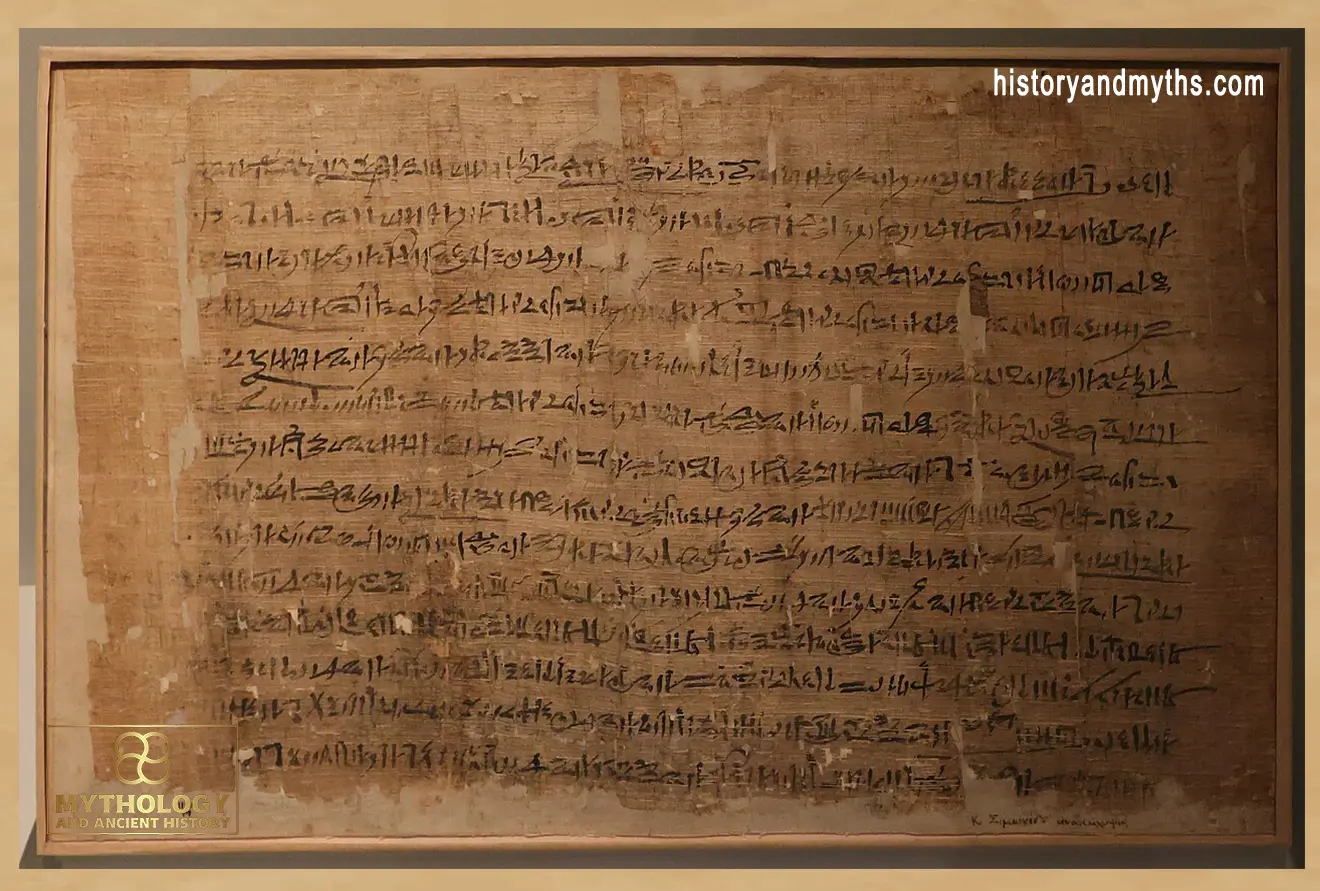
Papyrus Mayer B (legal document on tomb-robbery investigations, Ramesses VI) — Source: Wikimedia Commons (CC BY-SA 4.0), photo by Geni (December 2023)
| Topic | How It Worked | Why It Matters | Risk in a False Case |
|---|---|---|---|
| False accusation | A claim used as a legal weapon | Turns private conflict into official judgment | The process itself can damage the accused |
| Evidence style | Witnesses, oaths, records, plausibility | Credibility is the core legal currency | Fabricated stories collapse under questioning |
| Oaths | Truth sworn with divine and social pressure | Discourages perjury inside proceedings | False testimony becomes high-risk |
| Trial flow | Complaint, summons, testimony, record, decision | Creates structure and accountability | Recorded contradictions ruin credibility |
| False testimony | Lying during the trial (often under oath) | Threatens the court’s ability to decide truth | May trigger formal penalties and loss of status |
| Outcome risk for accuser | Loss of trust, exposure, counter-action | Accusation is a gamble | A proven liar loses future power in disputes |
Why People Made False Accusations (Power, Property, and Revenge)
False accusations usually weren’t random. They had motives, and those motives were often practical. In a society where reputation mattered and legal outcomes could reshape someone’s life, accusation became a tool for gaining advantage.
One major motive was property conflict. Land, inheritance, tools, and stored goods could be disputed without clear modern paperwork. If you could frame your opponent as a thief or liar, you could tilt the court in your favor and weaken their claim. The case stopped being about the object and became about the person’s credibility.
Another motive was status and workplace rivalry. In villages, temples, and work crews, accusations could remove a competitor. If someone was suspected of misconduct, corruption, or disloyalty, they became vulnerable. A false accusation could disrupt their role, damage trust, and push superiors to replace them with someone safer or more loyal.
Revenge and personal conflict also mattered. A legal accusation could turn grudges into formal punishment. Instead of fighting physically, a person could punish through institutions. That made the attack more dangerous because it carried the weight of authority and could last longer than a private dispute.
The key point is that false accusations were valuable because they could convert social conflict into legal consequences. When courts are powerful, accusations become powerful too—even when they are not true.
How Egyptian Courts Tried to Separate Truth from Manipulation
Because trials relied heavily on testimony, Egyptian courts needed tools to test credibility. They could not run laboratory analysis, but they could pressure a story until it either held together or collapsed. The legal system worked like a filter: it tried to expose contradictions, enforce consistency, and anchor claims to witnesses or written records.
The first method was witness comparison. A single statement was weaker than multiple consistent accounts. Courts could listen to several people and check whether their stories matched on key points: time, location, objects, and the sequence of events. If an accusation was fabricated, it became harder to maintain the same narrative across different voices.
The second method was oaths. Swearing truth was not a casual ritual. It was a high-risk commitment with religious and social pressure behind it. If someone lied under oath, the issue wasn’t only legal—it was moral and cosmic. That threat was meant to restrain false testimony and make perjury expensive.
A third method was documentary reference when available. Administrative Egypt produced records: deliveries, assignments, receipts, and lists. In disputes involving property, labor, or official duties, written evidence could confirm or weaken an accusation. Even when documentation was incomplete, the expectation of paperwork reduced the space for pure invention.
Finally, courts used reputation and plausibility. This sounds subjective, but in practice it was a reality check. If an accusation depended on an unlikely story, or if a person had a record of instability, the court could treat the claim as suspicious. The system was not perfect, but it wasn’t blind either. It actively tried to detect manipulation using the tools it had.
The Trial Itself Could Be the Punishment (Even Before a Verdict)
In many societies, the most damaging part of a false accusation is not the final judgment—it is the process. Ancient Egypt was no exception. Being pulled into a legal dispute could disrupt work, weaken alliances, and publicly stain a person’s name long before anyone proved guilt or innocence.
A trial forced people to perform credibility under pressure. The accused had to answer, defend, and often bring support. If they failed to produce witnesses or if their story sounded unstable, they could lose trust even if the evidence was weak. In tightly connected communities, suspicion spreads faster than proof.
The process also created practical vulnerability. If someone was detained, questioned, or removed from their role temporarily, their economic life could collapse. The accuser didn’t always need a conviction to win. Sometimes the goal was to isolate the target, break their standing, and make them “unsafe” to employ or defend.
That is why false accusations were dangerous. Courts were designed to enforce order, but when a claim was weaponized, the system could be used to inflict damage through exposure, disruption, and forced participation. The legal machine itself became a pressure tool—especially in local environments where reputation functioned like survival.
What Could Happen to the Accuser if the Claim Was Proven False?
A legal system cannot survive if accusations are cost-free. Even without modern laws against “false reporting,” Egyptian courts had strong incentives to discourage deliberate deception, because the entire process depended on credible testimony. When an accusation was exposed as false, the accuser could face consequences on several levels.
First, there was loss of credibility. In a world where courts and councils relied on witness networks, being labeled unreliable damaged a person’s future power. A proven liar became weaker in every later dispute, because even a true statement could be doubted.
Second, there were formal penalties, depending on context. If the accusation involved theft, disloyalty, or serious misconduct, a false claim could be treated as a form of wrongdoing itself—especially if it created harm, disruption, or threatened institutional order. Egyptian justice was not only about abstract truth; it was about protecting stability and discouraging social sabotage.
Third, there were social consequences, which were often harsher than legal ones. Relationships, work roles, and protection networks depended on trust. A person who used the court for dishonest attacks could lose allies, lose patronage, and become isolated. That isolation could be a slow punishment that outlasted any official ruling.
So the risk of false accusation was not only for the victim. The accuser also gambled with reputation, legal exposure, and long-term survival inside a society where people remembered who tried to destroy whom.
What This Reveals About Egyptian Justice: A System Built on Credibility
False accusations expose the core structure of Egyptian justice. The courts were not designed around scientific proof. They were designed around credibility, community pressure, and administrative order. That does not make them primitive—it makes them consistent with the tools and priorities of their world.
The system aimed to protect stability by forcing claims into a controlled space. It turned rumors into testimonies, private conflict into public questioning, and personal stories into recorded outcomes. That could restrain violence and keep disputes from becoming endless retaliation. But it also created a weakness: if credibility could be manufactured, the system could be manipulated.
This is the central lesson. Egyptian courts were powerful because they could reshape status and enforce authority without constant force. Yet that same power made them vulnerable to weaponized allegations. False accusations were the shadow side of a credibility-based legal world.
Understanding that balance is what makes the topic valuable. It shows that “justice” in Ancient Egypt was not only a set of punishments. It was a structure of social control—one that could deliver order, but also serve ambition when people knew how to play the system.
A Real Example: What Egyptian Trial Records Look Like
We do have real legal records from Ancient Egypt that show how accusations were handled in practice. One of the clearest sets of examples comes from the tomb-robbery trials of the late New Kingdom, preserved in documents like Papyrus Mayer B. These records show a legal process built around interrogation, repeated questioning, witness statements, and written summaries of what each person claimed.
The value of these documents is not the crime itself, but the legal method. Officials did not simply accept an accusation and punish instantly. They tried to lock the accused into a consistent narrative, compare accounts, and document the outcome. That is exactly the environment where a false accusation becomes risky: if a story is fabricated, it can collapse under repeated questioning and cross-comparison.
The Basic Trial Flow (Fast and Practical)
Most disputes followed a simple structure:
- Complaint filed (an accusation is stated formally)
- Summons and questioning (the accused is brought in)
- Witnesses and sworn statements (credibility is tested)
- Written record (the story becomes “official”)
- Decision and consequence (punishment, release, or settlement)
This matters because the system punished inconsistency. Once your words were recorded, changing the story could destroy your credibility.
False Accusation vs False Testimony (Not the Same Thing)
A false accusation is the act of launching a claim to trigger legal harm against someone.
A false testimony is lying inside the trial process after it has begun—especially as a witness or under oath.
That distinction matters because courts could tolerate uncertainty in accusations, but they treated deliberate deception during testimony as a direct threat to justice itself. In a credibility-based system, false testimony undermines every verdict, which is why oaths and witness consistency were central to Egyptian legal thinking.
- False accusations were legal weapons that could destroy reputation even before a verdict.
- Egyptian courts depended on credibility: witnesses, oaths, written records, and consistency.
- Most false claims aimed at property, status, or revenge—not random conflict.
- Real trial records show repeated questioning and documented statements, not instant punishment.
- False accusation and false testimony are different, but both threatened justice and stability.
Were false accusations common in Ancient Egypt?
They were possible wherever courts relied on testimony and local conflict, especially in disputes over property and status.
Did Egyptian courts require physical evidence?
Not in the modern forensic sense. Courts relied more on witness testimony, sworn oaths, records, and credibility checks.
Could someone be punished before being proven guilty?
Yes. Detention, public suspicion, and loss of standing could act as punishment even before a final verdict.
What role did religion play in legal truth?
Oaths carried religious pressure, making lying riskier socially and spiritually, not just legally.
How did officials detect a fabricated story?
By testing consistency, comparing witnesses, repeating questions, and anchoring claims to records when possible.
What happened if the accuser was exposed as dishonest?
The accuser could lose credibility, face penalties depending on context, and suffer long-term social damage.
Do we have real trial documents from Ancient Egypt?
Yes. Records such as the tomb-robbery trial documents show written proceedings and structured questioning.
Sources & Rights
- Allam, Schafik. Recht und Rechtspflege im Alten Ägypten. Munich: C.H. Beck, 1991.
- Assmann, Jan. Ma’at: Gerechtigkeit und Unsterblichkeit im Alten Ägypten. Munich: C.H. Beck, 1990.
- Bakir, Abd el-Mohsen. Slavery in Pharaonic Egypt. Cairo: Institut Français d’Archéologie Orientale, 1952.
- Černý, Jaroslav. A Community of Workmen at Thebes in the Ramesside Period. Cairo: Institut Français d’Archéologie Orientale, 1973.
- Gardiner, Alan H. Egypt of the Pharaohs. Oxford: Oxford University Press, 1961.
- Johnson, Janet H. Thus Wrote ’Onchsheshonqy: An Introductory Grammar of Demotic. Chicago: Oriental Institute of the University of Chicago, 2000.
- Kaplony, Peter. Die Inschriften der ägyptischen Frühzeit. Wiesbaden: Harrassowitz, 1963.
- Kemp, Barry J. Ancient Egypt: Anatomy of a Civilization. 2nd ed. London: Routledge, 2006.
- Lippert, Sandra. Einführung in die altägyptische Rechtsgeschichte. Münster: LIT Verlag, 2008.
- Meskell, Lynn. Private Life in New Kingdom Egypt. Princeton: Princeton University Press, 2002.
- Peet, T. Eric. The Great Tomb-Robberies of the Twentieth Egyptian Dynasty. Oxford: Clarendon Press, 1930.
- Ritner, Robert K. The Mechanics of Ancient Egyptian Magical Practice. Chicago: Oriental Institute of the University of Chicago, 1993.
- Shaw, Ian, ed. The Oxford History of Ancient Egypt. Oxford: Oxford University Press, 2000.
- Teeter, Emily. Religion and Ritual in Ancient Egypt. Cambridge: Cambridge University Press, 2011.
- Van De Mieroop, Marc. A History of Ancient Egypt. Malden, MA: Wiley-Blackwell, 2011.
- VerSteeg, Russ. “Legal Procedure and the Law of Evidence in Ancient Egypt.” Tulane Journal of International and Comparative Law 10, no. 1 (2001): 1–32.
- Wendrich, Willeke, ed. UCLA Encyclopedia of Egyptology. Los Angeles: University of California, Los Angeles, 2008–.
Written by H. Moses — All rights reserved © Mythology and History