How Ancient Egypt Preserved Its Monuments: Maintenance, Restoration
Ancient Egyptian monuments survived because they were maintained as working spaces, not abandoned ruins. Temples were cleaned and renewed through daily ritual routines, while craftsmen repaired plaster, pigment, and stone damage. Tombs and statues needed periodic repairs, and kings funded large restorations to restore order and legitimacy.
When people imagine Egypt’s monuments, they picture timeless stone resisting time by sheer weight. But survival was never passive. Sand, smoke, salts, humidity, and human reuse constantly threatened surfaces and structures. What kept many sites standing was a layered maintenance culture: daily care where institutions were active, and targeted restoration when monuments slipped toward collapse or political erasure.
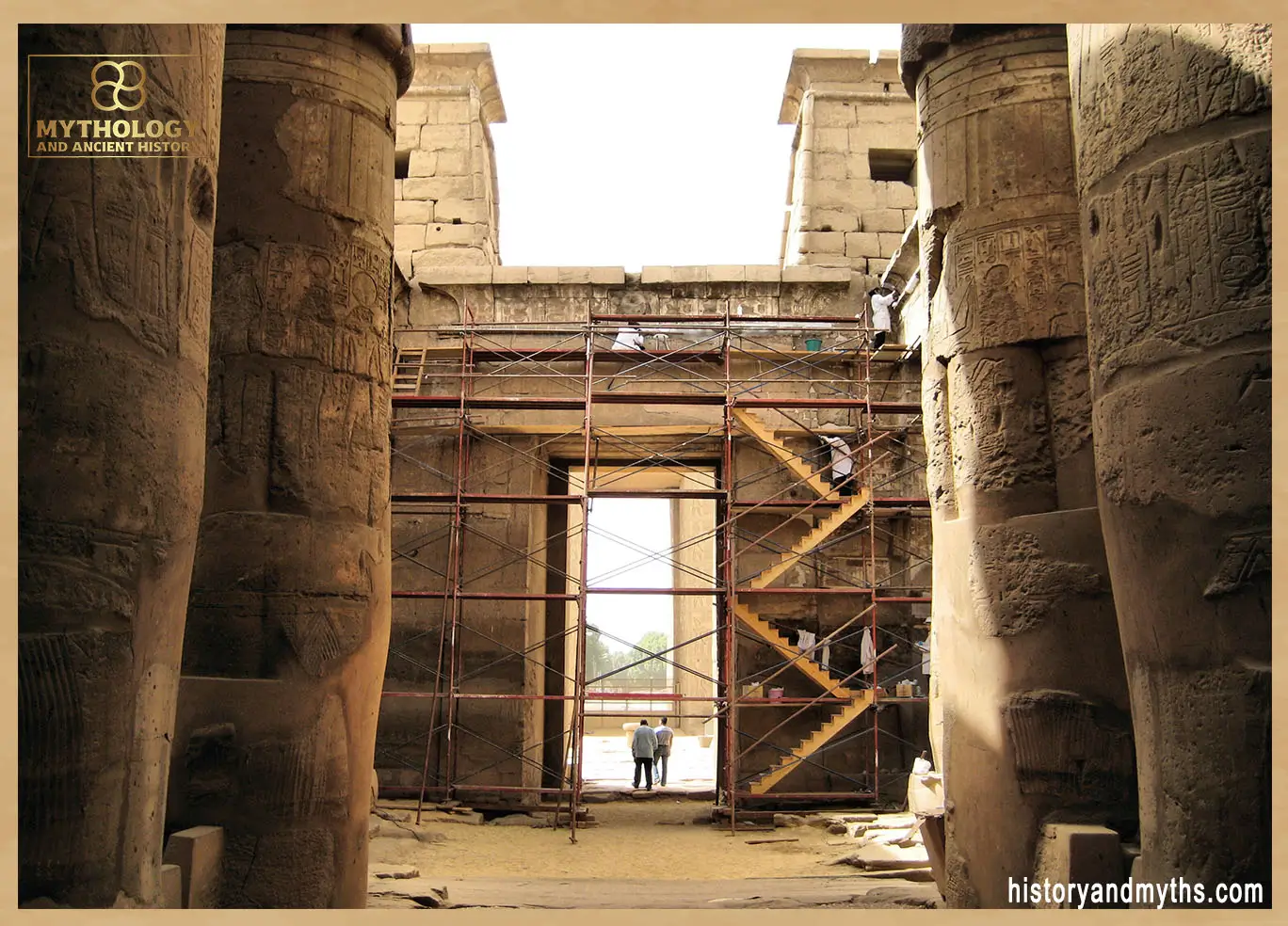
Image: Temple of Khonsu in Karnak (Restoration work), photo by Francisco Anzola, 13 March 2008 — Source: Wikimedia Commons (CC BY 2.0)
Maintenance vs. Restoration: What Egyptians Actually Meant
Modern writing often calls everything “restoration,” but Ancient Egypt worked with two different realities:
Routine maintenance was continuous and practical: cleaning sacred rooms, refreshing textiles and oils, repairing plaster, and keeping surfaces usable. It mattered most where monuments stayed “alive” as institutions especially temples.
Royal restoration was episodic and declarative. Kings presented major rebuilding as a public act of order: “I repaired what was ruined,” “I restored what was neglected,” and “I returned the gods to their proper places.” This language wasn’t only about stonework—it was political theology, designed to prove the king was re-establishing stability.
Monument Maintenance in Ancient Egypt (Quick Framework)
| Type of Monument | Most Common Maintenance Pattern | Main Threats | Who Usually Managed It |
|---|---|---|---|
| Temples | Daily operational upkeep plus periodic repairs | Soot, dust, salts, surface wear | Priesthood, administrators, craftsmen |
| Tombs | Reactive repairs when damage becomes visible | Cracking plaster, soot, humidity, salts | State teams, local authority, later interventions |
| Pyramids (core structure) | Long-term loss of casing with limited direct upkeep | Stone removal, erosion, structural stress | State decisions, later reuse pressures |
| Mortuary complexes | Supported while cult activity remained active | Sand, decay of plaster/paint, neglect | Temple institutions and personnel |
| Statues and colossi | Repair, reassembly, stabilization after breakage | Fracture, falls, deliberate damage, weathering | Workshops, state labor, later conservation |
Beyond Temples: Tombs, Pyramids, and Statues Needed Maintenance Too
Temple upkeep is the clearest model because temples operated daily. But “monument maintenance” in Ancient Egypt also included other built environments and sacred objects each with a different rhythm of care.
Tombs: preserved spaces, but not maintained like institutions
Most tombs were not maintained through a daily public routine the way temples were. Once sealed, their survival depended on architecture, geology, and luck until natural damage or human activity interfered. When tombs did require intervention, it typically involved targeted repairs rather than continuous upkeep: stabilizing weakened plaster layers, addressing cracking surfaces, and removing soot or grime that could obscure decoration.
The key point is that tomb care was often reactive, not scheduled. This difference matters because it explains why tomb decoration can look pristine in one chamber and heavily degraded in another: tomb environments fail unevenly, and maintenance is usually done only when access, authority, and resources align.
Pyramids: the cult infrastructure could be maintained even when the casing was lost
Pyramids are often treated as pure engineering monuments, but their original function depended on a wider system: causeways, valley temples, mortuary temples, storage areas, and staff activity connected to royal mortuary cult. Those functional spaces could be cared for and repaired while the pyramid’s exterior suffered long-term loss.
A crucial detail: major pyramids originally had outer casing stones designed to protect and visually finish the structure. Over centuries, those casing stones were stripped or collapsed, changing the pyramid’s appearance and exposing inner masonry. That loss does not automatically mean “nobody cared”; it often reflects a long timeline of reuse, earthquakes, and economic pressures.
Statues and colossal stone: breakage, reassembly, and long-term survival
Large statues were durable, but not invulnerable. They broke through falls, deliberate damage, structural weakness, or environmental stress. Maintenance here didn’t look like “cleaning a room” it looked like stone management: moving fragments, re-seating heavy elements, and sometimes reassembling shattered works.
Modern museum and conservation documentation makes the mechanics clear: once a statue breaks, “maintenance” becomes an engineering problem support, stabilization, and careful reconstruction. This is useful because it demonstrates a practical truth: even when stone survives, meaning and readability can collapse unless intervention preserves the form.
What Monument Maintenance Looked Like in Practice (Not Theory)
“Maintenance” in Ancient Egypt was not one single activity. It was a layered set of routines that ranged from basic cleanliness to heavy structural rescue. The difference matters because monuments usually fail in stages: first surfaces degrade, then joints and coatings fail, then architecture becomes unsafe.
Cleaning wasn’t cosmetic — it was structural prevention
Dust, sand, smoke, and biological residue do more than make a monument look dark. Over time they trap moisture, encourage salt movement, and create crusts that stress stone and paint layers. In enclosed or semi-enclosed spaces, soot from lamps can settle into relief carving and flatten detail visually, even when the stone remains intact.
That is why “cleaning” should be understood as the first defensive layer of maintenance: protecting surfaces before damage becomes irreversible.
Plaster and paint were meant to be renewed
A lot of Egyptian monuments were never intended to remain as raw stone forever. Painted reliefs, plastered surfaces, and finished architectural elements required renewal. When those layers crack or detach, the monument’s meaning becomes harder to read because Egyptian art relies on sharp outlines, color separation, and controlled contrast.
So repainting or surface renewal wasn’t “modern vandalism” in principle it was often a normal method of keeping sacred imagery functional and visible, especially in active cult contexts.
Recutting and re-inscribing: repair and authority at once
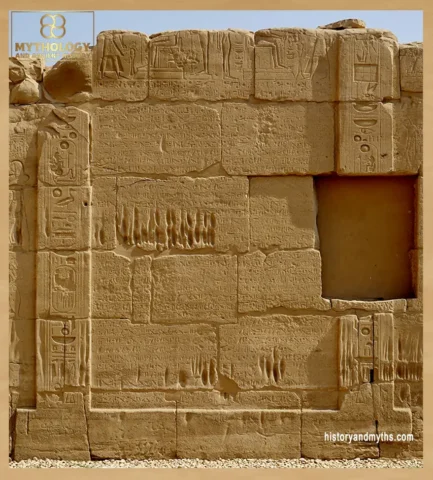
When inscriptions were damaged, eroded, or politically targeted, repair could take the form of recutting, re-carving, or replacing sections. This is where maintenance overlaps with power: restoring words restores ownership and legitimacy.
A king’s restoration claim wasn’t merely “I fixed stone.” It was “I restored correct order,” including correct names, titles, and the proper presentation of the divine world.
Heavy restoration: when maintenance becomes engineering
Some monuments don’t need surface care they need rescue. That includes stabilizing columns, re-seating displaced blocks, and rebuilding portions that are structurally failing. In those cases, maintenance stops being “upkeep” and becomes a major project.
Modern documented restoration work on large Egyptian monuments shows the real scale of this problem: once huge stones shift or collapse, preservation depends on engineering decisions, not just cleaning. This is the closest practical analogy to what ancient “major restoration” implied large resources, organized labor, and a visible result that could be claimed as an achievement.
The Biggest Threats to Monuments: What Egyptians Were Fighting Against
Monument survival in Egypt was never guaranteed. Even the hardest stone fails when stress is constant and maintenance stops. The danger was not one dramatic catastrophe it was a slow, predictable set of pressures that wore monuments down year after year.
Sand and abrasion: the “quiet” erosion
Wind-driven sand acts like fine grinding. Over time it softens carved edges, flattens relief detail, and weakens paint boundaries. This is especially destructive on exposed façades, open courtyards, and lower wall zones where windblown sediment accumulates. Once carving loses sharpness, texts become harder to read and scenes lose their visual clarity.
Maintenance here is not glamorous: clearing accumulations, preventing sand build-up in corners, and protecting vulnerable surfaces wherever possible.
Smoke, soot, and residue from human use
Smoke is one of the most underrated long-term threats to decorated surfaces. Lamp soot settles into carved grooves and creates a dark film that masks detail. It also bonds to surfaces in ways that are difficult to reverse without damaging pigments or stone.
Documented cleaning and conservation work on temple reliefs demonstrates how much meaning can be “lost” under surface layers long before stone actually breaks. That makes soot a perfect example of why maintenance is often about preserving legibility, not merely preventing collapse.
Salts and moisture: damage that starts inside the stone
Salt damage is destructive because it works internally. Water dissolves salts, pulls them through porous stone or plaster, and then leaves them behind as crystals when it evaporates. Crystal growth exerts pressure, which can lift paint, detach plaster, and fracture surfaces.
This is one reason monuments can look “fine” for decades and then suddenly shed decoration in sheets: the failure is happening beneath the visible layer, and it accelerates as conditions shift.
Structural stress: settling, cracking, and load failure
Large monuments carry enormous weight, and small shifts can compound into serious failures. Cracks widen, blocks drift out of alignment, and entire architectural units lose stability. At that stage, maintenance becomes structural intervention resetting stones, rebuilding supports, reinforcing weak points.
Modern restoration documentation on major monuments illustrates how quickly damage becomes an engineering problem once stability is compromised. The same logic applies to ancient large-scale restorations: they required planning, labor, and resources far beyond routine upkeep.
Human reuse: the most effective “damage” of all
The most decisive force against monuments was often not nature—it was later humans treating old monuments as stone quarries.
Reuse could mean:
- removing casing blocks from pyramids
- dismantling walls to harvest cut stone
- reusing carved blocks as construction fill
- building new monuments on older foundations
This is not always simple “destruction.” Research on Egyptian reuse shows it as a long-term pattern shaped by economics, politics, and availability of workable material. It is one of the clearest reasons why many monuments did not simply decay they were actively transformed into building resources.
Why Egyptian “Maintenance” Was a Survival System
- Temples survived longer because they were staffed, supplied, and actively used.
- Cleaning preserved meaning by keeping texts and reliefs readable, not just “pretty.”
- Surface renewal was normal in a culture where paint and plaster mattered.
- Royal restoration was ideology as much as engineering.
- Reuse was practical and could erase monuments faster than nature ever could.
Who Paid for Maintenance — and How It Was Actually Organized
Ancient Egyptian monument maintenance wasn’t funded by “random repairs.” It was funded because major monuments especially temples were institutions with budgets, staff, and supply chains.
Temples had income, land, and labor
Large temples owned estates and controlled resources that supported daily operations: food, linen, oils, workshops, and manpower. That economic base is the practical reason maintenance could happen continuously instead of only after disasters.
Maintenance was a staffing system, not a one-time project
Keeping monumental spaces functional required roles that were always “on,” including:
- administrators managing supplies and storage
- priests responsible for purity routines and sacred equipment
- craftsmen handling surface renewal, repairs, and materials
- laborers for heavy movement, clearing, and building tasks
This is why temples often looked like small towns around a sacred core: workshops, storage areas, and staff zones weren’t optional they were the maintenance infrastructure.
Royal restoration worked differently: it was political spending
When kings funded large restorations, the logic wasn’t just technical. It was state messaging: restoring monuments meant restoring correct order and proving legitimate rule. Tutankhamun’s Restoration Stela is explicit about temples being in ruin and then being re-endowed with offerings, personnel, and resources as part of a national “reset.”
Restoration Claims Were Political — Not Neutral “Maintenance Reports”
When an Egyptian king says he “restored” temples or monuments, that statement should not be read like a modern engineering log. It is usually a public legitimacy claim.
Why restoration texts sound absolute
Royal inscriptions often describe a previous time of neglect, chaos, or improper worship, followed by the king “repairing everything.” The point is not just to document work it is to present the ruler as the one who re-established correct order.
Restoration = rebuilding authority as much as rebuilding stone
Fixing a monument meant fixing what the monument represented: divine presence, correct ritual, and state stability. That’s why restoration language frequently connects repairs to moral order and divine approval, not just masonry details.
How to read these claims intelligently
The safe reading is:
- Some restorations were real, practical projects.
- The scale is often framed in exaggerated or totalizing language.
- The text tells you what the king wanted people to believe about the past and about him.
That interpretation fits how Egyptian royal ideology used monuments as proof of competence, piety, and control.
Continue Reading
Case Studies: Real Moments That Show How Maintenance Worked
Abstract explanations are easy. What proves the system is when you can point to specific moments where monuments were treated as something that had to be kept functional politically, ritually, or physically.
Case 1: Tutankhamun’s Restoration Stela — “Repairing Egypt” through monuments
The Restoration Stela of Tutankhamun is one of the clearest examples of restoration being framed as a national repair program. It describes temples and cult institutions as neglected and damaged, then presents the king’s actions as reopening, re-endowing, and restoring proper worship.
Even if the language is ideological, the core point is solid: restoration is described as staffing + resources + repaired sacred spaces, not just rebuilding walls.
Case 2: Temple surfaces at Edfu — why “cleaning” changes what survives
Conservation documentation at Edfu shows how monuments can become visually “lost” under layers of soot, dirt, salt activity, and biological residue. Removing those layers revealed details that were functionally unreadable before.
This matters for one reason: monument survival isn’t only about standing stone. It’s about legibility texts, scenes, and symbols staying visible enough to keep their meaning.
Case 3: The Ramesseum — heavy restoration as structural rescue
Large ruined monuments don’t always need small repairs; sometimes they need stabilization and reconstruction choices. Modern restoration work at the Ramesseum demonstrates the real issue: once blocks collapse or shift, preservation becomes engineering re-seating stones, supporting unstable masses, and preventing further loss.
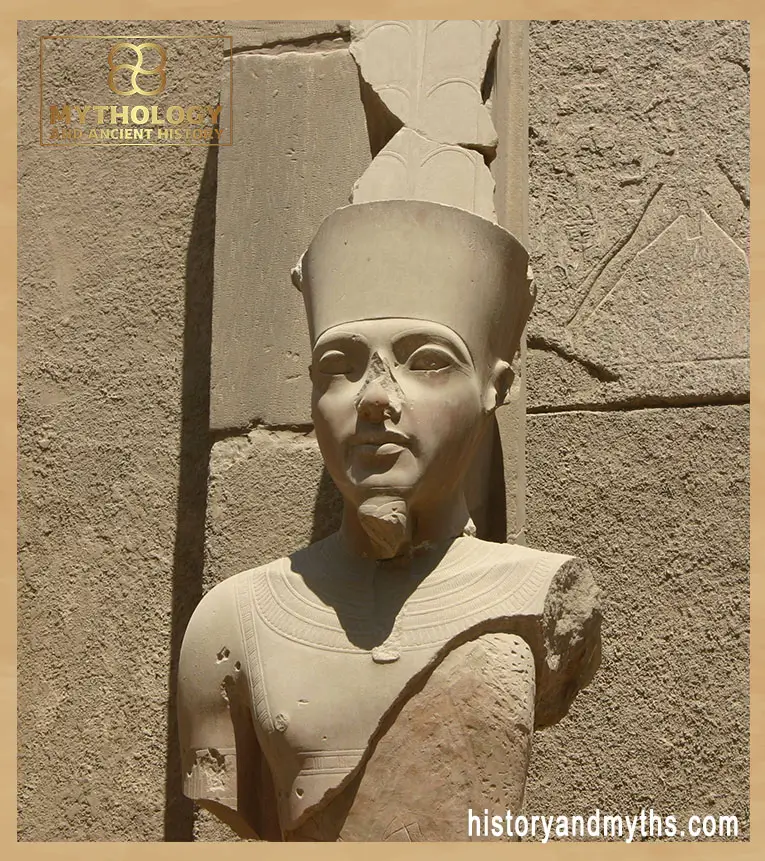
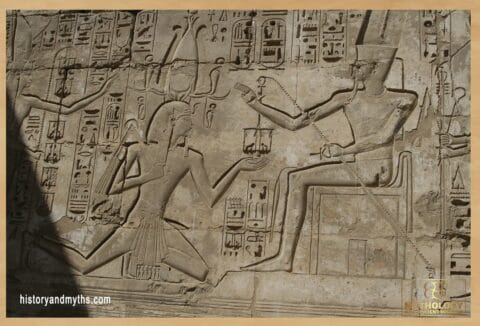
Image: Statue of Tutankhamun at Karnak, Egypt — Source: Wikimedia Commons (Public domain; released by Markh)
Key Takeaways
- Ancient Egyptian monuments survived because they were managed, not abandoned.
- Temple upkeep was continuous because temples functioned like institutions with staff and supply chains.
- Tombs and pyramids were not maintained the same way; care was often episodic or reactive.
- Royal restoration texts are political claims and must be read critically.
- The biggest threats were slow damage (sand, soot, salts) and human reuse of stone.
FAQ
Did Ancient Egyptians repaint temple walls regularly?
Yes. Many monuments relied on painted and plastered finishes, so surface renewal helped keep scenes readable and ritually “correct.”
Why do some inscriptions look sharper than others on the same monument?
Uneven wear comes from exposure, surface damage, and sometimes later recutting or repair work that refreshed certain areas.
Was monument cleaning mainly religious or practical?
Both. Cleaning supported ritual purity, but it also reduced residue that can flatten details and accelerate surface decay.
Why did kings claim they “restored everything” even when damage remained?
Restoration language is political. It frames the ruler as the one who re-establishes order, so claims are often totalizing.
Did pyramids receive the same type of maintenance as temples?
Not usually. Temple complexes had staff and daily routines, while pyramid shells were more vulnerable to long-term stone removal and reuse.
What destroyed monuments faster than erosion?
Human reuse. Removing casing blocks and dismantling older structures for building material could erase monuments quickly.
How do we know cleaning can change what a monument “says”?
Because removing soot and surface layers can reveal carved details and pigments that were visually unreadable before.
Sources
- Arnold, Dieter. Building in Egypt: Pharaonic Stone Masonry. Oxford University Press, 1991.
- Assmann, Jan. The Search for God in Ancient Egypt. Cornell University Press, 2001.
- Baines, John, and Jaromír Málek. Atlas of Ancient Egypt. Facts On File, 1980.
- Bard, Kathryn A. An Introduction to the Archaeology of Ancient Egypt. 2nd ed. Wiley-Blackwell, 2015.
- Brand, Peter J. “Reuse and Restoration in Ancient Egypt.” In Art and Identity in Ancient Egypt.
- Dodson, Aidan, and Salima Ikram. The Tomb in Ancient Egypt. Thames & Hudson, 2008.
- Goelet, Ogden. “The Egyptian Book of the Dead.” In The Egyptian Book of the Dead, edited by James P. Allen. Chronicle Books, 2005.
- Haring, Ben. Divine Households: Administrative and Economic Aspects of the New Kingdom Royal Memorial Temples in Western Thebes. Leiden, 1997.
- Ikram, Salima. Death and Burial in Ancient Egypt. Longman, 2003.
- Kemp, Barry J. Ancient Egypt: Anatomy of a Civilization. 2nd ed. Routledge, 2006.
- Lehner, Mark. The Complete Pyramids. Thames & Hudson, 1997.
- O’Connor, David. Ancient Nubia: Egypt’s Rival in Africa. University of Pennsylvania Museum, 1993.
- Quirke, Stephen. The Cult of Ra: Sun-Worship in Ancient Egypt. Thames & Hudson, 2001.
- Reeves, Nicholas. The Complete Tutankhamun. Thames & Hudson, 1990.
- Richards, Janet. Society and Death in Ancient Egypt. Cambridge University Press, 2005.
- Shaw, Ian, ed. The Oxford History of Ancient Egypt. Oxford University Press, 2000.
- Spencer, A. Jeffrey. Ancient Egypt. British Museum Press, 1997.
- Weeks, Kent R. The Lost Tomb. William Morrow, 1998.
- Wilkinson, Richard H. The Complete Temples of Ancient Egypt. Thames & Hudson, 2000.
- Wilkinson, Toby. The Rise and Fall of Ancient Egypt. Random House, 2010.
- UCLA Encyclopedia of Egyptology. “Temple.”
- UCLA Encyclopedia of Egyptology. “Conservation.”
- UCLA Encyclopedia of Egyptology. “Architecture.”
- UCLA Encyclopedia of Egyptology. “Building Materials.”
- The British Museum. Ancient Egyptian temples and monuments.
- The Metropolitan Museum of Art. Egyptian Art Collection.
- Getty Conservation Institute. Conservation of Stone Heritage.
- American Research Center in Egypt (ARCE). Conservation Projects.
- UNESCO World Heritage Centre. Ancient Thebes with its Necropolis.
- Theban Mapping Project. Conservation and Documentation of the Valley of the Kings.
Written by H. Moses — All rights reserved © Mythology and History
Written by H. Moses — All rights reserved © Mythology and History