Crime and Punishment in Ancient Egypt: How Justice Was Enforced
In ancient Egypt, crime was not defined simply as a violation of written rules, nor was punishment driven by revenge or spectacle. A crime was understood as an act of disorder—something that disrupted social balance, threatened authority, or undermined trust within the community. Punishment, in turn, existed to restore stability, deter future harm, and reaffirm the values that held society together.
This article examines crime and punishment as a legal reality, not as a collection of shocking penalties. It explains what Egyptians considered criminal behavior, how different types of crimes were treated, why certain offenses drew severe punishment, and whether institutions such as prisons actually existed. By focusing on legal reasoning, social control, and surviving judicial evidence, the article shows how punishment functioned as a practical tool of governance in a society without a modern penal system.
What Was Considered a Crime in Ancient Egypt
In ancient Egypt, a crime was defined less by written statute and more by its impact on social and cosmic order. Any act that disrupted harmony, violated trust, or threatened authority could be treated as criminal. This flexible definition allowed the legal system to respond to real situations rather than adhere to rigid classifications.
Criminal acts generally fell into three broad categories. First were crimes against individuals, such as theft, assault, fraud, and false testimony. These offenses harmed personal security and property, and they were often resolved through restitution or compensation. The emphasis was on repairing damage and preventing escalation rather than inflicting punishment for its own sake.
Second were crimes against institutions, including the state and temples. These were considered far more serious because they endangered public order and the legitimacy of authority. Corruption by officials, embezzlement, tax abuse, and theft from temples fell into this category. Such crimes undermined confidence in governance and were therefore treated as systemic threats requiring strong corrective action.
Finally, some acts were understood as offenses against Maʿat, even when no immediate victim could be identified. Perjury, deliberate injustice, and betrayal of official duty belonged here. These acts blurred the line between moral failure and legal crime, illustrating how ethics and law overlapped in Egyptian society. The absence of a strict legal code allowed courts to judge offenses according to context, intent, and consequence—an approach that prioritized stability over formal legality.
| Aspect | Crime and Punishment in Ancient Egypt |
|---|---|
| Concept of Crime | Any act disrupting social order, authority, or Maʿat |
| Main Crime Categories | Crimes against individuals, institutions, and state authority |
| Common Individual Crimes | Theft, assault, fraud, false testimony |
| Serious State Crimes | Corruption, temple theft, conspiracy, treason |
| Primary Punishments | Restitution, forced labor, corporal punishment, exile, execution |
| Use of Prison | Temporary detention only, not long-term incarceration |
| Role of Social Status | Higher status increased responsibility and potential punishment |
| Purpose of Punishment | Deterrence, restoration of order, protection of society |
| Legal Philosophy | Justice as correction, not revenge |
Crimes Against Individuals
Crimes against individuals formed the most common category of legal disputes in ancient Egypt. These offenses directly affected personal security, property, and trust, and they were usually handled at the local court level. The legal response focused on repairing harm rather than imposing exemplary punishment.
Theft was one of the most frequently recorded offenses. It ranged from petty theft of tools or livestock to more serious cases involving grain stores or household property. Courts typically ordered restitution—the return of stolen goods or compensation of equal or greater value. Repeated theft or theft under aggravating circumstances, such as abuse of official position, could lead to harsher penalties.
Assault and bodily harm were treated as disruptions of social peace. Legal records suggest that judges considered the severity of injury and the circumstances of the act. Compensation to the victim was common, sometimes accompanied by corporal punishment. The aim was to prevent cycles of retaliation by offering a formal resolution.
Fraud and false testimony were especially serious because they undermined the credibility of the legal system itself. Perjury was seen as an attack on justice, not just on the opposing party. False witnesses could face penalties comparable to those intended for the accused, reinforcing the expectation of truthfulness in court proceedings.
Across these cases, the guiding principle remained consistent: justice sought restoration first. Punishment escalated only when an offense threatened wider social stability or demonstrated deliberate disregard for legal and moral norms.
Crimes Against the State and Temples
Crimes directed against the state or temple institutions were regarded as the most dangerous offenses in ancient Egypt. Unlike disputes between individuals, these acts threatened the foundations of authority, economic stability, and religious legitimacy. As a result, they attracted the harshest legal responses.
Corruption and abuse of office ranked among the gravest crimes. Officials who extorted taxes, falsified records, or seized property unlawfully were seen as betraying both the pharaoh and Maʿat. Royal decrees—most famously issued to curb such abuses—describe corruption as a systemic illness that required decisive correction. Punishments could include dismissal, confiscation of property, forced labor, or corporal penalties, depending on the scale of the offense.
Theft from temples was treated with exceptional severity. Temples were not only religious centers but also major economic institutions controlling land, labor, and resources. Stealing from a temple was therefore both a material crime and a sacrilegious act. Legal texts frame such offenses as direct attacks on divine order, justifying punishments far beyond simple restitution.
Conspiracy and treason represented the ultimate crimes against the state. Plots against the king, royal family, or central administration were prosecuted through special investigations rather than ordinary courts. Surviving trial records reveal systematic interrogations and collective judgments, underscoring the perception that these crimes endangered the survival of the state itself.
In these cases, punishment served a clear purpose: to reassert authority and deter disorder. Severity was not arbitrary but proportional to the perceived threat. By drawing a sharp distinction between private harm and institutional betrayal, Egyptian law reinforced the idea that the stability of governance was inseparable from justice.
Types of Punishment
Punishment in ancient Egypt was shaped by practical necessity rather than fixed penal codes. The severity of a sentence depended on the nature of the crime, the threat it posed to order, and the status of those involved. Courts aimed to deter wrongdoing while maintaining social stability, escalating penalties only when lesser measures failed.
The most common response to crime was restitution or compensation. Stolen property was returned, losses were repaid, and contractual obligations were enforced. This approach resolved disputes efficiently and reduced the risk of ongoing conflict. Financial penalties and labor compensation were often sufficient for minor offenses.
For more serious crimes, authorities imposed forced labor, frequently in state projects, quarries, or agricultural work. This punishment combined deterrence with economic utility, reinforcing the idea that wrongdoing disrupted society and must be corrected through service.
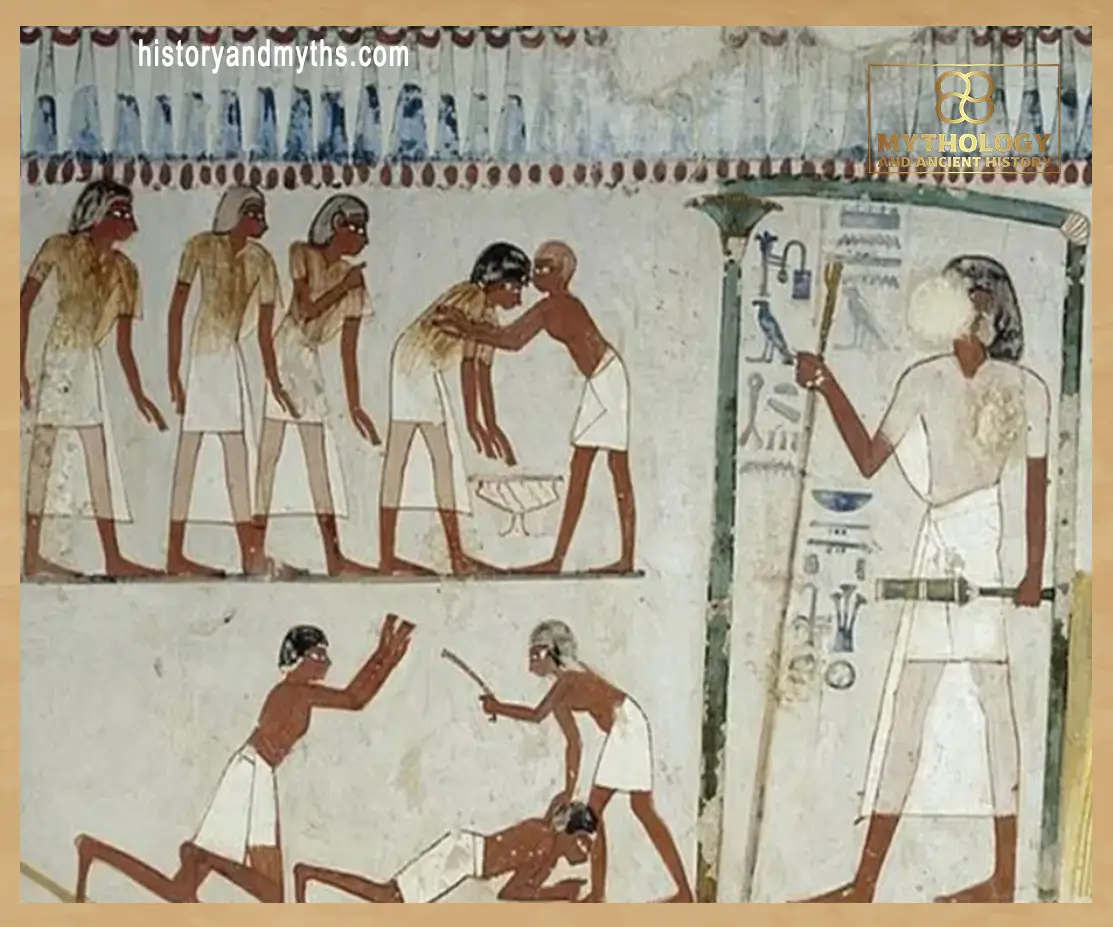
Corporal punishment appears in legal records, particularly for repeated offenses or abuses of authority. Its purpose was corrective rather than theatrical, intended to mark wrongdoing publicly without resorting immediately to irreversible penalties.
Exile removed offenders from their social networks and local influence. This punishment was especially effective against officials or community leaders whose presence posed continued risk. By isolating the offender, the state neutralized potential disruption without permanent elimination.
Capital punishment was reserved for exceptional cases—treason, severe corruption, or crimes that threatened the state or divine order. Its use underscores the principle that execution was a last resort, applied when an offense was seen as irreparable. Egyptian law favored restoration, but it recognized limits beyond which stability could not be preserved.
Was There Prison in Ancient Egypt?
Ancient Egypt did not maintain prisons in the modern sense of long-term incarceration as a standard punishment. Instead, confinement functioned primarily as temporary detention, used to hold suspects, debtors, or accused officials while investigations and trials were conducted.
Texts and administrative records indicate the existence of holding places attached to temples, administrative centers, or estates. These facilities served practical purposes: preventing escape, ensuring availability for questioning, and maintaining order during legal proceedings. Detention was therefore procedural rather than punitive.
In cases involving debt, labor obligations, or administrative misconduct, confinement could be used to compel compliance rather than to punish. Once restitution was made, testimony given, or judgment delivered, the individual was released or transferred to another form of penalty such as forced labor or exile.
The absence of prisons as permanent institutions reflects a broader legal philosophy. Egyptian justice prioritized resolution and correction over prolonged punishment. Long-term imprisonment was inefficient in a society that valued labor and social reintegration. Punishment aimed to restore order quickly, not to isolate individuals indefinitely.
This approach distinguishes Egyptian law from later systems that relied heavily on incarceration. Instead of using prisons to punish, ancient Egypt relied on economic, physical, and social penalties that directly addressed the harm caused by criminal behavior.
Social Status and Punishment
Social status influenced legal outcomes in ancient Egypt, but not always in the direction of privilege. While elites possessed resources and connections, they were also held to higher standards of accountability, especially when their actions threatened public trust or state authority.
For ordinary individuals, punishment often focused on material correction—restitution, compensation, or labor—reflecting the goal of restoring balance with minimal disruption. Local courts handled most such cases, and outcomes depended largely on evidence, testimony, and context rather than rank alone.
Officials and administrators faced greater scrutiny. Abuse of office, corruption, or falsification of records was treated as a betrayal of duty and a violation of Maʿat. Legal texts and royal decrees emphasize that wrongdoing by those in power caused broader harm than similar acts by private individuals. As a result, penalties for elites could be more severe, including dismissal, confiscation of property, exile, or execution in extreme cases.
Status also shaped how punishment functioned socially. Public penalties—loss of office, public censure, or removal from one’s community—were particularly damaging to elites whose authority depended on reputation. In this sense, the law leveraged social standing as part of its enforcement strategy, using shame and loss of honor as powerful deterrents.
Overall, Egyptian justice did not guarantee equality before the law, but it consistently asserted a core principle: authority increased responsibility. The higher one stood within the social hierarchy, the greater the expectation to uphold order—and the greater the consequences when that trust was violated.
Crime and Punishment in Ancient Egypt
- Crime as disorder: Criminal acts were defined by their threat to social and cosmic order, not by fixed legal codes.
- Restoration over revenge: Punishment aimed to restore balance and deter future harm.
- Severe crimes, severe responses: Offenses against the state or temples triggered the harshest penalties.
- No prison system: Confinement was temporary, used for investigation rather than punishment.
- Status meant responsibility: Officials faced stricter accountability for abuse of power.
- Deterrence through visibility: Public punishment and loss of status reinforced social control.
© historyandmyths.com — Educational use
Justice, Deterrence, and Fear
Deterrence in ancient Egypt did not rely on permanent incarceration or constant surveillance. Instead, it operated through a combination of visible punishment, social accountability, and moral expectation. The legal system aimed to prevent crime by making consequences clear and immediate, reinforcing the cost of disorder within a tightly connected society.
Public knowledge of punishment played a crucial role. Legal outcomes—especially in cases involving officials or serious offenses—were meant to be seen and remembered. The removal of corrupt administrators, forced labor sentences, or exile served as warnings that wrongdoing would not remain hidden. Fear, in this context, was not arbitrary terror but a calculated deterrent designed to protect social stability.
Equally important was social pressure. Reputation mattered deeply in Egyptian communities, where personal standing affected economic opportunity, family honor, and religious participation. Legal punishment often carried lasting social consequences, discouraging repeat offenses even when physical penalties were limited. The threat of shame, loss of trust, or exclusion from communal life functioned as a powerful form of control.
Finally, deterrence was reinforced by the belief that injustice carried consequences beyond the courtroom. While this article focuses on legal practice rather than theology, it is clear that Egyptians understood crime as an act with enduring repercussions—legal, social, and moral. Together, these mechanisms allowed the state to maintain order effectively without the institutions typical of later penal systems.
Key Takeaways: Crime and Punishment in Ancient Egypt
- Crime was understood as a disruption of order rather than a simple legal violation.
- Punishment aimed to restore balance and deter future wrongdoing.
- Most individual crimes were resolved through restitution and compensation.
- Crimes against the state or temples carried the harshest penalties.
- Ancient Egypt did not rely on long-term imprisonment as punishment.
- Social status increased responsibility, especially for officials.
Frequently Asked Questions about Crime and Punishment in Ancient Egypt
What was considered a crime in ancient Egypt?
A crime was any act that disrupted social order, threatened authority, or violated Maʿat, rather than a simple breach of written law.
Were punishments always severe?
No. Most individual crimes were resolved through restitution or compensation, with severe penalties reserved for serious offenses.
What crimes were punished most harshly?
Crimes against the state or temples, such as corruption, theft of sacred property, or conspiracy, received the strongest punishments.
Did ancient Egypt have prisons?
There were no prisons in the modern sense. Detention was temporary and used mainly during investigations or trials.
What types of punishment were used?
Punishments included restitution, forced labor, corporal punishment, exile, and in rare cases, execution.
Did social status affect punishment?
Yes. Higher status often meant greater responsibility, and officials could face harsher penalties for abuse of power.
Was punishment meant to deter crime?
Yes. Deterrence relied on visible punishment, social accountability, and the restoration of order.
Sources & Rights
- Breasted, James Henry. Ancient Records of Egypt, Vols. I–V. Chicago: University of Chicago Press, 1906–1907.
- Breasted, James Henry. A History of Egypt from the Earliest Times to the Persian Conquest. New York: Charles Scribner’s Sons, 1905.
- Gardiner, Alan H. Egypt of the Pharaohs: An Introduction. Oxford: Oxford University Press, 1961.
- Johnson, Janet H. The Legal System of Ancient Egypt. Chicago: Oriental Institute of the University of Chicago, 1992.
- Peet, Thomas Eric. The Great Tomb-Robberies of the Twentieth Egyptian Dynasty. Oxford: Clarendon Press, 1930.
- Van Blerk, Nicolaas Johannes. The Concept of Law and Justice in Ancient Egypt. PhD diss., University of South Africa, 2018.
- Allam, Schafik. Strafrecht im Alten Ägypten. Wiesbaden: Harrassowitz, 1976.
- Allam, Schafik. Beiträge zum ägyptischen Strafrecht. Wiesbaden: Harrassowitz, 1973.
- Lorton, David. The Juridical Terminology of International Relations in Egyptian Texts through Dyn. XVIII. Baltimore: Johns Hopkins University Press, 1974.
- Menu, Bernadette. Recherches sur l’histoire juridique, économique et sociale de l’Égypte ancienne. Cairo: Institut Français d’Archéologie Orientale, 2001.
- McDowell, Andrea G. Village Life in Ancient Egypt: Laundry Lists and Love Songs. Oxford: Oxford University Press, 1999.
- Trigger, Bruce G., Barry J. Kemp, David O’Connor, and Alan B. Lloyd. Ancient Egypt: A Social History. Cambridge: Cambridge University Press, 1983.
- Assmann, Jan. The Mind of Egypt: History and Meaning in the Time of the Pharaohs. Cambridge, MA: Harvard University Press, 2002.
- Assmann, Jan. Ma’at: Gerechtigkeit und Unsterblichkeit im Alten Ägypten. Munich: C.H. Beck, 1990.
- Goedicke, Hans. Studies in the Hekanakhte Papers. Baltimore: Johns Hopkins University Press, 1959.
- Haring, Ben J. J. Divine Households: Administrative and Economic Aspects of the New Kingdom Royal Memorial Temples. Leiden: Brill, 1997.
- Redford, Donald B., ed. The Oxford Encyclopedia of Ancient Egypt. Oxford: Oxford University Press, 2001.
- Shaw, Ian, ed. The Oxford History of Ancient Egypt. Oxford: Oxford University Press, 2000.
- VerSteeg, Russ. “Law in Ancient Egypt.” In Law and Legal Theory in Ancient Civilizations. New York: Routledge, 2002.
- Quirke, Stephen. Ancient Egyptian Religion. London: British Museum Press, 1992.
- Wilson, John A. The Culture of Ancient Egypt. Chicago: University of Chicago Press, 1951.
Written by H. Moses — All rights reserved © Mythology and History