Child Death and Grief in Ancient Egypt: Loss Before Life Began
Child death in Ancient Egypt was common, but it was never treated as ordinary. The loss of a child raised unique social and religious problems: grief without a life story, death before identity was complete, and questions about the afterlife for someone who had not yet become fully human in society.
Child mortality forced Egyptians to confront death at its most disruptive point. An adult death closed a biography; a child’s death interrupted one before it had meaning. This difference shaped how families grieved, how children were buried, and how religion adapted to explain innocence, loss, and unfinished lives.
Unlike adult death, child death could not rely on social achievement, moral reputation, or completed roles. Parents mourned not only a person, but a future that never materialized. Egyptian responses—archaeological, textual, and magical—show attempts to stabilize that rupture without pretending it did not exist.
This article explains why child death required different emotional, ritual, and theological handling, how grief operated when identity was incomplete, and what these responses reveal about Egyptian ideas of childhood, innocence, and human value.
Childhood Before Death: Why Children Were Different
In Ancient Egypt, childhood was not simply a shorter version of adulthood. Children existed in an unfinished social state. They had names, family ties, and emotional value, but they had not yet accumulated status, moral reputation, or ritual authority. This mattered deeply when death intervened.
An adult’s death could be measured against a life lived—work done, duties fulfilled, reputation earned. A child’s death could not. The child had not yet “become” anything socially complete. That absence created a problem: how to mourn someone whose identity was still forming, and how to place them within a system designed around completed lives.
This explains why Egyptian responses to child death often look inconsistent. Some children received careful burials; others were buried simply or even within domestic spaces. These were not signs of indifference, but of adaptation. The burial system had to stretch to accommodate a death that did not fit its original logic.
| Aspect | Child Death | Adult Death |
|---|---|---|
| Social Identity | Incomplete | Fully established |
| Burial Form | Simplified, flexible | Structured, formalized |
| Mourning Focus | Lost potential | Life completed |
| Religious Concern | Protection and innocence | Judgment and memory |
| Use of Texts | Rare or absent | Common and extensive |
How Common Was Child Death? Normalized Loss, Not Emotional Absence
Child death in Ancient Egypt was frequent enough to be expected, but expectation did not equal acceptance. High mortality—especially in infancy and early childhood—was driven by disease, malnutrition, and childbirth complications. Families lived with the risk constantly, yet the evidence does not support emotional detachment or indifference.
What frequency changed was social preparation, not feeling. Parents knew loss was possible and developed ways to absorb it without collapsing family structure. This produced a controlled form of grief—present, real, but contained. The culture did not deny pain; it regulated it.
This normalization explains why child death rarely appears as dramatic narrative in texts. It was part of lived reality, not an exceptional crisis needing explanation each time. But archaeological choices—burial location, protective objects, repeated amulets—show that families responded materially to loss even when texts remained silent.
So prevalence reduced surprise, not meaning. Child death was common, but it remained disruptive because it violated expectation of growth and continuity. Egyptians learned to live with that tension, not erase it.
Burial of Children: Adjusted Rules Within the Same System
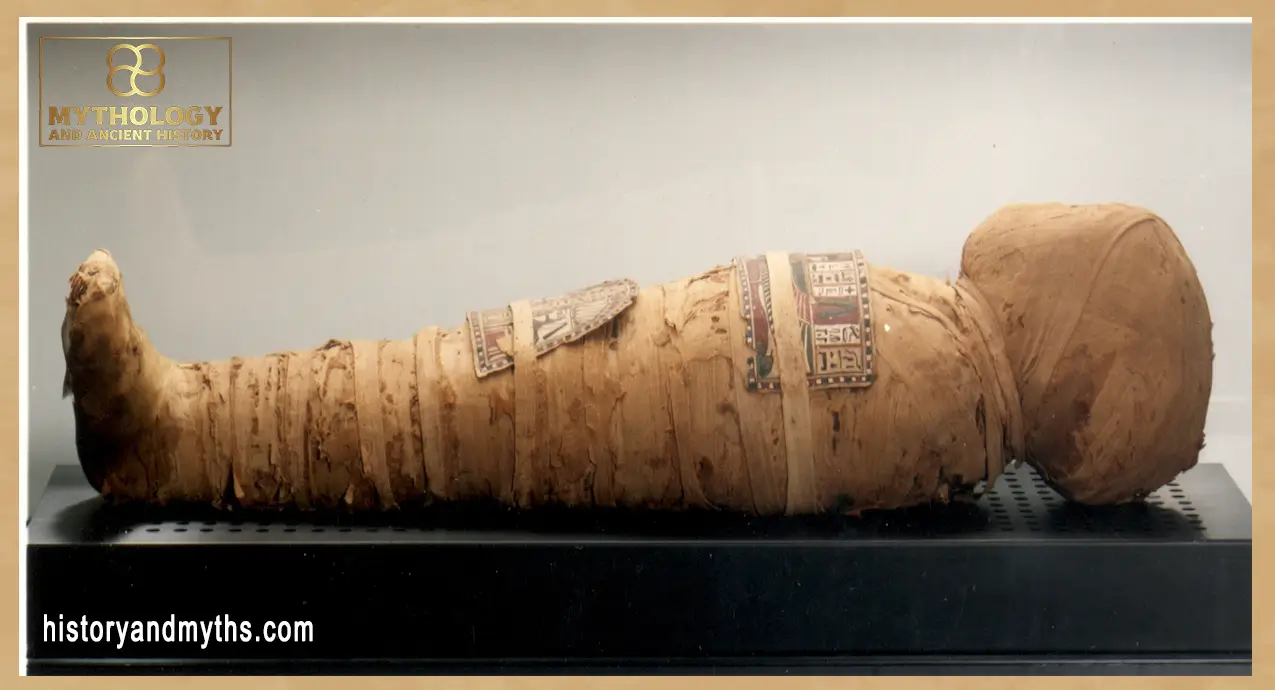
Children were not buried outside the Egyptian funerary system, but they were not absorbed into it unchanged. The same core logic—separation from the living, care for the body, and symbolic protection—remained in place, yet it was scaled and modified to fit an incomplete life.
Archaeologically, children appear in a wide range of burial contexts: small graves in cemeteries, placement within family tombs, burials near houses, and in some cases container or pot burials. This variability is not random. It reflects a negotiation between cost, age, and perceived need for protection. Younger children, especially infants, were more likely to receive simplified treatment, while older children increasingly resembled adults in burial form.
What stands out is that children were rarely treated as disposable. Even when burial was modest, it was intentional. Positioning, wrapping, and inclusion of small protective items indicate that families aimed to stabilize the child’s transition, even if they did not deploy the full adult toolkit of texts and equipment.
Child burial therefore reveals flexibility in Egyptian practice. The system could compress or expand depending on circumstance, without losing its underlying purpose. Death before social completion required adjustment—not exclusion.
Egyptian funerary belief was designed around completed lives.
When a child died, the system adapted—reducing judgment, simplifying burial,
and shifting focus toward protection rather than evaluation.
© historyandmyths.com — Educational use
Grief Without Biography: Mourning a Life That Never Fully Formed
The grief caused by child death operated under different emotional conditions than adult loss. Adults were mourned for what they had been; children were mourned for what they were expected to become. This made grief less about memory and more about interruption.
Egyptian mourning practices relied heavily on biography—names, titles, achievements, and social presence. A child had little of this. Parents and relatives therefore grieved without a completed narrative to hold onto. The loss was not of a finished person, but of possibility: future labor, future family roles, future continuity of the household.
This helps explain why child grief is rarely articulated directly in texts. It was difficult to ritualize something that lacked clear social definition. Instead, grief appears indirectly—through careful burial choices, protective gestures, and magical responses aimed at preventing further loss rather than explaining the one that occurred.
Child death exposed a limit in the cultural language of mourning. Egyptians responded not by inventing new emotional scripts, but by redirecting grief into action: protection, containment, and attempts to restore balance after a break that words could not easily resolve.
Religion and the Problem of the Innocent Dead
Child death created a theological tension the Egyptian system was not originally built to solve. Religious ideas about judgment, responsibility, and moral balance assumed a life long enough to act, fail, and correct. A child who died early disrupted that logic by leaving no moral record to evaluate.
This is why children are rarely framed as sinners or judged figures. Their death did not require justification or moral accounting. Instead, innocence was assumed, and protection replaced evaluation. Religious response shifted away from judgment toward guardianship—keeping harmful forces away rather than weighing deeds that never occurred.
The absence of anxiety about punishment is telling. Children did not need extensive confessions, justifications, or defenses against accusation. The concern was not whether they deserved the afterlife, but how to secure their safe passage despite their unfinished status. In this sense, child death softened the otherwise rigid structure of Egyptian afterlife thought.
Religion adapted quietly. It did not rewrite doctrine, but it allowed exceptions. The innocent dead revealed that Egyptian belief systems were flexible enough to absorb loss without forcing it into categories that did not fit.
Protective Objects and Magical Responses: Preventing Loss from Repeating
When a child died, Egyptian families often shifted their response away from explanation and toward prevention. The goal was not to rationalize the loss, but to stop it from happening again. This is where protective objects and everyday magic became especially visible.
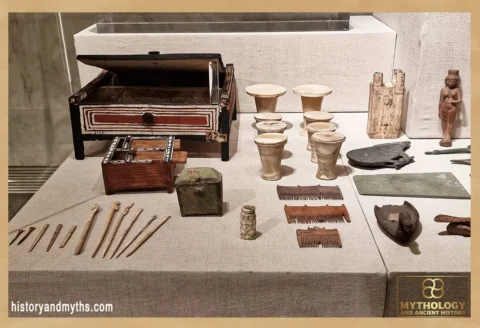
Amulets, figurines, and small charms appear frequently in child burials and domestic contexts associated with children. These objects were not symbolic decoration. They were practical tools meant to repel danger, stabilize vulnerable lives, and restore balance after disruption. Their use reflects a belief that child death was not inevitable fate, but a sign of exposed weakness in need of correction.
Magic here functioned as emotional action. It gave parents something to do when grief could not be articulated through formal ritual. Instead of mourning through long ceremonies, families invested in protective measures—both for the deceased child’s passage and for the safety of surviving children. The focus moved forward, not backward.
This pattern shows a key difference between adult and child death. Adult mourning looked backward at a completed life. Child death redirected attention toward continuity and survival. Magic did not explain why the child died; it addressed the fear that loss might repeat.
Child Death Versus Adult Death: Interruption, Not Closure
The clearest way to understand child death in Ancient Egypt is to contrast it with adult death. Adult death completed a social cycle. Roles had been filled, identity established, and memory anchored in work, family, and reputation. Mourning could organize itself around what was finished.
Child death did the opposite. It interrupted development before completion. There was no full identity to preserve, no long biography to ritualize, and no moral account to balance. This is why responses to child death look uneven when compared to adult practice—they were dealing with a different kind of loss.
The system adjusted by reducing emphasis on judgment and increasing emphasis on protection. Burial was simplified, grief was contained rather than dramatized, and religious concern shifted toward safety rather than evaluation. The goal was not to close a life, but to absorb disruption without allowing it to destabilize the household or community.
Seen this way, child death exposes the flexibility of Egyptian belief. The culture did not deny grief, but it refused to force unfinished lives into frameworks built for completed ones. Loss was managed, not explained.
- Child death was common but never emotionally neutral.
- Children lacked completed social and moral identities.
- Burial practices were simplified but intentional.
- Grief focused on interruption, not closure.
- Religion emphasized innocence and protection.
- Magic addressed fear of repeated loss.
Was child death common in Ancient Egypt?
Yes. High infant and child mortality was part of everyday life.
Did Egyptians mourn children differently from adults?
Yes. Grief focused on interruption and lost potential rather than closure.
How were children buried?
Burial was usually simplified and adjusted to age and circumstance.
Were children judged in the afterlife?
There is little evidence of judgment anxiety; innocence was assumed.
Did child burials include funerary texts?
Rarely. Texts were less relevant to unfinished lives.
Why were protective objects common in child contexts?
They aimed to prevent further loss and restore balance.
What does child death reveal about Egyptian belief?
It shows flexibility in adapting religion to human limits.
Sources & Rights
- Ikram, Salima. Death and Burial in Ancient Egypt. Harlow: Pearson Longman, 2003.
- Grajetzki, Wolfram. Burial Customs in Ancient Egypt: Life in Death for Rich and Poor. London: Duckworth, 2003.
- Taylor, John H. Death and the Afterlife in Ancient Egypt. Chicago: University of Chicago Press, 2001.
- Assmann, Jan. Death and Salvation in Ancient Egypt. Ithaca: Cornell University Press, 2005.
- Meskell, Lynn. Private Life in New Kingdom Egypt. Princeton: Princeton University Press, 2002.
- Robins, Gay. Women in Ancient Egypt. Cambridge, MA: Harvard University Press, 1993.
- Kemp, Barry J. Ancient Egypt: Anatomy of a Civilization. London: Routledge, 2006.
- Quirke, Stephen. Exploring Religion in Ancient Egypt. Chichester: Wiley-Blackwell, 2015.
Written by H. Moses — All rights reserved © Mythology and History