Women in the Workforce in Ancient Egypt: Jobs, Labor, and Limits
When people ask whether women worked in the ancient world, the question is often framed as a matter of rights or exceptions. In Ancient Egypt, the issue is more precise and more revealing: women worked widely, but their labor was classified, recorded, and valued differently from men’s. Understanding that difference is the key to understanding Egypt’s economy.
Women participated across multiple sectors-textile production, food processing, temple service, estate management, and household-based manufacturing. Some roles were formally recognized and rationed; others were economically essential yet poorly documented. This was not marginal labor. In industries such as weaving, women formed the backbone of production that supplied temples, royal estates, and state redistribution systems.
This article examines women’s work as it actually functioned: where it was institutional, where it was informal, how compensation operated through rations rather than wages, and why visibility in records mattered more than effort. By separating economic reality from modern assumptions, we can see how women contributed to production while remaining constrained by administrative and social boundaries and why their labor, though indispensable, rarely translated into power.
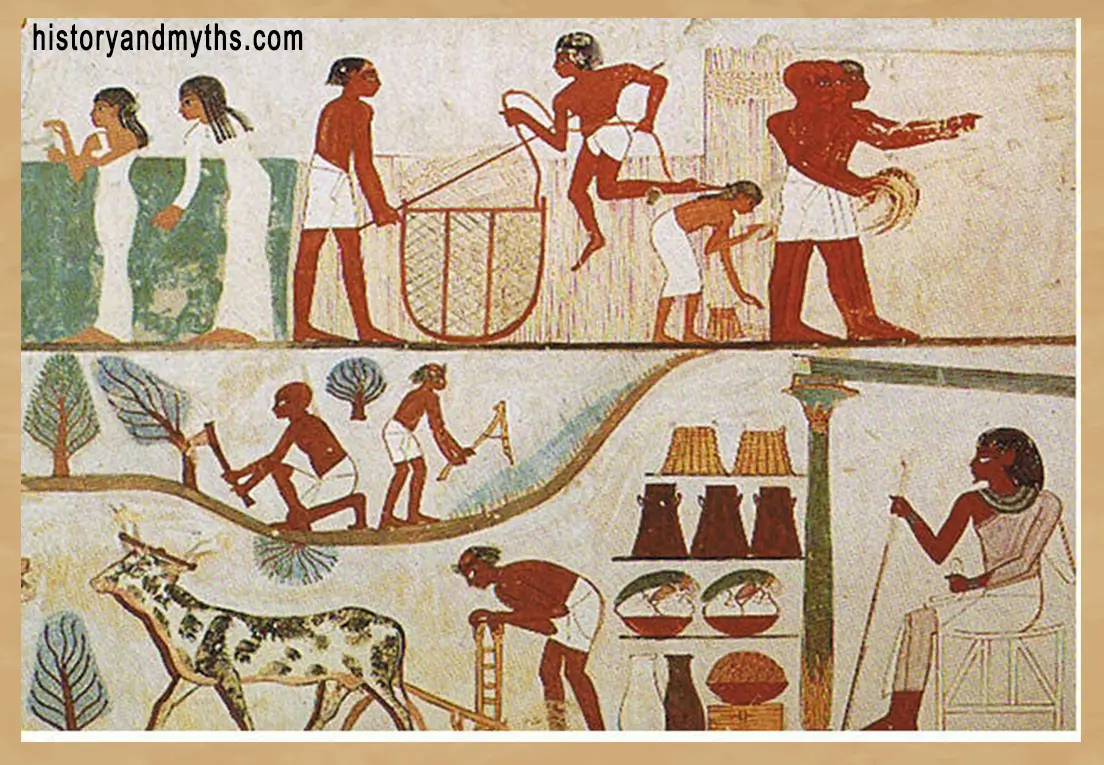
What “Work” Meant for Women in Ancient Egypt
To understand women in the workforce, we must first define what “work” meant in the Egyptian context. Work was not limited to formal employment, nor was it always recorded in administrative texts. It existed on a spectrum-from fully institutional roles to economically vital labor that remained largely invisible.
At one end were formal positions tied to temples, estates, and state-controlled workshops. These roles were assigned, supervised, and compensated through rations. Women in such contexts appear in records because their labor intersected with bureaucracy. Visibility depended less on importance and more on whether an institution needed to track the output.
At the other end was household-based production. Food processing, textile preparation, and craft support often took place within domestic spaces. This labor generated real economic value, feeding into redistribution networks through deliveries or obligations, yet it rarely carried titles or regular documentation. Absence from records should not be mistaken for absence from the economy.
Crucially, women’s work was not defined by exclusion but by classification. Tasks associated with administration, record-keeping, and oversight were male-dominated because authority flowed through writing. Production-especially repetitive, large-scale, and skill-based work-could involve women extensively without granting them institutional power.
This distinction explains why women were everywhere in production but scarce in official hierarchies. Their labor sustained the system; the system simply did not prioritize recording it unless control required it.
| Work Sphere | Typical Roles | Institutional Control | Compensation Type | Visibility in Records |
|---|---|---|---|---|
| Textile Production | Weavers, spinners, cloth preparers | High (temples & estates) | Rations (grain, beer) | Medium (output-focused) |
| Temple Service | Singers, attendants, food preparers | Very high | Regular rations | High |
| Estate Labor | Food processing, storage support | High | Rations | Medium |
| Household Production | Textiles, food, craft support | Low / indirect | Indirect household provisioning | Low |
| Skilled Craft Support | Specialized textile and food work | Moderate | Enhanced rations | Low–medium |
The Biggest Employer: Textile Production and Weaving
Textile production was the largest and most consistent area of female labor in ancient Egypt. Weaving, spinning, and cloth preparation employed women on a scale unmatched by any other sector. This was not occasional or domestic craft-it was organized production tied directly to temples, estates, and state supply systems.
Linen was essential. It clothed workers, priests, and elites; it served ritual, administrative, and everyday needs; and it functioned as a standardized good within redistribution. Producing it required time, skill, and repetition. Women dominated this process because it aligned with how labor was structured: intensive, skilled, and controllable without granting administrative authority.
Much of this work took place in workshops connected to institutions, even when physically located near households. Women worked in groups, followed quotas, and delivered finished textiles to storehouses. Compensation came through rations, not wages, placing textile labor firmly inside the same economic logic as other state-supported work.
Despite its scale, textile production often appears indirectly in records-through delivery lists rather than individual worker accounts. The system tracked output, not people. As long as linen arrived, the labor behind it remained secondary to administrators.
This explains a key paradox: women were central to one of Egypt’s most important industries, yet rarely visible as individuals. Textile work generated value without visibility, productivity without power. It sustained the economy while reinforcing the boundaries that kept authority elsewhere.
Women in Temples and Estates
Women also worked within temples and large estates, but their roles were narrowly defined and closely supervised. These were institutional settings, which meant visibility in records-but visibility did not imply authority. Women appear as participants in service and production, not as decision-makers.
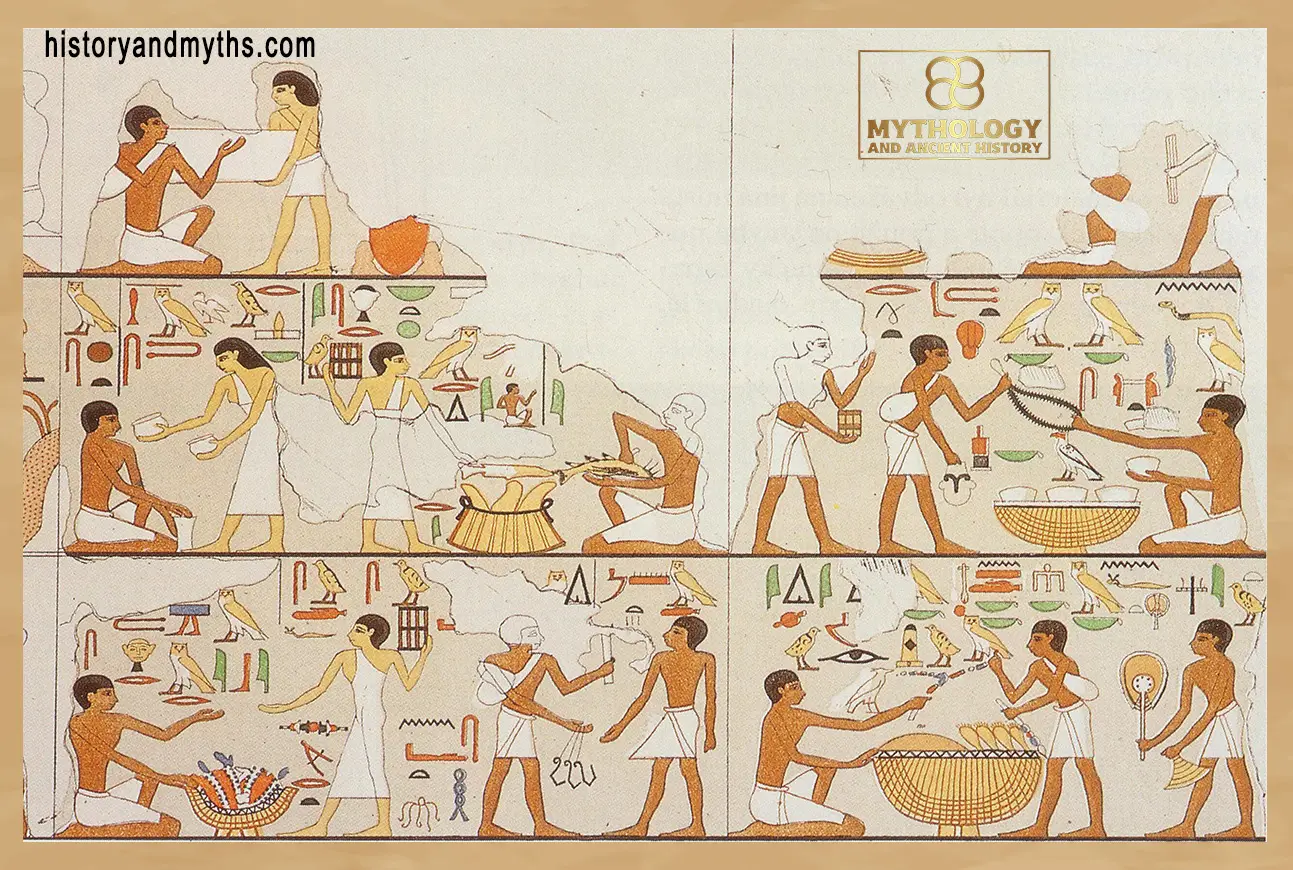
In temples, women served in roles connected to ritual support and daily maintenance: singers, dancers, attendants, and workers involved in preparing offerings, food, and textiles. These positions were regulated, often hereditary, and compensated through rations. They were part of the temple economy without controlling it. Religious proximity did not translate into administrative power.
Estate labor followed a similar pattern. Women worked in food processing, storage preparation, and textile-related tasks tied to agricultural output. Their labor supported redistribution networks that supplied officials, workers, and dependents. Again, compensation was standardized and role-based, not negotiated.
What distinguishes temple and estate work from household production is documentation. Because these institutions required accountability, women’s labor entered the record. Yet even here, titles remained functional and limited. Oversight, accounting, and allocation were handled by male officials and scribes.
These settings reveal the structural boundary of women’s work. Inclusion in institutions meant security and regular rations, but it also meant confinement to roles that sustained the system without shaping it. Women were present, necessary, and regulated-integral to institutional life, yet excluded from its levers of control.
Did Women Receive Wages or Rations?
Women who worked within institutional settings-temples, estates, and workshops-were compensated through rations, not wages. The system made no distinction between male and female labor in its basic logic: compensation was provision, not pay. What differed was where women appeared in the hierarchy, and therefore the size and regularity of what they received.
Rations for women followed the same principles applied across the workforce. Grain, beer, and basic necessities were allocated according to role and institutional need. A woman working in textile production or temple service received sustenance sufficient to maintain her function, not to reward productivity or encourage advancement. The goal was continuity, not incentive.
In household-based production, compensation was often indirect. Women contributing labor within family units did not receive separate rations recorded in their own names. Their work fed into the household’s overall provisioning. This absence from ration lists reflects documentation practices, not economic insignificance.
Crucially, there is no evidence of women receiving independent monetary wages or negotiating compensation. Where women appear in records, they do so as part of administrative distribution, not labor markets. Their economic participation was real and often extensive, but it remained embedded within structures that valued control over autonomy.
This confirms a broader pattern: women’s work was integrated into Egypt’s economy on the same ration-based foundations as men’s labor, while remaining constrained by visibility, role classification, and access to authority.
Skilled vs Unskilled Work Among Women
Skill shaped women’s work in ancient Egypt, but it did not redefine their economic position. As with men, skilled labor brought greater stability and slightly higher rations. Unlike men, however, skill rarely opened a path beyond production.
Women engaged in skilled work-especially in weaving, textile finishing, and specialized food production-developed expertise that required training and repetition. This made them valuable and harder to replace. As a result, their work was more consistently supported and integrated into institutional supply systems. Skill reduced precarity.
Yet skill did not grant leverage. Skilled women did not gain supervisory authority, control over records, or access to allocation decisions. Their value lay in output, not coordination. The system recognized competence without converting it into power.
Unskilled female labor, by contrast, was more easily absorbed into household production or seasonal institutional work. It remained essential but interchangeable. Rations, where provided, covered basic needs and little more.
The distinction reveals the limit of skill within Egypt’s economy. Skill increased security, not autonomy. For women, this boundary was especially firm. Expertise could sustain a role for decades, but it did not alter the structural division between those who produced and those who controlled.
Women in the Workforce (Economic Pathway)
- Households — Daily production (food processing, textile prep) sustained families and fed wider supply through obligations.
- Workshops — Group labor, especially weaving and spinning, produced linen at scale for estates and temples.
- Temples & Estates — Institutional roles (service, production) brought supervision, quotas, and scheduled deliveries.
- Rations as Compensation — Support came through provisions (grain, beer, essentials), not negotiated wages.
- Records Track Output — Administrators documented deliveries and quotas more than individual women’s careers.
- Authority Stayed Elsewhere — Writing, accounting, and allocation remained male-dominated, limiting upward mobility.
Key Insight: Women’s labor was economically central, but administrative visibility determined recognition.
© historyandmyths.com — Educational use
Evidence — What the Records Show and What They Miss
What we know about women in the workforce comes almost entirely from administrative survival, not from deliberate documentation of women’s labor. Egyptian records were designed to track control-deliveries, quotas, rations-not to represent the workforce comprehensively. This bias shapes what appears and what disappears.
Women surface most clearly in contexts where institutions needed accountability: textile deliveries, temple service lists, ration distributions, and estate accounts. When output had to be measured, labor entered the record. Names appear beside quantities, but rarely beside authority. The documents care about results, not workers.
At the same time, vast areas of women’s labor remain underrepresented. Household-based production, seasonal work, and auxiliary tasks often left no paper trail. Absence from records does not indicate marginality; it reflects what administrators chose to monitor. Economic value could exist without visibility.
This imbalance explains why women seem simultaneously present and absent in the sources. They were integral to production yet peripheral to administration. The written record preserves their contribution indirectly-through goods produced and services maintained-while obscuring their daily labor.
Understanding this limitation is essential. Without recognizing the administrative bias of Egyptian documentation, women’s economic role can appear smaller than it was. The evidence does not deny their participation; it reveals the priorities of the system that recorded it.
- Women participated widely in Egypt’s economy, especially in textile production and food processing.
- Most women’s labor was classified by function, not recognized as independent employment.
- Institutional work brought rations and supervision, while household production remained economically vital but poorly documented.
- Skill increased stability for women workers but did not grant authority or administrative power.
- Visibility in records depended on institutional control, not on the importance of the work itself.
Frequently Asked Questions
Did women work in ancient Egypt?
Yes. Women participated widely in Egypt’s economy, especially in textile production, food processing, temple service, and estate labor.
What jobs did women have in ancient Egypt?
Common roles included weaving, spinning, food preparation, textile finishing, temple service, and household-based production tied to institutional supply.
Were women paid wages in ancient Egypt?
Women were compensated through rations rather than monetary wages. Grain, beer, and basic necessities formed the basis of payment.
Did women work in temples and estates?
Yes. Women served in temples and large estates in regulated roles, receiving rations and working under close administrative supervision.
Were skilled women workers treated differently?
Skill brought greater stability and sometimes higher rations, but it did not grant authority or access to administrative power.
Why are women less visible in Egyptian records?
Records focused on outputs and institutional control. Much of women’s economically vital labor took place in households or workshops and went undocumented.
Sources & Rights
- Robins, Gay. Women in Ancient Egypt. London: British Museum Press, 1993.
- Wilkinson, Toby. The Rise and Fall of Ancient Egypt. New York: Random House, 2010.
- Kemp, Barry J. Ancient Egypt: Anatomy of a Civilization. 2nd ed. London: Routledge, 2006.
- Trigger, Bruce G., Barry J. Kemp, David O’Connor, and Alan B. Lloyd. Ancient Egypt: A Social History. Cambridge: Cambridge University Press, 1983.
- Janssen, Jac. J. Commodity Prices from the Ramessid Period: An Economic Study of the Village of Necropolis Workmen at Thebes. Leiden: E. J. Brill, 1975.
- Černý, Jaroslav. A Community of Workmen at Thebes in the Ramesside Period. Cairo: Institut Français d’Archéologie Orientale, 1973.
- Eyre, Christopher. The Use of Documents in Pharaonic Egypt. Oxford: Oxford University Press, 2013.
Written by H. Moses — All rights reserved © Mythology and History