The Sacred Cat of Ancient Egypt: Symbol of Protection and Order
In ancient Egypt, the cat was not sacred because it was loved—it was revered because it protected order. Long before it appeared in temples or myths, the cat earned its place inside Egyptian homes by defending grain stores, killing snakes, and standing guard over the fragile boundary between safety and chaos. What began as a practical necessity slowly became a powerful symbol, turning the everyday cat into a living expression of vigilance, balance, and controlled danger. To understand why cats mattered in Egyptian belief, one must look beyond statues and mummies and ask what the animal did before it was ever worshipped.
The cat’s symbolic strength lay in its contradictions. It could rest in silence and strike with sudden violence; it could nurture and destroy with equal precision. These traits mirrored how the Egyptians understood divine power itself—not as constant aggression, but as force held in reserve. This is why feline imagery appears across different layers of myth, from household protection to cosmic defense. In religious texts, the cat is not merely associated with gods; it can act as a god, confronting chaos and preserving the world’s balance.
This article explores the cat as a symbol rather than a deity. It explains how the animal came to represent protection, justice, and sacred order, why its image moved from the domestic sphere to the cosmic realm, and how Egyptians used feline symbolism to express their deepest fears and hopes. By focusing on meaning instead of mythology repetition, the aim is to answer the real question behind modern searches: what the cat truly symbolized in ancient Egyptian belief—and why that symbolism endured for thousands of years.
The Cat as a Mythic Necessity, Not a Sacred Pet
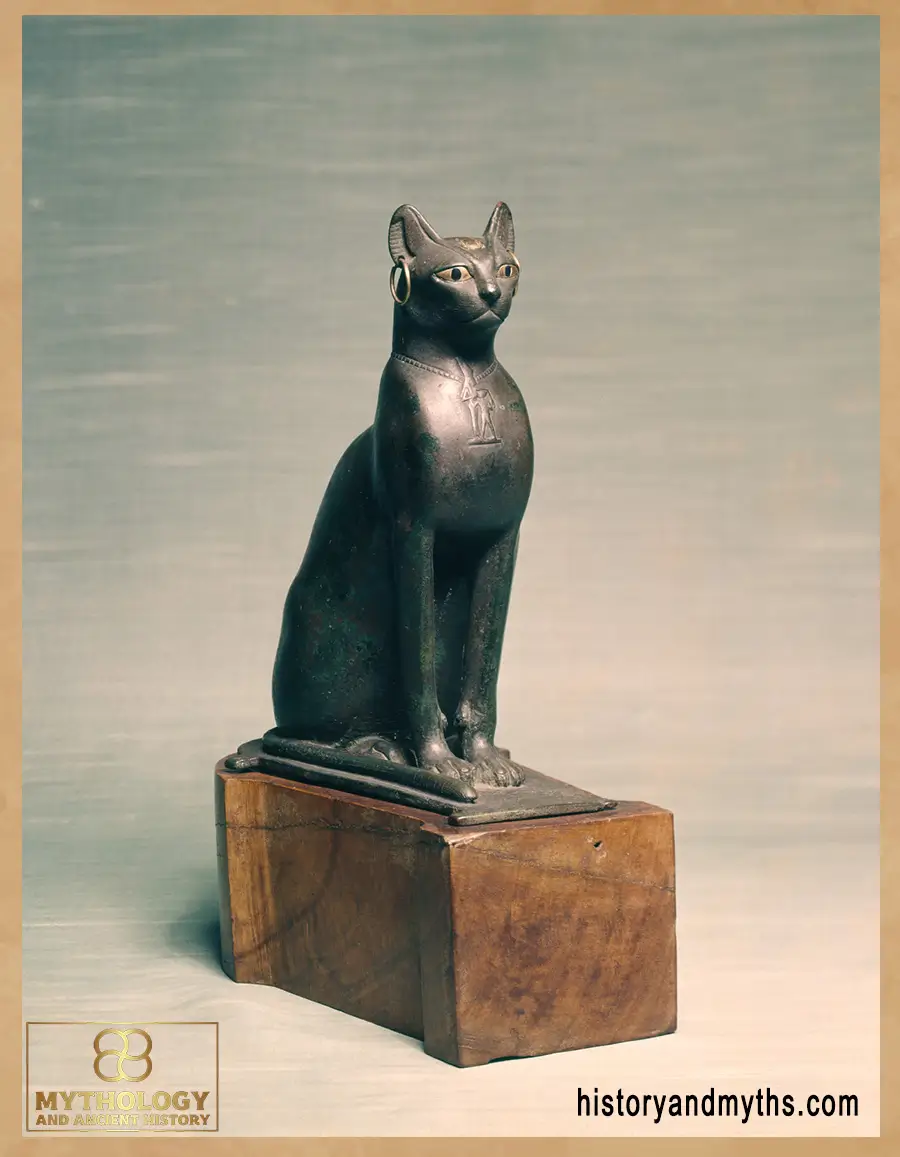
The symbolic rise of the cat in ancient Egypt did not begin in temples or theology—it began in storage rooms. Egyptian survival depended on grain, and grain attracted rodents, which in turn attracted snakes. The cat entered this fragile ecosystem as a silent regulator, eliminating threats before they became disasters. In this context, the cat was not admired for beauty or companionship, but for its ability to preserve stability. Over time, this practical role reshaped perception: the animal that defended life became inseparable from the idea of protection itself.
Unlike animals associated with brute force, the cat represented controlled power. It did not chase chaos openly; it waited, observed, and struck only when necessary. This behavior aligned perfectly with the Egyptian concept of order—maat—which was not about constant action, but about maintaining balance through restraint. The cat’s presence inside the home symbolized a hidden safeguard, an unseen force ensuring that disorder never crossed the threshold.
This is why the cat’s symbolism developed differently from other sacred animals. It was neither distant nor purely wild. It lived among humans, slept near children, and guarded the most vital resources of daily life. In doing so, the cat became a living metaphor for protection that operates quietly, without ceremony. Sacredness followed function, not the other way around making the cat one of the clearest examples of how Egyptian religion transformed necessity into myth.
| Symbolic Aspect | Meaning in Egyptian Myth | Interpretive Insight |
|---|---|---|
| Domestic Guardian | Protector of homes, grain stores, and families from snakes and rodents | Daily survival became sacred—protection began inside the household. |
| Watcher of Thresholds | Guardian of night, doorways, and moments of vulnerability | Symbolized vigilance that prevents chaos before it appears. |
| Controlled Violence | Swift, precise action when balance is threatened | Power used ethically—force as correction, not aggression. |
| Cosmic Defender | The solar cat defeating the serpent of chaos | Household protection projected onto the universe itself. |
| Justice and Punishment | Feline symbolism linked to instant justice (Mafdet) | Justice defined by speed and certainty, not deliberation. |
| Ritual Medium | Cat mummies offered as votive dedications | Devotion activated protection rather than worshipping the animal. |
The Cat as Guardian of Thresholds
In Egyptian symbolic thinking, the most dangerous spaces were not the open desert or the deep underworld, but the thresholds—the moments and places where order could fail. Doorways, nightfall, sleeping hours, and storage rooms were all vulnerable points where chaos might enter unnoticed. The cat’s symbolic power grew precisely because it occupied these liminal zones. It was most active at night, most alert when humans slept, and most present at the edges of domestic life rather than its center.
This role made the cat a natural guardian of boundaries. It patrolled the invisible line between safety and threat, acting before danger became visible. Unlike protective symbols that relied on ritual or prayer, the cat’s protection was immediate and physical. Its ability to see in darkness, move silently, and react faster than human perception turned it into a living embodiment of watchfulness. In mythic terms, the cat did not block chaos after it arrived—it prevented its arrival altogether.
Because of this, the cat came to represent a form of protection that required no constant supervision. Its presence alone implied control. Egyptians did not need to imagine the cat fighting disorder endlessly; they trusted that it would act if necessary. This trust elevated the animal into a symbolic model for divine guardianship—power that remains calm, invisible, and restrained until the precise moment it is needed. The cat guarded not just homes, but the idea that order could be preserved quietly, without spectacle.
Two Faces of One Symbol: Gentle Protection and Controlled Violence
The cat’s power in Egyptian symbolism did not come from choosing between gentleness and violence, but from embodying both at once. This duality explains why feline imagery could express radically different forms of divine action without contradiction. In calm moments, the cat symbolized domestic safety, fertility, and maternal protection. Yet the same animal could transform instantly into a predator capable of decisive, lethal force. For the Egyptians, this was not a paradox—it was the ideal model of power.
Divine strength was never imagined as constant aggression. Instead, it was understood as force held in reserve, released only when balance was threatened. The cat mirrored this perfectly. It could remain still for hours, appearing harmless, only to strike with absolute precision when danger emerged. This behavior offered a symbolic lesson: true protection does not announce itself, and true violence is justified only when order is at risk.
This is why feline symbolism could stretch from household guardianship to the most destructive aspects of divine wrath without losing coherence. Whether protecting a child, a grain store, or the cosmic order itself, the cat represented measured response. Its violence was never chaotic; it was corrective. In Egyptian mythic thinking, this made the cat an ethical symbol as much as a protective one—demonstrating how power should be used, not merely possessed.
The Solar Cat and the Defeat of Chaos
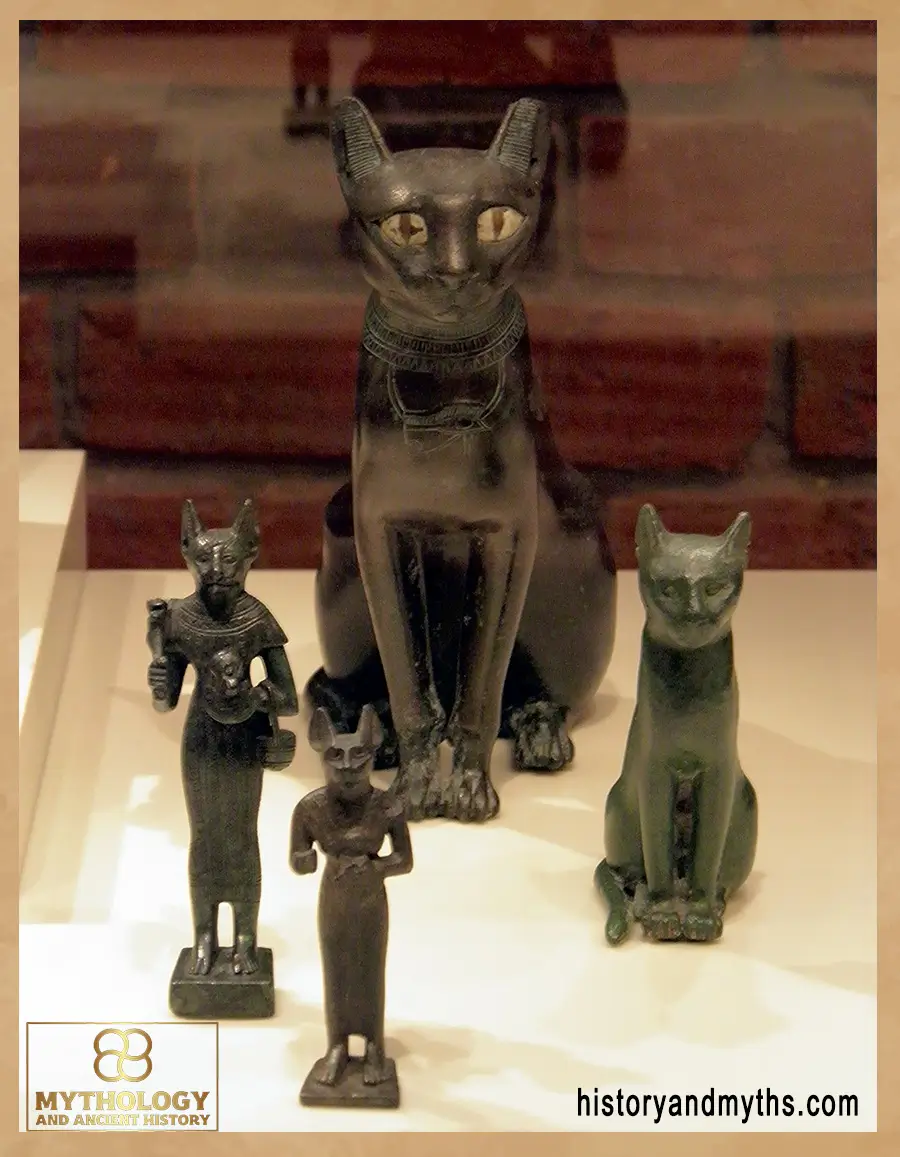
At the highest level of Egyptian symbolism, the cat was no longer a household guardian—it became a cosmic agent of order. Religious texts and imagery describe a great cat associated with the sun god, confronting and destroying the serpent of chaos that threatened the daily rebirth of the sun. This was not a decorative myth or an animal metaphor added for color. It was a symbolic statement about how order survives: not through constant war, but through a single, precise act at the critical moment.
In this role, the cat represents divine intervention stripped to its essentials. It waits. It observes. And when chaos rises, it strikes once—decisively. The image of the solar cat slaying the serpent expresses the same principle seen in domestic life, but on a universal scale. Just as the household cat protects grain from destruction, the cosmic cat protects existence itself from collapse. The scale changes; the logic remains the same.
This symbolism reveals something fundamental about Egyptian religious thought. Chaos was not imagined as permanently defeated, nor was order assumed to be automatic. Instead, the universe depended on vigilance. The cat embodied that vigilance in its purest form. It was not a creator, nor a ruler, but a guardian of continuity—the force that ensures tomorrow arrives intact. By placing the cat at the heart of the solar cycle, Egyptian myth elevated a familiar animal into a symbol of cosmic survival.
Mafdet and the Idea of Instant Justice
Before cats became symbols of comfort or cosmic balance, feline imagery was already tied to justice and punishment. Mafdet, one of the earliest feline-associated figures in Egyptian belief, represented a form of justice that was swift, precise, and final. Unlike later gods connected to law or judgment, Mafdet did not deliberate or weigh evidence—her justice arrived suddenly, like the strike of a claw. This made her symbolism fundamentally different from moral instruction; it was about immediate correction.
The choice of a feline form was not accidental. Speed, sharpness, and certainty defined both the animal and the concept it expressed. In Egyptian thinking, some threats did not deserve delay. Serpents, traitors, and forces that endangered royal or cosmic stability required instant removal. Mafdet embodied this necessity. She was not cruel, nor arbitrary—she was efficient. Her violence was not emotional; it was functional, reinforcing the idea that order sometimes depends on decisive action rather than prolonged judgment.
This association added another layer to the cat’s symbolic identity. Beyond protection and vigilance, the feline became a model for ethical force—power used only when boundaries are crossed and used without hesitation once they are. In this sense, Mafdet bridges the domestic and cosmic meanings of the cat. The same instincts that protect a home at night also defend justice itself. The cat, through Mafdet, became a reminder that order is fragile—and that preserving it may require speed rather than mercy.
Votive Cats and the Economy of Devotion
When the cat became a symbol of protection, justice, and cosmic stability, it also entered the everyday mechanics of Egyptian religion. Millions of cat mummies discovered across Egypt were not created as pets laid to rest, nor as expressions of personal grief. They were offerings—material acts of devotion meant to activate the protective power the cat symbolized. In this context, the cat was no longer just an image of sacred force; it became a medium through which humans negotiated safety, health, and divine favor.
These votive practices reveal how deeply feline symbolism had penetrated Egyptian life. Worshippers did not pray to the cat, nor did they worship the animal itself. Instead, they offered its form as a request for intervention—protection for a household, healing for a child, or defense against unseen dangers. The act of dedication mattered more than the individuality of the animal. What was honored was the symbolic function, not the creature’s personal story.
This system also transformed sacred symbolism into an organized religious economy. Breeding, mummifying, and dedicating cats became a structured activity tied to temples and pilgrimages. Yet this did not dilute the symbol’s meaning. On the contrary, it reinforced it. Each offering repeated the same message: protection must be renewed, vigilance must be maintained, and order requires participation. Through votive cats, Egyptians expressed a powerful idea—that divine guardianship was not distant or abstract, but something that could be approached, requested, and sustained through ritual action.
Core Meanings of the Cat Symbol in Ancient Egypt
- Silent Protection: The cat symbolized vigilance that operates quietly, guarding homes and lives without constant display of force.
- Guardian of Boundaries: It stood at thresholds—night, doorways, and moments of weakness—where chaos was most likely to enter.
- Controlled Violence: Feline power represented force used only when balance was threatened, never random or excessive.
- Cosmic Defense: In solar myth, the cat became an agent of order, striking chaos at the precise moment of danger.
- Swift Justice: Through early feline symbolism, justice was imagined as immediate correction rather than prolonged judgment.
- Ritual Activation: The cat’s image functioned as a medium through which protection and stability could be renewed through devotion.
© historyandmyths.com — Educational use
Why the Cat Endured as a Symbol of Order
The endurance of the cat in Egyptian symbolism was not the result of fashion, affection, or isolated mythology. It survived because it expressed a complete philosophy of protection. From the household to the cosmos, the cat represented a form of power that was present but restrained, alert but silent, violent only when necessary. This made it uniquely suited to express how the Egyptians understood stability—not as something guaranteed, but as something that must be constantly guarded.
Unlike animals that symbolized raw strength or distant divinity, the cat remained close to human life. It slept beside families, guarded food, and watched the night. This proximity gave its symbolism credibility. The Egyptians did not imagine protection abstractly; they observed it daily. When this familiar behavior was projected onto gods, justice, and cosmic cycles, it carried authority because it was already trusted. The cat’s sacred role felt earned, not imposed.
Ultimately, the cat endured because it offered a reassuring model of order. It showed that chaos does not always require overwhelming force to be defeated—sometimes it only requires vigilance, timing, and precision. In Egyptian mythic thought, this lesson was timeless. As long as disorder threatened the world, the image of the watchful cat remained relevant. Not as a mascot of divinity, but as its quiet guardian.
Key Takeaways — Cat Symbolism in Ancient Egypt
- Protection came first: The cat became sacred because it defended grain, homes, and life—symbolism followed function.
- Guardian of thresholds: Cats represented vigilance at moments and places where chaos could enter, especially at night.
- Power held in reserve: Feline violence symbolized ethical force—used only when balance was threatened.
- From home to cosmos: Domestic protection expanded into a cosmic role, where the cat defended universal order.
- Justice without delay: Early feline symbolism framed justice as swift correction rather than prolonged judgment.
- Ritual participation: Votive cats allowed people to actively renew protection through devotion.
Frequently Asked Questions About Cats in Egyptian Myth
Why were cats sacred in ancient Egypt?
Cats were sacred because they protected grain stores, homes, and families from rodents and snakes. Their role in preserving daily life transformed them into symbols of protection and order.
Did ancient Egyptians worship cats themselves?
No. Ancient Egyptians did not worship cats as gods. They revered what cats symbolized—vigilance, protection, and balance—and connected those qualities to divine power.
Is cat symbolism only connected to the goddess Bastet?
No. While Bastet is the most famous feline deity, cat symbolism extended beyond her to include justice, controlled violence, and cosmic defense.
What did the cat represent in Egyptian religion?
The cat represented protection, alertness, ethical use of force, and the maintenance of order in both domestic and cosmic contexts.
Why were cats associated with justice in ancient Egypt?
Feline symbolism expressed swift and decisive justice. This idea appeared early in Egyptian belief, where threats to order required immediate correction.
What is the meaning of cat mummies in ancient Egypt?
Cat mummies were usually votive offerings dedicated in temples. They symbolized requests for protection, healing, or divine intervention rather than personal pets.
Why did cat symbolism last so long in Egyptian culture?
The cat endured as a symbol because it consistently represented vigilance and balance—qualities essential to survival and order in Egyptian thought.
Sources & Rights
- Pinch, Geraldine. Egyptian Mythology: A Guide to the Gods, Goddesses, and Traditions of Ancient Egypt. Oxford: Oxford University Press, 2002.
- Wilkinson, Richard H. The Complete Gods and Goddesses of Ancient Egypt. London: Thames & Hudson, 2003.
- Teeter, Emily. Religion and Ritual in Ancient Egypt. Cambridge: Cambridge University Press, 2011.
- Ikram, Salima. Divine Creatures: Animal Mummies in Ancient Egypt. Cairo: American University in Cairo Press, 2005.
- Assmann, Jan. The Search for God in Ancient Egypt. Ithaca: Cornell University Press, 2001.
- Hornung, Erik. Conceptions of God in Ancient Egypt: The One and the Many. Ithaca: Cornell University Press, 1982.
- Quirke, Stephen. Exploring Religion in Ancient Egypt. Chichester: Wiley-Blackwell, 2015.
- Ritner, Robert K. The Mechanics of Ancient Egyptian Magical Practice. Chicago: Oriental Institute of the University of Chicago, 1993.
Written by H. Moses — All rights reserved © Mythology and History