What Is the Book of Gates? Authority and Judgment in Ancient Egypt
In ancient Egyptian belief, reaching the afterlife was not simply a matter of surviving the night. It was a matter of permission. The Book of Gates presents a vision of the underworld where movement is controlled, access is restricted, and passage depends on recognition rather than endurance. Unlike other funerary texts that describe transformation through time, this work focuses on who is allowed to proceed—and who is stopped.
The underworld described in the Book of Gates is organized around thresholds. Each gate marks a point of authority where guardians enforce boundaries and test legitimacy. Knowledge of names, correct identification, and alignment with cosmic order determine whether passage is granted. Judgment here is not abstract or delayed; it is immediate and visual. Those who lack the right status, knowledge, or balance simply cannot move forward.
This article explains the Book of Gates as a system of control within the Duat. Rather than retelling myths or listing gates, it explores why the Egyptians framed the afterlife around permission, exclusion, and authority—and what this meant for the dead who hoped to pass beyond judgment into renewal.
What Is the Book of Gates?
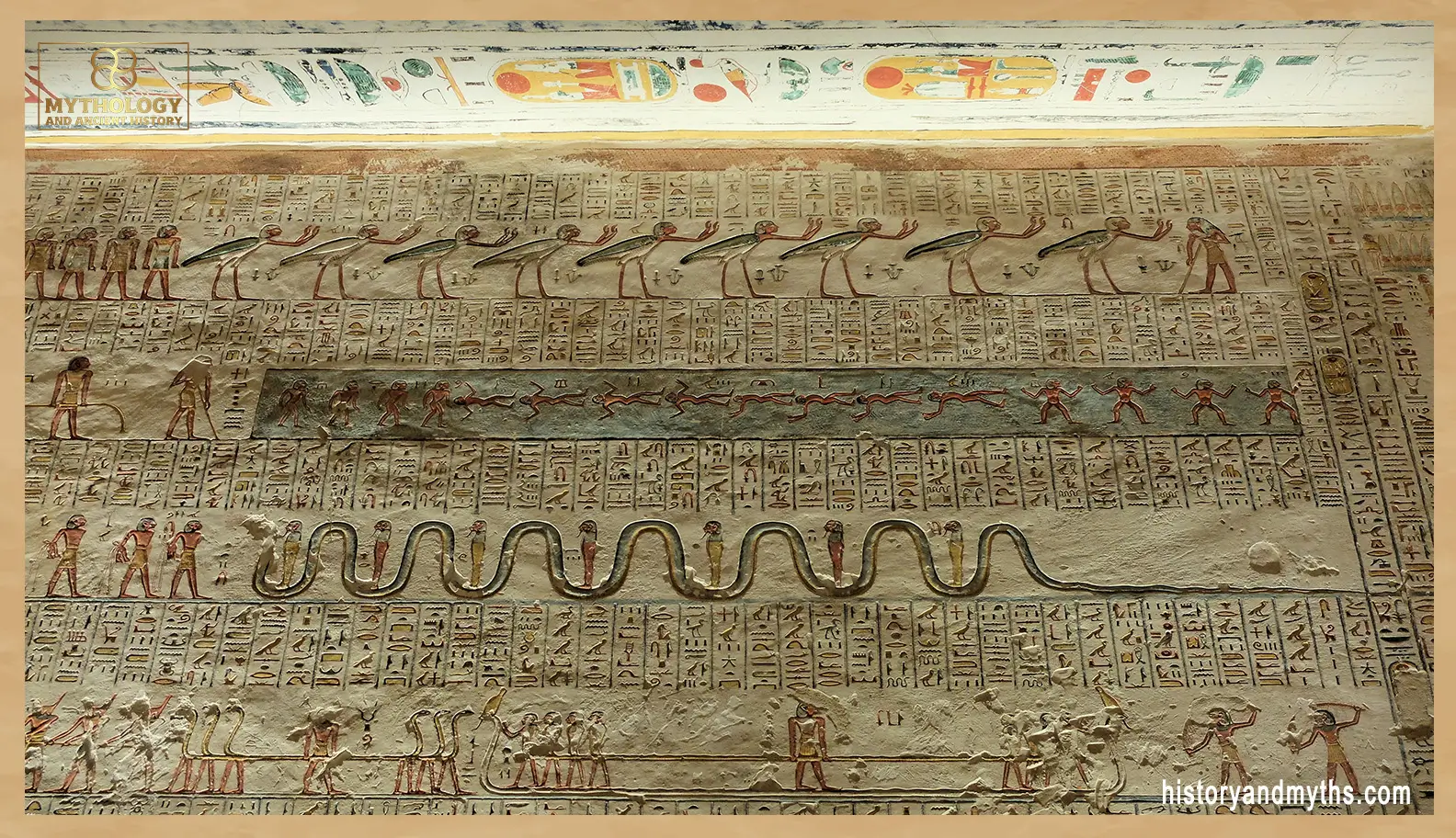
The Book of Gates is a New Kingdom funerary text that describes the underworld as a sequence of controlled thresholds rather than a continuous journey. Its central idea is simple but strict: passage through the Duat depends on authorization. Movement is halted at gates, each guarded by divine figures who enforce order and decide who may proceed.
Unlike texts that emphasize transformation through time, the Book of Gates emphasizes regulation. Each gate represents a point where legitimacy is tested. Names must be known, roles recognized, and cosmic balance respected. Knowledge functions as access. Without it, even the presence of the sun god does not guarantee passage for accompanying souls.
The structure of the book reflects this logic. The night is divided conceptually, but the focus is not on hours themselves. Instead, attention centers on moments of stoppage—places where progress pauses and judgment occurs. The gates are not symbolic scenery; they are mechanisms of control designed to prevent disorder from spreading within the afterlife.
For the Egyptians, this system solved a theological concern. If the afterlife was orderly, it required limits. Not all beings could be allowed to move freely, and not all souls deserved continuation. The Book of Gates provided a clear answer: authority governs passage, and authority must be obeyed.
| Aspect | The Book of Gates |
|---|---|
| Core Purpose | Regulates access to the Duat through controlled gates and enforced authority. |
| Primary Focus | Permission, legitimacy, and exclusion rather than transformation over time. |
| Structure | A sequence of guarded thresholds where movement is repeatedly halted and evaluated. |
| Role of Gates | Points of authority that control passage and enforce cosmic boundaries. |
| Guardians | Officials of order who verify identity and deny access when requirements are unmet. |
| Function of Knowledge | Names and recognition serve as keys that authorize or block movement. |
| Judgment Method | Immediate and repeated evaluation at each gate rather than a single final verdict. |
| Meaning for the Dead | Survival depends on preparedness, legitimacy, and understanding of cosmic authority. |
| Relation to Other Texts | Complements the Amduat by enforcing boundaries where transformation alone is insufficient. |
Why Gates Instead of Hours?
The shift from hours to gates reflects a change in how the Egyptians understood control in the afterlife. Hours measure time, but gates regulate movement. By framing the Duat around gates, the Book of Gates replaces endurance with authorization. Survival is no longer about passing through darkness; it is about being allowed to pass at all.
In this system, time alone is insufficient. A soul may endure the night, but endurance does not grant access. Gates introduce interruption. Progress stops, questions are asked, and authority intervenes. This makes judgment immediate rather than delayed. Instead of waiting for a final verdict, the soul encounters decision points throughout the night.
Gates also transform the underworld into a hierarchy. Each threshold is controlled by specific guardians whose power lies not in violence but in legitimacy. They enforce boundaries, not punishment. Entry is granted only to those who belong—those who know the correct names, possess the right status, and align with cosmic order. Exclusion happens quietly, through denial rather than destruction.
This structure reflects a broader theological development. As funerary beliefs evolved, the afterlife became more regulated. The Book of Gates answers a critical question left open by earlier texts: if order governs the cosmos, who ensures that order inside the underworld? Gates are the answer. They embody authority, limit chaos, and ensure that renewal remains selective rather than automatic.
Guardians, Names, and Authority
In the Book of Gates, guardians are not monsters placed to terrify the dead. They are officials of cosmic order. Their primary function is not to punish, but to verify. Each guardian controls access to a gate, and their authority rests on recognition—of names, roles, and legitimacy.
Names are not decorative labels in this system. To know a name is to demonstrate alignment with order. Names establish identity, define boundaries, and confirm belonging. When a soul addresses a guardian correctly, it signals preparedness and knowledge of the cosmic structure. Silence, ignorance, or misidentification results in exclusion, not attack.
Authority in the Book of Gates is therefore procedural. Guardians do not act on impulse or emotion. They enforce rules that already exist. This removes randomness from judgment and replaces it with regulation. The afterlife becomes a space governed by protocols rather than mercy or force.
This framework also clarifies why violence is secondary. Guardians rarely destroy; they deny. The most severe outcome is not torment, but immobilization—being unable to proceed. In Egyptian thought, this is a greater failure than suffering, because it halts renewal entirely.
For the dead, guardians represent the final test of preparedness. Moral alignment alone is not enough. One must also understand how the system works. The Book of Gates teaches that survival in the afterlife depends on knowledge exercised at the right moment, before the right authority, at the correct threshold.
Who Is Allowed to Pass — and Who Is Not
The Book of Gates draws a clear line between inclusion and exclusion. Passage through the underworld is not universal, nor is it compassionate by default. Only those who meet specific conditions are allowed to move forward. Everyone else is stopped—not violently, but decisively.
Those permitted to pass are characterized by legitimacy. They possess the correct knowledge, demonstrate recognition of authority, and exist in alignment with cosmic order. Their movement is regulated but uninterrupted. Passage is not a reward; it is confirmation that they belong within the system. Renewal is possible only for those who fit its structure.
Exclusion operates quietly. Souls that lack knowledge, status, or alignment are not tortured in dramatic fashion. Instead, they are immobilized, confined, or left behind at the gates. This reflects a crucial Egyptian belief: the ultimate failure is not pain, but stagnation. To be unable to proceed is to be denied renewal entirely.
This system also limits divine privilege. Even the presence of the sun god does not guarantee access for all who follow him. The gates apply their rules universally. Authority overrides companionship. This reinforces the idea that order, not favor, governs the afterlife.
For the ancient Egyptians, this logic carried a clear message. The afterlife was not a place of automatic justice or universal salvation. It was a controlled environment where continuity depended on preparedness. The Book of Gates made this explicit: survival beyond judgment required more than hope—it required qualification.
Book of Gates vs Amduat
Although both texts describe the sun’s passage through the night, the Book of Gates and the Amduat operate on fundamentally different principles. Confusing them leads to misunderstanding how the Egyptian afterlife was imagined and controlled.
The Amduat is concerned with process. It explains how the night unfolds over time and how transformation becomes possible through endurance, cooperation, and regeneration. Movement in the Amduat is expected. The question it answers is how renewal happens.
The Book of Gates, by contrast, is concerned with permission. It does not assume movement. Instead, it interrupts it. Progress halts at each gate, and access depends on recognition and authority. The central question here is not how transformation occurs, but who is allowed to proceed.
This distinction reveals two complementary systems. The Amduat presents the night as a necessary journey that must be completed. The Book of Gates treats the night as a controlled space where advancement is conditional. One emphasizes continuity; the other enforces limitation.
Together, they reflect a mature theological view. Transformation alone was not enough. Without regulation, renewal would become indiscriminate. The Book of Gates supplies what the Amduat leaves open: boundaries. It ensures that order is preserved not just through movement, but through exclusion.
Understanding this difference prevents repetition and clarifies purpose. The Book of Gates is not a retelling of the Amduat. It is a corrective framework—one that defines authority within the underworld and makes renewal selective rather than automatic.
The Book of Gates — Core Insights
- The Book of Gates presents the afterlife as a controlled system where access depends on authorization.
- Gates replace time as the main organizing principle, shifting focus from endurance to permission.
- Guardians function as officials of cosmic order rather than agents of punishment.
- Knowledge of names and roles acts as a key that enables or blocks passage.
- Judgment occurs repeatedly at each threshold, not in a single final moment.
- Exclusion is enforced through denial of movement rather than physical torment.
- Renewal in the afterlife is selective and conditional, not automatic.
What the Book of Gates Meant for the Dead
For the ancient Egyptian, the Book of Gates was not a myth to admire but a warning to understand. It described the afterlife as a regulated system where survival depended on readiness. Death did not erase responsibility; it intensified it. The dead were expected to navigate authority, recognize limits, and prove that they belonged within cosmic order.
This text made clear that moral intent alone was insufficient. One could be justified in heart yet still fail through ignorance. Knowledge—of names, roles, and procedures—was essential. The afterlife required competence. To pass a gate was to demonstrate not only worthiness, but awareness of how order functioned beyond life.
The Book of Gates also reframed judgment. Instead of a single decisive moment, judgment unfolded repeatedly. Each gate represented a new evaluation. This meant that failure was cumulative. One misstep could halt progress permanently, denying access to renewal. The dead were not punished for wrongdoing so much as excluded for unfitness.
In this way, the Book of Gates reinforced a disciplined vision of the cosmos. Renewal was possible, but not guaranteed. Continuity belonged only to those who respected boundaries and operated within structure. For the living, the message was unmistakable: preparation for the afterlife began long before death.
By presenting the Duat as a system of authority rather than a landscape of terror, the Book of Gates offered clarity. The afterlife was not arbitrary. It was governed, controlled, and selective. Survival required more than faith—it required understanding.
Key Takeaways
- The Book of Gates describes the afterlife as a system of controlled access, not a free journey.
- Gates represent authority and judgment, replacing time as the main organizing principle.
- Passage depends on legitimacy, knowledge, and recognition rather than endurance alone.
- Guardians enforce cosmic order by denying or granting access, not by random punishment.
- Judgment occurs repeatedly at each threshold throughout the night.
- Renewal in the afterlife is selective and conditional, not guaranteed for every soul.
Frequently Asked Questions
What is the Book of Gates in ancient Egyptian belief?
The Book of Gates is a funerary text that describes the underworld as a system of guarded thresholds where passage depends on permission and legitimacy.
How is the Book of Gates different from the Amduat?
The Amduat explains transformation through time, while the Book of Gates focuses on authority, access, and who is allowed to pass.
Why are gates so important in this text?
Gates represent control points where movement stops and judgment occurs, ensuring that only qualified beings may proceed.
Who guards the gates in the Egyptian underworld?
Divine guardians act as officials of cosmic order, verifying identity and enforcing boundaries rather than inflicting punishment.
What happens to souls who are denied passage?
They are immobilized or excluded from further movement, preventing renewal rather than subjecting them to dramatic torment.
Does the sun god Ra also pass through the gates?
Yes. Even Ra must pass through the gates, reinforcing that authority applies universally within the underworld.
What did the Book of Gates mean for ordinary people?
It taught that preparation, knowledge, and alignment with cosmic order were essential for survival in the afterlife.
Is the Book of Gates a guide or a warning?
It functions as both, offering instruction while emphasizing that renewal is conditional and controlled.
Sources & Rights
- Hornung, Erik. The Ancient Egyptian Books of the Afterlife. Cornell University Press, 1999.
- Hornung, Erik. The Egyptian Book of Gates. Living Human Heritage Publications, 2014.
- Assmann, Jan. Death and Salvation in Ancient Egypt. Cornell University Press, 2005.
- Taylor, John H. Journey through the Afterlife: Ancient Egyptian Book of the Dead. British Museum Press, 2010.
- Shafer, Byron E., ed. Religion in Ancient Egypt: Gods, Myths, and Personal Practice. Cornell University Press, 1991.
- Allen, James P. Middle Egyptian: An Introduction to the Language and Culture of Hieroglyphs. Cambridge University Press, 2014.
Written by H. Moses — All rights reserved © Mythology and History