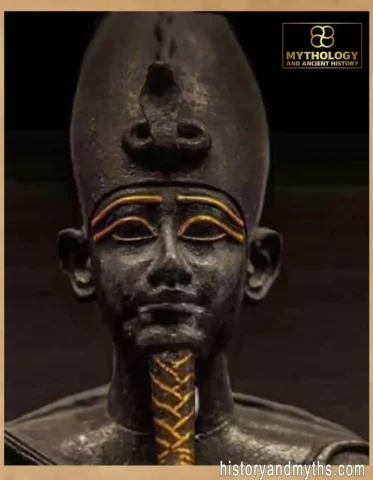
Tayt — The Egyptian Goddess of Linen, Purity, and Funerary Protection
Among the many deities of ancient Egypt, Tayt stands out not because of towering statues or famous myths—she has none—but because of the quiet power she held over one of the most essential materials in Egyptian life: linen. In a civilization built around purity, ritual order, and the careful preparation of the dead, linen was not just fabric; it was a boundary between the mortal world and the eternal one. And Tayt was the divine figure who guarded that boundary.
Her presence emerges not in grand temple reliefs but in the intimate language of funerary texts, where she is invoked to protect the deceased, purify their body, and wrap them in layers of sacred cloth meant to preserve their identity forever. The Egyptians believed that linen, touched by Tayt’s blessing, could shield the spirit from danger and keep the physical form intact for the journey beyond.
This makes Tayt a rare kind of goddess—one whose power was felt more than it was seen, and whose importance grew from the practices of everyday life: weaving, preparing garments, crafting shrouds, and helping families care for their dead. Through her, the simple act of weaving became an extension of cosmic order, linking household labor to divine protection.
Tayt may not appear in art, but she is woven into the deepest layers of Egyptian thought, where material, ritual, and memory come together. Her story begins not with images, but with the threads that held an entire worldview together.
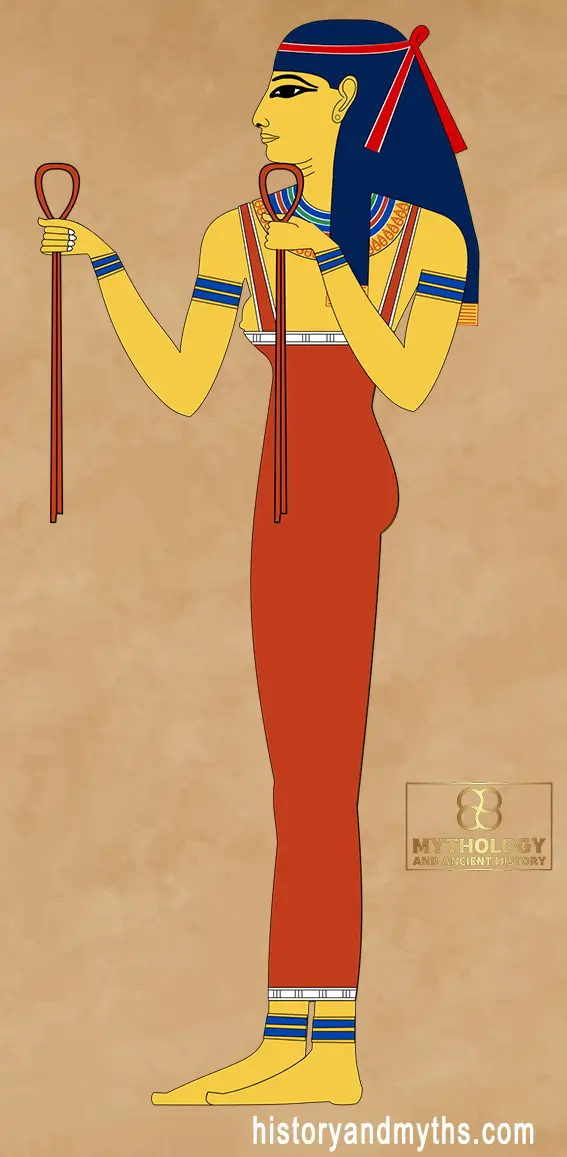
Tayt and the Sacred Meaning of Linen in Egyptian Life
To understand Tayt, we first need to understand linen itself. For the ancient Egyptians, linen was more than a textile — it was a symbol of purity, renewal, and protection. Clothes made from linen marked social identity, priestly rituals, and the daily rhythm of work and status. But its greatest significance emerged in moments of death, where linen became the final language spoken between the living and the dead.
Linen was considered the cleanest of all fabrics. Its pale color and ability to be woven finely made it the ideal material for temple service, purification rites, and sacred offerings. Priests wore fresh linen garments during rituals not for aesthetics, but because purity of cloth reflected purity of action. Every fold carried meaning, and every thread was a statement of order over chaos.
This symbolic weight explains why Tayt held an authority that seems disproportionate to the simplicity of her domain. By overseeing the creation of linen, she held influence over both the body and the spirit. Texts describe her as the one who “makes pure the bandages,” implying that her involvement transformed linen from a mundane object into a protective shield imbued with divine intention. A shroud prepared under Tayt’s blessing was not merely fabric — it was a safeguard, an assurance that the deceased would not lose their form or identity in the afterlife.
Even in everyday life, the act of weaving became a quiet extension of her presence. Women who crafted textiles worked within a tradition that connected domestic labor to cosmic order. Through them, Tayt’s influence bridged the practical and the sacred. Linen that clothed a living body and linen that wrapped a dead one were part of the same continuum: a cycle of cleanliness, renewal, and protection.
Tayt’s role shows how the Egyptians saw spirituality not just in temples or myths, but in the materials their hands touched. A thread could carry meaning. A garment could reflect the order of the universe. And a goddess could rise to prominence not through spectacle, but through the quiet power of preservation.
| Aspect | Details |
|---|---|
| Name | Tayt (also Tayet, Tait) |
| Domains | Goddess of linen, weaving, purity, funerary wrappings, and protective bandages |
| Symbolic Role | Embodied the sanctity of linen used by priests and in mummification rituals; guardian of bodily preservation and spiritual identity |
| Depictions | No known surviving visual depictions; represented symbolically through linen, weaving tools, and purification rituals |
| Texts Mentioning Tayt | Pyramid Texts, Coffin Texts, Book of the Dead, Book of Caverns, embalming liturgies |
| Role in Daily Life | Linked to weaving traditions, household textile production, and the spiritual purity of garments and burial shrouds |
| Associations | Connected with Nephthys, Isis, and Selket in funerary protection; related to purity and craftsmanship deities |
Tayt in Funerary Texts: The Goddess Who Preserved Identity After Death
Tayt’s clearest presence in ancient Egypt appears not on temple walls, but in the words spoken for the dead. In the Pyramid Texts and Coffin Texts, she is called upon to “bind,” “protect,” and “purify,” three actions that defined the transition between death and eternal life. Her role was not decorative — it was technical, precise, and essential.
When Egyptians prepared a body for burial, wrapping it in linen was more than a practical act. Each layer served a spiritual purpose: preserving the form, shielding the vulnerable spirit, and maintaining the integrity of the individual. The linen wrappings were believed to hold together not only the physical body but the ka and ba, ensuring the deceased did not lose themselves in the journey beyond.
Tayt is repeatedly invoked as the divine artisan who oversees this process. Texts describe her as one who “wraps the limbs in protection” and “purifies with the cloth of the gods.” In this language, her power is not symbolic but functional. She is responsible for the transformation of a fragile body into a being capable of entering eternity.
The Book of Caverns and related underworld texts depict her influence more subtly. Rather than appearing visually, her presence is implied through the repeated emphasis on purity, binding, and the preservation of form — all attributed to her sacred craft. This absence of imagery is not a sign of insignificance; it reflects the nature of her domain. The work she presided over was intimate, hidden, and layered, much like the wrappings themselves.
Tayt’s authority also extended to the conceptual world of protection spells. Many formulas rely on the idea that the bandages are “imbued with divine light” or “strengthened by the Lady of the Linen.” This reinforces her status as a guardian whose power rested not in mythic battles or dramatic stories, but in safeguarding identity — the very core of Egyptian beliefs about immortality.
Through these texts, Tayt becomes a quiet architect of eternal life. Her craft ensured that the deceased remained whole, recognizable, and anchored as they entered the realm of the gods. In a culture where the body and name defined existence, her task was one of immense cosmic weight.
From Domestic Craft to Eternal Preservation: The Evolution of Tayt’s Role Across Egyptian History
Tayt’s significance did not remain static. Like many Egyptian deities whose influence began in specialized tasks, her meaning expanded as cultural needs and religious practices evolved. What began as a guardian of weaving and linen gradually grew into a critical force in funerary theology — not because her domain changed, but because the Egyptian understanding of death deepened.
In the Old Kingdom, her presence is mostly implicit. She appears in the earliest Pyramid Texts in association with purity and wrapping, reflecting a time when royal burials relied heavily on ritual textiles. Her role was technical but essential: ensuring that the linen used in mummification met the spiritual standard required for a king’s rebirth.
By the Middle Kingdom, as funerary practices spread from royalty to common people, Tayt’s importance increased. The expansion of the Coffin Texts and the rise of more standardized burial customs gave her domain new relevance. Linen was now a universal medium of protection, and its sanctified use placed Tayt at the heart of the journey every Egyptian expected to take.
Her association with the “linen of the gods” also grew during this period. As priests and artisans formalized mummification techniques, the need for symbolic purity intensified. Tayt became more than a craft goddess — she became the divine quality control behind the material that preserved the body, identity, and memory.
In the New Kingdom, her influence integrates into the broader landscape of underworld theology. She remains unnamed in images, but her function becomes embedded in the logic of afterlife rituals. Spells speak of linen “strengthened by Tayt,” suggesting that her power was conceptual rather than visual — a force understood by priests, invoked by families, and woven into every funerary wrapping, even without a single carved depiction.
In later periods, her role stabilizes rather than disappears. She becomes one of several protective goddesses connected to mummification and purity, standing alongside Nephthys, Isis, and Selket. But unlike them, her authority is quiet and materialistic: she operates not through mythic scenes but through the physical fabric that touched everybody prepared for eternity.
Through this long evolution, Tayt demonstrates a rare form of divine endurance. She survived not through imagery or temples, but through relevance — woven into rituals that every Egyptian, rich or poor, depended upon at the moment when life and death touched.
Key Insights on Tayt
- Tayt’s importance comes from function, not imagery — her power is preserved in funerary texts rather than temple art.
- She sanctified linen, transforming it from a material into a protective medium essential for mummification and ritual purity.
- The Egyptians believed that her blessing strengthened the wrappings that preserved identity in the afterlife.
- Her domain bridged household craft and divine protection, linking domestic weaving to the cosmic order of rebirth.
- Her presence reflects how Egyptian spirituality extended into everyday materials, elevating simple cloth into a sacred tool.
- The absence of depictions highlights her intimate, hidden role — much like the linen layers she was believed to empower.
Tayt in Everyday Life: A Goddess Felt Rather Than Seen
Unlike deities whose images filled temple walls, Tayt lived in the quieter spaces of Egyptian life — in the rooms where women wove linen, in the markets where textiles were traded, and in the small family rituals performed before a burial. Her presence was practical, embodied in tasks that required care, precision, and a sense of purity. And because her domain touched nearly every household, she became a familiar figure despite the absence of any formal iconography.
The weavers who produced linen, especially women, operated within a tradition that blurred the line between craft and devotion. Preparing fine linen was not just labor; it was participation in a spiritual economy. Clean fabric meant clean ritual. Well-woven shrouds meant safe passage for a loved one. In that sense, Tayt’s presence was woven into each thread, not imagined through statues but enacted through skill and intention.
Families preparing a deceased relative also felt her influence. Even if they did not name her explicitly, the act of washing the body, laying out the linen, and wrapping it carefully was understood as working within her sphere. The Egyptians believed that divine protection did not always appear in grand displays — sometimes it emerged through the mastery of a simple material. Tayt’s power was in the discipline: making sure the layers were clean, aligned, and capable of preserving the body’s integrity.
Her invisibility in art may actually reflect how Egyptians perceived her. She belonged to a domain too intimate to require monumental representation. Just as a shroud hides the form it protects, Tayt’s role was hidden yet essential. Through her, everyday labor gained cosmological importance. What the hands of ordinary people created could influence the fate of a soul.
And this is perhaps Tayt’s most distinctive quality: she was a goddess whose authority came not from images, myths, or temples, but from trust. Egyptians relied on linen to safeguard their bodies and memories — and in doing so, they relied on Tayt. Her legacy survives not in stone but in the logic of their rituals, a reminder that the divine could reside in materials, actions, and the quiet rituals that shaped a life.
Key Takeaways
- Tayt presided over linen, purity, and the wrapping of the dead — making her central to Egypt’s funerary identity.
- Despite having no surviving depictions, her presence is strong in sacred texts that describe her purifying and protective role.
- Her domain connected domestic weaving with divine order, showing how everyday craft shaped spiritual life.
- Linen blessed by Tayt was believed to safeguard the body and preserve the individual’s form in the afterlife.
- Her influence evolved across periods, reflecting the growing importance of mummification and ritual purity.
- Tayt’s power was subtle but essential — a goddess whose protection was felt in touch, texture, and ritual precision.
FAQ — Tayt
1. Who is Tayt in ancient Egyptian religion?
Tayt is the goddess of linen, weaving, purity, and funerary wrappings, playing a key role in preserving the body and identity after death.
2. Why was linen sacred in ancient Egypt?
Linen symbolized purity and protection. It was used in temple rituals, priestly garments, and especially in mummification, where Tayt sanctified its use.
3. Why does Tayt have no known surviving depictions?
Her role was intimate and functional rather than ceremonial, appearing mainly in textual sources rather than temple art or monumental reliefs.
4. How is Tayt connected to mummification?
She blessed and purified the linen bandages used to wrap the deceased, ensuring that the body remained protected and spiritually intact.
5. What texts mention Tayt?
Tayt appears in the Pyramid Texts, Coffin Texts, Book of the Dead, Book of Caverns, and various embalming liturgies.
6. Was Tayt a household goddess?
Partly. Her domain over weaving linked her to domestic craft, while her funerary role placed her within the highest spheres of ritual practice.
7. How did her role evolve over time?
She shifted from a guardian of weaving to a central figure in funerary purity as mummification practices became more elaborate.
8. What makes Tayt unique among Egyptian goddesses?
She combines domestic skill with cosmic significance, demonstrating how everyday materials carried deep ritual meaning.
Sources & Rights
- Wilkinson, Richard H. The Complete Gods and Goddesses of Ancient Egypt. Thames & Hudson, 2003.
- Hart, George. A Dictionary of Egyptian Gods and Goddesses. Routledge, 2005.
- Pinch, Geraldine. Magic in Ancient Egypt. British Museum Press, 1994.
- Allen, James P. The Ancient Egyptian Pyramid Texts. Society of Biblical Literature, 2005.
- Faulkner, Raymond O. The Ancient Egyptian Coffin Texts. Aris & Phillips, 1973.
- Taylor, John H. Death and the Afterlife in Ancient Egypt. University of Chicago Press, 2001.
- Lesko, Barbara S. The Great Goddesses of Egypt. University of Oklahoma Press, 1999.
- Bleeker, C. J. Hathor and Thoth: Two Key Figures of the Ancient Egyptian Religion. Brill, 1973. (Context for textile purity and ritual associations)
- Ikram, Salima. Death and Burial in Ancient Egypt. American University in Cairo Press, 2015.
Written by H. Moses — All rights reserved © Mythology and History