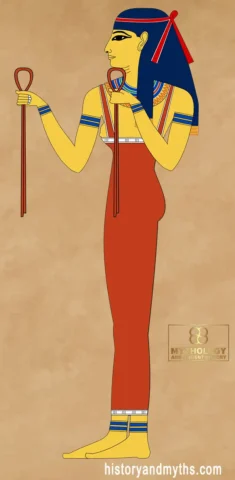
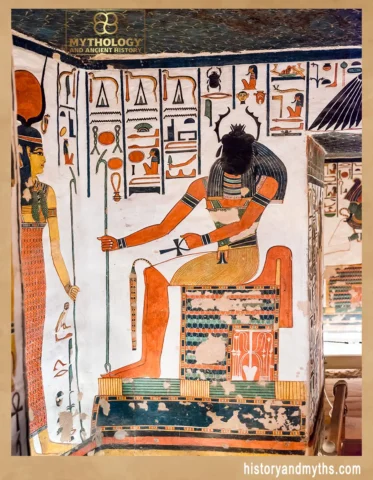
Renenutet — The Egyptian Goddess of Nourishment, Fate, and Protection
Renenutet was the kind of goddess whose influence was felt long before her name was spoken. In a land where the rhythm of the Nile determined survival, she represented the quiet, steady force that turned labor into sustenance and hope into reality. To the Egyptians, nourishment was never merely physical; it was a spiritual guarantee that life would continue. Renenutet embodied that guarantee. She watched over the ripening fields, guarded the granaries, and offered the reassurance that the fragile balance between abundance and loss would not collapse.
Yet her role extended far beyond the harvest. Renenutet was also the giver of identity and destiny — the one who imparted the ren, the personal name that shaped the path of a human life. In this sense, she stood at the threshold between nourishment and fate: the goddess who protected the body while anchoring the individual’s place in the world. This dual function made her one of the most quietly essential figures in Egyptian belief, bridging the material and the symbolic without spectacle or mythic drama.
Her presence in households, storage rooms, and state rituals reflected a truth the Egyptians understood deeply: survival starts with protection, but meaning begins with identity. Renenutet offered both. And through her image — often depicted as a cobra, the vigilant guardian of grain and children — she conveyed a form of care that was alert, practical, and unbreakably constant.
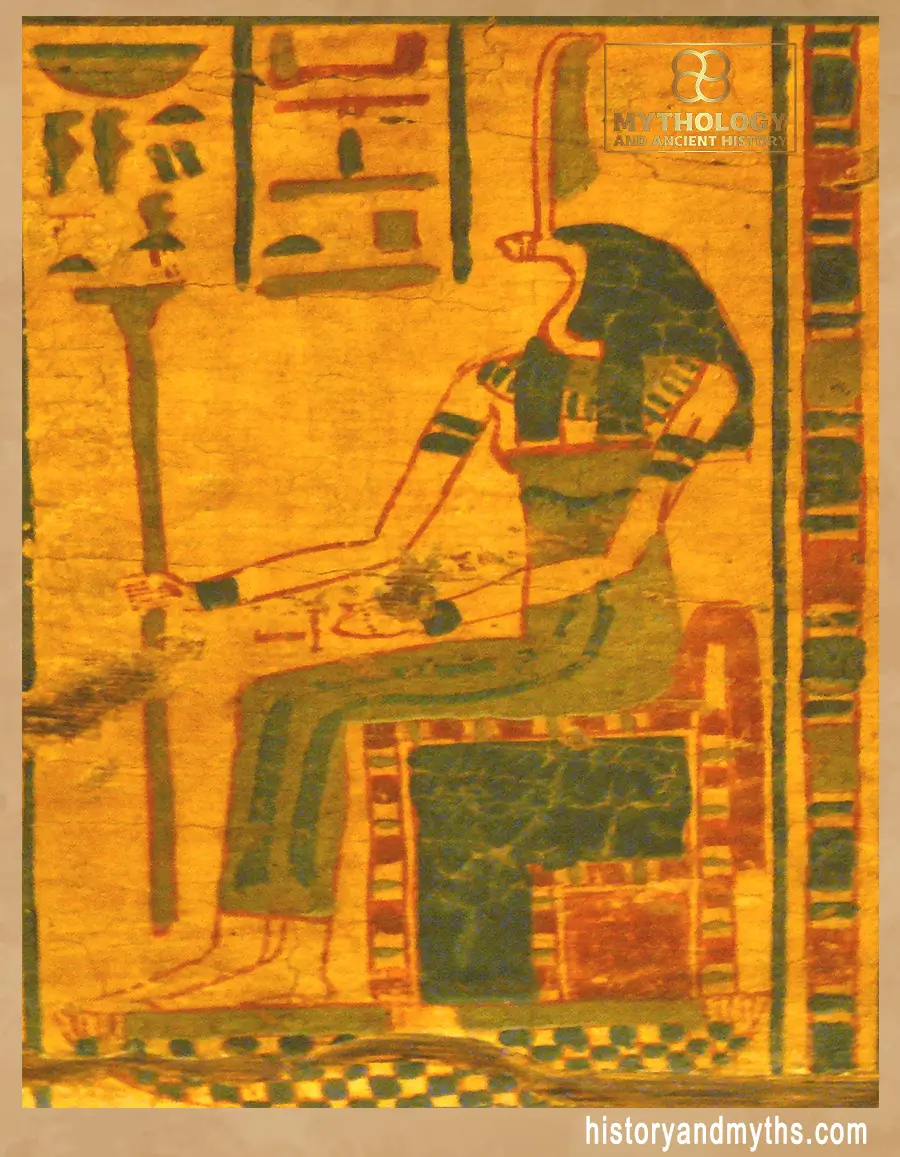
Why Egypt Needed Renenutet: Survival, Anxiety, and the Fragile Promise of the Harvest
Life in ancient Egypt depended on a single, uncertain cycle: whether the Nile would rise, retreat, and leave behind the fertile ground needed for grain. A slight shift in the flood could mean abundant food or widespread hunger. This constant uncertainty shaped not only the economy but the psychology of the people who lived along the river. Renenutet emerged directly from this tension.
She was not a distant cosmic deity. She was the guardian of the moment when survival became visible — when green shoots appeared, when grain filled the fields, when the effort of the year finally transformed into food. In a society where every household relied on a successful harvest, protection of the crops was not an abstract hope but a daily need. Renenutet offered that stability.
Her role also reflects an emotional reality: Egyptians feared not only external threats but the quiet disasters that unfold slowly, like a failing crop or an empty granary. These dangers attacked the foundation of the family and the future of their children. Renenutet’s presence eased this fear. She embodied a promise that the work of the year would not disappear, that sustenance would hold, and that households would not fall into scarcity.
This connection between nourishment and security made her influence deeply personal. She was invoked not through grand festivals but through routine acts — storing grain, tending fields, feeding children. Renenutet belonged to the rhythm of ordinary life, and that is where her power was strongest.
| Aspect | Details |
|---|---|
| Name | Renenutet (also Renanutet / Ernutet; later known as Thermouthis) |
| Domains | Harvest, nourishment, protection of grain, identity (ren), and destiny of children |
| Symbols | Cobra, full granary, nursing mother, cornucopia in Greek period |
| Cult Centers | Faiyum region, granary temples, household shrines |
| Role in Daily Life | Guardian of stored food, giver of the personal name (ren), protector of infants |
| Greek/Roman Evolution | Transformed into Thermouthis; associated with prosperity and the cornucopia |
The Cobra Symbol: Why Renenutet Was Seen Through the Eyes of a Guardian Serpent
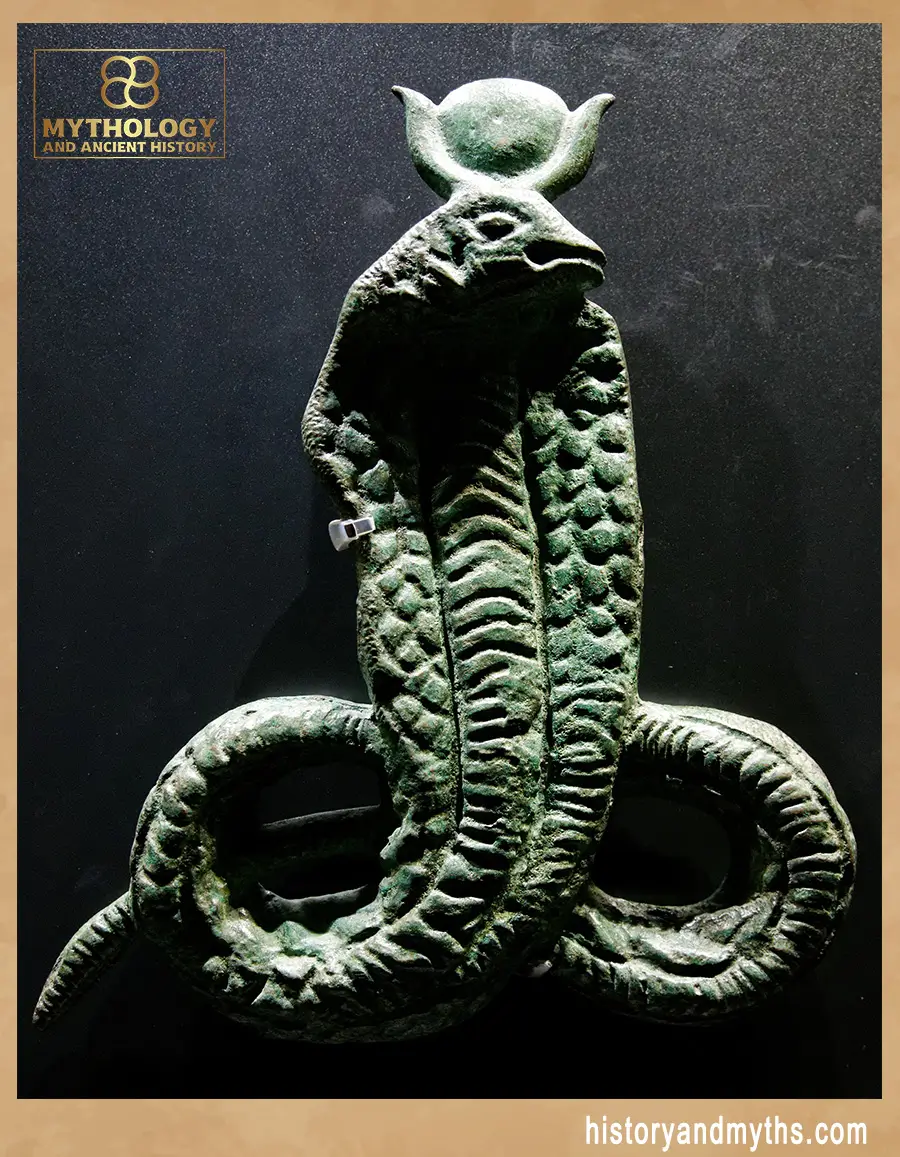
Renenutet’s cobra form is one of the most misunderstood aspects of her identity. Modern readers often view the serpent as threatening, but in the Egyptian world the cobra represented vigilance, precision, and protective force. It was the creature that watched, waited, and struck only with purpose — a perfect expression of the kind of protection the goddess offered.
Cobras also lived near fields and storage areas, hunting rodents that could destroy grain reserves. Egyptians would have seen the snake not as a menace but as a natural ally, a silent guardian preserving the food that sustained their homes. In this way, the symbol was not a metaphor invented by priests; it was grounded in everyday observation.
The cobra’s poised stance, with its hood flared, became a visual shorthand for alertness — the state of being ready to defend but never wasting energy. This reflected Renenutet’s role precisely. She did not wage battles or perform dramatic acts. Her power was constant, watchful, and anchored in the idea that protection is a form of nourishment.
By appearing as a cobra, Renenutet communicated that survival required both care and control. The fields may have needed water and sunlight, but the grain needed a guardian. Her serpent identity expressed a protective intelligence that stood between Egypt and the quiet disasters capable of undoing an entire year’s labor.
Renenutet and the Gift of Identity: The Goddess Who Shaped a Child’s Fate
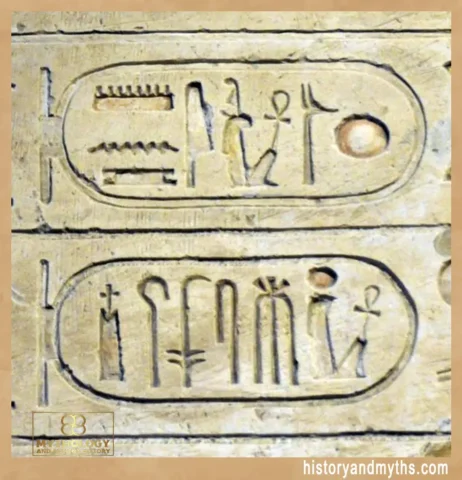
Renenutet’s influence extended beyond fields and granaries into the intimate space of human identity. Egyptians believed that every person received a ren—a name that carried not just recognition but the essence of destiny. To name someone was to anchor their place in the world. Renenutet was the goddess who bestowed and protected this identity.
This role reveals how the Egyptians understood fate. Destiny was not imposed from afar; it unfolded through the conditions of one’s life — nourishment, security, family, and opportunity. By connecting Renenutet to the ren, they linked survival with meaning. She provided the resources that sustained life and ensured that the individual who lived that life had a recognized, protected path.
Her partnership with Shai, the god of destiny, reflects this logic. Shai represented the framework of fate, while Renenutet safeguarded the circumstances that allowed it to take shape. Without nourishment, a child could not grow; without identity, a life could not be remembered. The Egyptians saw no separation between the physical and symbolic. Renenutet occupied the point where both converged.
This made her presence especially strong in rituals surrounding birth and early childhood. Her care was not dramatic; it was foundational. She ensured that a child survived long enough for destiny to matter and that the identity they were given remained guarded throughout their life.
By tying Renenutet to the formation of the ren, Egyptians turned her into a keeper of both nourishment and narrative — the one who watched over the body and the story it was meant to live.
Fields, Granaries, and the Economics of Trust: Renenutet in the Structure of Daily Life
Egypt’s agricultural system was precise, almost mathematical. The Nile’s flood determined the planting season; the harvest determined a family’s survival; and the granaries determined the kingdom’s stability. Within هذا الإطار، Renenutet was not simply a symbolic presence — she was woven into the mechanisms that kept society functioning.
Granaries were more than storage spaces; they were the backbone of Egypt’s economy. Taxes were collected in grain, wages paid in grain, offerings made in grain. The security of these stores meant the security of the state itself. Renenutet, as guardian of the fields and keeper of the full granary, became a spiritual guarantee that this system would hold together.
Her festivals and rituals often took place at the moment when risk was highest — the transition from harvest to storage. This was the point when a year’s labor could vanish through pests, rot, or misfortune. Invoking Renenutet was a way of acknowledging the vulnerability of abundance. The Egyptians understood that wealth was not measured at harvest; it was measured by what survived long enough to feed the people.
Through this role, Renenutet shaped the emotional relationship Egyptians had with work. Labor was not only productive; it was sacred. To tend a field was to partner with a goddess who ensured that effort would not be wasted. To store grain was to entrust the year’s sustenance to a vigilant guardian. And because she was associated with both nourishment and destiny, Egyptians saw her as the one who protected the conditions that made any future possible.
This practical form of spirituality — grounded in the rhythm of work, not the spectacle of myth — is what elevated Renenutet from a “harvest goddess” to a stabilizing force in Egyptian life.
Key Insights on Renenutet
- Renenutet embodied the Egyptians’ deepest anxiety: the fear that a year’s labor could vanish at the moment of harvest.
- Her cobra form symbolizes vigilance and controlled protection rather than threat — rooted in real agricultural observation.
- As giver of the ren (name), she shaped identity and destiny, linking nourishment with personal meaning.
- Her worship was tied to practical survival — granaries, household shrines, and transition moments between harvest and storage.
- The transformation into Thermouthis in the Greek–Roman period shows the universal relevance of her role in safeguarding prosperity.
- She represents a rare fusion of physical care and symbolic guardianship, protecting both the body and the narrative of a life.
From Renenutet to Thermouthis: How the Goddess Evolved Across Empires
When Egypt entered the Greek and later the Roman world, many of its deities were reinterpreted through new languages and new cultural expectations. Renenutet was one of the goddesses who adapted most naturally to this transformation. Her identity as guardian of nourishment and protector of grain aligned perfectly with the Mediterranean world’s own agricultural concerns. As a result, she was not diminished — she was reshaped.
Under Greek influence, her name shifted to Thermouthis, and her image took on new symbolic elements. Instead of appearing only as a cobra or a woman with a serpent’s head, she was sometimes shown holding a cornucopia — the horn of plenty — a Greek emblem of prosperity. This was not a replacement of her Egyptian character but an expansion of it. The foreign symbolism emphasized abundance, while the original cobra form preserved vigilance and protection.
This evolution reflects the flexibility of Egyptian religion. Deities were not static figures locked into a single identity; they were living symbols capable of absorbing new meanings while keeping their core intact. For Renenutet, the transformation into Thermouthis highlighted the universal value of the role she played. Every society feared scarcity, relied on agriculture, and understood that survival required both luck and care. Her appeal crossed political boundaries because her function was rooted in human necessity.
But even as her imagery changed, her essence remained the same. She continued to represent the moment when effort becomes sustenance, when vulnerability becomes security. Whether guarding the granaries of the Nile Valley or appearing as a symbol of plenty in the Hellenistic world, Renenutet carried forward the same quiet promise: that nourishment could be protected, and that life, through steady guardianship, would endure.
This final phase of her evolution shows why she persisted through centuries of cultural change. She was not tied to a single myth but to a universal human need — the assurance that what we cultivate will not be lost.
Key Takeaways
- Renenutet embodied the foundation of Egyptian survival: nourishment protected through vigilance.
- Her cobra symbolism reflected real agricultural guardianship, not mythic danger.
- As giver of the ren, she shaped identity and destiny alongside physical well-being.
- Her worship grew from practical life — fields, granaries, and household rituals — rather than royal mythology.
- The shift to Thermouthis in the Greek–Roman world expanded her role into a universal emblem of prosperity.
- She represents a rare union of care and control, ensuring both the sustenance of the body and the continuity of a person’s story.
FAQ — Renenutet
1. Who is Renenutet in ancient Egyptian religion?
Renenutet is the goddess of nourishment, harvest protection, and the safeguarding of grain and household prosperity.
2. Why is Renenutet associated with a cobra?
The cobra symbolized vigilance and practical protection, reflecting how snakes guarded fields and grain stores from pests.
3. What is Renenutet’s role in identity and destiny?
She was believed to give the ren—the personal name that shaped a child’s identity and guided their life path.
4. Where was Renenutet worshiped?
Her worship was strongest in the Faiyum region and in household shrines linked to grain storage and harvest rituals.
5. How did Renenutet’s image change in the Greek–Roman period?
She became known as Thermouthis and was often shown with a cornucopia, emphasizing abundance and prosperity.
6. What made Renenutet important in daily life?
She protected the harvest, ensured stored grain remained safe, and shaped the destiny and well-being of children.
7. Did Renenutet appear in major myths?
Her influence was practical rather than mythic, rooted in daily survival instead of narrative cycles.
8. What does her name mean?
Her name relates to “nursing” or “giving,” reflecting her role in providing sustenance and identity.
Sources & Rights
- Wilkinson, Richard H. The Complete Gods and Goddesses of Ancient Egypt. Thames & Hudson.
- Pinch, Geraldine. Egyptian Mythology: A Guide to the Gods, Goddesses, and Traditions of Ancient Egypt. Oxford University Press.
- Hart, George. The Routledge Dictionary of Egyptian Gods and Goddesses. Routledge.
- Teeter, Emily. Religion and Ritual in Ancient Egypt. Cambridge University Press.
- Lesko, Barbara S. The Great Goddesses of Egypt. University of Oklahoma Press.
- Frankfort, Henri. Kingship and the Gods. University of Chicago Press.
Written by H. Moses — All rights reserved © Mythology and History