Mut, Egypt’s Supreme Mother Goddess and the Heart of the Theban Triad
In ancient Egypt, the idea of divine motherhood was more than tenderness or protection it was a source of cosmic authority. At the heart of this idea stood Mut, the great mother of Thebes, a goddess whose power shaped kingship, ritual, and theology for centuries. To her followers, Mut was not simply a nurturing figure. She was the embodiment of strength wrapped in calm, a mother who defined order rather than reacting to it.
Mut emerged as a local deity, but when Thebes rose to prominence, she transformed into one of the most influential figures in Egyptian religion. As the consort of Amun and mother of Khonsu, she completed the Theban Triad, a divine family that mirrored the political and spiritual identity of the city. Through this triad, Mut became the goddess who validated rule, stabilized society, and connected the king to the eternal rhythms of creation.
Her image often serene, crowned, and composed hides a deeper truth: Mut’s motherhood was not passive. It was a form of cosmic governance. She absorbed aspects of other goddesses when needed, shifting between compassion and fierce protection. And in the great festivals of Thebes, she moved at the center of processions that renewed the king’s life-force and reaffirmed Egypt’s place in the universe.
Understanding Mut means understanding how the Egyptians imagined balance, power, and divine motherhood. She is where tenderness meets authority and where politics meets myth.
Who Is Mut? The Rise of Egypt’s Great Divine Mother
Mut occupies a unique place in Egyptian religion not as a goddess of a single domain, but as a complete embodiment of divine motherhood, power, and royal legitimacy. Her name simply means “Mother”, a title that suggests universality rather than limitation. For the Egyptians, Mut was not just a mother of one god or one region. She represented the ideal form of motherhood itself: protective, stabilizing, and essential to the order of creation.
In the earliest periods, Mut appears only locally in Thebes, without a grand mythology or wide national presence. But this local origin is precisely what made her rise remarkable. As Thebes transformed into the spiritual and political heart of Egypt especially during the Eighteenth Dynasty Mut rose with it. Her identity expanded from a local mother goddess into a pillar of the state religion.
Unlike deities defined by specific powers like fertility, war, or magic, Mut held authority through presence. Her strength came from being the silent center of divine order a mother who does not simply nurture but defines and upholds the structure surrounding her. When she was paired with Amun, the hidden creator, and Khonsu, the youthful lunar god, the resulting Theban Triad became a symbol of stability: creation, motherhood, and renewal.
Mut’s role therefore cannot be reduced to mythology alone. She became a theological anchor, a goddess whose symbolism supported kingship, ritual, and the identity of Thebes itself.
| Aspect | Details |
|---|---|
| Name Meaning | “Mut” simply means “Mother,” indicating universal motherhood |
| Primary Role | Goddess of divine motherhood, royal legitimacy, and cosmic order |
| Divine Family | Part of the Theban Triad: Amun (consort) and Khonsu (son) |
| Cult Center | The Mut Precinct at Karnak, Thebes |
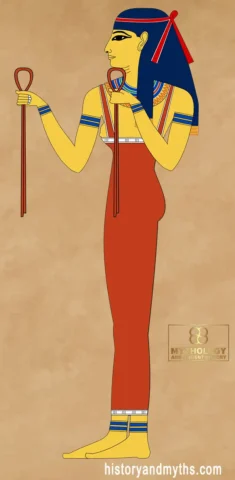
| Iconography | Woman with vulture headdress; sometimes double crown; serene, royal |
| Symbolic Nature | Motherhood as stability, authority, and cosmic structure |
| Festivals | Major presence in the Opet Festival alongside Amun and Khonsu |
| Archaeology | Large statue collections at Mut District; strong ties with Sekhmet statues |
| Historical Peak | New Kingdom (especially 18th Dynasty) during Theban dominance |
| Legacy | Enduring symbol of cosmic motherhood and state stability |
Origins: Mut Before Thebes Became the Heart of Egypt
Long before Mut stood at the center of Theban power, she existed as a quieter, more localized deity a mother figure whose presence was acknowledged but not yet elevated to a national scale. Unlike other goddesses whose identities were shaped early through complex myths or temple traditions, Mut’s origin was intentionally understated. She was not a goddess of dramatic narratives; she was a concept waiting for its moment to rise.
Early references suggest that Mut embodied a form of primordial motherhood, not tied to a single myth but to the idea of cosmic structure. In these early contexts, she represented completeness a mother not defined by childbirth alone, but by the capacity to contain and generate order. This abstract sense of motherhood, rather than a specific myth, is what made her so adaptable as Egypt’s religious landscape changed.
When Thebes was still a regional center, Mut’s identity remained simple. She was “the Mother,” a goddess whose authority came from essence rather than action. There is little evidence of temples or widespread cults dedicated to her in the earliest periods, which has led scholars to believe that Mut’s power was initially symbolic rather than institutional.
This early simplicity became her greatest advantage.
As political and theological power shifted toward Thebes during the Middle and New Kingdoms, Mut’s identity flexible, broad, and deeply rooted in the idea of motherhood allowed her to expand without conflict. She was not tied to a specific mythological lineage or regional narrative. She could become anything Egypt needed her to be.
Thus, by the time Thebes emerged as the center of royal and religious authority, Mut was perfectly positioned to evolve alongside it, rising from a local maternal figure into one of the most important goddesses in the entire Egyptian pantheon.
Mut and the Rise of the Theban Triad
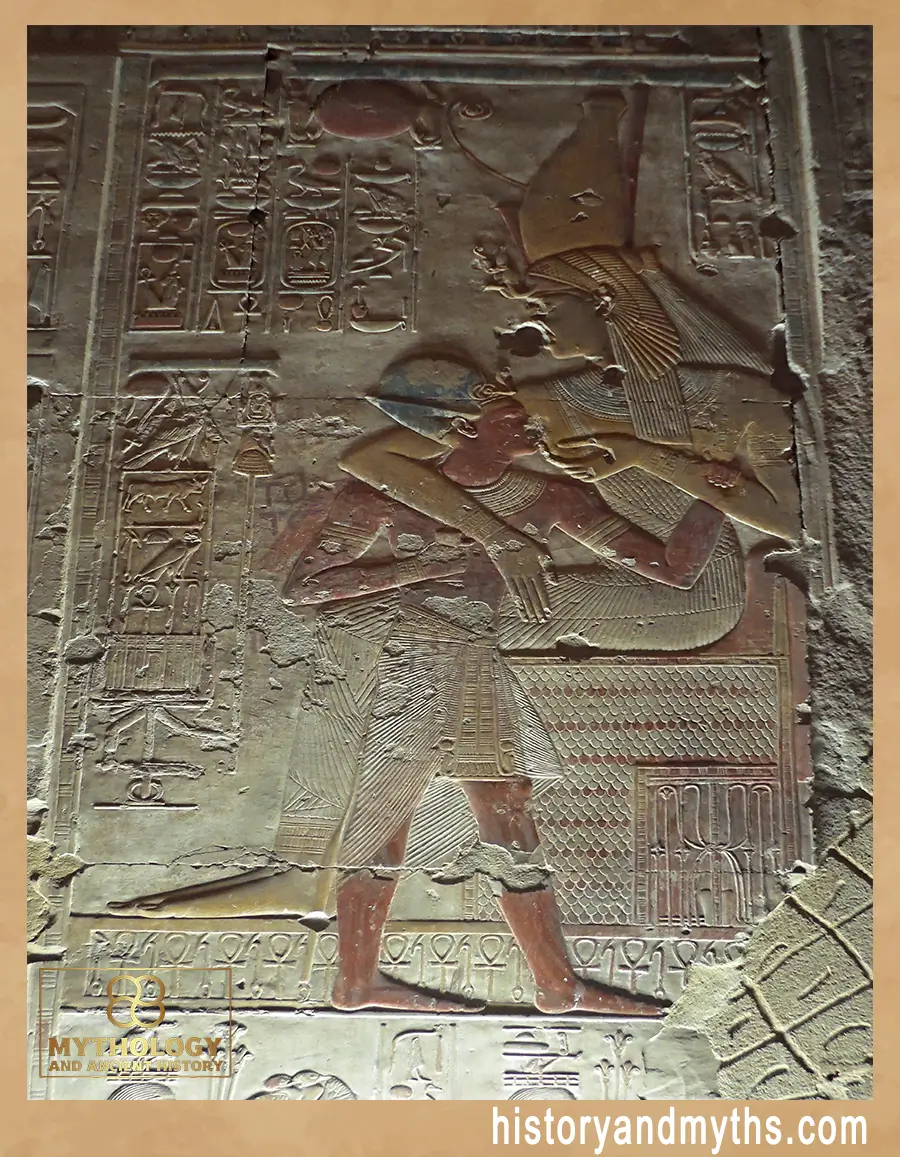
Mut’s transformation from a local mother figure into a national deity happened in parallel with the rise of Thebes as the political and spiritual heart of Egypt. When the Theban rulers of the Eighteenth Dynasty unified the country and established one of the most powerful periods in Egyptian history, their gods rose with them and none more significantly than Amun and his divine family.
At the center of this new religious order stood the Theban Triad:
- Amun, the transcendent creator;
- Mut, the great mother;
- Khonsu, the youthful lunar god.
This triad was more than a symbolic grouping. It represented a theological system, a divine family that mirrored the identity and aspirations of Thebes. Amun symbolized hidden cosmic authority, Khonsu represented renewal and time, and Mut embodied the order and protection that held the universe and the state together.
Mut’s elevation within this triad was not accidental. As Amun became the most powerful god in Egypt, surpassing even Ra in influence, his consort needed to reflect the grandeur of his position. Mut, with her broad, adaptable identity and her association with cosmic motherhood, was the perfect counterpart. She became not just a mother goddess, but the Mother of the God, the one through whom divine legitimacy flowed.
This new role placed Mut at the heart of royal and religious ceremonies. Kings and priests invoked her blessing to confirm dynastic continuity. Her presence in the triad helped reinforce the idea that Thebes was not merely a political center it was a sacred one, protected and nurtured by a divine family whose authority extended across the entire land.
The rise of the Theban Triad redefined Mut’s identity forever. She was no longer a local maternal figure. She had become the spiritual backbone of the greatest religious power Egypt had ever known.
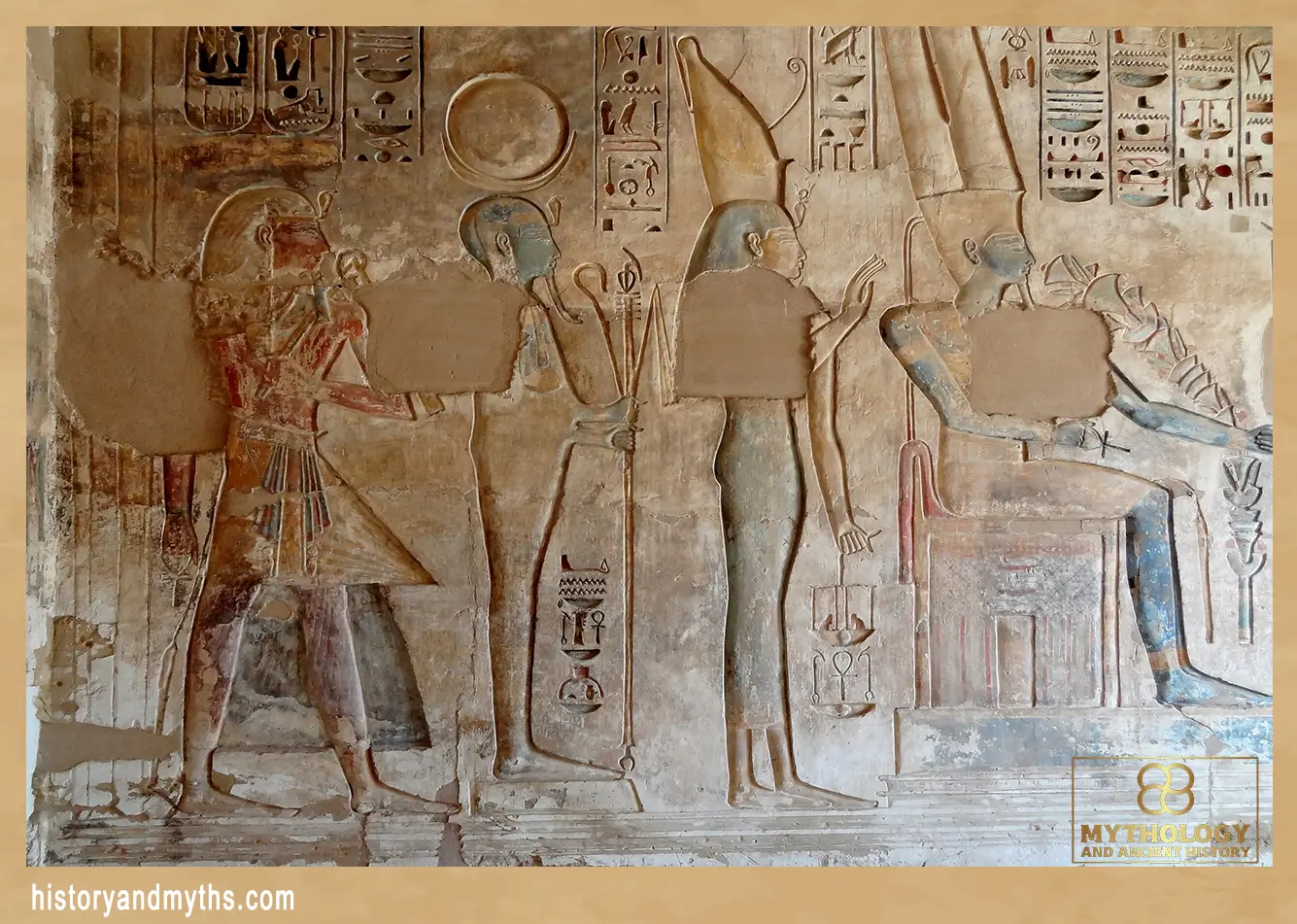
The Symbolism of Mut: Motherhood as Power, Order, and Divine Stability
Mut’s significance in Egyptian religion cannot be understood simply through the lens of maternal affection. To the ancient Egyptians, motherhood was a cosmic force, a source of authority that shaped the structure of the world. Mut embodied this force with a depth that few other deities achieved.
1. Motherhood as a Foundation of Order
In Egyptian belief, the world was constantly threatened by chaos. Motherhood in the divine sense was the stabilizing force that kept chaos at bay. Mut’s name, meaning simply “Mother,” reflects this foundational role. She was not the mother of one god; she was the principle of motherhood itself, the archetype through which order could be maintained.
Her presence in the Theban Triad reinforced this idea: where Amun embodied hidden creative power, Mut represented the structure that gave that power form.
2. Mut as the “Queen Mother” of Thebes
Unlike Hathor, whose motherhood is joyful and nurturing, or Isis, whose motherhood is defined by devotion and struggle, Mut’s motherhood is royal. She is often depicted wearing the double crown or vulture headdress symbols associated with queenship and sovereignty.
For Egyptians, this was more than decoration.
Mut’s motherhood validated kingship itself.
To be born under her protection was to be part of a cosmic lineage.
3. The Balance of Gentleness and Fierce Protection
Though usually depicted as calm and composed, Mut could assume more powerful forms when needed. At times she was associated with Sekhmet, the lioness goddess of destruction, showing that motherhood for the Egyptians was not weakness it could be fiercely protective when the order of the world was threatened.
This dual nature made Mut a complete goddess of motherhood: the nurturer and the guardian, the serene and the formidable.
4. Motherhood as Permanence
Mut’s identity changed very little over thousands of years. While other deities evolved dramatically across dynasties, Mut remained grounded in her essential role. To the Egyptians, this constancy reflected a deeper truth: motherhood is not a story. It is an eternal state.
This stability is why Mut could function as the cosmic mother, the royal mother, and the protective mother without contradiction.
5. A Symbol for Society, Not Only Religion
Mut’s symbolism extended beyond temples. She represented the ideal structure of Egyptian life family, authority, continuity, and protection. As a result, she became a philosophical model for the state itself:
a stable society requires a stable mothering force to preserve order.
What Does Mut Reveal About Egyptian Ideas of Power?
Mut reveals that the ancient Egyptians understood power as something sustained rather than imposed. While many civilizations celebrated rulers through conquest or military strength, Egyptian religious thought emphasized that lasting authority depended on stability, continuity, and the preservation of Ma’at.
This explains why Mut appears so frequently beside kings and major state rituals.
Seen from this perspective, Mut represents one of the clearest expressions of Egyptian political theology, where motherhood became a symbol of enduring authority rather than only family or fertility.
Mut vs Hathor vs Isis vs Sekhmet: What Makes Mut a Different Kind of Mother Goddess?
Egyptian mythology contains many powerful mother figures, each shaping a different aspect of femininity, creation, and authority. Yet Mut holds a role distinct from them all not because she is more nurturing or more fierce, but because her motherhood expresses a unique state of being rather than a mythic story.
Below is how Mut compares to Egypt’s most notable goddesses:
Mut — Motherhood as Authority and Structure
- Mut is the archetype of motherhood, the “Mother” in a universal sense.
- Her identity is stable and unchanging she is mother not through myth, but through nature.
- She represents order, legitimacy, and sovereignty.
- Her motherhood is inherently royal, linked to kingship and divine governance.
Mut does not depend on a story to justify her position; she is a philosophical truth within Egyptian cosmology.
Hathor — Motherhood as Joy and Nourishment
- Hathor is the goddess of music, beauty, joy, and maternal warmth.
- Her motherhood is emotional and celebratory.
- She embodies fertility, love, and the life-affirming aspects of femininity.
Where Mut stabilizes the cosmos, Hathor uplifts it emotionally.
Isis — Motherhood as Devotion and Magic
- Isis’s motherhood is defined through narrative: her search for Osiris, protection of Horus, and mastery of magic.
- She represents resilience, protection, and the personal side of divine motherhood.
- While Mut symbolizes order, Isis symbolizes care and determination.
Isis is the mother who fights, suffers, and prevails a dramatic contrast to Mut’s serene authority.
Sekhmet — Motherhood as Power and Destruction
- Sekhmet is the lioness goddess of war, fire, and plague.
- When linked to motherhood, she represents the fierce, destructive force that protects through domination.
- Mut is occasionally associated with Sekhmet, but only as an aspect never her full identity.
Sekhmet is motherhood sharpened into a weapon; Mut is motherhood stabilized into cosmic strength.
What Makes Mut Unique?
The comparison reveals something important:
Mut is not a “mother in a story” she is the mother in the structure of the universe.
- She does not love like Hathor.
- She does not fight like Isis.
- She does not rage like Sekhmet.
She grounds the divine world and gives legitimacy to kings, stability to ritual, and meaning to Theban identity.
This philosophical nature is precisely why Mut became the central goddess of Thebes at the height of its power.
Mut in Festivals: Her Central Role in the Opet Ceremony
If Amun embodied hidden cosmic power and Khonsu represented cyclical renewal, then Mut was the force that held both together. Nowhere is this clearer than in the Opet Festival, one of the most important religious celebrations in ancient Egypt. During this grand event, Mut was not a background presence she was a cornerstone of the ritual logic that renewed kingship and restored cosmic order.
1. The Purpose of the Opet Festival
The Opet Festival took place annually between Karnak and Luxor Temple, a journey symbolizing the rejuvenation of the king’s divine essence.
The core belief was simple yet profound:
The king is reborn through the union of Amun and Mut.
Where many festivals honored individual gods, Opet was entirely about regeneration of royal legitimacy. Mut’s role was essential because motherhood was understood as the source of rightful rebirth not biological motherhood, but cosmic motherhood.
2. Mut as the Divine Mother Who Recreates Kingship
During Opet, Mut’s image was transported alongside Amun and Khonsu in sacred barges. Her presence represented:
- The womb of divine authority
- The force that reaffirms the king’s connection to Amun
- The stability that allows creation and monarchy to continue
The Egyptians saw Mut not as a passive escort to Amun, but as the goddess who makes renewal possible.
3. Ritual Scenes Emphasizing Mut’s Power
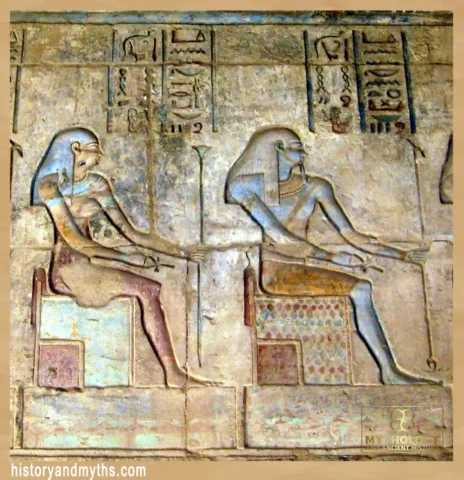
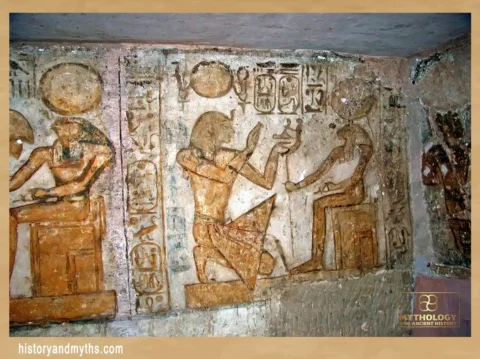
Temple reliefs especially in Luxor Temple depict Mut receiving offerings from the king during Opet. These scenes do more than honor her; they re-enact the theological truth that Mut’s motherhood confers legitimacy.
The king does not simply worship Mut.
He seeks renewal through her.
4. Mut’s Relationship to Amun and Khonsu in the Festival
The Theban Triad operated as a symbolic life cycle:
Amun → hidden creative force
Mut → structuring, legitimizing motherhood
Khonsu → renewal, time, celestial order
During Opet, this cycle became a ritual reality.
Mut was the link that allowed divine power to move from the invisible (Amun) to the visible (the king), stabilizing both cosmos and kingdom.
5. Opet as a Reflection of Mut’s Character
The festival reveals something essential about Mut:
She is not a goddess of emotional motherhood, but institutional motherhood
the motherhood that sustains kingdoms, not households.
Mut’s presence in Opet affirmed that the world continued because the bonds between creation, rule, and order remained intact.
Mut in Art and Archaeology: How Egypt Visualized the Great Divine Mother
While Mut’s theological power shaped royal ritual and state ideology, her presence in art reveals another layer of her identity one that combines royal symbolism, maternal authority, and the quiet strength that defined her role in Thebes. Egyptian artists did not portray Mut through dramatic scenes or mythic narratives; instead, they captured her essence through calm, composed iconography that reflected stability above all.
1. Iconic Features: How Mut Appears in Egyptian Art
Mut is typically depicted as:
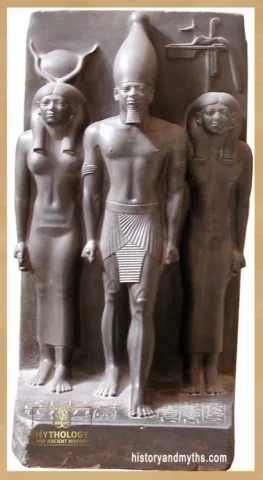
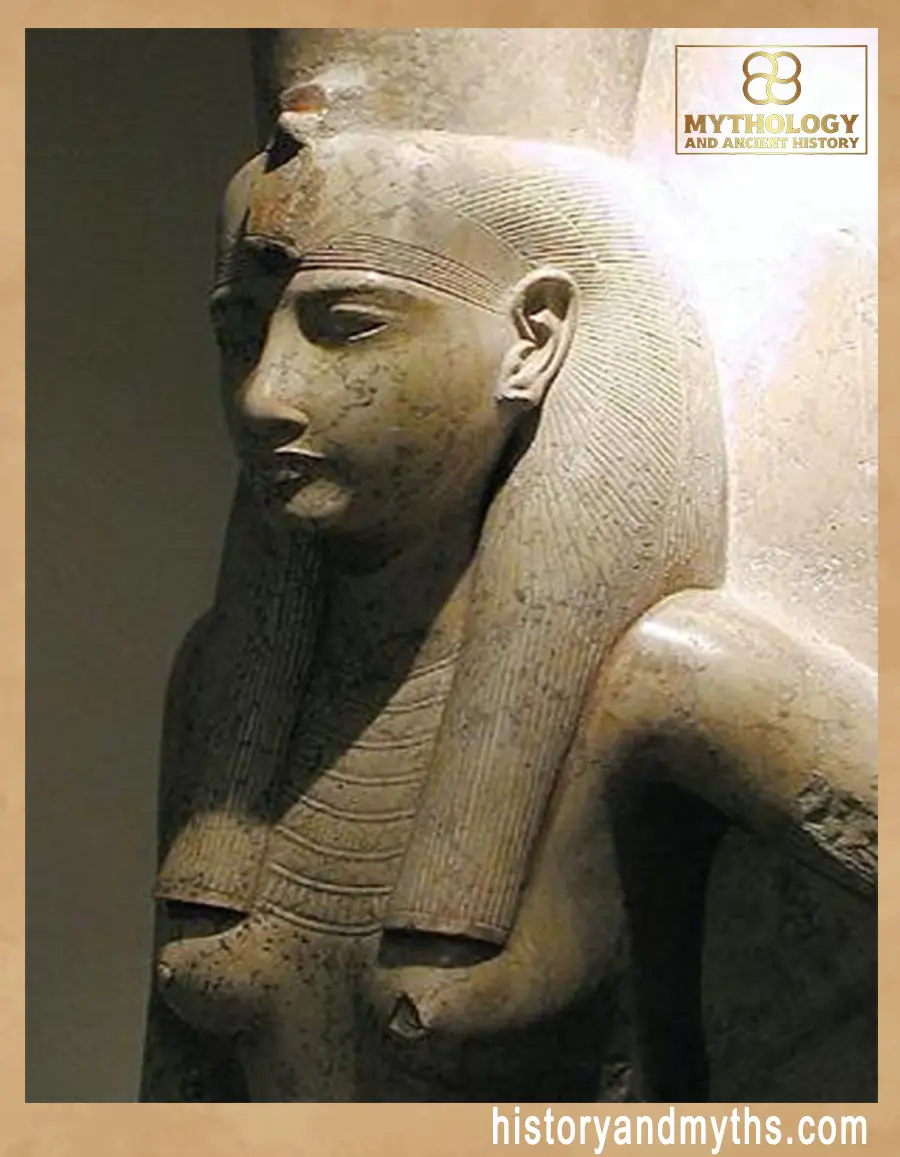
- A woman wearing the vulture headdress, symbol of queenship and divine motherhood.
- Sometimes crowned with the double crown (Pschent), linking her to unified Egypt.
- Frequently seated on a throne, emphasizing her status as a divine queen rather than a mythic heroine.
- Occasionally shown with wings, reinforcing her protective nature.
The vulture headdress is especially important. In Egyptian belief, the vulture was a protective mother a silent, watchful guardian. Mut inherited and elevated this symbolism, turning it into an emblem of state-level protection.
2. The Mut District at Karnak: Her Most Important Archaeological Site
One of the most significant archaeological areas dedicated to a goddess in Egypt is the Mut Precinct (the Mut District) in Karnak.
This vast complex included:
- A massive crescent-shaped sacred lake known as Isheru
- Temples dedicated to Mut and her manifestations
- Hundreds of statues, especially of Sekhmet, linked to Mut during powerful forms
The presence of so many Sekhmet statues has led scholars to believe that Mut sometimes absorbed fierce aspects when political or cosmic balance required it.
3. Why So Many Sekhmet Statues Are Found Here
The Mut Precinct contains one of the world’s largest collections of statues of Sekhmet the lioness goddess of wrath and healing.
This is not random. It reflects a theological truth:
When Mut needed to protect order, she could manifest as a form of Sekhmet the fierce mother who defends the world.
In art, this dual identity remained subtle, but archaeologically it is impossible to ignore.
4. Mut in Temple Reliefs: Authority Through Stillness
Reliefs from Karnak, Luxor, and Deir el-Bahari show Mut receiving offerings from kings or standing alongside Amun and Khonsu. What makes these scenes unique is their lack of motion. Mut is rarely shown performing an action. She embodies:
- Stability
- Permanence
- The quiet power of a queen who needs no spectacle to be obeyed
This artistic stillness reinforces her theological identity as the grounding force of the Theban Triad.
5. A Goddess of Presence, Not Performance
Unlike Isis, who appears in dramatic scenes of resurrection, or Hathor, who appears in joyful, musical imagery, Mut’s artistic presence is restrained.
But this restraint is deliberate.
Mut’s power lies not in mythic feats, but in:
- Legitimizing kingship
- Stabilizing divine order
- Representing the eternal mother of the state and cosmos
Artists captured this through symmetrical, balanced portrayals that emphasize serenity and authority.
Mut — The Divine Mother of Thebes
Mut embodies the highest form of divine motherhood in ancient Egypt.
More than nurturing or fertility, her power reflects structure, authority,
and the cosmic order that stabilizes both the heavens and the state.
As the consort of Amun and mother of Khonsu, she stands at the heart of the Theban Triad —
a symbol of legitimacy, protection, and the enduring strength of creation.
- Represents cosmic motherhood and royal legitimacy.
- Central figure in the Theban Triad with Amun and Khonsu.
- Key presence in the Opet Festival, renewing the king’s divine essence.
- Iconography emphasizes stability and queenship over dramatic action.
- Target of one of the largest temple complexes dedicated to a goddess: the Mut Precinct.
© historyandmyths.com — Educational use
The Decline and Legacy of Mut: From State Goddess to Enduring Symbol
As Egypt entered the Late Period and later the Ptolemaic and Roman eras, its religious landscape grew more diverse and increasingly syncretic. New cults rose in influence, older traditions blended with foreign beliefs, and political fragmentation altered the balance of power among local priesthoods. In this shifting environment, Mut’s role began to change not through disappearance, but through transformation.
1. The Shift from Theban Dominance
Mut’s greatest prominence came when Thebes was the core of political and religious authority.
As that dominance weakened in the Late Period, the prominence of the Theban Triad naturally declined.
New religious centers such as Memphis and Philae grew in importance, and their deities filled roles that once belonged to Amun, Mut, and Khonsu.
But Mut did not vanish.
Her precinct remained active, and her name continued to appear in inscriptions and liturgies, especially those that emphasized divine motherhood and cosmic order.
2. Mut in the Ptolemaic Era: A Goddess Preserved by Theology
In the Ptolemaic period, Egyptian religion absorbed Greek influences, reshaping many gods into hybrid forms. Isis became Hellenized, Hathor merged with Aphrodite in some regions, and even Amun was reinterpreted through different cultural lenses.
Yet Mut remained largely unchanged.
She was not merged with Greek goddesses nor reimagined for new myths.
Her identity as the eternal mother, the stabilizing force was too rooted in Egyptian cosmology to be altered.
Priests of Thebes preserved her in hymns, temple rituals, and philosophical texts, keeping her role intact even as other gods evolved.
3. Persistence Through Ritual, Not Popular Worship
By the Roman era, public devotion shifted heavily toward Isis, Serapis, and regional cults. Mut’s worship was no longer widespread among the general population.
However, she survived through:
- Temple liturgies
- Ritual inscriptions
- The ongoing maintenance of the Mut Precinct
- The theological structure of the Theban Triad
These elements allowed her identity to endure even after Egypt’s temples began to decline.
4. Mut as a Symbol Beyond Religion
When scholars today study Egyptian concepts of motherhood, queenship, or political legitimacy, Mut becomes a central figure.
She represents an idea that transcends myth:
Motherhood not as emotion, but as cosmic architecture.
Her legacy lies in defining what divine motherhood meant in the world’s oldest continuous religious system.
5. Why Mut Matters Today
Modern audiences often remember Isis or Hathor first, but Mut offers something different a lens for understanding how Egyptians viewed:
- Authority
- Stability
- The relationship between goddess and state
- The sacred foundation beneath kingship
Mut endures because she represents the idea that power is not always loud or dramatic.
Sometimes it is quiet, foundational, and essential like the mother who holds the world together.
Key Takeaways — Mut
- Mut is the supreme divine mother of Thebes, symbolizing cosmic stability and authority.
- Central member of the Theban Triad with Amun and Khonsu.
- Her motherhood represents order rather than emotion, grounding kingship and ritual.
- Key figure in the Opet Festival, where the king’s divine essence was renewed.
- Her iconography emphasizes queenship, protection, and permanence.
- One of Egypt’s most important goddess precincts, the Mut District, was dedicated to her at Karnak.
© historyandmyths.com — Educational use
Frequently Asked Questions about Mut
Who is Mut in ancient Egyptian mythology?
Mut is the great divine mother of Thebes, representing cosmic order, royal legitimacy, and the stabilizing force of creation.
What is Mut’s role in the Theban Triad?
Mut is the consort of Amun and the mother of Khonsu, forming the central triad of Thebes that symbolized creation, motherhood, and renewal.
Why was Mut important in the Opet Festival?
Mut’s presence enabled the ritual rebirth of the king, reaffirming his divine connection to Amun and ensuring the continuation of cosmic order.
How is Mut depicted in Egyptian art?
She is usually shown wearing the vulture headdress or double crown, often seated with serene authority, emphasizing queenship and protection.
What is the Mut Precinct at Karnak?
The Mut Precinct is a major temple complex dedicated to the goddess, featuring the Isheru lake and hundreds of statues linked to her power.
How does Mut differ from Isis, Hathor, and Sekhmet?
Unlike these goddesses, Mut represents motherhood as cosmic structure and political authority, not emotion, magic, or destructive power.
Did Mut’s worship decline in later periods?
Her public worship decreased as Thebes lost dominance, but her theological role remained strong in temple rituals and priestly traditions.
Sources & Rights
- Allen, James P. Middle Egyptian: An Introduction to the Language and Culture of Hieroglyphs. 3rd ed. Cambridge University Press, 2014.
- Assmann, Jan. The Search for God in Ancient Egypt. Cornell University Press, 2001.
- Assmann, Jan. Death and Salvation in Ancient Egypt. Cornell University Press, 2005.
- Hart, George. A Dictionary of Egyptian Gods and Goddesses. Routledge, 2005.
- Hornung, Erik. Conceptions of God in Ancient Egypt: The One and the Many. Cornell University Press, 1996.
- Lesko, Barbara S. The Great Goddesses of Egypt. University of Oklahoma Press, 1999.
- Pinch, Geraldine. Egyptian Mythology: A Guide to the Gods, Goddesses, and Traditions of Ancient Egypt. Oxford University Press, 2004.
- Quirke, Stephen. The Cult of Ra: Sun Worship in Ancient Egypt. Thames & Hudson, 2001.
- Teeter, Emily. Religion and Ritual in Ancient Egypt. Cambridge University Press, 2011.
- Wilkinson, Richard H. The Complete Gods and Goddesses of Ancient Egypt. Thames & Hudson, 2003.
- British Museum. Collection Online: Mut, Amun, and the Theban Triad.
- The Metropolitan Museum of Art. Heilbrunn Timeline of Art History: Ancient Egyptian Religion.
- UCLA Encyclopedia of Egyptology. Theban Theology and State Religion in Ancient Egypt.
- Digital Egypt for Universities (University College London). Thebes, Karnak, and the Cult of Mut.
- World History Encyclopedia. Mut.
Written by H. Moses — All rights reserved © Mythology and History