Punishments in the Afterlife — Ancient Egyptian Belief
In ancient Egyptian belief, punishment in the afterlife was not designed to inflict endless pain, nor to satisfy divine anger. Its purpose was far more precise: to prevent chaos from entering eternity. Punishment existed as the consequence of moral failure, but it was framed around loss rather than suffering loss of continuation, loss of identity, and loss of place within the ordered universe.
Unlike later concepts of eternal hell, Egyptian texts describe punishment as exclusion from life itself. Those who failed judgment were not sentenced to perpetual torment; they were denied the rewards that made eternal existence possible. Annihilation, erasure, or what modern scholars call the “second death” marked the ultimate consequence. In this system, the absence of life—not the presence of pain—was the true punishment.
Understanding punishment this way reveals a consistent moral logic. The afterlife was meant to preserve maat, not to mirror human cruelty. Justice functioned as a boundary: only those aligned with balance could continue, while those who threatened order were removed entirely. Punishment was therefore not an end in itself, but a mechanism that protected eternity from disorder.
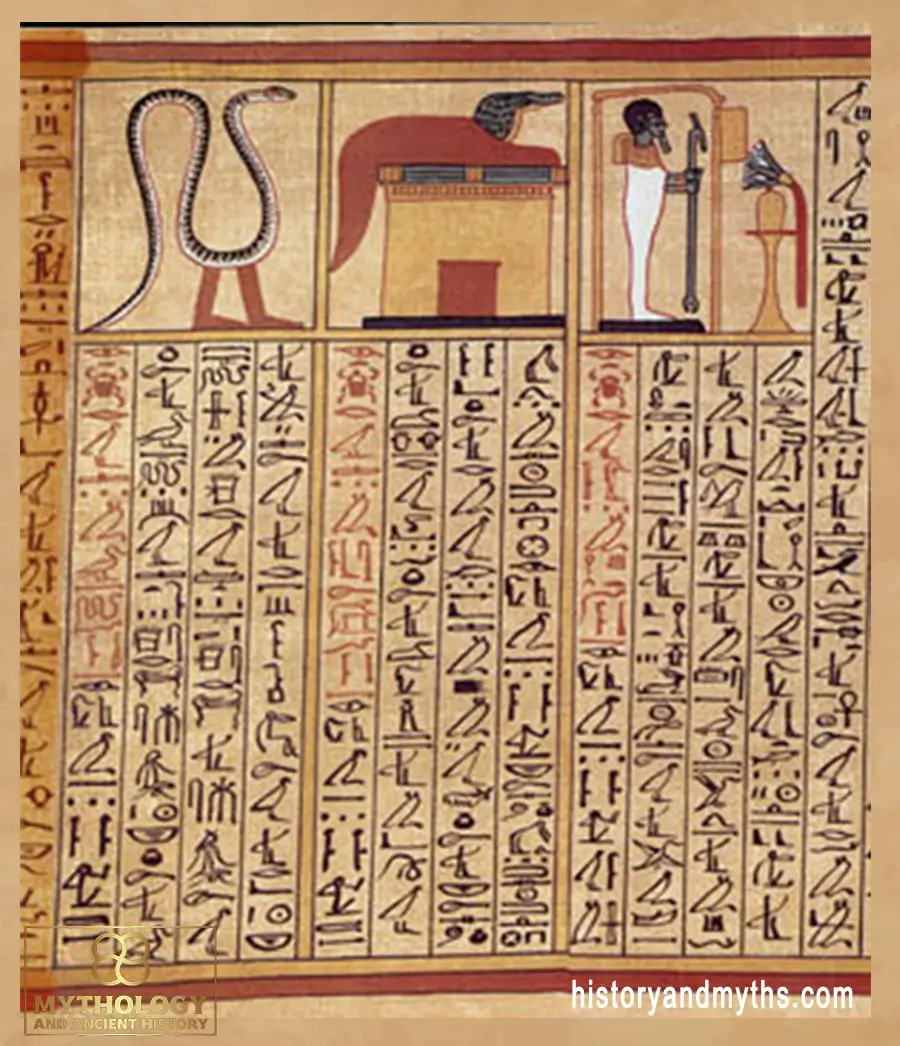
Source: British Museum via Wikimedia Commons — CC BY-SA 3.0
What Did Punishment Mean in the Egyptian Afterlife?
In ancient Egyptian belief, punishment did not mean torture. It meant failure—the failure to qualify for continued existence within maat. Punishment was defined by what was lost, not by what was inflicted. To be punished was to be denied the conditions that made eternal life possible: nourishment, recognition, protection, and place within the ordered cosmos.
This distinction is crucial. Egyptian texts rarely describe elaborate scenes of suffering. Instead, they emphasize exclusion. The condemned were barred from the Field of Reeds, cut off from offerings, and stripped of identity. Names could be erased, bodies rendered ineffective, and souls prevented from rejoining the rhythms of life. Punishment, in this sense, was the collapse of continuity.
Such outcomes served a clear purpose. The afterlife was imagined as a perfected system that could not tolerate instability. Allowing morally unbalanced individuals to persist would reintroduce chaos into eternity. Punishment therefore functioned as a protective boundary, ensuring that only those aligned with maat could continue beyond judgment.
By defining punishment as denial rather than pain, Egyptian belief framed justice as preventive and preservative. The goal was not to make the guilty suffer, but to remove disorder from the eternal order altogether. In this system, the most severe penalty was not agony—it was non-being.
| Form of Punishment | Description | Purpose |
|---|---|---|
| Denial of Provision | Cutting off food, water, offerings, and protection | To prevent continued existence after death |
| Erasure of Identity | Forgetting the name, loss of recognition and memory | To dissolve personal identity and continuity |
| Destruction of the Soul | Burning, dismemberment, or devouring by judgment beings | To ensure irreversibility and finality |
| Exclusion from Sacred Realms | Ban from Aaru, the divine presence, and eternal community | To protect the afterlife from disorder |
| Second Death | Complete annihilation and loss of all continuation | To permanently remove chaos from eternity |
Failure of Judgment: Loss, Erasure, and the Second Death
Failure at judgment did not result in endless torment; it resulted in loss. The condemned lost access to nourishment, protection, and belonging—the very conditions that sustained existence after death. Egyptian texts describe this outcome as erasure: the name forgotten, the body rendered powerless, and the soul denied continuation. This was not a dramatic punishment; it was a terminal one.
Modern scholars often refer to this fate as the “second death.” Unlike physical death, which marked a transition, the second death meant the end of all transitions. There was no return, no renewal, and no participation in the cycles that defined life and afterlife alike. Without offerings, without memory, and without a place in the ordered cosmos, the individual simply ceased to be.
This concept explains why Egyptians feared forgetting as much as judgment itself. Names preserved existence; remembrance activated offerings; continuity depended on recognition. To fail judgment was to fall outside these sustaining networks. The second death was therefore not violent, but absolute—a state where identity dissolved and time no longer applied.
By framing failure this way, Egyptian belief reinforced a clear moral logic. Eternal life was not guaranteed; it was earned and maintained. Those who threatened order were not punished within eternity—they were excluded from it. The second death ensured that eternity remained stable, uncontaminated by imbalance or injustice.
Forms of Punishment: Denial, Destruction, and Exclusion
Egyptian punishment in the afterlife took distinct forms, all centered on removing the conditions of existence rather than inflicting pain. These forms can be understood as denial, destruction, and exclusion—each representing a different way of preventing moral failure from entering eternity.
Denial was the most immediate form. The condemned were denied access to offerings, water, and protection. Without sustenance, the afterlife could not function. Texts emphasize the cutting off of food and drink because nourishment was not symbolic—it was existential. To deny offerings was to deny continued being.
Destruction went further. In some traditions, the condemned faced dismemberment, burning, or consumption by creatures of judgment. These acts did not aim to cause suffering; they ensured irreversibility. Destruction eliminated the possibility of return, rebirth, or repair. Once destroyed, the individual could no longer threaten order.
Exclusion was the most conceptually important form. The condemned were barred from sacred spaces—the Field of Reeds, the company of the justified, and the presence of the gods. Exclusion meant no place within the system. Without place, identity collapsed. To be excluded was to exist nowhere, and thus not at all.
Together, these forms show that punishment was systemic, not emotional. Each method removed a pillar of existence—provision, integrity, or belonging. The result was the same: non-continuation. Egyptian punishment was not about suffering inside eternity; it was about ensuring that eternity remained purely ordered.
Why Eternal Torture Was Not the Goal
Ancient Egyptian sources do not frame punishment as endless suffering. Unlike later religious models that emphasize perpetual torment, Egyptian belief focused on preserving order, not on punishing pain. Eternal torture would have required the continued existence of the condemned—exactly what the system sought to prevent.
Texts and images prioritize finality over duration. Scenes of burning, cutting, or devouring appear not to depict ongoing agony, but to signal termination. Once destroyed or erased, the condemned could no longer act, disrupt, or return. Pain, if present at all, was incidental; cessation was the objective.
This logic aligns with maat. An ordered eternity could not include beings who embodied imbalance. Maintaining a realm of endless torment would paradoxically sustain chaos forever. Egyptian justice avoided this contradiction by removing disorder entirely rather than housing it eternally.
Understanding this point corrects a common modern projection. Egyptian punishment was functional, not theatrical. It was designed to safeguard the afterlife’s stability by ensuring that only the justified continued. In this worldview, the gravest consequence was not suffering without end, but the end of existence itself.
Punishments in the Afterlife — At a Glance
- Core Idea: Punishment meant loss of continuation, not endless torture
- Trigger: Failure at judgment and separation from maat
- Main Forms: Denial of provision, erasure of identity, destruction, and exclusion
- Ultimate Outcome: “Second death” — annihilation and non-being
- Role of Beings: Monsters and demons functioned as agents, not the definition of punishment
- Purpose: Protecting eternity from chaos and preserving cosmic order
- Key Correction: Egyptian afterlife punishments differ from later ideas of eternal hell
© historyandmyths.com — Educational use
Punishment vs. Justice: Preserving Maat
In the Egyptian worldview, punishment was never separate from justice. Its sole purpose was to preserve maat—the balance that sustained both cosmos and society. Justice did not seek retribution; it sought stability. When judgment failed, punishment ensured that imbalance did not carry forward into eternity.
This explains why punishment targeted continuation, not sensation. Justice functioned as a gatekeeper: those aligned with maat were allowed to continue; those who threatened it were removed. By denying existence to disorder, the system protected the integrity of the afterlife. Punishment was therefore preventive, not vindictive.
Seen this way, Egyptian justice was restorative at the level of the universe. Rewards restored life in perfected form; punishment restored balance by eliminating what could not be reconciled. Both outcomes served the same end—an eternal order free from decay and injustice.
Understanding punishment as justice-in-action clarifies the moral coherence of Egyptian belief. Eternity was not a place where anything could happen; it was a realm carefully protected by boundaries. Punishment marked the line beyond which chaos could not pass, ensuring that the afterlife remained stable, fair, and complete.
Key Takeaways
- Egyptian punishment focused on loss and exclusion, not endless physical suffering.
- The gravest penalty was the “second death”—complete erasure and non-continuation.
- Denial of offerings, identity, and place removed the conditions of existence.
- Monsters and demons acted as agents; punishment was a system, not a spectacle.
- The aim of punishment was to preserve maat by keeping chaos out of eternity.
Frequently Asked Questions About Punishments in the Egyptian Afterlife
Did ancient Egyptians believe in eternal hell?
No. Ancient Egyptian belief did not include the idea of eternal hell. Punishment focused on loss of existence rather than endless suffering.
What happened to those who failed judgment?
Those who failed judgment were denied continuation. They lost access to offerings, identity, and eternal life, often facing what scholars call the “second death.”
What was the worst punishment in the Egyptian afterlife?
The worst punishment was complete annihilation or erasure—non-being rather than physical torment.
Were punishments physical or symbolic?
Punishments could appear physical in imagery, but their purpose was symbolic and final: to destroy continuity, not to cause prolonged pain.
What is the “second death” in Egyptian belief?
The second death refers to total destruction after judgment, where the soul ceased to exist and could not be reborn or remembered.
What role did monsters and demons play in punishment?
Monsters and demons acted as agents of judgment. They enforced punishment but did not define it.
How did punishment protect maat?
Punishment removed disorder from eternity, ensuring that only balanced and justified beings continued to exist.
Was punishment meant as revenge?
No. Egyptian punishment was preventive and corrective, designed to preserve cosmic order rather than inflict revenge.
Sources & Rights
- Allen, James P. The Ancient Egyptian Pyramid Texts. Princeton University Press, 2005.
- Allen, James P. Middle Egyptian: An Introduction to the Language and Culture of Hieroglyphs. Cambridge University Press.
- Assmann, Jan. Death and Salvation in Ancient Egypt. Cornell University Press.
- Assmann, Jan. The Search for God in Ancient Egypt. Cornell University Press.
- Faulkner, Raymond O. The Ancient Egyptian Book of the Dead. British Museum Press.
- Faulkner, Raymond O. The Ancient Egyptian Coffin Texts. Aris & Phillips.
- Hornung, Erik. The Ancient Egyptian Books of the Afterlife. Cornell University Press.
- Hornung, Erik. Conceptions of God in Ancient Egypt. Cornell University Press.
- Pinch, Geraldine. Egyptian Mythology: A Guide to the Gods, Goddesses, and Traditions of Ancient Egypt. Oxford University Press.
- Quirke, Stephen. Ancient Egyptian Religion. British Museum Press.
- Shaw, Ian (ed.). The Oxford History of Ancient Egypt. Oxford University Press.
- Taylor, John H. Death and the Afterlife in Ancient Egypt. British Museum Press.
- Teeter, Emily. Religion and Ritual in Ancient Egypt. Cambridge University Press.
- UCLA Encyclopedia of Egyptology.
- British Museum Collection Online.
- The Metropolitan Museum of Art, Heilbrunn Timeline of Art History.
Written by H. Moses — All rights reserved © Mythology and History