Solar Barque Explained — Ra’s Sacred Boat in Ancient Egypt
In ancient Egyptian thought, the universe did not remain stable by stillness—it survived through movement. Each day and night, the sun god Ra crossed sky and underworld aboard the solar barque, a vessel that was far more than a mythic image. It represented the mechanism by which time advanced, order renewed itself, and existence avoided collapse. Without motion, creation would stagnate; without the barque, motion itself would fail.
The solar barque was therefore not a decorative symbol attached to Ra, but the means by which cosmic continuity functioned. Egyptian texts consistently portray the sun as something that must travel, cross, and be conveyed. Light did not simply appear at dawn—it arrived because it had successfully moved through danger, resistance, and transformation. The barque embodied this principle: survival depended on passage, not permanence.
This logic extended beyond the god himself. The dead, having passed judgment, hoped not for static immortality but for continued movement within the cosmic system. To endure after death meant to align with the same process that carried the sun forward. The solar barque thus stood at the center of Egyptian cosmology, linking time, renewal, and survival into a single moving structure that kept both gods and humans from slipping into non-existence.
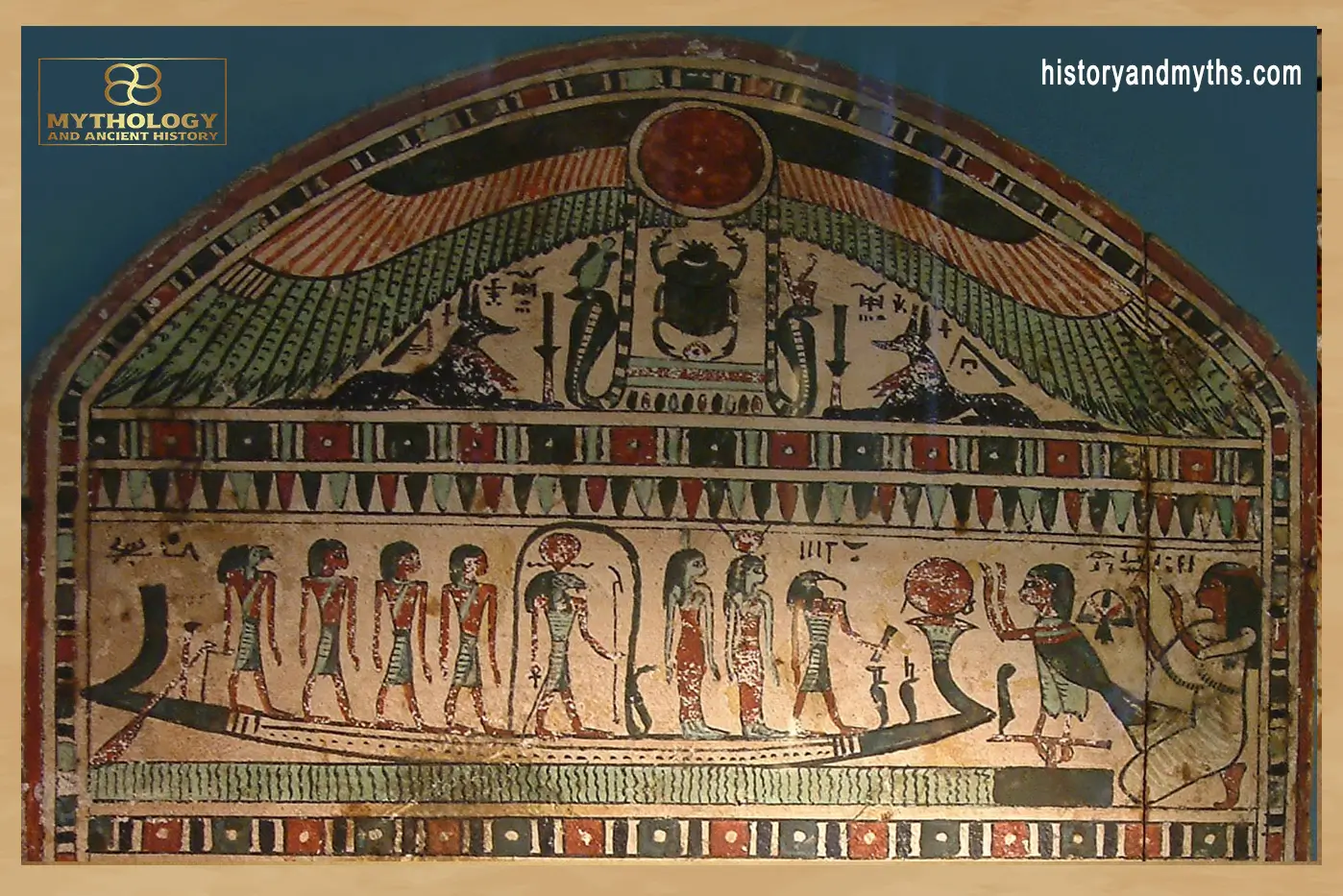
Source: Louvre Museum (Inv. N 2700), via Wikimedia Commons
Photographer: Guillaume Blanchard
License: GNU Free Documentation License (GFDL)
What Was the Solar Barque? More Than a Symbol
In Egyptian cosmology, the solar barque was not an artistic metaphor attached to the sun—it was the operational form of motion itself. Texts do not describe the sun as simply rising and setting; they insist that it travels, crosses, and is conveyed. The barque gave physical structure to this belief, turning abstract movement into a knowable, repeatable process.
A symbol usually points to something beyond itself. The solar barque did the opposite: it made movement visible and functional. Without a vessel, motion would be undefined—there would be no path, no direction, no continuity. The barque established boundaries for travel, transforming chaos into a navigable route. It defined where movement began, how it progressed, and where it could safely end.
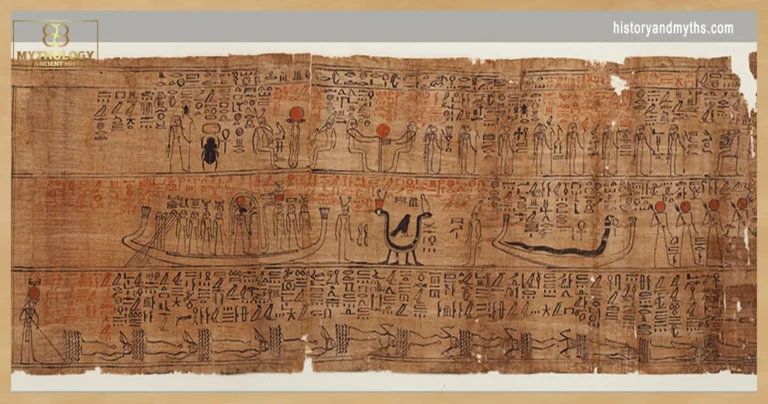
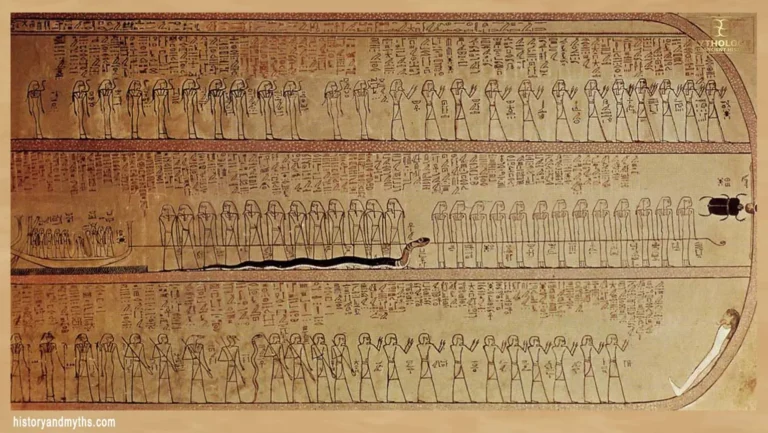
This explains why the barque appears consistently in funerary texts rather than only in temple art. In the Amduat and Book of Gates, the barque is shown moving through hostile regions, passing gates, and requiring cooperation. Movement here is conditional. It must be supported, defended, and maintained. The barque is the structure that allows this to happen night after night.
Seen this way, the solar barque functioned as a cosmic framework, not a decorative image. It answered a fundamental question in Egyptian thought: how does the universe continue without falling into stillness? The answer was not force or speed, but guided passage—movement that followed order. The barque was the embodiment of that principle.
| Aspect | Role of the Solar Barque | Cosmic Meaning |
|---|---|---|
| Movement | Carries the sun across sky and Duat | Prevents stagnation and cosmic collapse |
| Time | Structures daily and nightly cycles | Allows time to advance rather than freeze |
| Order (Ma’at) | Maintains correct passage through danger | Ensures balance against recurring chaos |
| Collective Action | Requires multiple deities and functions | Survival depends on cooperation, not isolation |
| Afterlife | Model for the justified dead after judgment | Continued existence through movement |
| Failure | If movement stops, renewal ends | Non-existence replaces continuity |
Why Movement Sustained the Universe
Ancient Egyptian cosmology rejected the idea that stability came from stillness. What does not move decays. For the Egyptians, existence survived only through continual passage—through cycles that advanced rather than paused. The sun’s journey was the clearest proof of this logic: if movement stopped, time itself would collapse.
Movement ensured that order (Ma’at) was repeatedly renewed. Each completed journey—day or night—reaffirmed that chaos had been held back once more. Stillness, by contrast, belonged to non-existence. Tombs were sealed, but the dead were not meant to remain motionless. Renewal required transition, just as seeds required burial before growth. The universe advanced because it crossed thresholds, not because it rested within them.
The solar barque made this principle visible. It imposed direction on movement and continuity on time. Without a vessel, motion would dissolve into randomness; without passage, repetition would turn into stagnation. The barque transformed endless recurrence into meaningful progression—night into dawn, death into renewal.
This belief shaped how Egyptians understood both life and the afterlife. Survival was never static immortality. To exist eternally meant to keep moving within the system, aligned with order and capable of passage. The universe endured not by freezing chaos, but by outpacing it through structured motion. Every successful journey proved that continuity was still possible.
Why a Boat, Not Wings or Flight
If movement was essential, why did the Egyptians imagine it as a boat rather than flight? The answer lies in how they understood transition. Movement, in Egyptian thought, was not vertical escape—it was horizontal crossing. Existence advanced by passing through spaces, not by leaving them behind.
The boat was the perfect vehicle for this worldview. It crossed boundaries without breaking them. It moved through danger rather than above it, maintaining contact with the realm it traversed. Flight would have implied transcendence and separation; the barque implied engagement. Ra did not escape darkness—he entered it, navigated it, and emerged renewed.
This logic mirrors the Nile itself. Life in Egypt depended on controlled movement across water: transport, trade, burial processions, and ritual journeys. The river was not an obstacle; it was a pathway of continuity. By placing the sun in a boat, Egyptians aligned cosmic motion with the most fundamental experience of survival they knew.
In the afterlife, this distinction mattered deeply. The dead were not meant to soar away from the world, but to cross into another mode of existence. Passage required stability, balance, and guidance—qualities a boat provided. Wings suggest freedom from limits; a boat accepts limits and works within them. For a cosmos threatened by chaos, that difference was decisive.
The solar barque therefore expressed a core principle: survival does not come from abandoning the system, but from moving correctly within it. The universe endured not because it fled danger, but because it learned how to cross it—again and again.
Mandjet and Mesektet
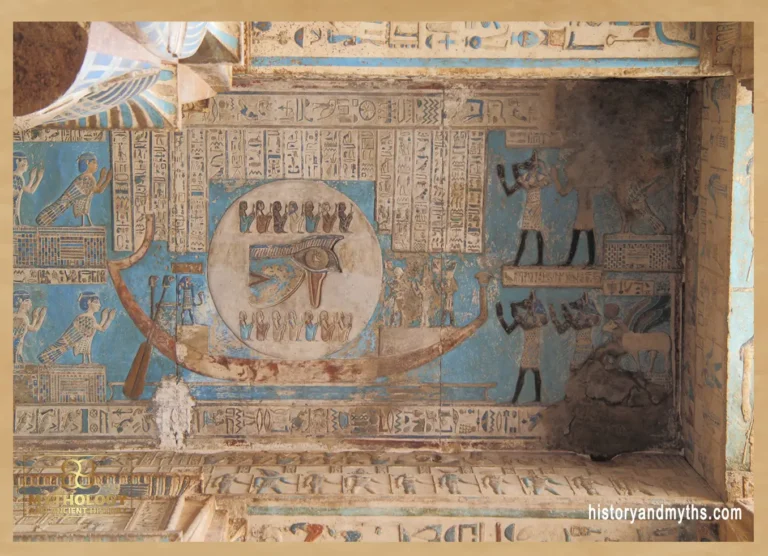
Egyptian texts distinguish between two solar barques, not to multiply symbols, but to clarify different modes of movement. The Mandjet carried the sun during the day, across the visible sky, sustaining order in the world of the living. The Mesektet, by contrast, carried the sun at night, through the Duat, where renewal occurred under threat.
This distinction was functional rather than narrative. Daylight movement affirmed stability and continuity; nocturnal movement restored vitality and resisted collapse. The barques did not represent separate identities of the sun god, but separate operational phases of the same cosmic system.
In this context, naming the two vessels mattered less than understanding why they existed: the universe required different kinds of movement to survive light and darkness. The solar barque remained the constant element—what changed was the environment it crossed.
A Collective Vessel: Why Ra Never Traveled Alone
The solar barque was never imagined as a solitary vehicle. Egyptian texts consistently show Ra surrounded by other deities, guardians, and forces, each performing a specific role. This was not decorative symbolism—it reflected a core belief: cosmic survival was collective, not individual.
No single power, not even the sun god, could sustain order alone. Movement through danger required cooperation: protection, navigation, speech, and restraint. Some deities guarded the barque, others repelled threats, while others ensured correct passage through gates. Each function mattered. If one failed, movement could stop.
This vision mirrored how Egyptians understood society and the cosmos alike. Stability came from roles working in harmony, not from domination by a single figure. The barque embodied this principle in motion. It was a system, not a throne.
For the dead, this carried a clear message. Salvation was not achieved through isolation or personal strength alone. To endure after death meant to join an ordered structure, to move as part of a larger process aligned with Ma’at. The solar barque thus modeled an afterlife where survival depended on integration, cooperation, and correct placement within the cosmic flow.
Ra’s presence gave the journey purpose, but the barque’s success depended on many hands and voices. The universe moved forward because it moved together.
Solar Barque — At a Glance
- Core Function: The cosmic mechanism that enables movement, time, and renewal
- Primary Role: Carries the sun god through sky and Duat to prevent cosmic stagnation
- Cosmic Principle: Survival depends on guided movement, not stillness
- Day & Night: Operates in different modes to sustain order in light and darkness
- Collective System: Requires multiple divine roles working in harmony
- Afterlife Meaning: Model for the justified dead to continue existence after judgment
- Failure Outcome: Stoppage of movement leads to erasure and non-existence
© historyandmyths.com — Educational use
The Solar Barque and the Dead
In Egyptian belief, the solar barque was not reserved for the gods alone. After judgment, the justified dead hoped to move within the same system that carried the sun. Survival in the afterlife did not mean standing still in a perfected state; it meant continued participation in cosmic movement.
Funerary texts repeatedly express this desire. The dead wished to join, follow, or be near the solar barque—not as passengers of privilege, but as beings who had proven their alignment with order. To move with the barque meant protection from stagnation and erasure. To be excluded from movement was to risk non-existence.
This explains why the barque appears so often in tomb decoration and afterlife literature. It represented the path of endurance. The dead did not seek escape from the cosmos, but integration within it. Movement alongside the sun ensured renewal, just as it did for Ra himself.
Importantly, access to this movement was conditional. Judgment determined whether the soul could continue within the system or be halted outside it. The solar barque thus marked the difference between continuation and final loss. It was not a reward granted before trial, but a possibility earned through balance and order.
In this way, the barque unified divine and human destiny. What carried the sun forward also carried the justified dead beyond death—not toward static eternity, but toward ongoing existence through motion.
What Would Happen If the Barque Failed?
Egyptian cosmology rarely asked hypothetical questions—but this one was implied everywhere. If the solar barque failed, existence itself would unravel. Sunrise would not occur, time would stall, and the boundary between order and non-being would dissolve. Failure was not a dramatic catastrophe; it was cessation.
The threat was not destruction by an enemy alone, but immobility. Without movement, renewal could not happen. Chaos would not need to conquer the cosmos; it would simply remain unchallenged. The solar barque’s success each cycle prevented this outcome by ensuring that motion continued, thresholds were crossed, and transformation completed.
This logic applied equally to the afterlife. Souls denied passage—unable to move within the cosmic system—faced erasure rather than torment. Survival meant continuity; failure meant disappearance. The barque therefore marked the thin line between existence renewed and existence ended.
By imagining the universe as something that must be carried forward, Egyptian thought framed survival as an active process. Order did not persist by inertia. It endured because movement was maintained against resistance. Every dawn testified that the barque had not failed—and that the system still held.
The solar barque was thus more than a mythic image. It was the guarantee that motion, time, and renewal remained possible, night after night, for gods and for the dead alike.
Key Takeaways
- The solar barque was a cosmic mechanism, not a decorative symbol.
- Movement—rather than stillness—was essential for time and renewal.
- A boat embodied guided passage through danger, not escape from it.
- Ra’s journey required collective roles, showing survival as cooperative.
- The justified dead sought continued movement within the same system.
- Failure of the barque meant cessation and erasure, not eternal torment.
Frequently Asked Questions About the Solar Barque
What was the solar barque in ancient Egyptian belief?
The solar barque was the vessel that carried the sun god Ra across the sky by day and through the Duat by night, enabling movement, time, and renewal.
Why was the solar barque essential to the universe?
Egyptians believed the universe survived through movement. The solar barque ensured that time advanced and that renewal could occur instead of stagnation.
Why did Ra travel by boat rather than flying?
A boat represented controlled passage through danger. It allowed Ra to move within the cosmos rather than escape it, maintaining order through guided movement.
Did Ra use more than one solar barque?
Texts distinguish between the Mandjet for daytime travel and the Mesektet for nighttime travel, representing different modes of cosmic movement.
Who accompanied Ra on the solar barque?
Ra was accompanied by multiple deities and protective forces, showing that cosmic survival depended on cooperation rather than solitary power.
What role did the solar barque play in the afterlife?
After judgment, the justified dead hoped to move within the same system as the solar barque, continuing existence through participation in cosmic order.
What would happen if the solar barque stopped?
If movement ceased, renewal would fail, time would stall, and existence would collapse into non-being.
Sources & Rights
- Assmann, Jan. Death and Salvation in Ancient Egypt. Cornell University Press, 2005.
- Hornung, Erik. The Ancient Egyptian Books of the Afterlife. Cornell University Press, 1999.
- Taylor, John H. Death and the Afterlife in Ancient Egypt. British Museum Press, 2001.
- Taylor, John H. (ed.). Ancient Egyptian Book of the Dead: Journey through the Afterlife. British Museum Press, 2010.
- Faulkner, Raymond O. The Ancient Egyptian Book of the Dead. University of Texas Press, 1990.
- British Museum. Funerary texts and reliefs related to the solar barque, the Duat, and nocturnal cosmology.
- UCLA Encyclopedia of Egyptology. Entries on solar theology, movement, and afterlife cosmology.
Written by H. Moses — All rights reserved © Mythology and History