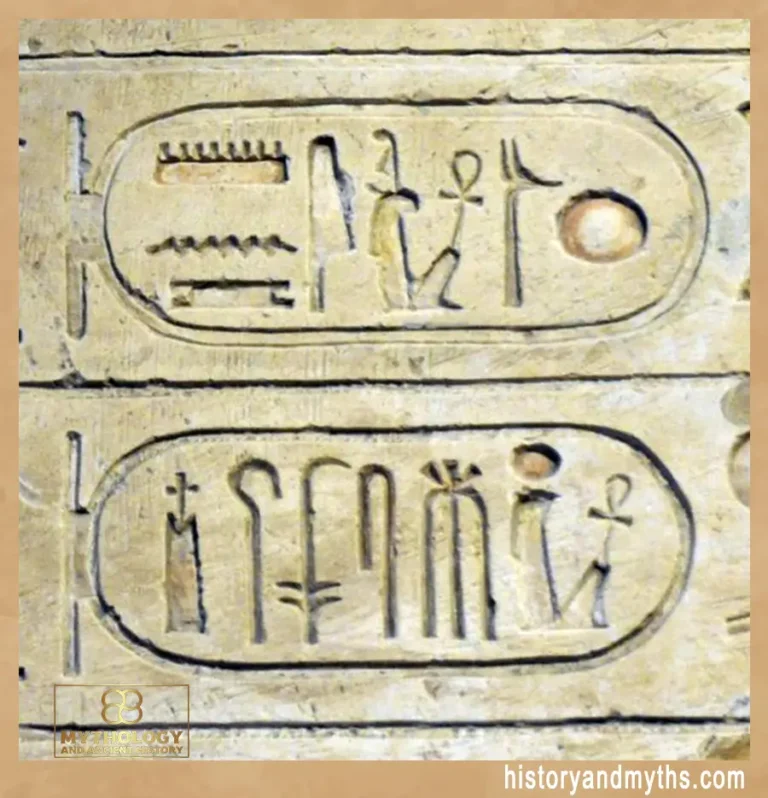
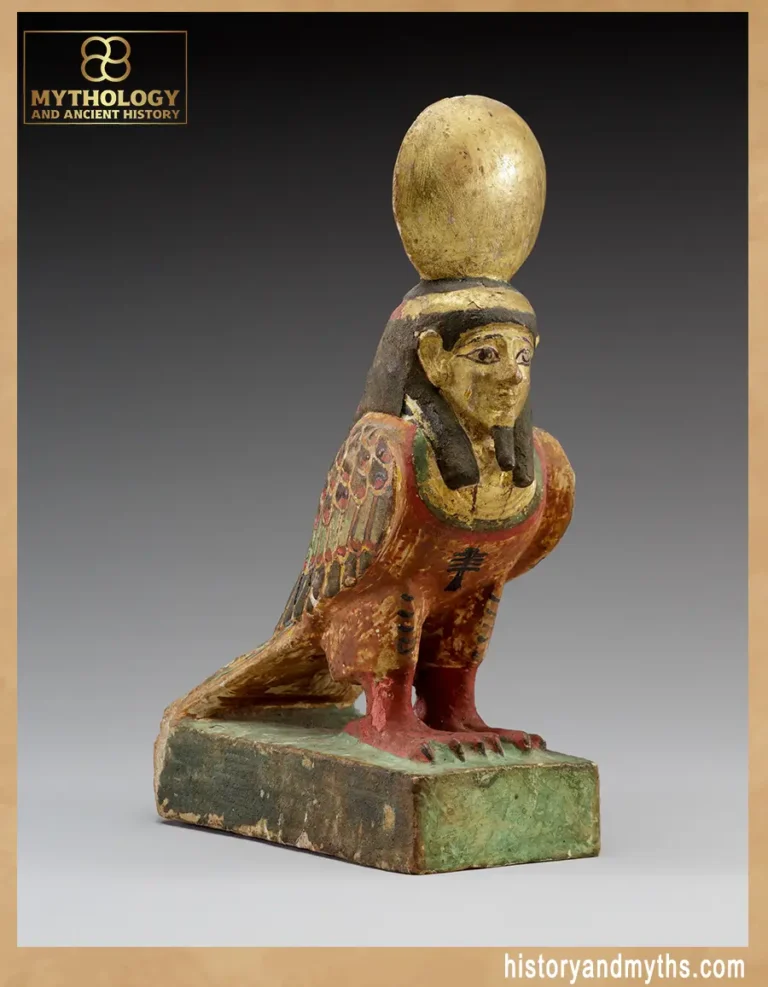
Kauket in Ancient Egypt: Goddess of Primordial Darkness and Creation
Before the sun rose for the first time, before the sky separated from the waters and before any god took shape, the ancient Egyptians imagined a moment of absolute stillness a cosmic pause where nothing yet existed. In this silent pre-creation realm, darkness was not a threat or a punishment. It was a raw, fertile potential. And at the heart of this darkness stood Kauket, the feminine personification of night and the counterpart of Kek in the Hermopolitan Ogdoad.
Kauket is one of those deities who rarely appear in modern summaries of Egyptian mythology, not because she was unimportant, but because her role is subtle, philosophical, and easy to overlook. She does not carry a scepter, lead a myth, or intervene in human affairs. Instead, she represents a condition of the universe itself the quiet, enveloping darkness from which creation would eventually emerge.
To the Egyptians, Kauket was not “evil darkness.” She was the comforting blanket of night, the hidden womb of possibility, the stillness that allows beginnings to happen. Her presence explains a profound idea:
creation requires darkness first not as an enemy, but as a necessary stage.
Understanding Kauket means understanding how the Egyptians viewed existence, time, and rebirth. She is an essential piece of the creation puzzle, even though she stands in the shadows literally and symbolically.
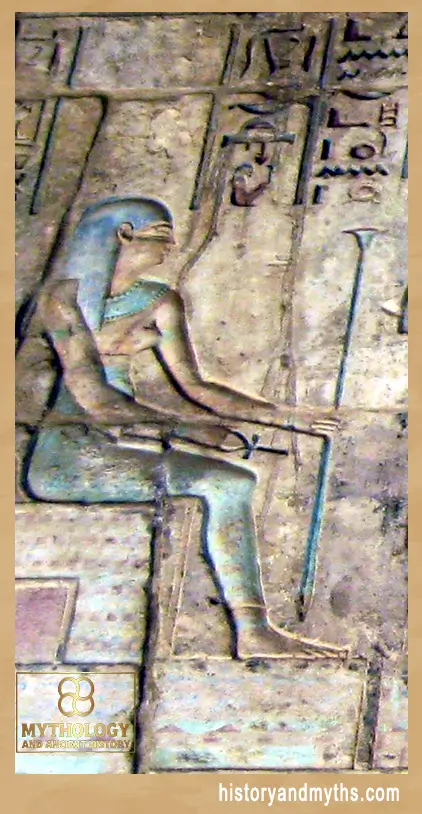
Who Is Kauket in Egyptian Mythology?
In the Hermopolitan creation system, the universe begins not with a single god but with eight primordial forces four male and four female known collectively as the Ogdoad. Each pair represents a condition of the cosmos before the moment of creation. Among them, Kek and Kauket embody one of the most mysterious and essential principles: darkness itself.
While Kek represents the shifting, indefinite darkness of the male aspect, Kauket represents the stable, enveloping, purely feminine darkness. She is the quiet night, the stillness before dawn, the unseen depth from which light eventually emerges. She does not act in myths, fight enemies, or appear in dramatic scenes. Instead, she is a state of existence a cosmic ingredient without which the universe could not begin.
To the ancient Egyptian imagination, Kauket’s darkness was not a force of fear. It was a necessary balance:
- Darkness balances light
- Night precedes day
- The unseen nourishes what will appear
In this way, Kauket is not merely “the goddess of darkness.” She is the feminine potential of creation, the passive-but-powerful backdrop that makes becoming possible. Her presence signals that even in the oldest Egyptian cosmology, creation is not chaos versus order, but a harmony of opposites working together.
| Aspect | Description |
|---|---|
| Name | Kauket (Kauket/Keket) — feminine principle of primordial darkness |
| Role in Mythology | Represents the still, enveloping night before creation; the feminine aspect of darkness |
| Cosmic Pair | Partner of Kek within the Ogdoad (Hermopolitan creation system) |
| Symbolism | Night, concealment, potential, the womb-like darkness before light |
| Worship | No temples or priesthood; conceptual deity rather than one with rituals |
| Importance | Represents a foundational stage of existence — the moment before creation begins |
Kauket and the Feminine Nature of Primordial Darkness
To understand Kauket fully, we have to step into how the ancient Egyptians interpreted darkness not as an enemy of light, but as a fertile, feminine state. In many creation systems, darkness is presented as chaos or danger. But in the Hermopolitan tradition, darkness holds a very different meaning.
For the Egyptians, the feminine aspect of existence was deeply tied to protection, enclosure, and hidden potential. Just as a seed grows in the dark soil, and a child grows in the darkness of the womb, the universe itself was imagined as beginning in a soft, enveloping night. This is the realm of Kauket.
While Kek represents the “movement” or “shift” within the darkness the unknowable fluctuations before form Kauket represents the stable container of that darkness, the calm that cushions transformation. Her darkness is:
- Protective, not threatening
- Still, not chaotic
- Nurturing, not destructive
In Egyptian cosmology, creation does not explode out of violence it emerges gently from a hiddenness that is essential for growth. Thus, Kauket becomes the symbol of a truth the Egyptians saw everywhere:
“All beginnings require a moment of quiet.”
This understanding explains why Kauket does not appear as a dramatic character in myths. Her purpose is metaphysical, not narrative. She embodies the principle that nothing can be created before it is first concealed, just as dawn cannot exist without night.
Kauket and the Ogdoad: Eight Forces Before the Universe
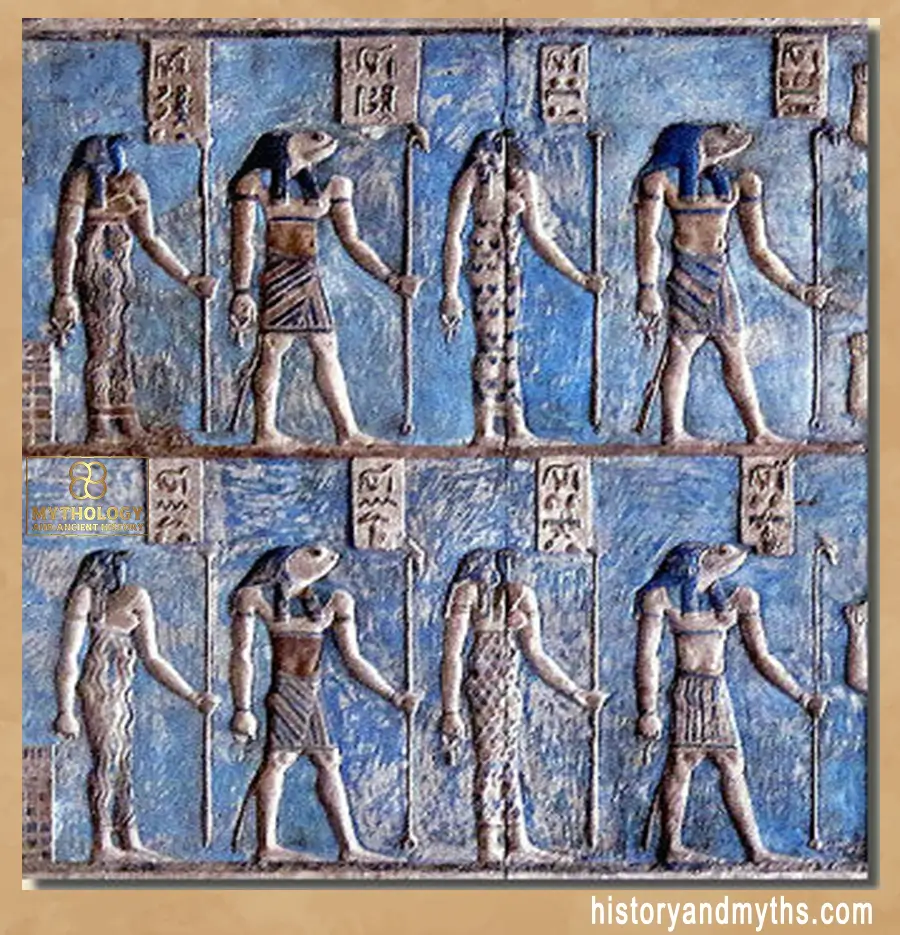
Kauket cannot be understood in isolation. Her identity only becomes clear when she is viewed within the Ogdoad, the group of eight primordial beings who embody the conditions of the cosmos before creation. This system, centered in Hermopolis, expresses a uniquely philosophical view of the universe: creation does not begin with a deity it begins with states of existence.
The Ogdoad consists of four male–female pairs, each representing a cosmic duality:
- Nun & Naunet — the primeval waters
- Heh & Hehet — infinity and limitless space
- Kek & Kauket — darkness and the unformed night
- Amun & Amunet — hiddenness and the unseen force
Within this structure, Kauket plays a vital complementary role. She completes the pair of darkness, balancing Kek’s dynamic, undefined obscurity with her own enveloping, stabilizing night. This duality reflects a profound insight in Egyptian cosmology:
every force in the universe contains both an active (male) and passive (female) aspect.
What’s remarkable is that the Ogdoad is not depicted as gods “doing” something; rather, they are the ingredients from which creation will unfold. For this reason, Kauket stands not as a goddess with rituals or temples, but as a cosmic principle personified.
Her presence in the Ogdoad teaches us that the Egyptians saw the beginning of the world not as a moment of conflict, but as a delicate balance of opposites water and sky, infinite and finite, light and dark all coexisting before the first sunrise.
Symbolism of Kauket: What Her Darkness Really Means
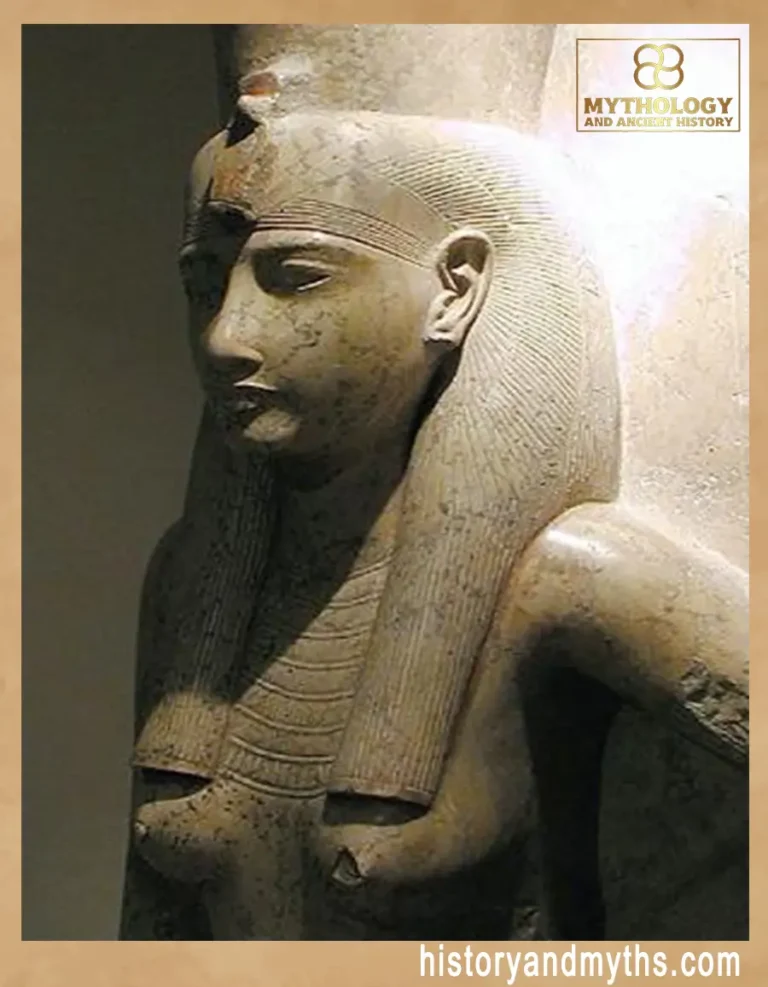
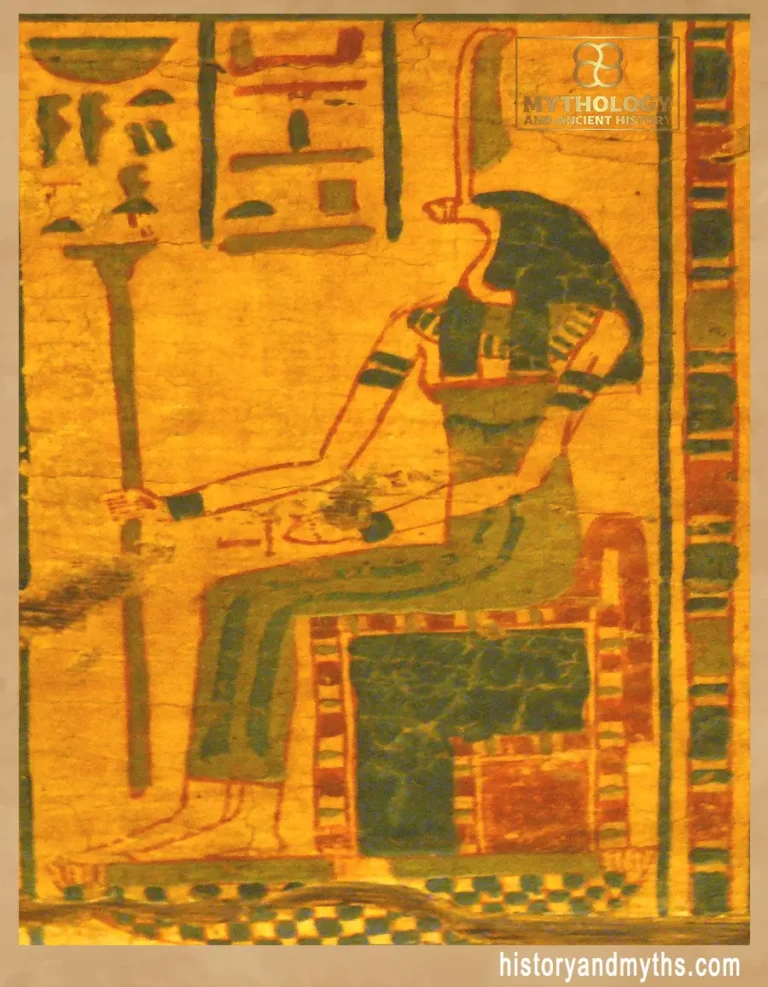
Although Kauket rarely appears in artwork or temple inscriptions, her symbolic role in Egyptian thought is surprisingly deep. The Egyptians treated “darkness” not as a moral category, but as a cosmic phase something every cycle of existence must pass through before renewal. Kauket personifies this idea perfectly.
1. Darkness as the Womb of Creation
For the Egyptians, creation was imagined as emerging from a hidden, enclosed space much like a child developing inside the mother. Kauket’s feminine darkness mirrors this concept:
- It conceals, but also protects
- It limits vision, but allows forms to grow
- It precedes light, but makes light meaningful
This is why her darkness is not chaotic. It is pregnant darkness full of unrealized potential.
2. Darkness as Balance, Not Opposition
Modern interpretations often assume “darkness versus light.”
But in Egyptian cosmology, night and day are complementary, not enemies. Kauket and Kek together maintain the equilibrium needed for the world to exist.
Without the calm of night, the cycle of the sun would lose meaning. Without concealment, revelation would be impossible.
Kauket’s existence reminds us that the Egyptians saw the universe as a balance of forces not a battlefield.
3. The Silence Before Transformation
Kauket represents the quiet moment before change happens a concept deeply tied to Egyptian ritual and cosmic order. Before the sun can rise (a symbol of creation), it must pass through the stillness of night.
This gives Kauket a subtle but powerful influence over cycles of:
- Rebirth
- Renewal
- Regeneration
- Resurrection
4. The Hidden Unknown
She also embodies the mysterious dimensions of the world that humans cannot grasp the unseen parts of time, space, and the self. While other gods are concerned with life, death, or daily order, Kauket symbolizes what lies beyond understanding.
Kauket in a Nutshell — Feminine Darkness Before Creation
- Identity: Feminine aspect of primordial darkness in the Hermopolitan Ogdoad.
- Cosmic role: The still, enveloping night before the first dawn of creation.
- Pairing: Partner of Kek, together embodying the dual nature of darkness.
- Nature: More a cosmic condition than a personal, temple-based goddess.
- Symbolism: Concealment, protection, hidden potential, and the womb-like space of beginnings.
- Legacy: Shows how the Egyptians saw darkness as a necessary phase, not an enemy of light.
Through Kauket, ancient Egypt teaches that every act of creation begins in silence, shadow, and unseen potential.
Why Did the Egyptians Separate Darkness from Night?
To modern readers, darkness and night may seem like the same thing. The ancient Egyptians, however, treated them as different realities. Night was part of the daily cycle created by the sun’s journey. Primordial darkness existed before the sun, before time, and before the ordered universe itself.
This distinction explains why Kauket was not simply a goddess of nighttime. She represented the condition that existed before creation began, when nothing had yet taken form. Every evening reminded Egyptians of darkness, but only primordial darkness belonged to the beginning of existence itself.
By separating these ideas, Egyptian theology transformed darkness from a temporary absence of light into one of the fundamental building blocks of creation. Kauket therefore represents not the darkness people experienced every night, but the timeless darkness that made the first sunrise possible.
What Does Kauket Reveal About Egyptian Ideas of Creation?
Kauket reveals that the ancient Egyptians did not understand creation as a sudden event. Instead, they imagined it as a gradual emergence from preexisting cosmic conditions. Darkness, hiddenness, water, and infinity were not obstacles to overcome but essential elements that made creation possible.
This perspective distinguishes Egyptian cosmology from traditions that describe creation as a victory over evil or chaos. In the Hermopolitan worldview, the universe develops through balance rather than conflict. Kauket’s role demonstrates that even the absence of light had meaning within the structure of existence.
Her presence therefore tells us something larger than the story of one goddess. It shows that Egyptian religion explained the universe through complementary forces, each contributing to creation without competing for supremacy. Kauket is valuable not because she performs heroic acts, but because she reveals how Egyptians understood the origins of reality itself.
Why Kauket Had No Temples or Cult: A Goddess Without Worship
One of the most striking things about Kauket is that, unlike Isis, Hathor, Amun, or even lesser deities tied to daily life, she never had a standalone temple, cult, priesthood, or popular devotion. But this absence does not mean she was unimportant.
Instead، it reveals something fundamental about her nature.
1. Kauket Is a Concept, Not a Personal Deity
Kauket doesn’t appear as a mother, protector, healer, or guardian.
She represents a condition of existence “the darkness before creation” rather than a divine personality involved in human affairs.
Such abstract forces were not worshipped, because you do not pray to the night; you acknowledge it as part of the cosmic cycle.
2. She Belongs to a Pre-Creation Era
The Ogdoad exists before the world begins, before temples or rituals or society.
So the deities of this group including Kauket symbolize what came before religion itself.
This makes her role cosmic, not devotional.
3. Her Function Is Complete Once Creation Begins
Once the sun rises for the first time (in Hermopolitan myth), creation moves into:
- Light
- Order
- Time
- Space
- Daily cycles
Kauket’s darkness becomes the background that allowed these things to emerge
a foundational layer rather than an active divine agent in the new world.
4. Yet She Is Always Present in the Egyptian View of the Universe
Even without temples, her presence is embedded in:
- the nightly journey of the sun
- the cycle of death and rebirth
- the idea that all renewal comes from a moment of concealment
- the unseen dimensions of existence
Thus، Kauket is “invisible” in worship because she represents the invisible itself.
5.Why This Makes Her Fascinating Today
Because she lacks myths, temples, or a personal narrative, modern summaries of Egyptian mythology often overlook Kauket entirely. Yet this absence is exactly what makes her so compelling for readers today. She represents an aspect of Egyptian thought that is rarely discussed the idea that creation depends on conditions, not characters; on states of being, not divine personalities.
Kauket embodies a philosophical depth that predates ritual religion and storytelling. She is the stillness before the voice, the night before the sunrise, the unformed potential that allows form to appear. In studying her, we gain insight into how the Egyptians understood not only the world, but the unseen forces that make the world possible.
Thus, even without temples or ritual worship, Kauket remains woven into the Egyptian understanding of the universe. She exists in the cycles of night and rebirth, in the hidden phases of transformation, and in every moment where creation pauses before moving forward again. Her power is subtle, but it is fundamental.
In this sense, Kauket shows us that the ancient Egyptians did not imagine the cosmos as a battle between light and darkness, but as a harmony between stillness and motion, concealment and revelation, night and day. She is the quiet reminder that every beginning requires a moment in the shadows.
Key Takeaways — Kauket Explained
- Kauket is the feminine personification of primordial darkness in the Hermopolitan Ogdoad.
- She represents the still, enveloping night before creation, not evil or destructive darkness.
- Together with Kek, she expresses the dual nature of darkness as both active and receptive.
- She had no popular cult or temples because she is a cosmic condition, not a personal goddess of daily life.
- Kauket symbolizes hidden potential, the womb-like space from which light, order, and creation emerge.
- Studying Kauket reveals how the Egyptians saw darkness as a necessary phase in every cycle of beginning and rebirth.
Who is Kauket in ancient Egyptian mythology?
Kauket is the feminine personification of primordial darkness in the Hermopolitan Ogdoad, representing the still, enveloping night before creation.
What does Kauket symbolize?
She symbolizes concealment, hidden potential, and the womb-like darkness from which creation emerges.
Is Kauket the same as Kek?
No. Kek represents the male, active aspect of darkness, while Kauket embodies the feminine, receptive, stabilizing darkness.
Did ancient Egyptians worship Kauket?
No. She had no temples or priesthood because she represents a cosmic condition, not a personal deity involved in daily life.
Where does Kauket appear in Egyptian mythology?
She appears mainly in the Hermopolitan creation system as part of the Ogdoad, the eight primordial forces that existed before the world began.
What is the role of Kauket in the creation story?
Her darkness provides the still, silent backdrop from which the first sunrise—and thus creation—emerges.
Why is Kauket considered important today?
Because she represents a rarely discussed philosophical idea: that darkness is not an enemy of light, but a necessary phase in every cycle of beginning and rebirth.
Sources & Rights
- Allen, James P. Middle Egyptian: An Introduction to the Language and Culture of Hieroglyphs. 3rd ed. Cambridge University Press, 2014.
- Assmann, Jan. The Search for God in Ancient Egypt. Cornell University Press, 2001.
- Frankfort, Henri. Ancient Egyptian Religion: An Interpretation. Dover Publications, 2000.
- Hornung, Erik. Conceptions of God in Ancient Egypt: The One and the Many. Cornell University Press, 1996.
- Hornung, Erik. The Ancient Egyptian Books of the Afterlife. Cornell University Press, 1999.
- Pinch, Geraldine. Handbook of Egyptian Mythology. ABC-CLIO, 2002.
- Quirke, Stephen. Exploring Religion in Ancient Egypt. Wiley-Blackwell, 2015.
- Wilkinson, Richard H. The Complete Gods and Goddesses of Ancient Egypt. Thames & Hudson, 2003.
- British Museum. Collection Online: Ancient Egyptian Religion and Creation Myths.
- Digital Egypt for Universities (University College London). Hermopolis, the Ogdoad, and Egyptian Creation Beliefs.
- The Griffith Institute, University of Oxford. Topographical Bibliography of Ancient Egyptian Hieroglyphic Texts.
- UCLA Encyclopedia of Egyptology. Cosmogony, Hermopolis, and Egyptian Religion.
- World History Encyclopedia. Egyptian Creation Myth.
- World History Encyclopedia. Hermopolis.
- The Metropolitan Museum of Art. Essays on Ancient Egyptian Religion and Cosmology.
Written by H. Moses — All rights reserved © Mythology and History