Heh and Hehet — The Egyptian Gods of Infinity and Eternal Time
To the ancient Egyptians, eternity was not an abstract idea locked away in philosophy. It was a living force—a power that shaped the cycles of the universe, the rebirth of the sun, and the promise of an afterlife. And at the heart of this vast concept stood two enigmatic deities: Heh and Hehet, the male and female personifications of infinity and endless time.
Unlike the familiar gods who walked through myths, ruled over temples, or guided human lives, Heh and Hehet belonged to a different category entirely. They were part of the Ogdoad, the eight primordial beings that existed before creation itself. In this silent, formless world, Heh and Hehet embodied limitless space—the boundless expanse from which the universe would one day emerge.
What makes them fascinating is not their stories—because they have none—but their meaning. Their presence reveals how the Egyptians understood the structure of existence: that creation requires a backdrop of infinite possibility, and that the cosmos itself rests on a foundation older than gods, older than time, older than light.
Heh and Hehet remind us that to the Egyptian mind, eternity was not the end of time—it was the source of it.
Who Are Heh and Hehet?
Heh and Hehet stand at the very edge of creation—literally at the point where “nothingness” becomes “something.” As members of the Hermopolitan Ogdoad, they do not act as rulers or storytellers. Instead, they represent conditions that had to exist before the world could begin.
Heh, the masculine form, personifies endless space and infinite time, while Hehet, his feminine counterpart, mirrors the same idea in its receptive, generative form. Together, they express a balance the Egyptians saw as essential: infinity is both expansive and containing, both outward-reaching and inward-holding.
Because of their role, Heh and Hehet were never worshipped in the everyday sense. They had no temples, no priesthoods, no personal prayers. Their significance lies in what they symbolize—not in stories they appear in. For the Egyptians, they were the mathematical backdrop of the universe: the unending stretch of existence on which all creation would be drawn.
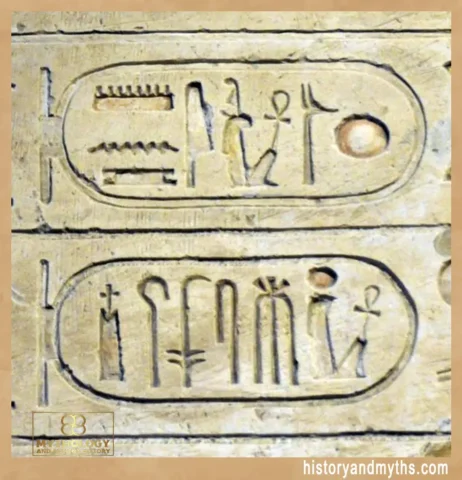
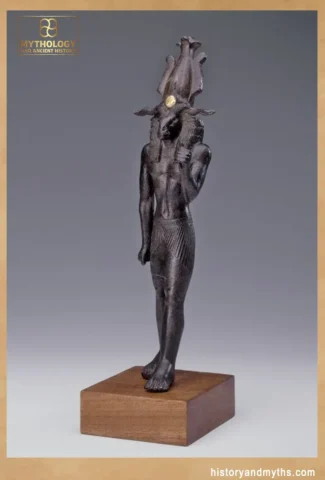
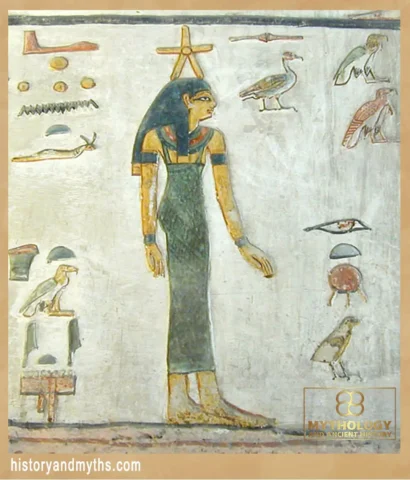
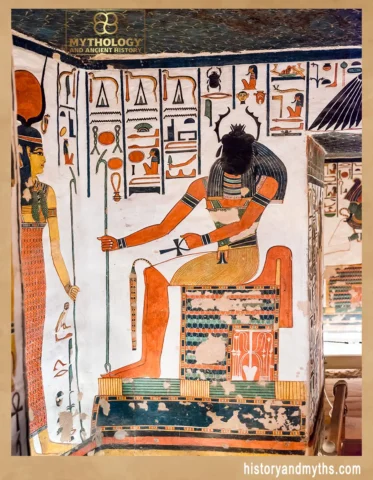
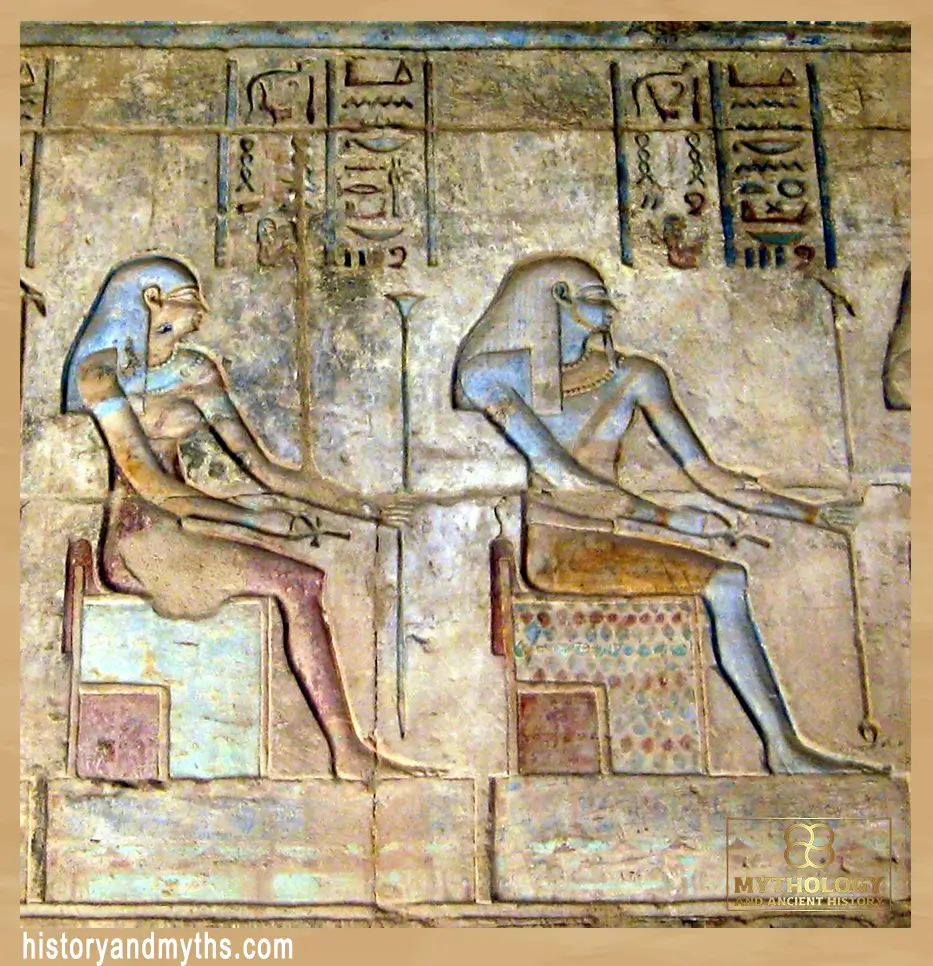
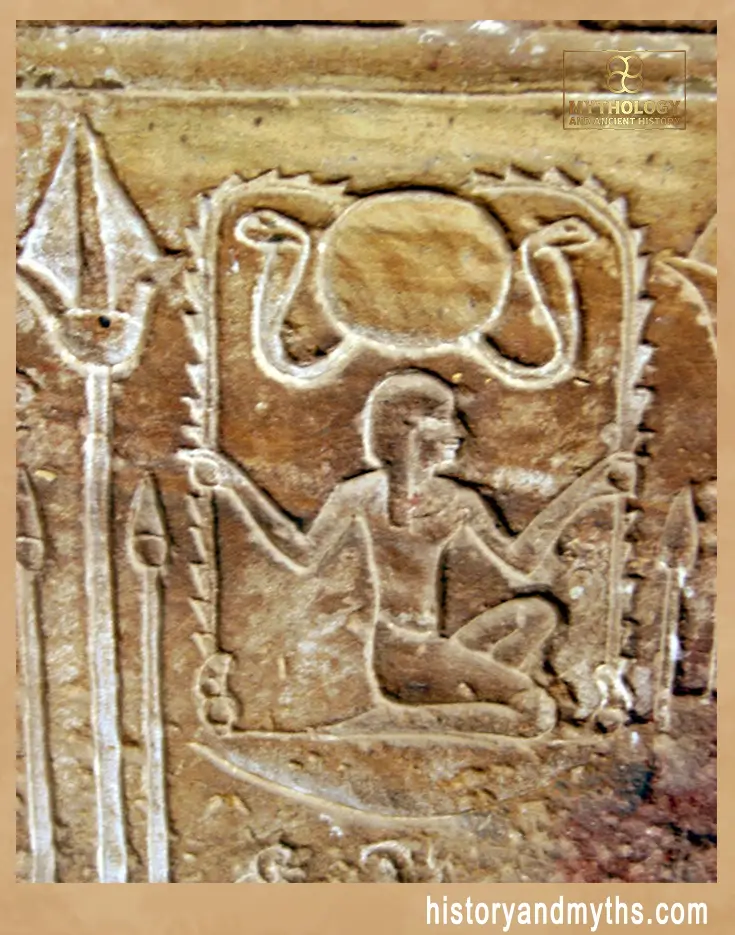
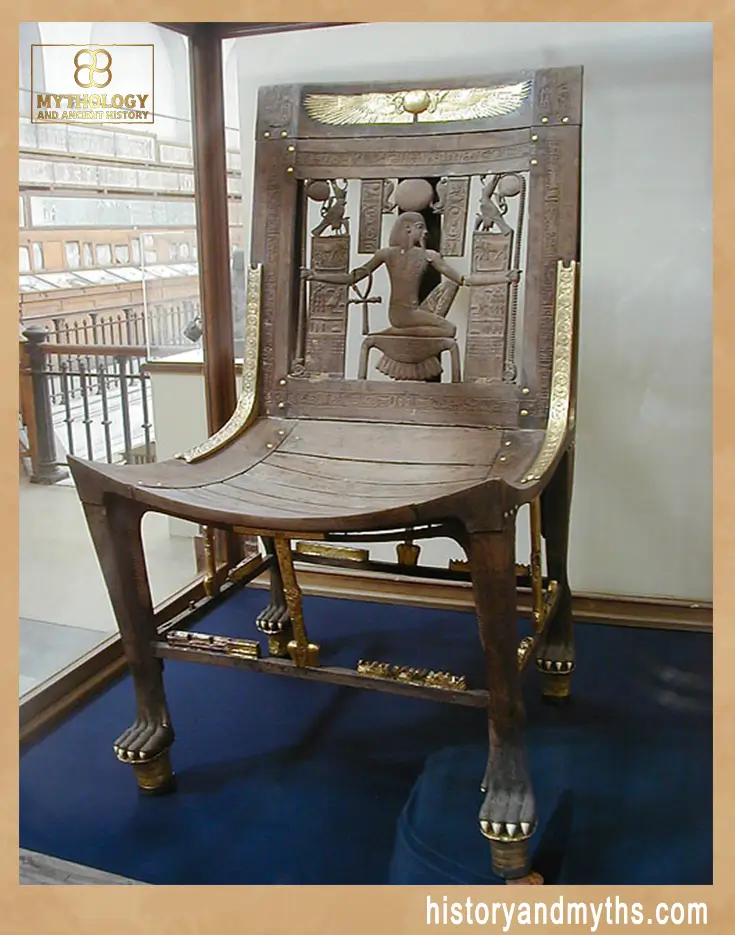
Despite their simplicity, depictions of Heh are surprisingly recognizable. He often appears holding palm ribs—the hieroglyphic sign for “a million years”—while seated with his knees drawn up, a gesture echoing the idea of compacted infinity. Through this image, Heh became a visual shorthand for “eternity,” appearing on amulets, sarcophagi, and royal iconography to emphasize unending life.
Hehet, though less frequently depicted, completes the duality. Where Heh symbolizes the measureless expanse, she represents the endless potential held within it. If Heh is the canvas, Hehet is the possibility of form.
| Aspect | Heh | Hehet |
|---|---|---|
| Role in Ogdoad | Male personification of eternity and infinite space | Female counterpart expressing infinite potential |
| Symbolism | Timelessness, boundless expansion, “a million years” | Receptive, generative infinity; the womb of potential |
| Depictions | Seated figure holding palm ribs (eternity symbol) | Rare; mirrors Heh’s pose and symbolism |
| Function | Ensures continuity and cyclical renewal of time | Balances and complements infinite expansion |
| Worship | No temples; conceptual cosmic principle | No temples; expressed jointly with Heh |
Heh and Hehet in the Structure of the Ogdoad
Within the Ogdoad, every pair expresses a cosmic polarity: water and its depths, darkness and its potential, hidden air and its stirring movement. Heh and Hehet occupy the final and most abstract of these pairs—the concept of infinity. Their domain is not an element like water or darkness, but the framework that makes all existence possible.
The Egyptians imagined the pre-creation universe as limitless, directionless, and without boundaries. This boundlessness was not chaos; it was a quiet, stable eternity. Heh and Hehet personified that state. As long as they existed, creation had room to unfold, and the cycles of life could renew themselves endlessly.
Their role also extends into royal symbolism. Kings were often depicted with the “million years” sign, a visual connection to Heh. The message was clear: a pharaoh’s rule was ideally timeless, supported by the cosmic infinity embodied in this ancient god. Even temple architecture reflects their influence—columns and ceilings decorated with repeating patterns that suggest unending continuity.
In the Ogdoad, Heh and Hehet function as the cosmic guarantee that the universe is spacious enough, and time is long enough, for creation to take place. Without infinity, no beginning would be possible.
Why Heh and Hehet Had No Temples or Cults
Unlike gods such as Ra, Osiris, Hathor, or Thoth, Heh and Hehet were never the center of temples, festivals, or local worship. This absence isn’t a sign of unimportance—quite the opposite. It reflects their cosmic scale. They were not deities who interacted with people or controlled aspects of daily life. They represented conditions of existence themselves.
Egyptian religion made a clear distinction between:
- Gods of function — who oversaw nature, kingship, love, fertility, death, justice.
- Gods of principle — who embodied intangible forces like darkness, potential, infinity.
Heh and Hehet belong firmly to the second category. Their role was too vast, too abstract, to be contained in a temple ritual. You could pray to Hathor for love or to Thoth for wisdom, but how do you pray to infinity? How do you offer incense to boundless time?
Instead, the influence of Heh and Hehet appears subtly in Egyptian culture:
- On royal regalia, where the “million years” symbol evoked eternal kingship.
- In magical texts, where references to endless time reinforced protective spells.
- In tomb imagery, connecting the deceased to the promise of endless existence.
They were not worshipped as personal gods—
They were recognized as the very fabric upon which the universe rests.
The Symbolism of Infinity: What Heh and Hehet Truly Represent
To understand Heh and Hehet, you cannot treat them as mythological characters. They have no narratives, no conflicts, no miracles. Their entire importance lies in the ideas they embody. And those ideas are some of the most sophisticated in all of Egyptian cosmology.
1) Infinity as Space
Heh represents the unending expanse—the cosmic “room” creation needs to exist.
Before the first sunrise, before the first breath of air, there had to be space for these things to emerge. This limitless space was not empty; it was potential.
2) Infinity as Time
Heh and Hehet together express the idea of time stretching without beginning or end. This is why Heh often holds the palm rib, a symbol for “a million years.”
To the Egyptians, eternity was not a single moment. It was the background on which all moments unfold.
3) Infinity as Renewal
The Egyptians believed the universe was cyclical, always renewing itself.
Eternity is not just “long time”—it is the guarantee that cycles can continue forever.
In this sense, Heh ensures stability: the world endures because eternity endures.
4) Duality of Infinite Potential
Hehet completes this idea.
If Heh represents the infinite space outward, Hehet represents the infinite potential inward—the silent, receptive womb of possibility.
Together, they are the full equation of eternity:
boundless expansion + boundless potential = the possibility of creation.
5) Why This Makes Them Fascinating Today
Modern readers may find Heh and Hehet abstract, but that abstraction is precisely why they matter.
They show us that the Egyptians did not see the universe as a place filled only with gods and myths. They saw it as a structured reality governed by principles—time, space, order, renewal—long before modern science even existed.
Heh and Hehet prove that ancient Egyptians were not simply telling stories…
They were thinking cosmologically.
Heh & Hehet — At a Glance
- Heh and Hehet are the male and female embodiments of infinity and eternal time in ancient Egyptian cosmology.
- They belong to the Ogdoad of Hermopolis, the eight primordial forces that existed before creation.
- Heh symbolizes boundless space and “a million years,” often shown holding palm ribs.
- Hehet represents infinite potential — the receptive counterpart completing the duality of eternity.
- They had no temples or cults because they embodied cosmic principles, not personal deities of daily life.
- Their influence appears in royal iconography, protective spells, and cosmic scenes linking the king and the universe to unending renewal.
How Heh and Hehet Appeared in Art and Royal Symbolism
Even though Heh and Hehet were not worshipped in the traditional sense, the Egyptians still found visual ways to express their presence. These images are not portraits of “gods with stories,” but symbols of a concept so vast that it needed a visual anchor.
1) Heh as the Symbol of “A Million Years”
The most recognizable depiction of Heh shows him in a seated, compact posture, holding palm ribs—the hieroglyphic sign meaning “a million years.” This image appears:
- On royal regalia
- On tomb decorations
- In protective amulets
- Within cosmic scenes emphasizing eternal life
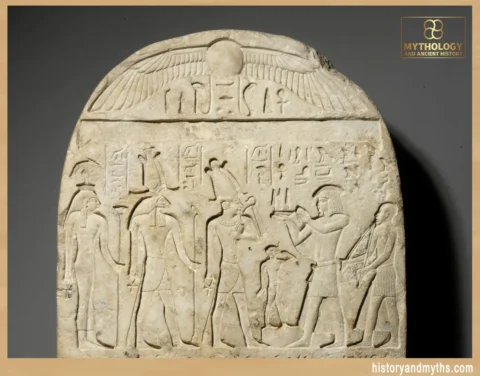
Whenever a pharaoh wanted to express that his reign would last “forever,” Heh was the figure chosen to represent that eternity.
2) Heh Supporting the Universe
Some scenes portray Heh holding up the sky or supporting the sun’s cycle.
This is not literal worship—it’s symbolic:
Heh is the force that ensures time continues, allowing the sun to rise every day.
3) Hehet: Rare but Significant
Depictions of Hehet are less common but follow the same concept. She is usually shown in a form similar to Heh, emphasizing her role as the complementary half of infinity.
Her presence reinforces the Egyptian principle of balance—every cosmic force has both a masculine and feminine expression.
4) The Ogdoad Scenes at Dendera and Deir el-Medina
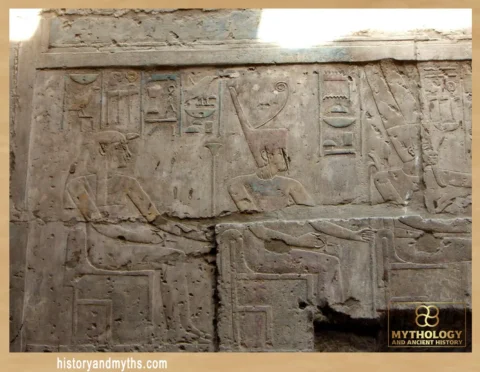
In the few temple scenes where the Ogdoad appear, Heh and Hehet stand among the other primordial pairs, each representing a cosmic condition: water, darkness, air, and infinity.
These scenes are not decorative.
They remind the viewer that the world rests on principles older than the gods themselves.
5) Why Their Art Matters
Because Heh and Hehet are conceptual deities, their iconography becomes a visual philosophy.
Every palm rib, every repeated pattern, every figure holding “a million years” is a reminder that the Egyptians imagined eternity as the foundation beneath all creation.
This is not mythology for entertainment.
It is mythology as cosmology.
Key Takeaways — Heh & Hehet
- Heh and Hehet represent infinite time and endless space in ancient Egyptian cosmology.
- They belong to the Ogdoad of Hermopolis, a group of primordial forces existing before creation.
- Heh symbolizes boundless expansion and eternity (“a million years”), while Hehet represents receptive infinite potential.
- They had no temples or cults because they personified cosmic principles, not personal gods.
- Their imagery appears in royal symbolism, amulets, and scenes emphasizing eternal kingship and cosmic renewal.
- Understanding Heh & Hehet reveals how Egyptians viewed eternity as the foundation from which creation emerges.
Who are Heh and Hehet in ancient Egyptian mythology?
Heh and Hehet are the male and female personifications of infinity and eternal time within the Ogdoad of Hermopolis.
What does Heh represent?
Heh embodies endless space and “a million years,” symbolizing boundless time and cosmic continuity.
What is the role of Hehet?
Hehet mirrors Heh’s symbolism, expressing the receptive, generative side of infinite potential.
Why did Egyptians not worship Heh and Hehet?
They were cosmic principles, not personal gods, so they had no temples or priesthoods.
Where do Heh and Hehet appear in ancient art?
They appear mainly in symbolic scenes, especially in royal iconography and depictions of the Ogdoad.
What is the main symbolism of Heh and Hehet?
They represent eternity as the foundation of the universe—endless time, infinite space, and perpetual renewal.
How does understanding Heh and Hehet help us today?
They reveal how Egyptians saw infinity not as emptiness but as the essential backdrop for creation and cosmic order.
Sources & Rights
- Allen, James P. Middle Egyptian: An Introduction to the Language and Culture of Hieroglyphs. Cambridge University Press.
- Hornung, Erik. Conceptions of God in Ancient Egypt: The One and the Many. Cornell University Press.
- Wilkinson, Richard H. The Complete Gods and Goddesses of Ancient Egypt. Thames & Hudson.
- Assmann, Jan. Egyptian Solar Religion in the New Kingdom. Routledge.
- Frankfort, Henri. Ancient Egyptian Religion: An Interpretation. Harper & Row.
- Studies on the Ogdoad cosmology and Hermopolitan creation texts from Egyptological academic publications.
Written by H. Moses — All rights reserved © Mythology and History