Ren in Ancient Egypt — The Name Responsible for Immortality
In ancient Egypt, a person did not truly exist unless their name endured. The body could decay, the heart could be weighed, and the soul could travel — but without a name, nothing remained.
They called this name the Ren.
To modern eyes, a name is a label. To the Egyptians, it was a living anchor. It fixed a person in the world of the living and carried them into the world of the dead. It was not a sound alone. It was identity made permanent.
This is why names were carved deep into stone. Why they lined the walls of tombs. Why they were repeated like spells. To speak someone’s Ren was not courtesy — it was revival. Silence did not just forget a person. It erased them.
If the Ba could wander and the Ka could hunger, the Ren ensured something more essential: that the self remained locatable. The dead were not ghosts drifting through eternity. They were beings who could only survive if the world still knew their names.
This is also why Egypt feared one thing above all others:
Not death.
Not judgment.
But namelessness.
To destroy a name was not a punishment.
It was annihilation.
And in that belief lies one of the oldest and most unsettling ideas in human history:
You do not survive by breathing.
You survive by being remembered.
What Ren Really Was — Existence in Sound
The Ren was not a nickname, a title, or a casual label. In ancient Egypt, a name was not symbolic — it was real. The Ren was believed to contain a person’s being, compressed into sound.
To speak a name was to activate existence.
To write a name was to bind it to reality.
To erase a name was to destroy a person.
Egyptians did not think of the self as something locked inside the body. Identity was distributed across forces — and the Ren was the one that made a person findable across worlds. If the afterlife was a vast and dangerous landscape, the Ren was the address.
This is why people repeated names obsessively in tomb texts. Not for flattery. For survival. Each repetition worked like a spiritual GPS signal. A soul without a Ren could wander endlessly but never arrive.
Ren Was Stronger Than Flesh
Bodies decay.
Statues break.
Even memory fades.
But name, once cut into stone or sealed in papyrus, could outlive empires.
To the Egyptians, the Ren was more durable than bone. It did not rot. It did not age. It could survive when everything else failed — as long as someone could still say it.
This is why kings built monuments not to be admired, but to be spoken. Their greatest fear was not a weak reign, but a silent future.
Ren Was Not Abstract — It Was Magical
Egyptian names were not neutral sounds. They were thought to work. When a name was spoken inside a ritual, it did something. When written inside a coffin, it protected something.
The Ren carried:
- identity
- memory
- authority
- permanence
To name a thing was to control it.
To know a true name was to hold power.
This belief explains why secrecy surrounded divine names and royal titles. A name in the wrong mouth could be dangerous.
Ren and the Crime Worse Than Murder
There was a punishment worse than execution.
It was deletion.
If someone’s Ren was hacked out of a wall or scratched off a statue, the act was not vandalism. It was metaphysical violence. You did not harm their reputation.
You murdered their existence.
That is why kings erased rivals not with swords but with chisels. The Ren was the battlefield on which eternity was won or lost.
| Aspect | Ren in Egyptian Belief | Meaning & Impact |
|---|---|---|
| Core Nature | Existence in sound | A person exists as long as the name is spoken or written. |
| Function in life | Identity anchor | Defines social identity and ties the person to family, gods, and status. |
| Function after death | Survival key | Allows offerings, spells, and remembrance to reach the dead. |
| Relationship to Ka | Locator | Without a name, the Ka cannot be summoned or sustained. |
| Relationship to Ba | Guide | Keeps personal identity intact while the Ba moves. |
| Medium | Stone, ink, speech | Carving and recitation were tools of immortality. |
| Royal use | Political weapon | Erasing names destroyed rivals beyond death. |
| Greatest threat | Namelessness | Loss of the name meant total annihilation. |
Ren in Daily Life — When a Name Began Before Birth
The force of the Ren did not wait for death to matter.
It began working the moment a child was named.
In ancient Egypt, naming was not casual. It was an act of creation.
A child did not simply receive a label — they were called into existence.
The chosen name did not describe the person.
It declared them.
Names were chosen carefully, often containing:
- references to gods,
- ancestral titles,
- hopes for destiny,
- prayers embedded inside syllables.
To name a child was to program a future.
Parents did not whisper names thoughtlessly.
They spoke them as vows.
Names Were Social Architecture
To the Egyptians, identity did not float privately inside the skull.
It was public.
Audible.
Remembered.
Your Ren told people:
- who you belonged to,
- which god watched you,
- what kind of life you were expected to live.
A name acted as a social fingerprint.
This is why royal names changed throughout a king’s life.
The pharaoh had:
- a birth name,
- a throne name,
- ritual names,
- divine titles.
Each change reflected a transformation of role, not personality.
Names did not follow the person.
The person entered the name.
Ren in Writing — Why Egypt Obsessively Carved Names
The Egyptians did not write to store information.
They wrote to protect existence.
When a name was:
- carved into stone,
- inked on papyrus,
- repeated across walls,
it was being physically anchored to time.
This is why tombs overflow with names.
Not for historical record.
For survival.
Each carving was an insurance policy against oblivion.
To exist in death, your Ren had to exist in matter.
Stone became memory.
Ink became eternity.
The Fear Was Not Being Forgotten
It Was Being Unspoken
The worst fate in Egypt was not judgment.
It was silence.
A name that was never spoken began to dissolve.
A name no longer read began to wither.
A name not written anywhere vanished entirely.
This was the real Egyptian horror:
Not suffering.
Disappearance.
Ren meant:
“As long as someone can say me — I am.”
Ren and the Afterlife — Why the Dead Needed to Be Named
In death, the Ren became a matter of survival.
The Egyptians believed that a person who lost their name did not drift aimlessly into darkness.
They ended.
A soul without a Ren could not be summoned.
Could not be fed.
Could not be addressed.
Could not be found.
Without a name, even the gods could not locate you.
The Name Was the Address of the Dead
The afterlife was not imagined as an open meadow or a silent void.
It was vast, dangerous, and crowded with forces.
The Ren was how a person was located inside that chaos.
Priests did not offer food “to whoever rested here.”
They offered food to a name.
Relatives did not mourn the dead in silence.
They spoke them.
And by speaking, they believed they reached across worlds.
When a name was spoken:
- the dead were notified,
- the offering reached its recipient,
- identity stayed intact.
Without the Ren, the Ka starved.
Without the Ren, the Ba wandered.
Without the Ren, nothing reassembled.
Why Names Were Covered Everywhere
This explains an obsession that puzzles many modern visitors:
Why are names carved again and again on the same tomb?
Because one carving was never enough.
Time could eat stone.
Sand could bury walls.
Humans could forget.
So they wrote the Ren everywhere:
- on coffins,
- on statues,
- on doors,
- on pillars.
Not decoration.
Redundancy.
The Egyptians built redundancy into survival.
The more places a name existed,
the harder it was to erase a person.
The Dead Needed to Be Called
Life ended quietly.
Existence did not.
The dead required:
- invocation,
- remembrance,
- repetition
But a name never spoken did.
That is why Egyptian rituals required constant renewal.
Not of the body.
Of the name.
A silent tomb was a dying tomb.
A recited name was oxygen.
Ren and the Ultimate Horror
There was a fate worse than failing judgment.
It was being unnameable.
A destroyed Ren meant:
- no offerings could reach you,
- no spells could help you,
- no gods could hear you.
You did not go to punishment.
You went to absence.
This single belief explains everything else:
Why Egypt feared erosion.
Why scribes were sacred.
Why stone mattered more than flesh.
Because in Egypt…
The grave was not where you died.
It was where your name tried to live.
Ren and Power — Why Names Controlled History
The Ren was not only spiritual.
It was political.
In ancient Egypt, to rule was not just to command armies — it was to control names.
To Rule Was to Be Named
A king’s power did not begin at coronation.
It began when his name was carved.
Royal monuments were not built to be seen.
They were built to be spoken.
Every visitor who read a royal name aloud renewed that king’s existence.
This is why rulers obsessed over:
- titles,
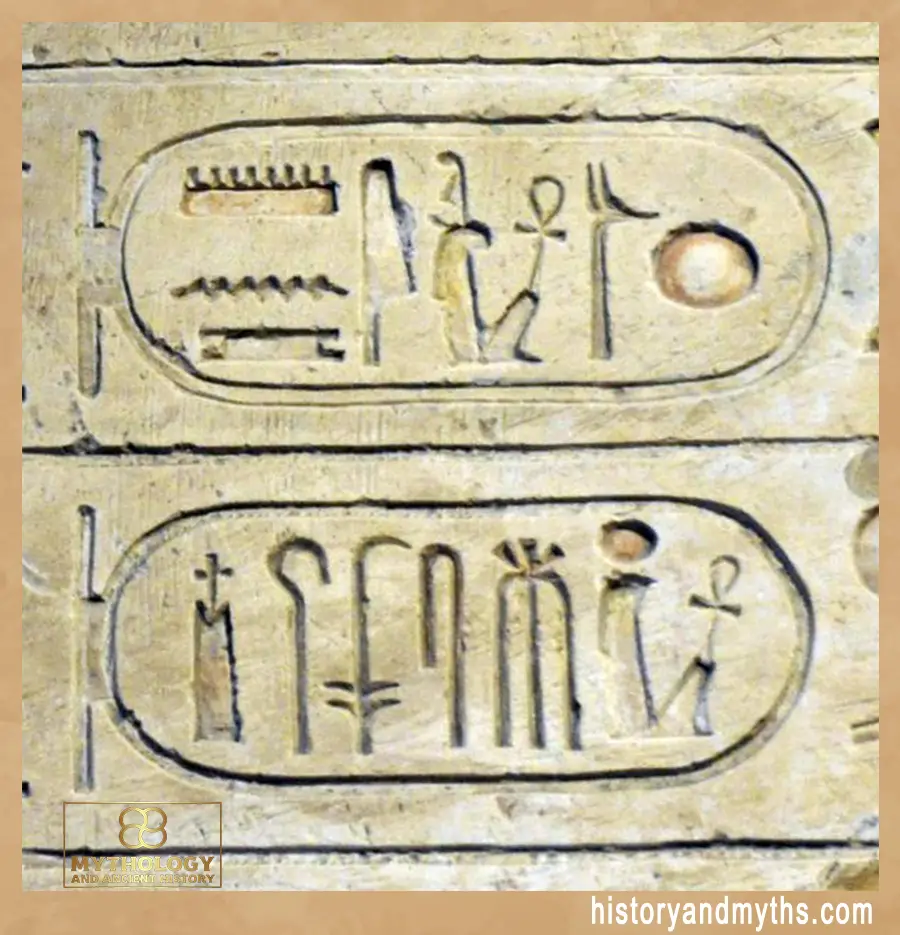
- cartouches,
- epithets,
- divine names attached to their own.
A king without a name was not a king.
He was already disappearing.
Erasing a Name Was a Political Execution
Rivals were not simply assassinated.
They were unwritten.
Chisels scraped names off walls.
Statues were smashed at the face.
Cartouches were obliterated.
Not to destroy bodies.
To delete identity.
This practice was not revenge.
It was strategy.
If you destroyed a man’s Ren, you destroyed his afterlife.
No honors.
No offerings.
No remembrance.
The ultimate humiliation was not death.
It was silence.
The Ren Was Stronger Than Bloodlines
Dynasties fell.
Names did not.
This is why Egypt’s history feels eternal.
Because what endured was not flesh.
It was inscription.
Power in Egypt was not inherited.
It was engraved.
Ren in a Nutshell — Existence in a Name
- Essence: Ren is the true name — existence compressed into sound.
- In life: Anchors identity, linking a person to family, gods, and status.
- After death: Allows offerings, prayers, and spells to reach the dead.
- Medium: Preserved through carving on stone, ink on papyrus, and spoken recitation.
- Power: Controlling names meant controlling memory, history, and honor.
- Greatest fear: Erasing the Ren — a second death that destroys existence.
For the ancient Egyptians, you did not survive because you breathed — you survived because your Ren continued to be spoken and read.
Why Ren Still Matters — The Oldest Technology of Memory
The Egyptians invented nothing more powerful than the idea that identity survives through a name.
Not stone.
Not gold.
Not ritual.
A name.
Three thousand years before data storage, before archives, before the internet, Egypt built the first system of immortality — and it ran on sound and inscription.
Ren Was Memory With Authority
Modern memory is passive.
Egyptian memory was active.
To remember someone today is emotional.
To remember someone in Egypt was existential.
They turned memory into machinery:
- carving names to make them permanent,
- speaking names to keep them alive,
- repeating names to defend against disappearance.
What we now do with files and backups, they did with chisels and names.
Ren Explains Modern Obsession With Names
Why do we name buildings after people?
Why carve names on graves?
Why credit authors?
Why fear being forgotten more than dying?
We inherited Ren.
Not as religion.
As instinct.
The need to be named — to exist in a traceable way — did not vanish.
It migrated.
From stone → to paper → to screens.
But the fear is the same:
“If no one remembers me… did I ever really exist?”
Egypt answered that question long ago.
Existence is not physical.
It is recorded.
Ren Is Still Operating
Every biography is a Ren.
Every citation is a Ren.
Every headstone is a Ren.
Every username is a Ren.
We did not outgrow this belief.
We digitalized it.
The afterlife changed format.
The system stayed the same.
The Final Truth of Ren
The Egyptians never asked:
“What happens after death?”
They asked something harder:
“What happens when no one can say your name?”
Their answer was terrifying.
And honest.
Nothing.
That is why Ren mattered more than life.
Life ends.
Names don’t — unless we let them.
And this is their final message to us:
You are not remembered because you lived.
You live because you are remembered.
Key Takeaways — Ren Explained
- Ren was not a label — it was existence in sound.
- A person survived only as long as their name endured.
- Carving and reciting names were tools of immortality.
- Without Ren, offerings and prayers could not reach the dead.
- Erasing a name meant erasing a soul.
FAQ — Ren in Ancient Egyptian Belief
What was the Ren in ancient Egypt?
Ren was the true name of a person and the key to their continued existence after death.
Was Ren just a personal name?
No. Ren was believed to contain identity itself, not merely a label or title.
Why was the Ren written everywhere in tombs?
Because repeating the name was thought to keep the person alive in the afterlife.
What happened if someone’s Ren was destroyed?
Erasing the Ren was believed to cause total annihilation beyond death.
How did Ren relate to Ka and Ba?
Ren allowed the Ka to be fed and the Ba to remain identifiable.
Did gods and kings have special Ren?
Yes. Divine and royal names were guarded carefully because knowing a true name meant power.
Why does Ren still matter today?
It reflects humanity’s deepest fear: being forgotten.
Sources & Rights
- Assmann, Jan. Death and Salvation in Ancient Egypt. Translated by David Lorton. Ithaca: Cornell University Press, 2005.
- Faulkner, Raymond O. The Ancient Egyptian Coffin Texts. 3 vols. Warminster: Aris & Phillips, 1973–1978.
- Hornung, Erik. Conceptions of God in Ancient Egypt: The One and the Many. Translated by John Baines. Ithaca: Cornell University Press, 1982.
- Lichtheim, Miriam. Ancient Egyptian Literature. Vol. I: The Old and Middle Kingdoms. Berkeley: University of California Press, 1973.
- Pinch, Geraldine. Egyptian Mythology: A Guide to the Gods, Goddesses, and Traditions of Ancient Egypt. Oxford: Oxford University Press, 2002.
- Quirke, Stephen. Ancient Egyptian Religion. London: British Museum Press, 1992.
- Wilkinson, Richard H. The Complete Gods and Goddesses of Ancient Egypt. London: Thames & Hudson, 2003.
- Ikram, Salima. Death and Burial in Ancient Egypt. Cairo: American University in Cairo Press, 2003.
- Teeter, Emily. Religion and Ritual in Ancient Egypt. Cambridge: Cambridge University Press, 2011.
Written by H. Moses — All rights reserved © Mythology and History