Nun & Naunet — Gods of Primordial Chaos and Creation in Ancient Egypt
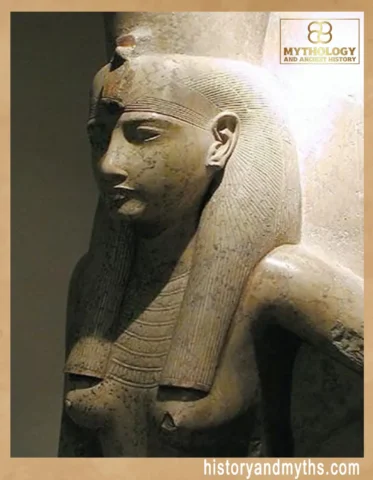
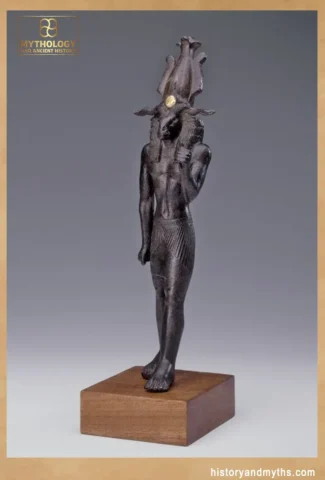
In ancient Egyptian thought, creation did not begin with a god lifting the sky, shaping the earth, or breathing life into the first beings. It began in silence—an endless, unfathomable ocean known as Nun, accompanied by his feminine counterpart Naunet. They were not deities in the familiar sense, with temples, prayers, or personal stories. Instead, they embodied a cosmic condition: the infinite waters that existed before existence, the boundless darkness from which every shape, force, and god would eventually rise.
To the Egyptians, the world did not emerge from nothing. It rose out of something older, deeper, and eternal—an ocean without surface or floor, without light or boundary. Nun and Naunet represented this primordial state: chaotic yet fertile, formless yet filled with potential. They were the canvas on which creation could happen, the invisible foundation beneath every myth of birth, order, and renewal. Even when the cosmos was fully formed, the Egyptians believed that the waters of Nun still pressed gently against it, surrounding the world like a reminder that creation was fragile and could dissolve back into the deep at any time.
What sets Nun and Naunet apart from other deities is not what they did, but what they were. They symbolized the uncreated source behind all creation—an idea that feels surprisingly modern. Their presence appears quietly across texts: in Coffin Spells, where the deceased hopes to navigate the primordial waters; in temple hymns, where even Ra, lord of light, acknowledges Nun as the father from whom he first arose; and in cosmological traditions, where Naunet completes the duality that Egyptians believed was essential to cosmic balance. They remind us that creation, in Egyptian eyes, was not a single moment but an ongoing negotiation between order and the ever-present possibility of chaos.
Nun and Naunet were not worshipped as personal gods, nor were they feared as hostile forces. Instead, they were understood as the world’s oldest truth: that before life, before form, before time itself, there was an ocean of pure potential. Their myth speaks to a civilization that saw creation not as a miracle of beginnings, but as a continuous emergence—something that could only be understood by acknowledging what came before.
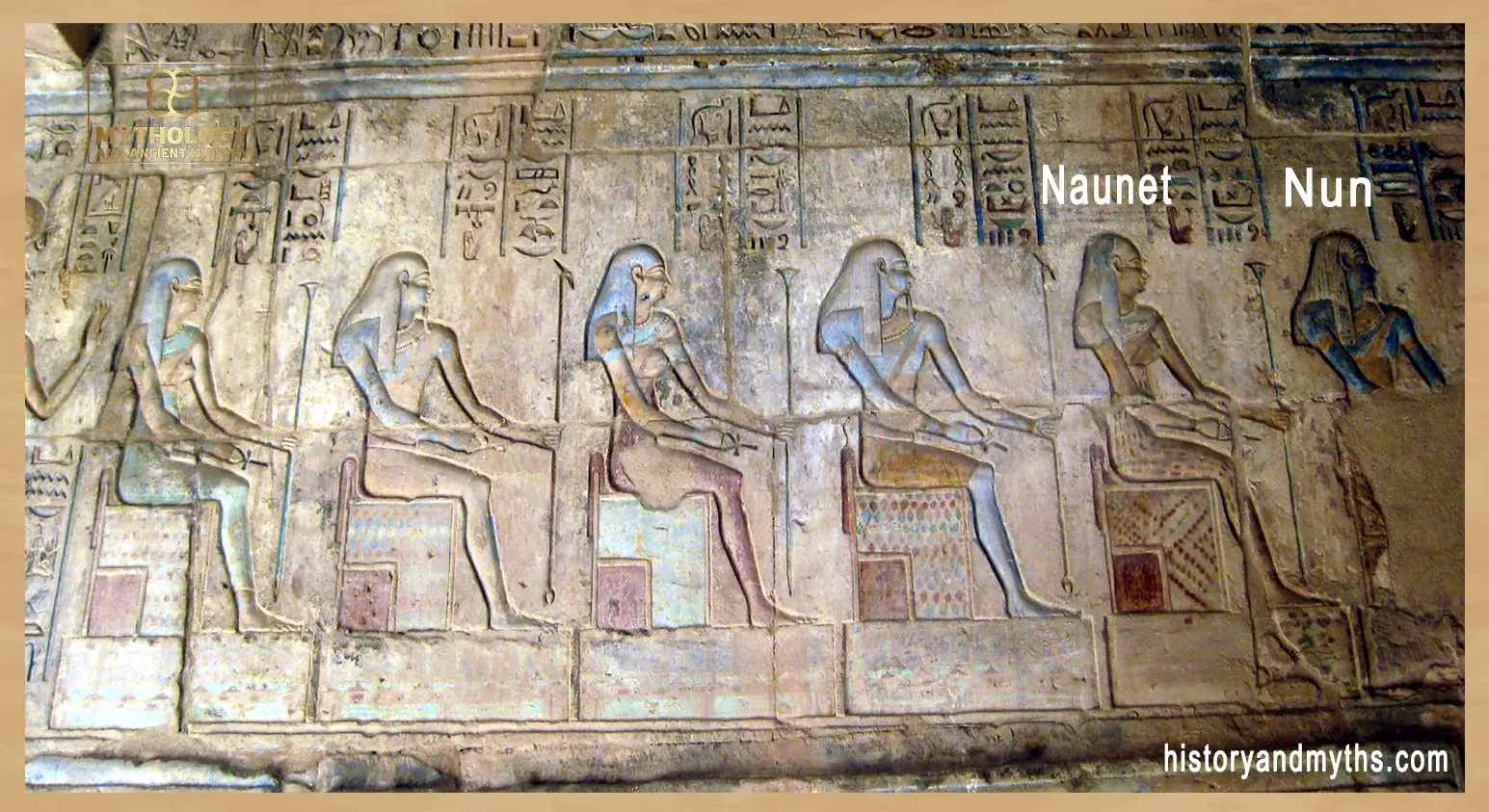
Source: Derived from SFEC_2009_POT-0008.JPG by S. F.-E. Cameron; derivative work by JMCC1 — Wikimedia Commons (CC BY-SA 3.0).
The Primordial Waters: Understanding What Nun & Naunet Really Represented
To understand Nun and Naunet, we must first step into the Egyptian imagination—one that pictured the universe not as a vast stretch of empty space, but as a living structure built within an infinite ocean. This was not water in the physical sense, but a symbol of everything that is undefined, unbounded, and yet full of possibility. The Egyptians believed that before the first sunrise, before the first mound of earth emerged, this ocean existed alone, stretching endlessly in every direction.
Nun represented this limitless expanse, while Naunet expressed its hidden, feminine dimension—a principle of potentiality rather than form. Their duality was not about gender in a human sense; it was a cosmological pairing meant to express balance. Together, they explained how something as stable as the cosmos could arise out of something as fluid as the primordial sea.
Ancient texts describe Nun as “the father of the gods,” not because he shaped them with his hands, but because everything—including the creator-god—came from his depths. The Egyptians saw creation as a natural consequence of the potential stored within this cosmic ocean. Even the first hill, the benben, which symbolized the moment of emergence, was imagined as rising from Nun’s waters the way a lotus might rise in the morning sun.
What makes this worldview compelling is its philosophical depth. The Egyptians weren’t asking how matter appeared from nothing; they were asking how order emerges from formlessness. Nun and Naunet were the answer. They were the backdrop against which creation unfolds each day, both cosmically and spiritually. For the living, the world existed because the waters remained in balance. For the dead, journeying into the afterlife meant navigating the same oceanic forces that existed before creation.
This idea appears repeatedly in funerary texts. The deceased calls upon Nun for guidance, acknowledging him as the one who “lifted the gods when they were weary” or who “gave birth to the sun when there was no sky.” These fragments reveal a subtle belief: even the gods depend on a reality older than themselves.
Nun’s waters were not hostile—only indifferent. They represented the potential that preceded creation but could also swallow it back. This duality made them central to Egyptian cosmology: creation was never fully secure. It continued only because order (ma’at) kept chaos from rising again.
| Aspect | Nun | Naunet |
|---|---|---|
| Role in Creation | Primordial ocean representing limitless potential | Feminine counterpart of the primordial waters |
| Symbolism | Chaos-as-potential, the source of all creation | Hidden, unseen aspect of primeval potential |
| Presence in Myth | Appears in cosmology and funerary texts supporting gods | Appears within the Ogdoad and cosmological dualities |
| Connection to Afterlife | Waters the soul must pass through to be reborn | Symbol of protective concealment during transformation |
How Creation Emerged from Nun & Naunet: The Moment of Cosmic Rise
Creation, in the Egyptian worldview, was not a sudden spark or a divine command—it was an emergence. The universe rose gently, almost organically, from the quiet depths of Nun and Naunet. This “first rising” became one of the most powerful ideas in Egyptian religion, repeated across temples, funerary texts, and theological schools.
The earliest forms of this myth describe a moment when the waters, still and infinite, produced a single point of solidity: the primeval mound. This mound symbolized stability, the first thing that could be stood upon, and therefore the first moment in which form separated itself from formlessness. From that point onward, creation could unfold.
Different theological centers told the story differently, but all shared the same foundation:
the primeval mound rose from Nun, and the first creator-god emerged with it.
- In Heliopolis, Atum rose on the mound, self-generated, drawing strength from the primordial waters.
- In Memphis, Ptah’s emergence was conceptual rather than physical, yet still rooted in the potential of Nun’s depths.
- In Hermopolis, the Ogdoad—including Nun and Naunet—prepared the conditions from which the first light appeared.
Even Ra, the great solar god, acknowledged Nun as the place from which he first awakened. Hymns describe him emerging “as the first light upon the waters,” suggesting that day one began not with a spoken act of creation, but with illumination spreading across a limitless sea.
This emergence was not meant to be understood in literal terms. To Egyptians, Nun and Naunet expressed a truth about existence: that before form, there is always potential; before light, there is always shadow. Their ocean represented everything that could be but has not yet been shaped.
What makes this concept profound is that it does not end with the first moment of creation. Each day’s sunrise was a memory of that first rising. Each rebirth, whether personal or cosmic, referred back to it. The Egyptians believed that creation was cyclical, a process renewed again and again, and that Nun’s waters remained beneath all things, waiting patiently, timelessly.
Because of this, Nun and Naunet were not simply origins—they were continuities. They explained not only how the world began, but why it continues, and what lies behind every transformation in the cosmos.
Nun & Naunet in Egyptian Religion: Presence Without Temples or Cults
Unlike gods who received daily offerings, festivals, and grand temples, Nun and Naunet had no priesthood devoted to them and no cult centers that drew pilgrims. Their influence was quieter—cosmic rather than personal. They existed in the background of Egyptian religion, forming the invisible architecture of creation rather than taking part in its dramatic stories.
This absence of active worship does not mean they were unimportant. On the contrary, their significance was foundational. Every temple carried within its structure a symbolic reference to the primeval waters. The floor of a sanctuary, slightly raised above the ground, echoed the rising of the first mound from Nun. Sacred lakes inside temple complexes—still found today at Karnak, Dendera, and other sites—represented miniature fragments of the primordial ocean, reminders that every ritual reenacted the first moment of creation.
Texts from the Old Kingdom to the Late Period maintain this pattern: Nun and Naunet are acknowledged, invoked, and respected, but not treated like deities who intervene in human affairs. They are the conditions of existence itself. Their relationship with humanity was philosophical, not devotional.
Even the gods relied on them. In several Coffin Texts, Nun is described as lifting the sun god when he grows weak, reminding readers that even the supreme power of Ra is not entirely self-sustaining. Creation depends on the waters beneath it, and the gods themselves are not exempt from this truth.
Naunet’s presence, though less frequently mentioned, is equally essential. She represents the hidden, veiled aspect of the primordial sea—the unspoken counterpart that completes cosmic duality. Egyptian theology was built on pairs: sky and earth, order and chaos, life and death, light and shadow. Nun and Naunet expressed the oldest of these pairs: potential and manifestation.
Their influence extended into the afterlife as well. The deceased hoped to travel safely through the waters of Nun, to be reborn the way the sun was reborn each morning. Rituals, spells, and amulets all reflect a quiet confidence that these waters—though vast and undefined—could be navigated with knowledge and divine guidance.
Thus, even without temples or worshippers, Nun and Naunet shaped the Egyptian worldview at its deepest level. They did not rule the cosmos; they allowed it to exist. They did not act in myths; they made myth possible.
Chaos, Order, and the Ever-Present Deep: Nun & Naunet as the Boundaries of Ma’at
For the ancient Egyptians, the world survived only because order—ma’at—held chaos at bay. Yet chaos was never imagined as wholly destructive. Instead, it was the raw, unshaped power from which creation could arise. Nun and Naunet embodied this paradox. Their waters were not evil; they were necessary, formless energy. But if they ever surged unchecked, the structured cosmos could collapse back into them.
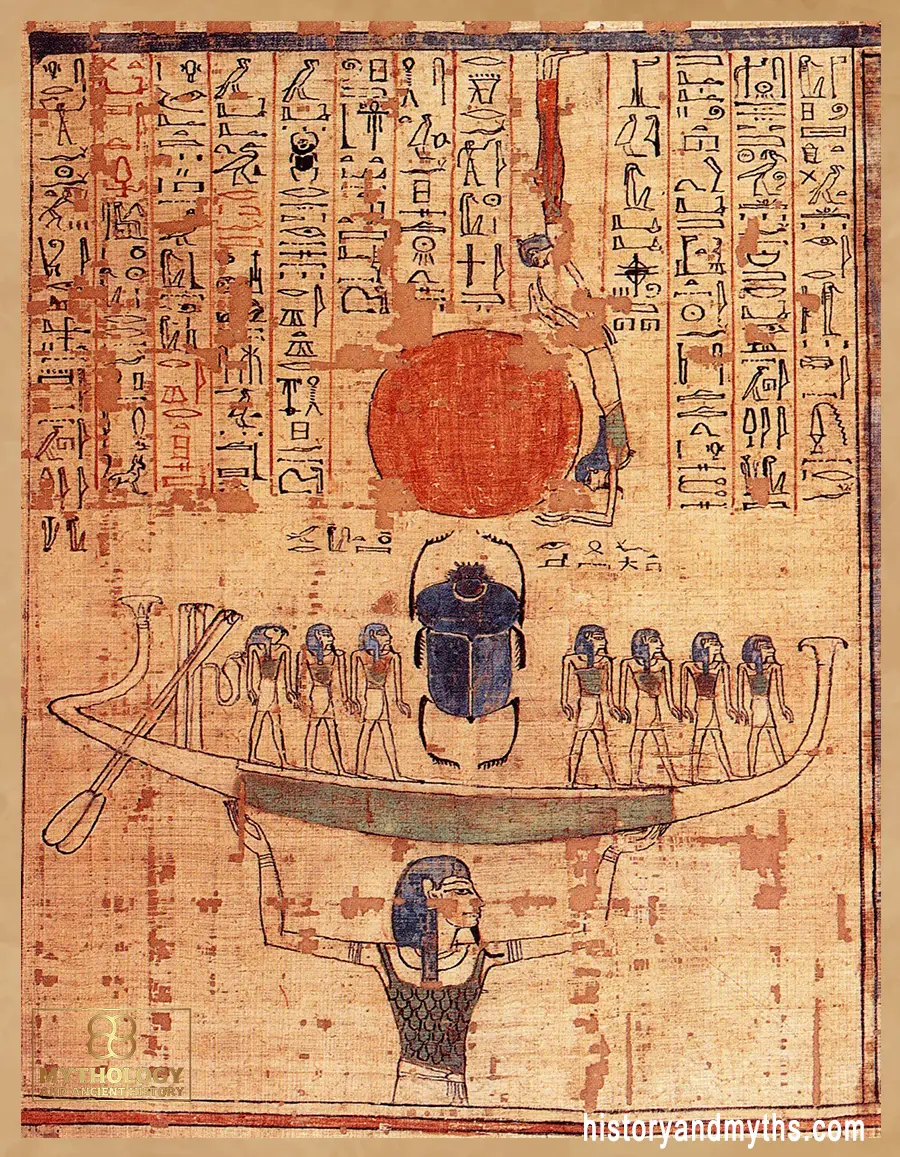
This idea gave their role a subtle, philosophical weight. While they did not act as villains, the Egyptians understood that the universe floated within their expanse. Ma’at—truth, balance, justice—was what kept the waters from reclaiming the world. Every sunrise was proof that order still held. Every night, when Ra sailed through the underworld, he passed again through the primordial waters. His renewal depended on his ability to emerge from Nun’s depths once more.
Texts from the New Kingdom describe moments when the boundary between creation and the primordial deep becomes fragile. When the gods grow weary, Nun supports them and steadies the cosmos. When the world risks slipping into disorder, the concept of the primeval waters serves as a reminder of what lies beyond the edges of creation: not destruction, but the dissolution of form. The Egyptians envisioned a universe constantly negotiated, not permanently secured.
What makes this worldview striking is its psychological dimension. Egyptian life was tied to the rhythms of the Nile, itself a symbol of life emerging from water. Too little flooding meant famine; too much brought devastation. Nun’s waters echoed this real-world relationship with unpredictability. They represented the understanding that creation is always vulnerable, that stability requires effort, and that order must be renewed, not assumed.
Naunet’s role deepens this interpretation. She embodies the concealed dimension of potential—the part of chaos that remains unseen but always present. Her presence suggests that the forces beneath the world are not simply external threats but internal truths. Every human life, like the sun, faced periods of submersion in darkness and reemergence into light.
Thus, Nun and Naunet were not only cosmological entities—they were mirrors of the Egyptian experience. They taught that existence depends on balance, that order must be maintained, and that every act of renewal is part of a cosmic cycle older than the gods themselves.
Key Insights on Nun & Naunet
- They represent the **primordial waters**—the state of infinite potential before creation.
- Creation was seen as an **emergence**, with the first mound rising from Nun’s depths.
- The pair belongs to the **Ogdoad of Hermopolis**, embodying cosmic duality and balance.
- Neither deity had temples or active cults; their role was **cosmic, not personal**.
- In funerary texts, the deceased must pass through Nun’s waters to achieve **rebirth**.
- Naunet symbolizes the **hidden, veiled dimension** of creation’s potential.
Nun & Naunet in the Afterlife Texts: The Waters of Rebirth and the Road Beyond Death
In the Egyptian imagination, death was not an ending but a passage—a transition that mirrored the first dawn of creation. Just as the sun rose from the primordial waters each morning, the deceased hoped to rise again into a renewed existence. This belief made Nun and Naunet central figures in funerary thought, even though they were not gods of the dead in a traditional sense.
The Pyramid Texts and Coffin Texts contain numerous references to the “waters of Nun,” described as the realm the soul must navigate before achieving transformation. These waters were not a void to be feared; they were the same fertile depth from which the creator-god emerged. Passing through them meant returning to the source, shedding form, and preparing for rebirth. In this sense, every deceased individual reenacted the world’s first moment of becoming.
Some spells speak directly to Nun, asking him to lift the deceased the way he lifted the gods in their moment of weakness. Others refer to the dead as “children of the primeval waters,” suggesting that humanity shares the same origin as the divine. Naunet appears in similar contexts, often associated with protection, concealment, and safe passage—qualities that reflect her symbolic connection to the hidden aspects of creation.
The Book of the Dead reinforces this theme through imagery: boats sailing across calm expanses, gods guiding the deceased through flooded regions, and scenes where the soul hovers above dark waters before taking form again. The journey is cyclical, not linear; one does not leave the world but returns to the place where all things began.
This cosmic perspective gave Egyptians a striking sense of continuity. Life was a single phase in a larger process, and death was simply the moment when the soul slipped beneath the surface of creation to reenter its original state. Emerging again—reborn, renewed—was the ultimate goal. Nun and Naunet were the silent companions in this journey, their waters serving as both path and promise.
Through them, the Egyptians expressed one of humanity’s oldest intuitions: that beginnings and endings are intertwined, and that rebirth comes only after a return to the depths from which all things first emerged.
Key Takeaways
- Nun and Naunet embody the **primordial waters**, the infinite potential preceding creation.
- They are not creators themselves, but the **cosmic condition** that made creation possible.
- The **primeval mound** emerged from their depths, initiating the first moment of existence.
- Neither deity had temples; their presence was **symbolic, philosophical, and cosmological**.
- Funerary texts depict the soul passing through Nun’s waters to achieve **rebirth** in the afterlife.
- Their duality reflects the Egyptian belief in **balance**, with Naunet representing the hidden dimension of potential.
FAQ — Nun & Naunet
1. Who are Nun and Naunet in ancient Egyptian mythology?
They are the personification of the primordial waters, representing the infinite, formless potential that existed before creation.
2. Were Nun and Naunet considered creator gods?
Not exactly. They did not create the world themselves, but creation emerged from their depths, making them older than all creator gods.
3. What does Nun symbolize?
Nun represents the boundless, unshaped ocean from which the first mound—and eventually the gods—arose.
4. What is Naunet’s role?
Naunet embodies the hidden, feminine dimension of the primordial waters, completing the cosmic balance essential to creation.
5. Why don’t Nun and Naunet have temples?
Because they were cosmic principles, not personal gods. Their presence was symbolic, reflected in temple architecture and cosmology rather than active worship.
6. How are Nun and Naunet connected to the Ogdoad?
They form one of the four divine pairs representing the chaotic, pre-creation world in Hermopolis.
7. What is the primeval mound and how is it related to Nun?
The primeval mound is the first solid form to emerge from the waters of Nun, marking the beginning of creation.
8. Did the Egyptians believe the world could return to the waters of Nun?
Yes. Nun’s waters symbolized potential dissolution, reminding Egyptians that order (ma’at) must be maintained to prevent cosmic collapse.
9. What role do they play in the afterlife?
The soul must pass through Nun’s waters to achieve rebirth, mirroring the sun’s daily cycle of renewal.
10. Are Nun and Naunet mentioned in the Book of the Dead?
Yes. They appear within spells that guide the deceased through the primordial waters toward transformation.
11. Do they appear in myths involving other gods?
Often indirectly. Even gods like Ra and Atum acknowledge emerging from the waters of Nun, reinforcing its foundational role.
12. What makes Nun and Naunet unique among Egyptian deities?
They are not characters in stories but cosmic conditions—the eternal backdrop behind every act of creation and rebirth.
Sources & Rights
- Allen, James P. Middle Egyptian: An Introduction to the Language and Culture of Hieroglyphs. Cambridge University Press.
- Hornung, Erik. Conceptions of God in Ancient Egypt: The One and the Many. Cornell University Press.
- Assmann, Jan. Death and Salvation in Ancient Egypt. Cornell University Press.
- Faulkner, Raymond O. The Ancient Egyptian Pyramid Texts. Oxford University Press.
- Faulkner, Raymond O. The Ancient Egyptian Coffin Texts. Aris & Phillips.
- Wilkinson, Richard H. The Complete Gods and Goddesses of Ancient Egypt. Thames & Hudson.
- Pinch, Geraldine. Egyptian Mythology: A Guide to the Gods, Goddesses, and Traditions of Ancient Egypt. Oxford University Press.
Written by H. Moses — All rights reserved © Mythology and History