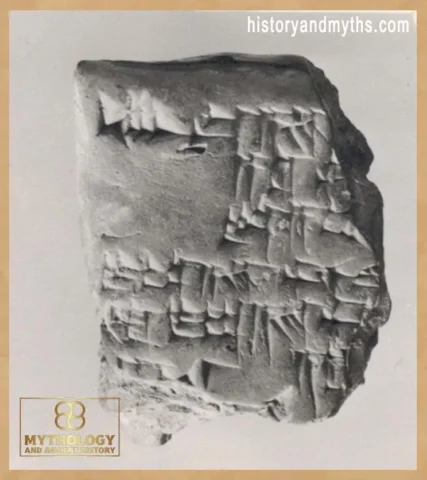
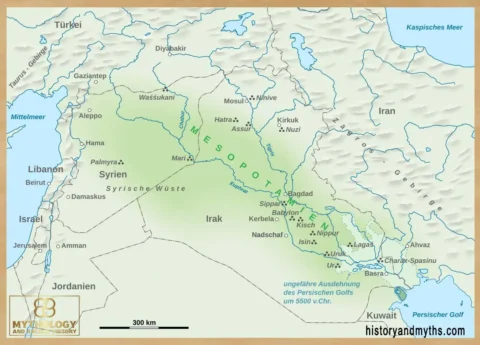
The Rise of the Sumerian Empire: Lugal-Zage-Si to Ur III
The Sumerian Empire emerged from a long tradition of independent city-states and reached its height between the reign of Lugal-Zage-Si and the Third Dynasty of Ur (Ur III). This period marks the first attempts at political unification in Mesopotamia, the rise of empire, and the final consolidation of Sumerian power before its collapse.
From City-States to Conflict in Late Sumer
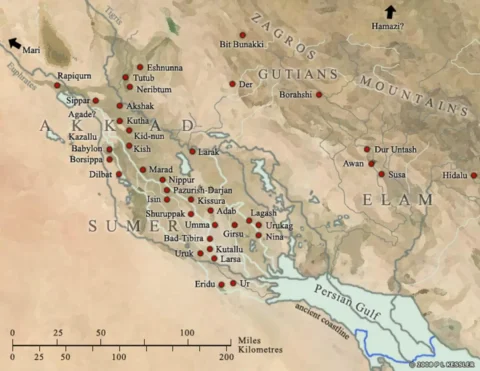
The era of the Sumerian city-states was an era of civilization, construction, and political peace, but the latter part of it witnessed political tension that began between two rival dynasties in Lagash and Umma.
The Reign and Conquests of Lugal-zage-si
It began first between them over irrigation water, agricultural land and defining borders, and concluded between them with the emergence of the powerful Umma king Lugal-zage-si, who eliminated the Lagash dynasty in the time of its last king Urukagina (whose name is now read Uru-inim-gina), a great social reformer and we consider him the first legislator in Sumer, but the political intransigence adopted by Lugal-zage-si made him rush towards the cities He rushed towards the other Sumerian cities and ruled Uruk, and then the Sumerian cities fell into his hands one after another, until he called himself (King of Sumer) and thus established a single Sumerian kingdom or state, which is the first of its kind in history.
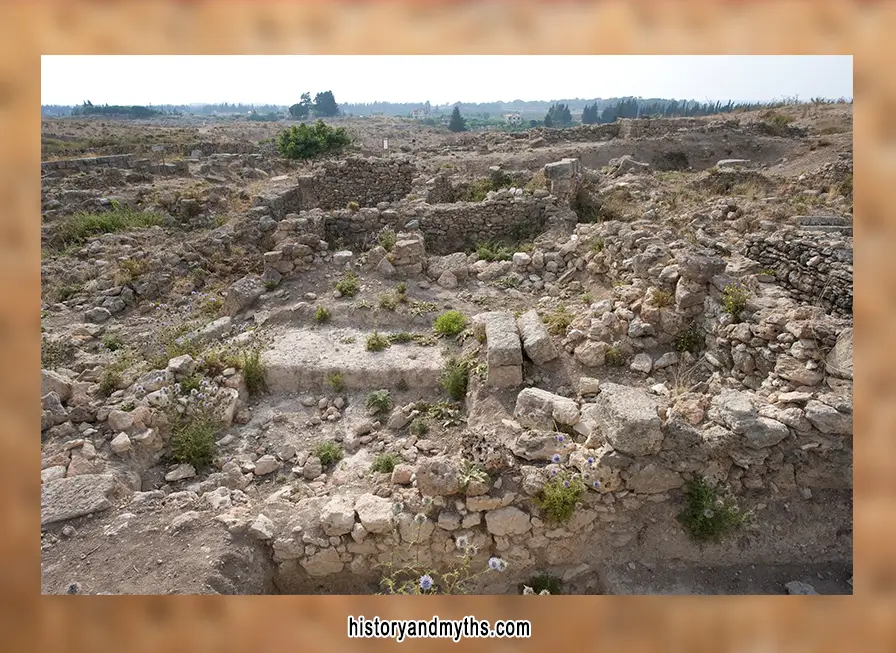
| Phase | Main Ruler / Dynasty | Political Form | Historical Role |
|---|---|---|---|
| Late City-States | Lugal-Zage-Si | Unified Kingdom | First political unification of Sumer |
| Akkadian Period | Sargon of Akkad | Empire | First empire in recorded history |
| Gutian Interlude | Gutian Rulers | Fragmented Rule | Political collapse and instability |
| Sumerian Revival | Utu-Hengal | Restored City-States | Expulsion of Gutians |
| Ur III Period | Ur-Nammu → Ibbi-Sin | Centralized Empire | Final peak of Sumerian power |
Why Centralization Changed the Fate of Sumer
If we want to pause for a moment on this serious event, we can objectively say that the emergence of a single Sumerian state was a prelude to the demise of all of Sumer. Because Sumer invented a great political system (city-states), and its governance was based on political decentralization, a kind of confederation that was suitable for the life of that time .
(When Enlil, the king of all sovereign countries, granted him kingship over the homeland (Sumer), drew the attention of the nation to him, made all countries wait for him, and made everyone, from wherever the sun rises to wherever the sun sets, surrender to him.
Although there are indications of the appearance of Sumerian cultural influences in these areas since the previous stage, we cannot be politically certain of the emergence of a Sumerian empire in the era of Lugal-zage- Si, although we can fully confirm the emergence of a unified Sumerian state or kingdom in his era, which included the south and north of the Rafidain Valley and lasted a little more than a quarter of a century.
The Emergence and Expansion of the Akkadian Empire
It seems that this period of the emergence of the sprawling Sumerian state aroused the lust of a non-Sumerian man who lived in this Sumerian state, who is of Semitic origin, who worked as a bearer (cup) or waiter for the Sumerian king of Kish (Ur-Zababa).
Why This Period Changed Mesopotamian History
- The first experiment in unifying Sumer under a single ruler
- The transition from city-states to empire
- The Akkadian model reshaped Near Eastern politics
- Ur III marked the last and most organized Sumerian state
- Set the template for later Mesopotamian empires
© historyandmyths.com — Educational use
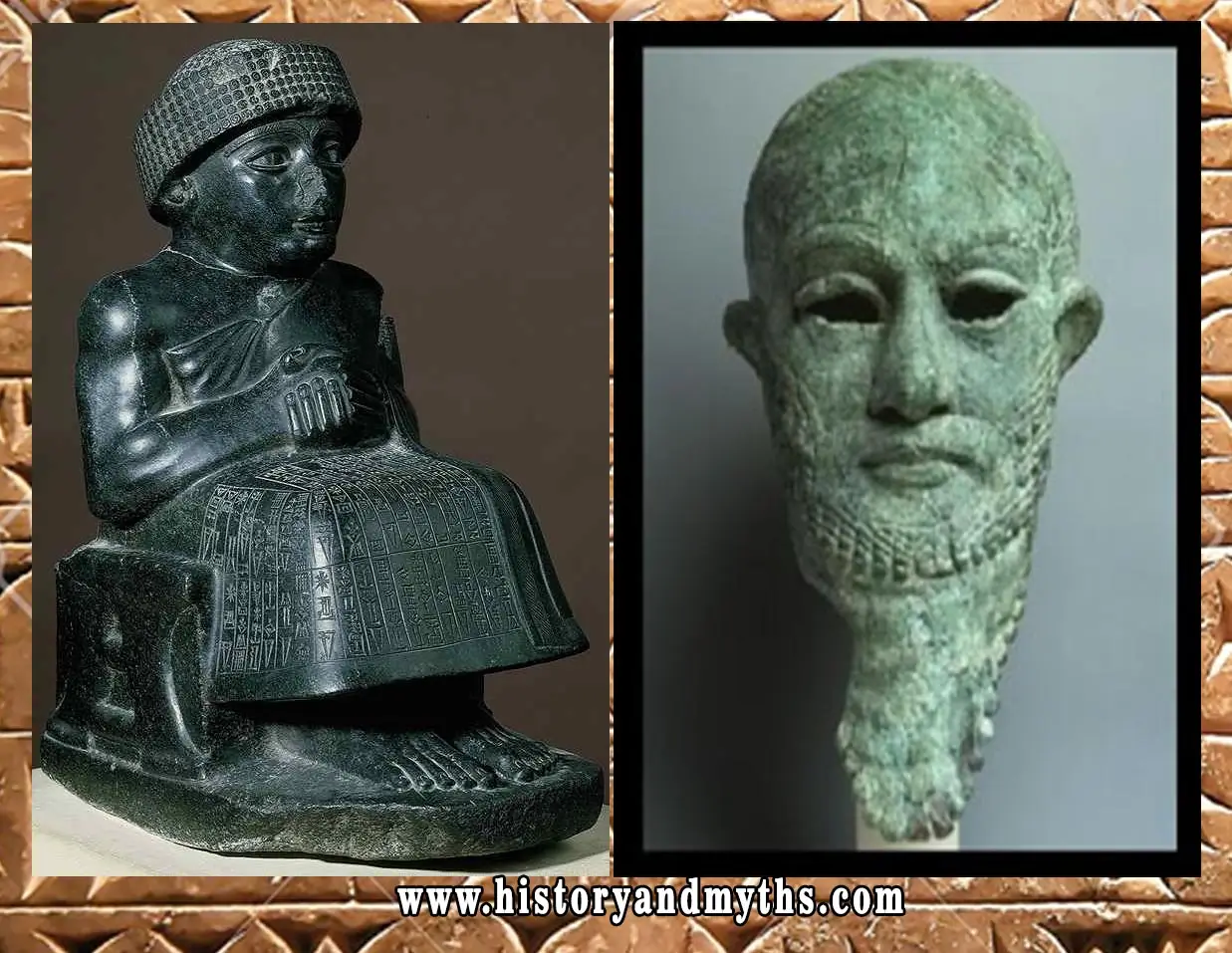
Sumerians and Akkadians: A Peaceful Cultural Shift
The transfer of power from the Sumerians to the Akkadians was peaceful because of the historical relationship that binds the two peoples and causes Sumer to embrace them for many centuries and reduce the possibilities of destruction between them, and among the civilizational matters that should be noted on the subject of the transfer of political power to the Akkadian Semites is the absence of the national conflict that was assumed by ancient researchers between the Semites and the Sumerians as originating from national reasons.
Continue Reading
The Decline of the Akkadian Empire and the Gutian Rule
The Akkadian state was ruled by ten kings, of whom the first five were famous, then the Gutians, who are from the Zagros Mountains adjacent to Iraq’s eastern border with Iran, were able to eliminate the Akkadian state and inherit most of its cities, especially the northern ones, and ruled for 125 years, during which they did not provide any culture or civilization to Iraq.
The Sumerian Revival and the Rise of Ur III
first of their kings (Sarlagab) and for a short time in southern Iraq until they withdrew to the north and took the city of (Arabkha) (Kirkuk) as their center, so that such an atmosphere paved the return of the Sumerian city-states to develop and revive, and a dynasty appeared in Uruk ruled by five kings.
The Era of the Sumerian Empire – The Third Dynasty of Ur
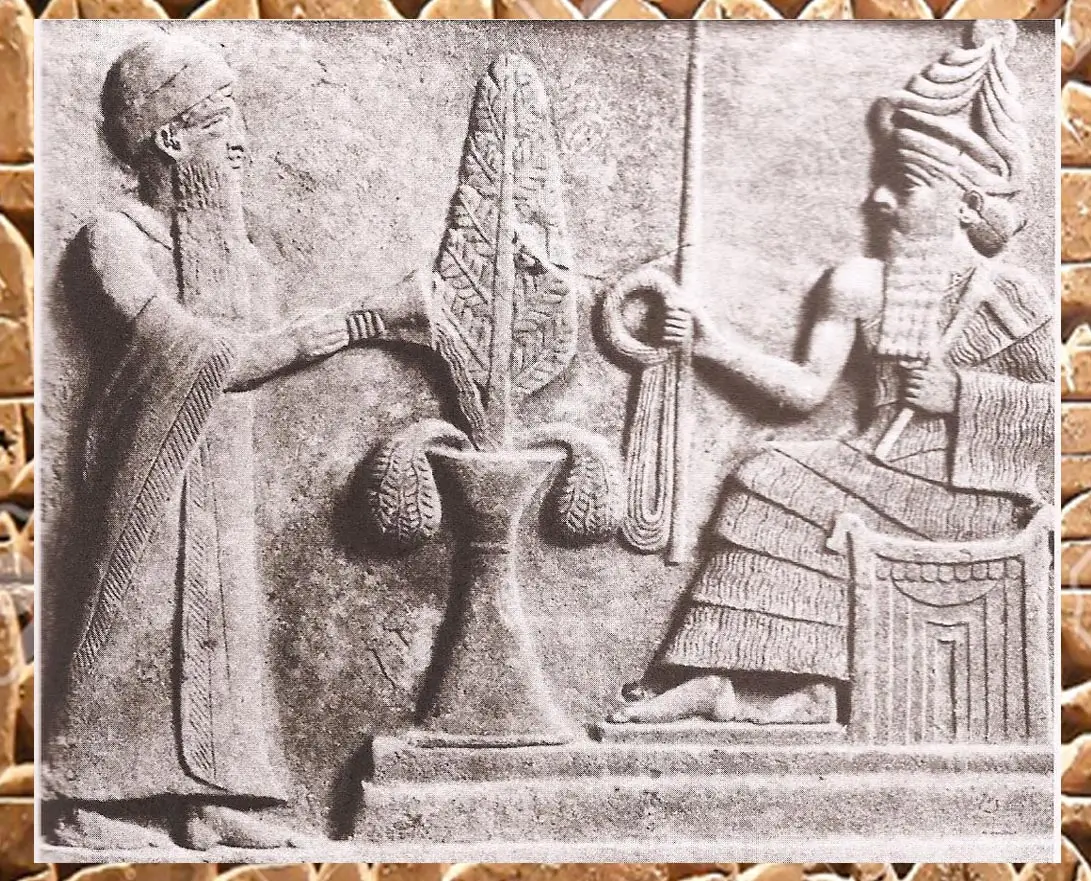
The rule of the Third Dynasty of Ur lasted almost one century, in which it was not satisfied with unifying the Sumerian cities, but was able to extend the influence of Sumer beyond the Mesopotamian Valley, imitating what the Akkadian Empire did, as its conquests included most of the Near East, in addition to North Mesopotamia, its conquests reached Elam, Syria, the eastern regions of Asia Minor and the Arabian Gulf regions.
The third dynasty of Ur was ruled by five kings, Ur-Nammu, Shulgi, Amar-Sin, Shu-Sin and Ibbi-Sin.
During this last Sumerian century, the Sumerians achieved their greatest achievements in all fields and established the pillars of a great civilization that would be the basis for what came after it, as the ancient Sumerian culture revived as a result of the Akkadian legacy that added much to it and thus a new Sumerian culture arose, which became more capable of giving the ancient world that began to rise and establish its states and civilizations.
The Sumerian king Ur-Nammu was the most famous and great king of the Ur dynasty, he was interested in building and urbanization in all of Sumer, and the Ur ziggurat built for the moon god (nanna) is considered one of his most famous and magnificent architectural metaphors. He is also considered one of the oldest legislators in history, as his law, written in the Sumerian language, which reflects his human sense of justice and his enactment of the laws of financial fines instead of physical retribution (an eye for an eye), which was later enacted by Hammurabi.
Reasons for the Fall of the Sumerian Empire
It is believed that the deep reason for the fall of the Sumerian Empire is an economic reason, as it became difficult for a country whose fertile land began to rise in salinity and its agricultural production decreased, to provide food and a quiet life to its distant regions. and to pay attention to its proper administration.
As for the political and military reasons, they were direct and violent, as it was clear that the heart of Sumer in southern Iraq became between two fierce jaws, the first came from the east, where the Elamites attacked the Sumerian cities and destroyed them, and the second came from the west, where the Amorites (who are new Semites) attacked Sumer and seized the rule in their cities, then they were able to expel the Elamites from Mesopotamia and became the kings of the new dynasties and kingdoms, then one of the Amorite dynasties united Iraq, the first Babylonian dynasty.
Thus, the political entity of the Sumerians disappeared forever, but their cultural presence was the foundation on which all the civilizations of ancient Iraq were built, and the Sumerian language continued to be used as a language of religion and science for later periods.
The Sumerian Empire in the late reign of its emperors had begun to disintegrate, as Elam separated from it, then the Syrian cities separated, while the cities of Mesopotamia were formed like scattered pieces of large and small kingdoms, in the south of the Mesopotamian Valley, a sharp struggle emerged between the kingdoms of ISIN and LARSA to occupy the center of Ur and rule the country of Sumer and Akkad. In the north of the Rafidain Valley, an intense struggle emerged between the kingdoms of Eshnunna and Assyria to control the major trade routes, and Iraq gradually disintegrated into new Semitic city-states this time until the emergence of the first Babylonian dynasty, which reunited it under a strong Semitic rule.
Conclusion
The Sumerian history shows us a gradual development, from the distant agricultural origins of the northern Iraqi peasantry to the emergence of clear leaders and priesthoods in the middle of the fourth millennium BC to the emergence of Sumerian city states to the emergence of a single Sumerian state to the emergence of the Sumerian Empire, a history that deserves reflection and re-examination always because it is the first written history in the world of the first civilization that graduated politically from the council government to the city to the state to the empire.
Key Takeaways
- Lugal-Zage-Si created the first unified Sumerian state
- Centralization weakened the traditional city-state system
- Sargon transformed Sumerian unity into a true empire
- The Gutian period caused political fragmentation
- Ur III restored Sumerian power through law and administration
Frequently Asked Questions
Who was Lugal-Zage-Si?
He was the first ruler to politically unify the Sumerian city-states into one kingdom.
Was Lugal-Zage-Si the first emperor?
No. He ruled a unified kingdom, not a true empire.
Why is Sargon of Akkad important?
He created the first territorial empire in Mesopotamian history.
What was the Third Dynasty of Ur?
The final and most centralized Sumerian state, known as Ur III.
Why did the Sumerian Empire collapse?
Economic decline, external invasions, and administrative overextension.
Sources & Rights
- Black, Jeremy; Green, Anthony. Gods, Demons and Symbols of Ancient Mesopotamia. London: British Museum Press, 1992.
- Cooper, Jerrold S. Reconstructing History from Ancient Inscriptions: The Lagash–Umma Border Conflict. Malibu: Undena Publications, 1983.
- Crawford, Harriet. Sumer and the Sumerians. 2nd ed. Cambridge: Cambridge University Press, 2004.
- Hallo, William W., and J. J. A. van Dijk. The Exaltation of Inanna. New Haven: Yale University Press, 1968.
- Kramer, Samuel Noah. The Sumerians: Their History, Culture, and Character. Chicago: University of Chicago Press, 1963.
- Leick, Gwendolyn. Mesopotamia: The Invention of the City. London: Penguin Books, 2001.
- Michalowski, Piotr. The Correspondence of the Kings of Ur. Winona Lake: Eisenbrauns, 2011.
- Postgate, J. Nicholas. Early Mesopotamia: Society and Economy at the Dawn of History. London: Routledge, 1992.
- Roux, Georges. Ancient Iraq. 3rd ed. London: Penguin Books, 1992.
- Steinkeller, Piotr. “The Sumerian City-State.” In Archaic States, edited by Gary M. Feinman and Joyce Marcus. Santa Fe: School of American Research Press, 1998.
- Van De Mieroop, Marc. A History of the Ancient Near East ca. 3000–323 BC. 3rd ed. Oxford: Wiley-Blackwell, 2016.
- Westenholz, Aage. Legends of the Kings of Akkade. Winona Lake: Eisenbrauns, 1997.
Written by H. Moses — All rights reserved © Mythology and History