What If Heracles Failed the Twelve Labors?
What if Heracles had reached the final challenge of the Twelve Labors but failed to capture Cerberus? In Pseudo-Apollodorus’ account, he descended into the Underworld, overpowered its three-headed guardian, and brought him before King Eurystheus. Our scenario changes that outcome: Heracles survives the encounter but returns without Cerberus.
Eurystheus would have grounds to reject the unfinished labor, leaving Heracles’ release from service unresolved and his promised immortality in doubt. His earlier achievements, including the rescue of Theseus, would remain intact. The question is whether he could complete the task on another attempt or find a different way to secure his freedom.
What Actually Happened in the Twelve Labors?
In Pseudo-Apollodorus’ account, Hera drives Heracles into madness, causing him to kill his children. After undergoing purification, he consults the oracle at Delphi. The priestess instructs him to live at Tiryns, serve King Eurystheus for twelve years, and perform ten assigned labors. She also promises him immortality upon their completion.
Eurystheus refuses to count two of those labors: the killing of the Lernaean Hydra because Iolaus assisted Heracles, and the cleaning of the Augean stables because Heracles had arranged to receive payment. He therefore assigns two replacements, obtaining the golden apples of the Hesperides and capturing Cerberus.
In this version, Cerberus is the final task. Heracles subdues the guardian without weapons, presents him to Eurystheus, and returns him to Hades. The familiar twelve feats are completed, although Eurystheus has accepted only ten toward the original requirement.
Our alternate scenario follows Pseudo-Apollodorus’ chronology. Other ancient accounts differ, notably Euripides’ Heracles, which places the madness and killing of Heracles’ children after the labors.
The Point of Divergence: Heracles Fails to Capture Cerberus
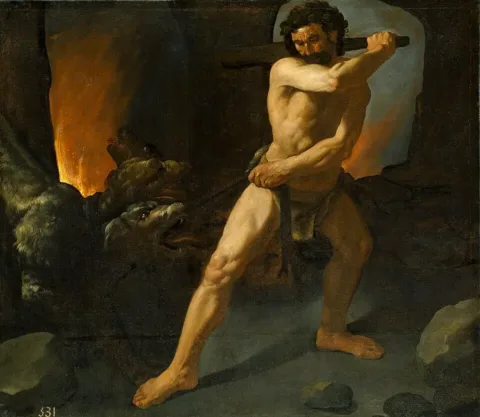
In Pseudo-Apollodorus’ account, Hades agrees to let Heracles take Cerberus on one condition: he must overpower the guardian without using his weapons.
Heracles finds Cerberus near the gates of Acheron. Protected by his armor and lion skin, he seizes the creature and holds on despite being bitten by the serpent in its tail. In the original myth, Heracles refuses to release his grip until Cerberus submits.
Our scenario changes the outcome of that struggle. Cerberus’ resistance and the painful bite force Heracles to loosen his hold, allowing the guardian to break free. Unable to subdue him under Hades’ conditions, Heracles abandons the attempt and leaves the Underworld alive but unsuccessful.
Alternate Mythology Scenario
Point of Divergence: Heracles survives his struggle with Cerberus but fails to subdue the guardian without weapons. He leaves the Underworld with his twelfth labor unfinished.
What Remains Unchanged: His previous eleven labors are complete. Theseus has already been rescued, and Cerberus remains in the Underworld under Hades’ authority.
What Changes: Heracles can no longer claim to have fulfilled every task assigned by Eurystheus. His release from service and the immortality promised upon completion are now uncertain. Everything that follows is an exploration of those consequences, not an event recorded in Greek mythology.
What Happens When Heracles Returns to Eurystheus?
Heracles returns without Cerberus, giving Eurystheus clear grounds to reject the final labor. Although the hero has accomplished eleven of the familiar twelve feats, Eurystheus has accepted only nine toward the ten required by the oracle. The Hydra and Augean stables were excluded from the count.
Eurystheus could insist on another attempt, but the surviving myth provides no fixed penalty for failure. The oracle had ordered both twelve years of service and the completion of ten accepted labors, without explaining what should happen if one obligation remained unfinished.
Heracles might agree to face Cerberus again or seek further guidance from Delphi. No surviving account establishes whether Eurystheus could extend Heracles’ service indefinitely.
Would Heracles Lose His Chance at Immortality?
In Pseudo-Apollodorus’ account, the Delphic oracle promises Heracles immortality upon completing his labors. Failing to capture Cerberus would leave that condition unfulfilled, but it would not automatically mean losing his chance to become a god forever.
Eurystheus could refuse to recognize the final labor, but he had no authority to grant or deny divine status. In the original myth, Heracles eventually ascends to Olympus from his funeral pyre on Mount Oeta and marries Hebe, daughter of Hera. The sources do not explain whether that destiny would still await him after an unfinished labor.
Would Hera Finally Defeat Heracles?
Hera had opposed Heracles since childhood. In Pseudo-Apollodorus, she sends serpents to kill him as an infant and later drives him into the madness that results in the deaths of his children.
Failing to capture Cerberus would be another serious setback for Heracles, but not a final victory for Hera. He would still be alive and capable of attempting the labor again. The original myth gives no indication that Hera could decide how Eurystheus handled a failed task, so any further intervention by her would remain speculative.
Would Theseus Still Escape the Underworld?
Yes. In Pseudo-Apollodorus, Heracles finds Theseus and Pirithous imprisoned in the Underworld after their attempt to abduct Persephone.
Heracles frees Theseus by taking his hand. When he tries to release Pirithous, the earth shakes, forcing him to abandon the attempt. Both events occur before Heracles asks Hades for permission to capture Cerberus.
Since our scenario changes that later encounter, Theseus has already been rescued, while Pirithous remains imprisoned.
How Would Heracles’ Later Myths Change?
In Pseudo-Apollodorus, Heracles travels to Oechalia after completing his labors and wins an archery contest for the hand of Iole, only to be refused by her family. Later, he kills Iphitus, who had sought his help recovering stolen cattle. The murder eventually leads to another period of servitude under Omphale, queen of Lydia.
If Heracles remained tied to Eurystheus, his journey to Oechalia could be delayed. That would disrupt the sequence leading to Iphitus’ death and Heracles’ service to Omphale.
The consequences could reach Troy. In Apollodorus, Heracles attacks the city after his service to Omphale, kills King Laomedon, and spares his son Podarces. Laomedon’s daughter Hesione then ransoms Podarces, who becomes known as Priam.
A prolonged delay in Heracles’ freedom could change when that campaign takes place, or whether it happens at all. If Heracles never attacks Troy, the particular events that lead to Podarces receiving the name Priam would not unfold as Apollodorus describes them.
Could Heracles Attempt the Final Labor Again?
Pseudo-Apollodorus does not describe what would happen if Heracles failed to capture Cerberus, but nothing in his account explicitly rules out another attempt.
Returning to the Underworld would present two obstacles. Heracles would need Hades to permit another confrontation, and he would still have to overpower Cerberus without weapons. Having already failed under those conditions, he could not count on succeeding through strength alone.
A second attempt remains possible, but neither Hades’ renewed permission nor its outcome can be assumed.
Final Verdict
If Heracles returned from the Underworld without Cerberus, Eurystheus would have grounds to reject the final labor, leaving the oracle’s conditions unfulfilled. Another attempt might restore his path to freedom and immortality, but the surviving Greek sources do not say what would happen if the task remained unfinished.
Academic Sources & Primary Texts
This article draws on ancient Greek accounts of Heracles and modern classical scholarship to examine the Twelve Labors, the capture of Cerberus, and the hero’s later fate. The alternate scenario is a fictional divergence from the surviving mythology.
Primary Ancient Sources
- Pseudo-Apollodorus.
Bibliotheca, Book II, 2.4.12–2.7.7.
Translated by James G. Frazer.
The principal source for the Delphic oracle, Eurystheus’ rejection of two labors, the capture of Cerberus, the rescue of Theseus, and Heracles’ later adventures.
Read the Ancient Text - Euripides.
Heracles.
Translated by Edward P. Coleridge, 1891. Perseus Digital Library, Tufts University.
An important alternative tradition that places Heracles’ madness and the killing of his children after the completion of his labors.
Read the Relevant Passage - Diodorus Siculus.
Library of History, Book IV, 4.25–4.26.
Translated by C. H. Oldfather.
Preserves a different ordering of the final labors, placing Cerberus before the golden apples, and offers another version of the Underworld journey.
Read the Ancient Text
Modern Academic Scholarship
- Pauline Hanesworth.
“Labor XII: Cerberus.”
In The Oxford Handbook of Heracles, edited by Daniel Ogden, pp. 165–180. Oxford University Press, 2021.
A specialized examination of the Cerberus labor, Heracles’ descent into the Underworld, and its relationship with the stories of Theseus and Pirithous.
Oxford Academic - Katherine Lu Hsu.
“The Madness and the Labors.”
In The Oxford Handbook of Heracles, edited by Daniel Ogden, pp. 13–26. Oxford University Press, 2021.
Compares the different traditions concerning Heracles’ madness, his service to Eurystheus, and the relationship between his labors and eventual apotheosis.
Oxford Academic - Kristin Heineman.
“Oechalia, Delphi, and Omphale.”
In The Oxford Handbook of Heracles, edited by Daniel Ogden, pp. 251–265. Oxford University Press, 2021.
Examines the traditions surrounding Oechalia, the Delphic oracle, and Heracles’ later servitude under Omphale.
Oxford Academic - Dámaris Romero-González.
“Deianeira, Death, and Apotheosis.”
In The Oxford Handbook of Heracles, edited by Daniel Ogden, pp. 266–280. Oxford University Press, 2021.
An academic study of Heracles’ death, his transformation into a god, and his marriage to Hebe in the surviving traditions.
Oxford Academic - Emma Stafford.
Herakles. Routledge, 2012.
A scholarly study of the hero’s mythology, literary traditions, religious significance, and changing representations across the ancient Greek world.
Routledge
Source & Methodology Note:
The scenario follows Pseudo-Apollodorus’ version, in which capturing Cerberus is Heracles’ final labor. Ancient accounts differ in chronology and narrative details. Heracles’ failure to capture Cerberus, and the consequences explored here, are hypothetical rather than events recorded in the ancient sources.