What If Ishtar Never Returned from the Underworld?
In the Akkadian Descent of Ishtar, the goddess’s absence affects more than the divine world. While she remains in the Underworld, sexual activity and reproduction stop among both humans and animals. The crisis ends only when the gods intervene and Ishtar is brought back.
But what if that rescue had failed?
Ishtar would remain trapped in Ereshkigal’s realm, while the disruption above continued. Existing people and animals would not disappear at once, but a world without new births would eventually face consequences far beyond the Underworld.
The question is not simply what happens to Ishtar. It is what happens to a living world that can no longer renew itself in the same way.
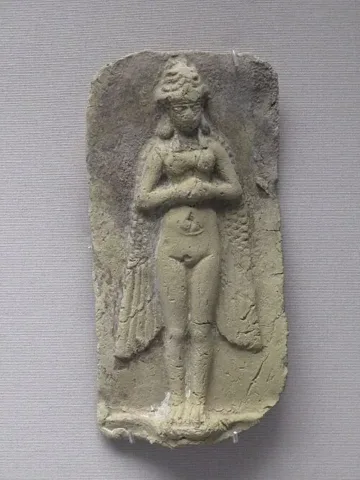
Ishtar or Inanna: Which Version Are We Using?
The descent survives in related Sumerian and Akkadian traditions, but they are not identical.
In the Sumerian version, the goddess is Inanna. In the Akkadian version, she appears as Ishtar. Both descend to the Underworld and confront Ereshkigal, but important details and the endings differ.
This scenario follows the Akkadian Descent of Ishtar because it states most clearly what happens during her absence: sexual activity and reproduction stop among humans and animals.
The Sumerian Descent of Inanna will only be used where it helps clarify later differences, especially the role of Dumuzi.
The Original Turning Point: How Ishtar Returned
In the Akkadian text, Ishtar does not escape the Underworld by her own power.
Once her absence begins to disrupt reproduction above, Papsukkal carries the crisis to Sin and Ea. Ea responds by creating Aṣûšu-namir and sending him into Ereshkigal’s realm.
The intervention succeeds. Ereshkigal orders Namtar to bring Ishtar forward and sprinkle her with the water of life. She is then led back through the seven gates, recovering the clothing and ornaments taken from her during her descent.
Her return ends the crisis above. That is the turning point this alternate scenario changes: Ea’s intervention fails, and Ishtar never reaches the gates that would take her back to the living world.
The Alternative Scenario: Ishtar Never Leaves the Underworld
In this version of the story, Ea’s rescue fails.
Ishtar remains in Ereshkigal’s realm, and the disruption already described in the Akkadian text does not end. Mating and reproduction remain suspended while life above continues without her.
The world does not collapse immediately. Cities still stand, people continue their daily lives, and rulers remain in power.
But the crisis is no longer temporary. With Ishtar still below, the living world now has to face a condition it was never meant to sustain indefinitely.
Reproduction Never Restarts
The clearest consequence of Ishtar’s continued absence is that reproduction does not resume.
In the Akkadian text, bulls no longer mount cows, donkeys stop mating, and men and women no longer come together while Ishtar remains in the Underworld. The disruption is therefore broader than reduced fertility; sexual union itself has been interrupted.
If Ishtar never returns, the text gives us no point at which that condition ends. The world above remains inhabited, but the process that produces new generations has stopped.
Would Humanity Eventually Die Out?
Not immediately, but a permanent halt in reproduction would eventually become a demographic crisis.
Adults already alive could continue farming, trading, governing, serving in armies, and maintaining temples for years. The problem would emerge as communities aged without children replacing them.
Workforces would shrink, households would disappear, settlements would contract, and fewer people would remain to support the institutions that kept cities functioning.
If no god restored reproduction, extinction would become the long-term consequence. The collapse would happen through ageing and population decline rather than through a single catastrophe.
What Would Happen to Animals and Food Supplies?
Animal populations would face the same basic problem.
The Akkadian text specifically mentions bulls and cows, as well as donkeys, no longer mating. Existing animals would remain for a time, but breeding populations could not replace losses from age, disease, slaughter, or accident.
As those losses accumulated, livestock supplies more broadly would come under pressure. That could reduce access to meat, milk, hides, wool, transport, and animal labor used in farming and hauling.
The text does not say that crops themselves stop growing, so the scenario should not be turned into an instant barren-earth crisis. The more likely problem is gradual: fewer animals, fewer workers, and an agricultural system becoming harder to sustain over time.
Would Love and Sexual Desire Disappear?
The Akkadian text links Ishtar’s absence directly to the breakdown of sexual activity. Men and women no longer come together, just as animals stop mating.
That does not mean every form of affection or emotional attachment disappears. The text is more specific: sexual union is disrupted while Ishtar remains in the Underworld.
If that condition continued, the effects would reach beyond reproduction. Marriage, household formation, and the creation of new families would become increasingly difficult to sustain.
Ishtar’s absence would therefore affect not only birth rates, but also the intimate relationships through which communities reproduce themselves socially as well as biologically.
Could Another Goddess Replace Ishtar?
Probably not completely.
Mesopotamian religion included deities whose functions overlapped with parts of Ishtar’s sphere, so some roles could be taken up elsewhere. But Ishtar brought together sexuality, reproduction, warfare, royal power, and divine favor in a combination that no single replacement could easily reproduce.
Restoring reproduction would address the most urgent crisis, but it would not restore everything associated with Ishtar.
Some of her functions could shift toward other gods, while her broader place in the religious system remained difficult to replace.
Would War Continue Without Ishtar?
Yes. Ishtar’s absence would not make warfare disappear.
She was strongly associated with battle, violence, and victory, but wars would still be fought by kings, armies, and rival cities. Her disappearance would change the divine support surrounding warfare rather than remove conflict itself.
Rulers who had relied on Ishtar’s favor in battle might turn more heavily to other gods for military protection or success.
War would continue, but one of Mesopotamia’s most important divine patrons of battle and victory would no longer be present in the world above.
What Happens to Kingship Without Ishtar?
Ishtar’s absence would not end kingship, but it could weaken one important source of royal legitimacy.
Mesopotamian kingship drew support from several gods and institutions, not from Ishtar alone. Even so, she was closely associated with royal favor, legitimate rule, and the bond between the king and the divine world.
Rulers who depended on her patronage would have to seek support elsewhere. Other gods could still legitimize kingship, but the religious language surrounding royal authority would begin to shift.
Monarchy would survive. What would change is the way some rulers justify and protect their power, especially in places where Ishtar’s cult was closely tied to the throne.
Read More
Would Ereshkigal Become More Powerful?
Keeping Ishtar in the Underworld would strengthen Ereshkigal’s position within her own realm.
She would have succeeded in holding one of Mesopotamia’s most important goddesses below despite attempts to bring her back. As long as Ishtar’s absence continued to damage the living world, that would give Ereshkigal considerable leverage over the gods above.
But there is no basis for saying she would inherit Ishtar’s functions. Controlling Ishtar would not make Ereshkigal a goddess of sexuality, warfare, or kingship.
Her advantage would come from control, not transformation. She possesses something the gods above urgently need returned.
What Would the Gods Do Next?
The gods would have strong reason to keep searching for a solution.
In the Akkadian story, they already intervene because Ishtar’s absence disrupts the living world. If Ea’s first rescue failed, leaving her below would allow that crisis to continue.
A second attempt might involve another messenger, a bargain with Ereshkigal, or some other way of restoring reproduction. The surviving text does not tell us what such a solution would look like, so any further intervention belongs to the alternate scenario rather than the original myth.
Complete inaction is the least convincing outcome. As long as reproduction remained suspended, the pressure on the gods to act would only increase.
What Happens to Tammuz If Ishtar Never Returns?
Tammuz becomes less central to the immediate crisis if Ishtar never escapes the Underworld.
In the Sumerian Descent of Inanna, Dumuzi enters the story after Inanna is allowed to return but must provide someone to take her place. The Akkadian Descent of Ishtar handles the Tammuz material differently and much more briefly.
If Ishtar never returns, the scenario never reaches the same stage in which her release creates the need for a substitute. Tammuz would not automatically descend simply because she remained below.
His role would therefore change substantially. Instead of becoming part of the aftermath of her return, he would remain outside a crisis that had never been resolved.
Would Mesopotamian Religion Change?
Ishtar’s worship would not disappear simply because the goddess remained in the Underworld.
Her cult was deeply rooted in major cities and connected with sexuality, warfare, royal authority, and divine protection. Temples, priesthoods, and traditions centered on her would not vanish overnight.
What could change is how worshippers understood her absence. If Ishtar were believed never to return, some traditions surrounding her might gradually place greater emphasis on loss, absence, or her connection with the world below. Other gods could also become more important in areas where worshippers once relied heavily on her.
The religious system would adapt rather than collapse. Ishtar could remain a major goddess even while the meaning of her continued absence became part of how she was remembered and worshipped.
Most Likely Outcome
If Ishtar never returned, the crisis would deepen gradually rather than destroy the world at once.
Reproduction would remain suspended, populations and herds would begin to decline, and the pressure on the gods to find another solution would increase.
The most likely response would be another attempt to negotiate with Ereshkigal or restore the lost function by some other means. If every intervention failed, however, long-term population decline would become unavoidable.
Ishtar’s permanent absence would not create one sudden apocalypse. It would create a world that slowly loses its ability to replace what it loses.
Why Ishtar’s Return Mattered
Ishtar’s return restored more than a goddess to the world above. It restored a link between the divine order and the continuation of life.
In the Akkadian story, her absence interrupts sexual union and reproduction among humans and animals. Her return ends that break and allows the living world to renew itself again.
That makes the descent more than a story of imprisonment and escape. Ishtar’s return marks the restoration of continuity: life can reproduce, households can form, and the world above can continue beyond the generation already alive.
Academic Sources
This article is based primarily on the Akkadian Descent of Ishtar,
with the Sumerian Descent of Inanna used only where comparison is necessary.
The hypothetical scenario is kept separate from what the ancient texts themselves state.
Primary Texts and Academic Translations
- Benjamin R. Foster.
Ištar’s Descent to the Netherworld.
Translation reproduced by SOAS University of London from
Before the Muses: An Anthology of Akkadian Literature.
This is the main textual basis for Ishtar’s descent, the suspension of sexual activity
among humans and animals, and the divine effort to bring her back. - Stephanie Dalley, trans. (2000).
Myths from Mesopotamia: Creation, the Flood, Gilgamesh, and Others.
Revised edition, Oxford University Press.
Includes a scholarly translation of The Descent of Ishtar to the Underworld
and provides an independent academic edition of the Akkadian tradition. - The Electronic Text Corpus of Sumerian Literature.
Inana’s Descent to the Nether World.
University of Oxford, Oriental Institute.
Used for comparison with the earlier Sumerian tradition, especially the roles of
Dumuzi, Ereshkigal, and the requirement for a substitute after Inanna’s return.
Modern Scholarship
- Louise M. Pryke (2017).
Ishtar.
Routledge.
A modern study of Ishtar’s complex identity, including her associations with
sexuality, warfare, kingship, divine favor, and Mesopotamian political culture. - Dina Katz (2003).
The Image of the Netherworld in the Sumerian Sources.
CDL Press.
A major scholarly study of the Mesopotamian Netherworld, its deities,
social structure, geography, and literary traditions surrounding death and descent. - Dina Katz (1995).
“Inanna’s Descent and Undressing the Dead as a Divine Law.”
Zeitschrift für Assyriologie und Vorderasiatische Archäologie, 85, 221–233.
Useful for understanding the ritual and mythological logic behind Inanna’s stripping
at the gates of the Netherworld.
Note: The Akkadian Descent of Ishtar and the Sumerian
Descent of Inanna are related but distinct traditions.
This article follows the Akkadian version for the main scenario and uses the
Sumerian text only for comparison where the two traditions differ.
Copyright Notice
© 2026 History & Myths. All rights reserved.
This article is original editorial content created for HistoryAndMyths.com.
Unauthorized reproduction, republication, or substantial copying of the text,
structure, or original analysis is prohibited without prior written permission.
Brief quotations are permitted for commentary, research, or educational use
when accompanied by clear attribution and a link to the original article.