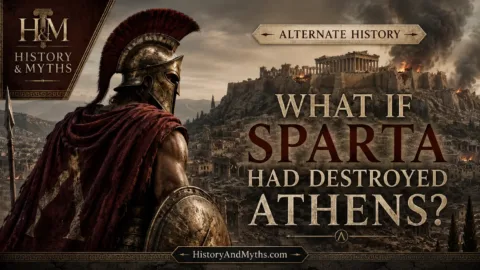
What If Sparta Had Destroyed Athens After the Peloponnesian War?
Sparta won the Peloponnesian War in 404 BCE, but it stopped short of destroying the enemy it had spent nearly three decades fighting. Athens lost its walls, most of its fleet, and its independence in foreign policy, yet the city itself survived.
That outcome was not inevitable. Corinth, Thebes, and other Greek allies reportedly wanted Athens destroyed after its surrender. Sparta refused. But what if it had made the opposite decision and removed Athens permanently as an independent Greek power?
At first, the answer seems obvious. Without Athens, Sparta would face no comparable rival and might appear ready to dominate Greece for generations. Yet destroying Athens would not solve the deeper problems behind Spartan power. Sparta still had a limited citizen population, a dangerous dependence on the helot system, ambitious allies, and other Greek states that had little reason to accept permanent Spartan control once their common enemy was gone.
The most important consequence might therefore be more complicated than a simple Spartan empire. Athens would disappear from the balance of power, but Thebes, Corinth, Persia, and eventually Macedonia would still shape the Greek world. Democracy, naval power, philosophy, and the political development of Greece could all follow different paths. Sparta might emerge from the war stronger than ever, while discovering that destroying its greatest enemy did not make Greece any easier to rule.
The Historical Turning Point
Athens entered 404 BCE with little room left to resist. The previous year, Lysander had destroyed or captured most of the Athenian fleet at Aegospotami, cutting the city off from the maritime network on which its power and food supply depended.
Spartan forces then tightened the pressure. Lysander blockaded Piraeus, while Athens faced a worsening famine. By the time Athenian envoys reached Sparta to negotiate surrender, continued resistance was no longer realistic.
At Sparta, Corinth and Thebes were among those who opposed peace and favored destroying Athens. The Spartans rejected that demand, arguing that a Greek city which had played a major role in resisting Persia should not be enslaved.
Instead, Athens was forced to demolish the Long Walls and the fortifications of Piraeus, surrender all but twelve ships, recall its exiles, and follow Sparta in foreign affairs and war.
Athens had lost the empire and military power that had made it Sparta’s principal rival, but the city survived.
That decision is the turning point of this alternate history. In our scenario, Sparta makes the opposite choice in 404 BCE and agrees to eliminate Athens as an independent Greek power.
The Scenario Used in This Article
This article is based on a hypothetical scenario. It assumes that in 404 BCE Sparta accepts
the calls to destroy Athens instead of allowing the city to survive under harsh peace terms.
In this scenario, Athens is destroyed as a political and military power. Its fortifications
are dismantled, its fleet is eliminated, its institutions are broken up, and a large part of
its population is killed, enslaved, displaced, or scattered across the Greek world.
Attica still exists, but Athens never returns as a major polis capable of rebuilding its navy,
restoring democracy, or challenging Spartan influence.
Everything else remains rooted in the historical conditions of 404 BCE. Sparta still faces the
same demographic limits, the helot system still shapes its society, Thebes and Corinth keep
their own ambitions, and Persia remains active in the Aegean and Asia Minor.
The central question is simple: could Sparta turn the destruction of Athens into lasting control of Greece?
What Would Happen to Athens After Its Destruction?
Destroying Athens would mean more than tearing down its walls. Sparta and its allies would need to make sure the city could not rebuild the political and military power that had dominated the Aegean.
The most likely first targets would be the fleet, Piraeus, and the institutions that allowed Athens to function as an independent polis. The historical peace already stripped Athens of most of its ships and fortifications. In this scenario, those measures would go further, leaving no realistic path for the city to recover as a naval power.
The fate of the population is harder to predict. Greek warfare offered brutal precedents for defeated cities, including execution, enslavement, and forced displacement. Athens could therefore lose a large part of its population without requiring us to assume that every inhabitant would be killed.
Attica would remain strategically valuable even if Athens itself ceased to exist as a major state. Sparta would have little reason to abandon the territory. It could be placed under a dependent government, divided among friendly interests, or controlled indirectly through a weakened local population.
The crucial result is clearer than the exact method: Athens would no longer recover politically after 404 BCE. There would be no restored Athenian democracy in 403, no rebuilt Athenian fleet on the historical scale, and no return of Athens as one of Sparta’s major rivals.
Would Sparta Become the Undisputed Master of Greece?
For a time, probably. Destroying Athens would leave Sparta as the strongest power in Greece immediately after 404 BCE.
It already possessed the Peloponnesian League, while Lysander had helped install friendly oligarchic governments in several former Athenian territories. Spartan garrisons and commanders, known as harmosts, provided another way to control distant cities without annexing them directly.
But military dominance was easier to achieve than to maintain.
Thebes and Corinth had helped defeat Athens, yet both had their own ambitions. Once the common enemy disappeared, continued Spartan interference in local governments and foreign policy could quickly turn former allies into opponents.
Sparta also faced a deeper limitation: manpower. Its full citizen population was relatively small and declining. Garrisons, campaigns abroad, allied governments, and homeland defense all depended on a limited pool of Spartiates.
Destroying Athens would remove Sparta’s greatest rival, but it would not give Sparta more citizens or stronger administrative institutions. Wider control would actually demand more of both.
Sparta could therefore dominate Greece more securely in the short term and build a wider network of dependent states. Turning that advantage into permanent rule would be much harder.
Would Thebes and Sparta’s Former Allies Turn Against It?
Probably.
The coalition that defeated Athens was held together largely by a common enemy. Once Athens disappeared, Sparta, Thebes, Corinth, and the other Greek states would still have competing interests.
That tension appeared quickly in the historical timeline. By 395 BCE, Thebes and Corinth were fighting against Sparta in the Corinthian War, joined by Argos and a recovering Athens. Persian support helped the coalition, but opposition to Spartan interference was already growing.
Without Athens, that resistance would be weaker, not absent.
Thebes would be the strongest candidate to become Sparta’s main rival. It already possessed substantial influence in Boeotia, and conflict with Sparta intensified during the fourth century BCE. But its rise would not be immediate. The Thebes of 404 BCE had not yet developed the political strength and military leadership associated with Epaminondas.
Still, the long-term threat was real. In 371 BCE, Thebes defeated Sparta at Leuctra and broke its position as Greece’s dominant land power.
Destroying Athens could therefore remove the enemy that united Sparta’s alliance while bringing its rivalry with Thebes to the center of Greek politics sooner.
Would Persia Gain More Influence in Greece?
Quite possibly.
Persia had helped Sparta defeat Athens, but that cooperation depended on shared interests rather than lasting friendship. Once Sparta began challenging Persian control of the Greek cities in Asia Minor, the relationship quickly broke down.
Persian money then became a weapon against Spartan power. In the historical timeline, Persia supported Sparta’s enemies during the Corinthian War and backed a fleet commanded by the Athenian Conon. That pressure helped force Sparta to divert attention and resources away from its campaigns in Asia.
Without Athens, Persia would lose one useful partner, but not its ability to interfere in Greek politics. Thebes, Corinth, Argos, and other states could still offer opportunities to build an anti-Spartan coalition.
A stronger Sparta might even give Persia more reason to intervene. Rather than trying to conquer Greece directly, the Persian king could support whichever states were best placed to prevent Sparta from dominating the Aegean or threatening Persian territory.
Destroying Athens would therefore remove one rival from Sparta’s path, but it could also make Persia an even more important counterweight to Spartan power.
What Happens to Greek Democracy Without Athens?
Greek democracy would survive, but it would lose its most important political center.
Athens was not the only Greek state to use democratic institutions, so destroying the city in 404 BCE would not erase democracy from Greece. Other communities could still develop or restore governments in which citizens exercised significant political power.
What disappears is the Athenian recovery of 403 BCE. Historically, opponents of the Thirty returned, democracy was restored, and Athens rebuilt a political system that survived through much of the fourth century. That restored democracy became an important part of the political and intellectual landscape of classical Greece.
Without Athens, the balance would initially favor oligarchic governments supported by Sparta. Yet that advantage would not guarantee their permanence. Political systems in Greek cities often changed as local factions, wars, and alliances shifted.
The larger effect would therefore be a weaker democratic tradition, not the disappearance of democracy itself. Greece would lose the largest and best documented democratic polis of the period, while no other city was certain to replace Athens as an equally influential model.
Democracy could remain part of Greek politics, but its later development would take place without the city most closely associated with it.
Would Greek Naval Power Shift Somewhere Else?
Yes, but probably not to a single Greek state.
Athens had spent decades building a naval system based on ships, trained crews, tribute, overseas bases, and control of key routes. Destroying the city would remove that system rather than simply hand it to Sparta.
Sparta would begin with the strongest fleet in the Aegean. Lysander had commanded around two hundred ships at the end of the war, and Spartan naval power had been crucial in cutting Athens off and forcing its surrender. But much of that strength depended on allied ships, foreign crews, and Persian money rather than on a permanent Spartan maritime structure.
Corinth and other maritime states could expand their influence, while Persia would remain capable of financing fleets when its interests required it. Historically, Persian backing later helped Sparta’s enemies challenge its position at sea.
The most likely result would therefore be a fragmented naval balance. Sparta could dominate immediately after 404 BCE, but without a revived Athens there would be no obvious Greek power ready to inherit Athenian control of the Aegean.
Sea power would become more contested, with Sparta, Persia, and several Greek states competing for influence rather than one city replacing Athens outright.
What Happens to Socrates, Plato, and Athenian Intellectual Life?
The intellectual consequences could be enormous, but Greek philosophy would not simply disappear.
Socrates was still alive in 404 BCE. If Athens were destroyed and much of its population dispersed, his later life becomes impossible to predict. The trial and execution that occurred in 399 BCE depended on the political environment of a restored Athens, so there is no reason to assume those events would happen in the same way.
Plato would face an even larger change. He was still a young man when the war ended, and the philosophical career for which he later became famous developed in the decades that followed. Without a functioning Athens, the Academy as we know it might never be established there.
That would also affect later intellectual networks. Aristotle eventually studied with Plato, while Athens became home to several major philosophical schools during the fourth and Hellenistic centuries.
But philosophy itself was not confined to Athens. Socratic associates came from places such as Megara, Thebes, and Elis, and other Greek intellectual traditions already existed outside the city.
The safest conclusion is therefore not that Greek philosophy disappears, but that its center shifts. Athens might lose the institutional role that allowed its philosophers and schools to shape intellectual history on such a large scale.
Would Sparta’s Helot Problem Become Even More Dangerous?
Yes. A wider Spartan hegemony could make the helot problem harder to contain.
Sparta’s economy depended heavily on helot labor, especially in Messenia, but the relationship was maintained through force and constant supervision. The danger was not theoretical. A major helot revolt had already followed the earthquake of 464 BCE, and Spartan leaders remained deeply concerned about rebellion during the Peloponnesian War.
Destroying Athens would not remove that vulnerability. If Sparta tried to police a larger network of allied and dependent states, more Spartan troops and commanders would spend time away from the Peloponnese. That could weaken the concentration of force available at home during a crisis.
Expansion could also create opportunities for Sparta’s enemies. A rival such as Thebes would not need to defeat Sparta everywhere if it could encourage unrest in Messenia and force Spartan armies to return home.
This became decisive historically after Leuctra, when Theban intervention helped restore an independent Messenia and deprived Sparta of much of the territory and labor system on which its power depended.
A larger empire could therefore increase Spartan prestige while making the security of its own homeland even more important.
Could Spartan Hegemony Actually Last Longer?
Possibly.
Without a recovered Athens, Sparta would face a weaker early opposition, especially at sea, which could allow its dominance to last longer than it did historically.
But the main threat to Spartan hegemony eventually came from Thebes, not Athens. In 371 BCE, Thebes defeated Sparta at Leuctra and ended its position as Greece’s leading land power.
There is also a less obvious cost. After Leuctra, Athens moved closer to Sparta because both feared Theban expansion. In this scenario, Sparta would lose that potential ally.
Destroying Athens could therefore extend Spartan dominance in the short term without guaranteeing a different long-term outcome.
Read Also
Sparta vs Athens: Key Differences Between the Two Greek Powers
Peloponnesian League: How Sparta Led a Powerful Greek Alliance
Greek Democracy Explained: How Athenian Democracy Worked
Ancient Greek Political Systems: Democracy, Oligarchy, and Power
Would Macedonia Face a Weaker Greece?
Probably, although not simply because Athens was gone.
By the time Philip II began expanding Macedonian power, the Greek world had already passed through decades of rivalry between Sparta, Thebes, Athens, and their shifting allies. Destroying Athens in 404 BCE would remove one of those major powers, but it would not create political unity. Sparta and Thebes could still exhaust each other, while Corinth and other states continued to pursue their own interests.
The biggest difference would appear in 338 BCE. Historically, Athens and Thebes formed the core of the coalition that confronted Philip at Chaeronea. Without Athens, Thebes would lose an important military and financial partner, making a comparable alliance harder to assemble.
That would not make Macedonian expansion inevitable. Philip’s success depended heavily on the army and political system he built in Macedonia, not simply on Greek weakness.
Still, a Greece without a recovered Athens would probably offer fewer resources for coordinated resistance. Macedonia might therefore encounter a more fragmented political landscape and face less opposition when Philip moved south.
The likely change is not that Macedonia rises because Athens disappears, but that its eventual conquest of Greece becomes easier to resist less effectively.
What Would Probably Not Change
Destroying Athens would alter the balance of power, but not the competitive structure of Greek politics.
Thebes, Corinth, Argos, and other city-states would still resist attempts at permanent domination. Sparta would retain the same structural limits, including its small citizen population, dependence on helot labor, and difficulty controlling distant territories.
Persia would also remain an important external power with interests in Asia Minor and the Aegean.
Athens would disappear as a major competitor, but Greece would not become unified. The struggle for dominance would continue with different rivals.
Explore another alternate turning point in ancient Greek history:
What If Sparta Had Destroyed Athens After the Peloponnesian War?
Most Likely
The most likely outcome is a stronger Sparta after 404 BCE, but not a permanent Spartan empire.
Without a recovered Athens, early resistance would be weaker and Spartan dominance could last longer. Yet the underlying limits would remain: rival Greek states, Persian intervention, declining citizen manpower, and dependence on the helot system.
Athens would disappear from the balance of power, but another coalition or rising state would eventually challenge Sparta.
The victory would be more complete. Lasting control of Greece probably would not be.
Plausible but Uncertain
A longer period of Spartan dominance is plausible, but its shape is difficult to predict.
Thebes might emerge as Sparta’s main rival earlier, while Persia could gain more leverage by backing anti-Spartan states. Sparta might also hold the naval advantage for longer without a revived Athens, though permanent control of the Aegean would still be difficult.
The cultural effects are even less certain. A destroyed Athens could disrupt the development of Plato’s Academy and later Athenian schools, but Greek philosophy might shift elsewhere rather than disappear.
All of these outcomes are plausible, but none is inevitable.
Highly Unlikely
It is highly unlikely that destroying Athens would allow Sparta to rule Greece permanently.
Thebes, Corinth, Argos, and Persia would still have reasons to resist Spartan dominance, while Sparta’s own demographic and internal weaknesses would remain.
It is also unlikely that democracy or Greek philosophy would disappear entirely. Athens gave both enormous influence, but neither depended on one city alone.
A permanent Spartan naval empire is equally doubtful. Sparta might dominate the Aegean for a time, but sustaining that position indefinitely would require resources and institutions it did not possess.
Destroying Athens would change the balance of power, not eliminate the forces that made permanent control of Greece so difficult.
Final Verdict: Destroying Athens Would Strengthen Sparta, Not Secure Its Rule
Destroying Athens in 404 BCE would probably strengthen Sparta in the short term. Its greatest naval rival would be gone, and organized resistance would be harder to build.
But Athens was not the only obstacle to lasting Spartan dominance. Limited manpower, dependence on the helot system, Persian intervention, and the rise of Thebes would still threaten its position.
Sparta might therefore enjoy a longer or more secure period of supremacy, but permanent control of Greece would remain unlikely.
Destroying Athens could remove Sparta’s greatest enemy. It could not remove the deeper forces that eventually challenged Spartan power.
Frequently Asked Questions
Did Sparta actually win the Peloponnesian War?
Yes. Sparta defeated Athens in 404 BCE after nearly three decades of war. Athens surrendered, demolished the Long Walls, gave up most of its fleet, and accepted Spartan leadership in foreign affairs.
Why did Sparta not destroy Athens after the war?
Some of Sparta’s allies, including Corinth and Thebes, favored destroying Athens. Sparta rejected the proposal, partly because of Athens’ earlier role in resisting the Persian invasions of Greece, and instead imposed severe peace terms.
What might have happened if Sparta had destroyed Athens?
Sparta would probably have faced weaker resistance in the years immediately after 404 BCE, especially at sea. However, Thebes, Corinth, Persia, and Sparta’s own internal weaknesses would still have limited its ability to dominate Greece permanently.
Would Greek democracy have disappeared without Athens?
Probably not. Athens was the most influential democratic polis, but democratic institutions existed elsewhere in the Greek world. Its destruction would weaken the democratic tradition rather than eliminate it entirely.
Could Sparta have ruled Greece permanently?
That is unlikely. Sparta faced a declining citizen population, dependence on the helot system, resistance from other Greek states, and pressure from Persia. Removing Athens would strengthen Sparta, but it would not remove those structural problems.
Would Thebes still have challenged Sparta?
Quite possibly. Thebes already had major influence in Boeotia and later became Sparta’s most dangerous land rival. Without Athens, the Spartan-Theban struggle could have become central to Greek politics even earlier.
Sources & Further Reading
This alternate-history analysis is speculative, but its historical starting points are based on ancient evidence and modern academic scholarship.
Xenophon, Hellenica, Book 2, Chapter 2
The principal ancient account of Athens’ surrender, the debate over destroying the city, and Sparta’s final peace terms in 404 BCE.
Thucydides, History of the Peloponnesian War, Book 1
Ancient evidence for the Messenian helot revolt and the internal security problem that remained central to Spartan power.
Harmost
Academic reference on Spartan military governors and the system Sparta used to exercise control over occupied cities after 404 BCE.
Democratic Collapse and Recovery in Ancient Athens, 413–403 BCE
Analysis of Athens’ defeat, Spartan intervention, the Thirty, and the historical restoration of democracy in 403 BCE.
Alliance and Hegemony in Fourth-Century Greece
Academic discussion of Spartan and Theban hegemony, including the importance of Leuctra in 371 BCE.
Socrates
Academic reference for Socrates’ chronology and the Athenian intellectual setting relevant to the article’s philosophical counterfactual.
Copyright & Use
Written by H. Moses
This article is original content published by History & Myths. Its alternate-history analysis, structure, and written interpretation may not be reproduced, republished, or redistributed in full without permission.
Short quotations may be used for reference or discussion when accompanied by clear attribution and a link to the original article on HistoryAndMyths.com.