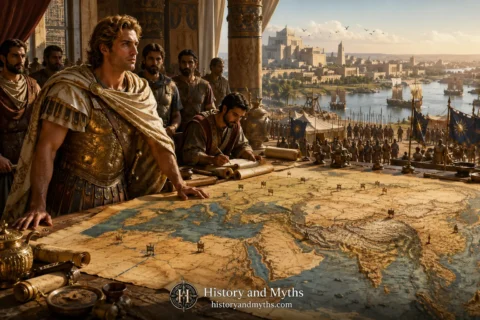
What If the Greeks Had Won at Thermopylae? Alternate History
The Battle of Thermopylae is remembered as a heroic Greek defeat, but its importance went far beyond the death of Leonidas and the Spartans. Once the pass fell in 480 BCE, Xerxes could continue south, Athens was evacuated and later sacked, and the war moved toward the naval victory at Salamis and the final Greek success at Plataea.
But what if the Greek alliance had actually held Thermopylae?
A realistic Greek victory would not mean destroying the Persian army. It would mean preventing Xerxes from forcing the pass long enough for reinforcements to arrive, while the Greek fleet continued to block Persian movement around Artemisium. Under those conditions, the invasion could become increasingly difficult to sustain.
Athens might never be burned. The Battle of Salamis might not occur in the form we know, and Plataea could disappear from the timeline entirely. Leonidas could survive, while Sparta gained enormous prestige for stopping the Persian advance.
Yet Persia would not suddenly collapse, and Athens would still possess the powerful fleet that later transformed Greek politics.
The real consequence of a Greek victory at Thermopylae might therefore be larger than simply ending the invasion earlier. It could create a very different struggle for leadership between Sparta and Athens after the Persian threat had passed.
The Historical Turning Point
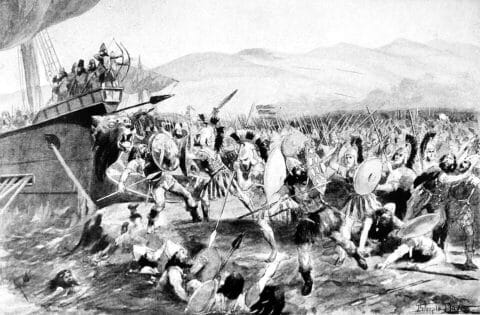
In 480 BCE, the Greek alliance chose Thermopylae because its narrow pass limited Persia’s ability to use its numerical advantage. Leonidas led the defense with several thousand troops from different Greek states, including the famous 300 Spartans.
For two days, the position held. The turning point came when Ephialtes revealed a mountain path around the pass. Xerxes sent troops under Hydarnes along that route, allowing the Persians to threaten the Greeks from behind.
Leonidas then dismissed much of the allied force and remained with the Spartans, Thespians, Thebans, and others for the final stand. The Persians broke through and continued south into central Greece.
Our alternate timeline changes only that crucial moment.
The mountain route is successfully defended. Hydarnes fails to reach the Greek rear, Thermopylae remains closed, and the invasion no longer has a quick path into southern Greece.
The Scenario Used in This Article
This is a hypothetical scenario, not a claim about what actually happened.
The point of divergence comes when the Persian force sent along the Anopaea path fails to reach the rear of the Greek position. The Phocians guarding the route hold long enough to prevent a successful encirclement, allowing Leonidas and the allied army to keep Thermopylae closed.
The Persian army remains powerful, but Xerxes can no longer expect a quick breakthrough. Greek reinforcements begin to arrive, while the allied fleet continues operating around Artemisium and makes a maritime bypass more difficult.
Leonidas survives, Xerxes survives, and Persia does not lose its empire.
The central question is narrower:
If the Greeks stopped the Persian advance at Thermopylae, how would that change Athens, Salamis, Sparta, and the rest of the war?
Could the Greeks Actually Have Won at Thermopylae?
Yes, but only in a limited strategic sense.
A Greek victory would not require Leonidas to destroy Xerxes’ army. The realistic objective was simply to keep the pass closed long enough to disrupt the Persian advance and allow more allied forces to arrive.
Thermopylae favored the defenders because its narrow ground reduced Persia’s ability to use superior numbers effectively. The Greek position failed only after Persian troops reached the rear through the Anopaea path.
If that route remained blocked, Xerxes would face an increasingly difficult choice. He could continue costly frontal attacks, search for another way around the position, or wait while a huge army consumed supplies far from its main bases.
None of those options guaranteed Greek success, and Persian naval power still mattered.
But holding Thermopylae for several more days or weeks could turn the battle from a heroic delaying action into a genuine strategic setback for the invasion.
Would Leonidas Survive the Battle?
Most likely, yes.
Leonidas died because the Greek position had been outflanked and the remaining defenders chose to stay for the final stand. If the Anopaea path remained secure, that situation would never develop in the same way.
He would still face serious danger at Thermopylae, but there would be no reason to sacrifice himself simply to delay an encirclement that had not happened.
His survival could have major political consequences. Leonidas would return not as a fallen hero, but as the Spartan king who helped stop Xerxes at the gateway to central Greece.
That would greatly strengthen his personal prestige and Sparta’s standing within the alliance.
Still, Leonidas would not become an absolute ruler of Greece. Spartan kings operated within a political system that limited royal power, and other Greek states would still defend their own interests.
What Happens at Artemisium?
If Thermopylae held, the naval battle at Artemisium would become even more important.
Historically, the Greek fleet fought there to prevent the Persians from using the sea to outflank the land defense. Once Thermopylae fell, however, the fleet had little reason to remain and withdrew south.
In this scenario, that withdrawal does not happen immediately.
The Greek navy, with Athens providing its largest contingent, would stay near Artemisium to protect the flank of Leonidas’ army and threaten Persian attempts to move troops or supplies by sea. That could force Xerxes to divide his attention between two connected fronts instead of treating Thermopylae as an isolated obstacle.
A prolonged struggle at Artemisium would still be dangerous for the Greeks, especially against a larger Persian fleet.
But as long as the land pass remained closed, the Greek navy would have a clear reason to keep fighting rather than retreat toward Salamis.
Would Xerxes Abandon the Invasion?
Possibly, but not immediately.
Xerxes had invested heavily in the campaign and would not withdraw simply because one pass remained closed for a few extra days. He could order more assaults, search for another route, or try to let the fleet solve the problem from the sea.
The difficulty would grow if Thermopylae and Artemisium both remained secure.
A large Persian army needed constant supplies, and every delay increased the burden of feeding men, horses, and ships far from the empire’s main centers. If Greek reinforcements strengthened the pass while Persian losses mounted, continuing the advance could become less attractive than preserving the army for another campaign.
So Xerxes would probably test every realistic option before retreating.
But if he failed to break the combined land and naval defense, abandoning the push into southern Greece would become a rational strategic decision, not a sign that Persia itself had been defeated.
Would Athens Escape Destruction?
Very likely, at least in 480 BCE.
Historically, the fall of Thermopylae opened the road into central Greece. Athens was evacuated, and Xerxes’ forces eventually occupied and burned the city.
If the Persian advance stalled at Thermopylae, that chain of events would be broken.
Athens would still prepare for the possibility of invasion, and Themistocles would probably keep the fleet ready, but there would be far less reason for an immediate evacuation while the land route remained closed.
That could spare the city, its temples, and the Acropolis from the destruction they suffered in the historical campaign.
The wider consequence is important. Athens would enter the postwar period without the same experience of occupation and rebuilding, which could subtly alter both its political memory and the monumental identity it later created.
Would the Battle of Salamis Still Happen?
Probably not in the form we know.
Salamis became necessary because the Persian army had already advanced into Attica and Athens had been evacuated. The Greek fleet then fought close to the island, where the narrow waters reduced Persia’s numerical advantage.
If Thermopylae remained secure, that situation would never fully develop.
The Greek fleet would have stronger reasons to stay around Artemisium, while Athens remained behind an unbroken land defense. Without the Persian occupation of Attica, there would be no urgent need to draw Xerxes’ navy into the straits of Salamis.
A major naval battle could still happen elsewhere if Persia tried to force the issue by sea.
But Salamis itself would likely disappear from the timeline, removing one of Athens’ greatest military victories and changing the way Greek naval power was remembered after the war.
Would Plataea Ever Be Fought?
Probably not in the historical form of 479 BCE.
The Battle of Plataea happened after Xerxes had already invaded southern Greece, occupied Athens, and then withdrawn with much of his army following Salamis. Mardonius remained behind with a large Persian force and tried to restore Persian control the following year.
If Xerxes never breaks through Thermopylae, that entire sequence changes.
There may be no Persian occupation of Attica, no retreat from Salamis, and no reason to leave Mardonius in central Greece under the same circumstances. Fighting could continue elsewhere, especially in Thessaly or along the northern approaches, but the decisive land battle at Plataea would likely disappear from the timeline.
That would also change the way the Greeks remembered the war. Victory would be associated more with holding the invasion at the frontier than with driving Persia out after a deep advance into Greece.
Would Sparta Become the Dominant Greek Power?
Sparta would probably emerge from Thermopylae with greater prestige, but that would not automatically make it the unquestioned leader of Greece.
If Leonidas survived after helping stop Xerxes, Sparta could claim the most celebrated land victory of the war. That would strengthen its authority within the alliance and reinforce its reputation as Greece’s strongest military state.
But Athens would still possess the largest and most important fleet. Corinth, Aegina, and other allies would also retain their own ambitions, while many Greek cities would resist permanent Spartan leadership.
The result would likely be a stronger Spartan position immediately after the war, especially in military affairs.
What changes is the balance of prestige. Without Salamis becoming Athens’ defining victory, Sparta could enter the postwar period with a clearer claim to leadership, making the later rivalry between the two powers begin from a very different starting point.
Would Athens Still Rise as a Naval Power?
Yes. The main foundation of Athenian naval power already existed before Thermopylae.
Under Themistocles, Athens had invested heavily in a large trireme fleet before Xerxes invaded. That fleet would not disappear simply because Salamis never happened.
What Athens would lose is the enormous prestige that came from its role in the naval victory at Salamis.
Without that moment, Athens might find it harder to present itself as the city that saved Greece at sea. Its fleet would still make it essential to any future war with Persia, protect Athenian trade, and give the city influence across the Aegean.
So Athens would probably remain the strongest Greek naval power.
The difference is political. Naval strength would still exist, but it might take longer for that military advantage to become the kind of leadership Athens later exercised over other Greek states.
Would the Delian League Still Form?
Possibly, but probably not in the same form.
Historically, the Delian League emerged after the Persian Wars as a naval alliance led by Athens, with the stated purpose of continuing the fight against Persia and protecting Greek communities around the Aegean.
In this scenario, Athens would still have the fleet needed to organize such an alliance, but its political position would be weaker without the prestige of Salamis. Sparta, having gained greater credit for stopping Xerxes at Thermopylae, might also remain more influential in decisions about the postwar settlement.
A naval coalition against Persia could therefore still appear, especially if Persian power remained strong in the eastern Aegean and Asia Minor.
What is less certain is whether Athens could dominate that alliance as quickly or turn it into the powerful Athenian led system that the Delian League eventually became.
Explore another alternate turning point in ancient Greek history:
What If Sparta Had Destroyed Athens After the Peloponnesian War?
Would Athens and Sparta Still Become Rivals?
Very likely, because their rivalry was driven by more than the outcome of one battle.
Sparta represented the strongest land power in Greece, while Athens was building a naval system that gave it growing influence across the Aegean. Even without Salamis, those different sources of power would eventually create tension.
What changes is the balance between them.
A Spartan success at Thermopylae would give Sparta greater prestige after the war, while Athens might rise more slowly without the same claim to having saved Greece at sea. That could delay the moment when Athenian influence began to alarm Sparta.
The rivalry would probably still develop, especially if Athens expanded its alliances and naval reach.
But the road to conflict could be slower, less predictable, and shaped by a stronger Spartan position from the beginning.
Could Persia Invade Greece Again?
Yes, especially if Xerxes withdrew with most of his army intact.
A failed breakthrough at Thermopylae would be a setback, not the destruction of Persian military power. The Achaemenid Empire still controlled enormous resources, and another campaign could be planned after studying why the first invasion stalled.
Persia might avoid repeating the same strategy. A future attack could rely more heavily on naval pressure, diplomacy, and support from Greek states willing to cooperate with the empire.
That possibility would keep the anti-Persian alliance together for longer.
The Greeks could celebrate Thermopylae, but they would know the threat had not disappeared. A second invasion might never reach the scale of Xerxes’ campaign, yet the fear of another Persian attempt would continue shaping Greek military planning and alliances.
Would the Persian Empire Be Seriously Weakened?
Not immediately.
A failure at Thermopylae would damage Xerxes’ prestige and cost Persia men, time, and resources, but the Achaemenid Empire was far larger than the Greek campaign itself. Its power stretched across Egypt, Anatolia, Mesopotamia, Iran, and much of the eastern Mediterranean.
The real loss would be strategic and symbolic.
Persia would have failed to force its way into southern Greece despite committing a massive army and fleet. That could encourage rebellion in some frontier regions and make Greek resistance more confident.
Even so, there is no strong reason to expect the empire to unravel because of Thermopylae alone.
Persia would remain the dominant power of the eastern Mediterranean and Near East. The defeat would limit its influence in mainland Greece, not destroy the imperial system that supported Xerxes.
What Would Probably Not Change
A Greek victory at Thermopylae would not erase the larger realities of the war.
Persia would remain a powerful empire with the resources to threaten the Aegean again. Athens would still possess the fleet created before Xerxes’ invasion, while Sparta would remain the strongest Greek land power.
The Greek world would also remain politically divided. Rivalries between city-states, competing alliances, and local ambitions would continue even after a successful defense against Persia.
What changes most is the sequence of events after Thermopylae, not the basic structure of Greek politics.
Athens and Sparta would still be powerful. Persia would still matter. The difference is that the balance between them would develop without the destruction of Athens, the victory at Salamis, and the campaign that ended at Plataea.
Most Likely
The most likely outcome is that the Greek alliance stops the Persian advance at Thermopylae without destroying Xerxes’ army.
Athens avoids occupation, Salamis never happens in its historical form, and Leonidas survives with his reputation transformed from martyr to victorious commander. Sparta gains greater prestige, while Athens remains the leading naval power but without the same political boost that followed Salamis.
Persia withdraws rather than collapses and remains capable of threatening the Aegean again.
The long-term effect is therefore a different balance inside Greece. Sparta begins the postwar period from a stronger position, while Athens still has the fleet and economic strength needed to challenge that leadership later.
Plausible but Uncertain
A longer Greek stand could produce consequences that are possible but difficult to predict with confidence.
Persia might attempt another invasion after reorganizing its forces, while Sparta could use the prestige of Thermopylae to keep a stronger grip on the Greek alliance. Athens, meanwhile, might respond by expanding its naval partnerships more aggressively to protect the Aegean.
It is also possible that rivalry between Athens and Sparta begins earlier if both cities compete over who deserves leadership after the war.
None of these outcomes would follow automatically from Thermopylae.
They would depend on how long Persia remained a threat, whether Leonidas stayed politically influential, and how quickly Athens turned its fleet into a wider system of alliances.
Highly Unlikely
A Greek victory at Thermopylae would be very unlikely to destroy the Persian Empire or trigger an immediate Greek invasion of Asia.
It is also unlikely that Sparta would suddenly control all of Greece. Even with Leonidas alive and Spartan prestige at its height, Athens, Corinth, Aegina, and other city-states would continue defending their own interests.
Nor would one victory permanently end Persian involvement in Greek affairs. Persia still possessed the wealth, fleet, and diplomatic reach to influence the Aegean for decades.
The least plausible outcome is a complete reversal in which Greece becomes the dominant power over Persia simply because Xerxes failed to cross Thermopylae.
The battle could reshape the war, but it would not overturn the entire balance of the ancient Mediterranean.
Final Verdict: Thermopylae Could Change Greece More Than Persia
A Greek victory at Thermopylae would probably shorten Xerxes’ campaign without destroying Persian power.
The biggest consequences would appear inside Greece. Athens could escape destruction, Salamis and Plataea might never happen in their historical form, and Leonidas could survive as the commander associated with stopping the invasion.
Sparta would gain enormous prestige, but Athens would still possess the fleet that made it a major power. That means their later rivalry would not disappear. It would simply begin from a different balance.
Persia would remain wealthy, dangerous, and capable of returning.
So the real alternate history is not a world where Greece suddenly defeats Persia forever. It is a Greek world shaped by a victorious Thermopylae, with Sparta stronger, Athens less dominant at first, and the political future of both far less predictable.
Frequently Asked Questions
Could the Greeks realistically have won at Thermopylae?
Yes, but a realistic Greek victory would mean holding the pass and stopping the Persian advance, not destroying Xerxes’ entire army. If the mountain route behind the Greek position had remained secure, the defense could have lasted much longer.
Would Leonidas have survived if the Greeks had won?
Most likely. Leonidas died after the Greek position was outflanked and the final defense became unavoidable. If the encirclement never happened, there would be far less reason for him to remain in a last stand.
Would Athens still have been burned by the Persians?
Probably not in 480 BCE. If Xerxes failed to break through Thermopylae, his army would not have reached Attica on the historical timetable, making the evacuation and destruction of Athens much less likely.
Would the Battle of Salamis still have happened?
Probably not in the form we know. Salamis developed from the Persian advance into Attica and the withdrawal of the Greek fleet southward. If Thermopylae held, the naval war would likely remain focused farther north.
Would Sparta have become the dominant power in Greece?
Sparta would gain enormous prestige from a victory at Thermopylae, especially if Leonidas survived. However, Athens would still possess the strongest Greek fleet, so permanent Spartan domination would be far from guaranteed.
Would Persia have collapsed after losing at Thermopylae?
No. Even a clear failure at Thermopylae would be a major setback for Xerxes, but the Achaemenid Empire remained far larger and wealthier than the Greek theater of war. Persia would still be capable of influencing or threatening Greece later.
Sources & Further Reading
This alternate-history analysis is grounded in ancient evidence and modern scholarship on Thermopylae, Artemisium, Salamis, Xerxes’ invasion, Persian logistics, and the political consequences of the Persian Wars.
Primary Ancient Source
Herodotus, The Histories, Books VII-IX.
The principal surviving ancient narrative for Xerxes’ invasion of Greece. Book VII provides the account of Thermopylae, Leonidas, the Greek forces, the Anopaea path, and the expected arrival of additional Spartan and allied troops. Book VIII covers Artemisium, the evacuation of Athens, and Salamis, while Book IX narrates the campaign culminating at Plataea.
Modern Academic Research
- John F. Lazenby, “Thermopylae, battle of,” Oxford Classical Dictionary.
A concise academic reconstruction of the battle, including the estimated 6,000 to 7,000 Greek defenders, Leonidas’ command, the Persian use of the mountain route, and the final withdrawal and last stand.
Oxford Academic
- Andrew Robert Burn and Antony Spawforth, “Thermopylae,” Oxford Classical Dictionary.
Examines the geography and strategic importance of the pass, including the weakness created by the mountain route that allowed an invading force to bypass the main defensive position.
Oxford Academic
- John F. Lazenby, “Artemisium, battle of, 480 BCE,” Oxford Classical Dictionary.
Covers the naval fighting that occurred alongside Thermopylae and explains why the Greek fleet withdrew after learning that the land position had fallen. This connection is central to the scenario explored in this article.
Oxford Academic
- Peter Krentz, “Battle of Salamis: 480 BC,” Oxford Bibliographies.
Provides an academic overview of Salamis and places the naval battle within the sequence that followed the fall of Thermopylae and the Greek withdrawal from Artemisium.
Oxford Academic
- John O. Hyland, Persia’s Greek Campaigns: Kingship, War, and Spectacle on the Achaemenid Frontier.
A recent Oxford University Press reassessment of the Persian campaigns from an Achaemenid perspective. It is particularly useful for avoiding a purely Greek-centered interpretation of Xerxes’ invasion and for understanding the scale and resilience of Persian imperial power.
Oxford University Press
- John O. Hyland, “Xerxes’s Greek Campaign as Logistical Performance.”
Examines the enormous logistical demands of moving and supplying Xerxes’ army and fleet. This study is especially relevant to assessing whether a prolonged delay at Thermopylae could have created serious strategic problems without requiring the destruction of the Persian army.
Oxford Academic
- Russell Meiggs and Simon Hornblower, “Delian League,” Oxford Classical Dictionary.
Explains the formation of the anti-Persian alliance under Athenian leadership after the war and provides the historical foundation for evaluating whether a different outcome at Thermopylae could have altered the later balance between Athens and Sparta.
Oxford Academic
Research Note:
Herodotus remains the essential ancient narrative for the campaign, but his account was written from a Greek perspective and should not be treated as modern battlefield reporting. Modern scholarship is used here to evaluate the geography, military constraints, Persian capabilities, and later political developments. The alternate outcomes proposed in this article are reasoned historical possibilities, not claims about events that actually occurred.
Copyright & Use
Written by H. Moses
This article is original content published by History & Myths. Its alternate-history analysis, structure, and written interpretation may not be reproduced, republished, or redistributed in full without permission.
Short quotations may be used for reference or discussion when accompanied by clear attribution and a link to the original article on
HistoryAndMyths.com
.