Peloponnesian League: How Sparta Led a Powerful Greek Alliance
The Peloponnesian League was not just a rival to Athens—it was a different way of organizing power in ancient Greece. Led by Sparta, it brought together independent city-states under a military alliance that relied on cooperation rather than centralized control.
The key question is why this system never turned into an empire like the Delian League. The answer lies in how it was designed: no tribute system, no centralized treasury, and no attempt to absorb member states into a single authority. This article breaks down how the Spartan alliance actually worked, how decisions were made, and why its structure preserved balance instead of concentrating power.
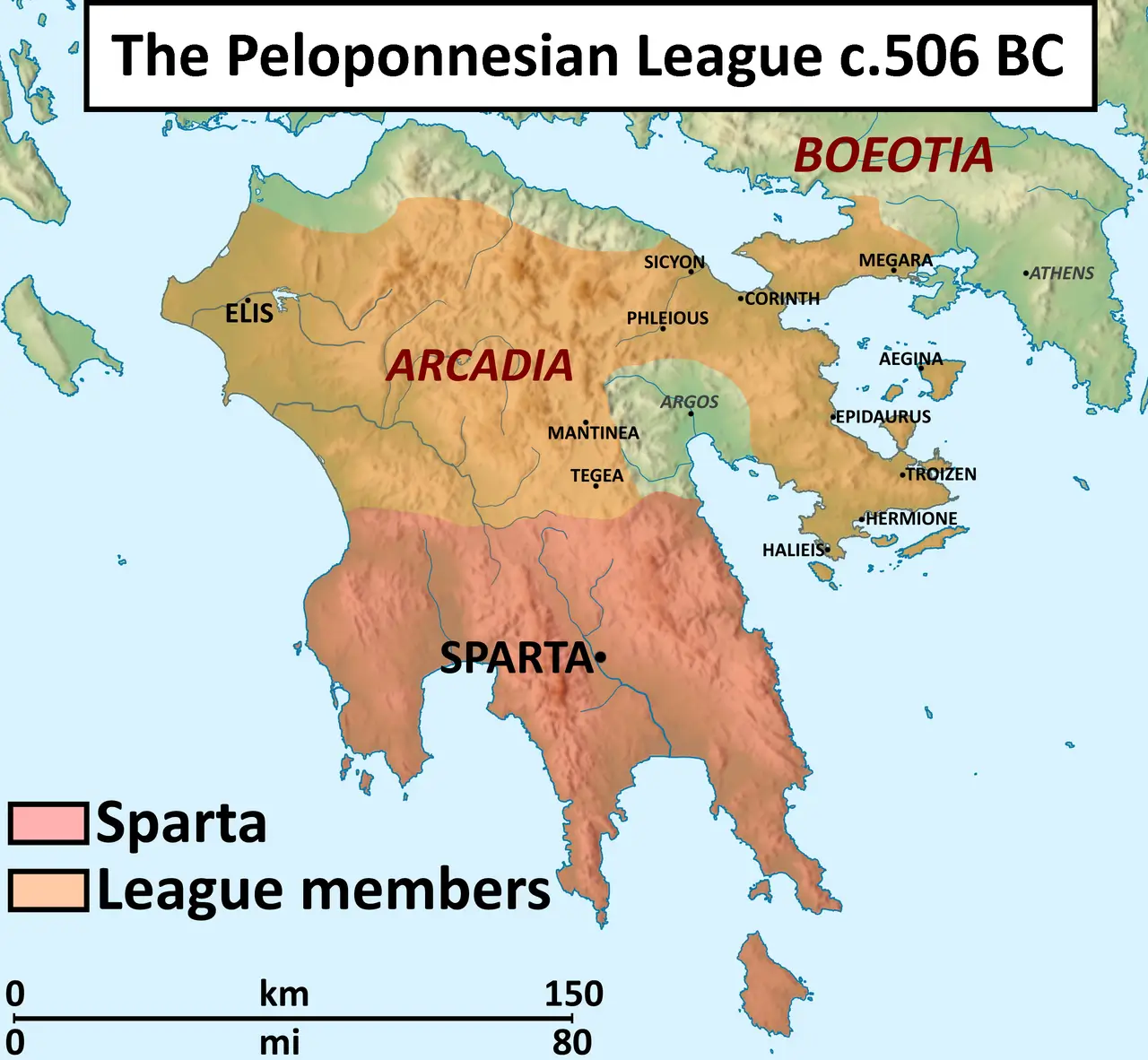
What Was the Peloponnesian League in Ancient Greece?
The Peloponnesian League was a structured military alliance built around cooperation between independent Greek city-states, rather than centralized control. It operated under the leadership of Sparta, but it did not function as a unified state or empire.
Member states joined through formal agreements that defined mutual obligations, primarily focused on military support. Each city retained its own political system, leadership, and internal autonomy. This is the key distinction: the alliance coordinated action but did not absorb authority.
Unlike other alliances, there was no shared treasury or system of financial contributions. Power was not built through money, but through military commitment. When collective action was required, members were expected to provide forces rather than payments.
Decision-making followed a cooperative model. Sparta led, but it did not operate unilaterally in all cases. The system relied on agreements and alignment between members, which meant influence was distributed rather than fully centralized.
From a system perspective, the Peloponnesian League was designed as a decentralized alliance, where coordination existed without full control—allowing Sparta to lead without transforming the system into an empire.
| System Element | How It Worked | Effect on Power |
|---|---|---|
| Military Contributions | Each state provided its own troops | Maintained independence |
| No Tribute System | No centralized financial payments | Prevented economic control |
| Leadership | Sparta guided strategy | Influence without full dominance |
| Decision-Making | Based on agreement among allies | Distributed authority |
| Autonomy | Each state kept its own system | Limited central control |
| System Outcome | Alliance remained decentralized | No transition to empire |
Why Was the Peloponnesian League Formed?
The Peloponnesian League was formed to manage a different kind of problem than the Delian League. It was not created in response to a single external threat, but as a way to stabilize power relationships between neighboring states in southern Greece.
For Sparta, the priority was control without overextension. Unlike Athens, Sparta did not rely on naval expansion or economic networks. Its strength was land-based, and its political system was built on maintaining internal stability. A direct empire would have required continuous administration and resource management—something Sparta was not structured to sustain.
The alliance provided an alternative. By forming agreements with nearby city-states, Sparta created a system where:
- allies supported each other militarily
- threats could be managed collectively
- influence could be maintained without direct control
For member states, joining the league offered security without losing independence. They gained the protection of a powerful military partner while keeping their own political systems intact.
The result was a strategic balance:
- Sparta gained regional influence
- allies retained autonomy
From a system perspective, the Peloponnesian League was formed as a controlled network of alliances, designed to extend influence while avoiding the costs and risks of centralized rule.
How the Peloponnesian League Worked as a Military Alliance
The Peloponnesian League operated through direct military obligations, not financial contributions. Its structure was built around one principle: each member state remained responsible for its own forces and contributed them when collective action was required.
Unlike systems that pooled resources centrally, there was no shared treasury and no permanent combined force under a single command. Each city maintained its own army, and coordination happened when the alliance was activated—typically in response to conflict or strategic need.
Leadership still mattered. Sparta directed overall strategy, especially in large-scale operations. However, this leadership depended on cooperation. Sparta could not deploy forces from other states independently—it relied on agreements and commitments already established within the alliance.
This created a different operational model:
- No centralized funding → no economic dependency
- Independent armies → retained autonomy
- Coordinated campaigns → shared military action
The system was therefore less efficient in terms of rapid, centralized response, but more stable in preserving the independence of its members.
From a system perspective, the Peloponnesian League functioned as a coordinated military network, where power came from alignment between states rather than control over shared resources.
Power Distribution: Who Controlled Decisions in the League
Power in the Peloponnesian League was distributed differently from centralized systems. Sparta led the alliance, but it did not control decisions in the same way Athens controlled the Delian League.
Major decisions—such as going to war or launching joint campaigns—were typically made through collective agreement among member states. Each ally had a role in the decision process, which meant outcomes depended on alignment rather than unilateral command.
Sparta’s influence came from its position, not from direct control:
- it set strategic direction
- it guided discussions
- it led military operations
But it still required support from its allies to act effectively. Without that support, decisions could not be implemented at scale.
This created a system where:
- authority was recognized but limited
- influence was strong but not absolute
- participation shaped outcomes
The result was slower decision-making compared to centralized systems, but also greater stability in maintaining cooperation.
From a system perspective, power in the Peloponnesian League was distributed through agreement, not concentrated through control—making leadership dependent on consensus rather than dominance.
Why the Peloponnesian League Did Not Become an Empire
The Peloponnesian League did not evolve into an empire because its structure limited the concentration of power from the beginning. Unlike systems built on centralized resources, this alliance did not create the conditions needed for one state to dominate the rest.
There was no tribute system. Member states did not transfer wealth to Sparta, which meant there was no financial mechanism for building a centralized military or administrative structure. Without control over resources, long-term dominance was difficult to establish.
There was also no permanent transfer of military power. Each city retained its own forces, which prevented Sparta from turning the alliance into a single controlled army. This preserved autonomy and limited the possibility of enforcement against members.
Equally important, participation remained conditional. Member states could cooperate, but they were not absorbed into a system that removed their independence. This reduced the risk of resistance and removed the need for coercion.
From a system perspective, the Peloponnesian League did not become an empire because it lacked the two key drivers of imperial control: centralized resources and direct authority over member states.
How the Peloponnesian League Actually Worked
- Built as a military alliance, not an economic system
- No tribute or centralized treasury
- Each member state kept its own army and government
- Sparta led strategy but depended on cooperation
- Decisions required agreement among allies
- The system preserved balance instead of centralizing power
© historyandmyths.com — Educational use
Peloponnesian League vs Delian League: Two Greek Alliance Systems
The difference between the Peloponnesian League and the Delian League was not just leadership—it was structural. Each alliance was built on a different model for organizing power, and that difference shaped its outcome.
The Delian League concentrated power through money and centralized command. Athens controlled resources, directed military operations, and gradually limited the independence of its members. This allowed the system to evolve into an empire.
The Peloponnesian League followed the opposite logic. It distributed power by keeping resources and military forces in the hands of individual states. Sparta led the alliance, but it did not absorb control in the same way.
This created two different outcomes:
- one system increased efficiency and control through centralization
- the other preserved stability and autonomy through distribution
The contrast explains why one alliance expanded into dominance while the other remained a cooperative network.
From a system perspective, these alliances represent two models of power:
centralized control versus coordinated independence.
Continue Reading
The Strategic Strength of the Spartan Alliance
The strength of the Peloponnesian League came from its ability to maintain stability without enforcing centralized control. By allowing each member state to remain politically and militarily independent, the system avoided the internal resistance that often emerges in more centralized alliances.
Because Sparta did not rely on tribute or direct administration, it did not create economic pressure on its allies. This reduced tension within the system and helped maintain long-term cooperation.
The alliance also benefited from distributed military responsibility. Each state maintained its own forces, which meant that military capacity was spread across the network rather than concentrated in one place. This made the system more resilient, as it did not depend on a single centralized force.
At the same time, Sparta’s leadership provided strategic direction without eliminating autonomy. This balance allowed the alliance to coordinate effectively while preserving internal stability.
From a system perspective, the Peloponnesian League was strong because it aligned independent states around shared goals without removing their control, creating a stable but less centralized form of power.
The Limits of the Peloponnesian League System
The same structure that made the Peloponnesian League stable also limited its effectiveness in certain situations. By avoiding centralization, the system reduced its ability to act quickly and decisively.
Because decisions depended on agreement between multiple states, response time could be slow. Sparta could guide strategy, but it could not always enforce immediate action. This made coordinated campaigns more difficult compared to centralized systems.
The lack of a shared financial system also restricted long-term planning. Without a central treasury, the alliance could not sustain large-scale operations independently. Military efforts depended on what each member could provide at a given moment.
Another limitation was inconsistency. Since each state maintained its own priorities, levels of commitment could vary. Some allies contributed fully, while others participated only when it aligned with their interests. This created uneven performance across the system.
From a system perspective, the Peloponnesian League traded efficiency for stability. It avoided the risks of centralized control, but in doing so, it also limited its ability to project power consistently across the Greek world.
What the Peloponnesian League Reveals About Greek Power Systems
The Peloponnesian League shows that alliances in ancient Greece were not defined by cooperation alone—they were defined by how power was structured within them.
Unlike centralized systems, this alliance demonstrates that influence can be maintained without direct control. Sparta led the system, but it did so by aligning interests rather than absorbing authority. This allowed the league to function without transforming into an empire.
The contrast with the Delian League highlights a key principle:
when resources and decisions are centralized, alliances tend to evolve into control systems. When power remains distributed, alliances preserve autonomy but sacrifice speed and efficiency.
This reveals that Greek political systems were not fixed models—they were experiments in managing power under different conditions. Some prioritized control, others prioritized balance.
From a system perspective, the Peloponnesian League represents a model where stability comes from limiting concentration of power, even at the cost of reduced coordination.
Key Takeaways
- The Peloponnesian League was a decentralized military alliance led by Sparta.
- Member states kept full political and military independence.
- The system relied on cooperation, not economic control.
- Power was distributed through agreement rather than centralized authority.
- The alliance remained stable but less efficient than centralized systems.
- Its structure prevented it from becoming an empire.
Frequently Asked Questions
What was the Peloponnesian League?
The Peloponnesian League was a military alliance of Greek city-states led by Sparta.
How did the Peloponnesian League work?
It operated through military cooperation, with each member providing troops rather than money.
Did Sparta control the Peloponnesian League?
Sparta led the alliance but relied on agreement and cooperation from other member states.
Why didn’t the Peloponnesian League become an empire?
It lacked centralized resources and direct authority over its members.
What was the difference between Delian and Peloponnesian Leagues?
The Delian League was centralized under Athens, while the Peloponnesian League remained decentralized.
Was the Peloponnesian League effective?
It was stable and balanced but less efficient than centralized alliances.
Sources & Rights
- Kagan, Donald. The Peloponnesian War. Penguin Books.
- Hornblower, Simon. The Greek World 479–323 BC. Routledge.
- Cartledge, Paul. Sparta and Lakonia. Routledge.
- Sealey, Raphael. A History of the Greek City States. University of California Press.
- Finley, M. I. Politics in the Ancient World. Cambridge University Press.
- Rhodes, P. J. A History of the Classical Greek World. Wiley-Blackwell.
- Thucydides. History of the Peloponnesian War. (Primary source).
- Osborne, Robin. Greece in the Making. Routledge.
- Pomeroy, Sarah B. Ancient Greece: A Political, Social, and Cultural History. Oxford University Press.
- Raaflaub, Kurt A. The Discovery of Freedom in Ancient Greece. University of Chicago Press.
Written by H. Moses — All rights reserved © Mythology and History