What If Ramses II Had Lost the Battle of Kadesh? Alternate History
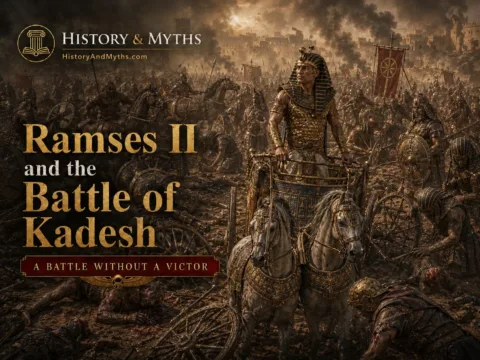
Ramses II turned the Battle of Kadesh into one of the most famous victory stories of the ancient world. His inscriptions show him standing almost alone against the Hittite army, rescued by Amun and powerful enough to reverse a battlefield disaster.
The reality was more complicated. Kadesh itself did not fall to Egypt, the Hittites remained dominant in much of Syria, and the struggle between the two empires continued for years.
But what if there had been no room for ambiguity?
If the Hittite attack had completely broken the Egyptian army and Ramses returned home after an undeniable defeat, Egypt would not necessarily collapse. The larger consequences would fall on its northern empire, its reputation among Levantine states, and the image Ramses was building of himself as an invincible warrior king.
Kadesh and Amurru would remain securely within the Hittite sphere, local rulers could become less willing to trust Egyptian protection, and Ramses might be forced to rebuild both his army and his royal prestige before challenging Hatti again.
The deeper question is therefore not whether Ramses could survive defeat. He probably could.
It is whether he could lose the battle that defined his military reputation and still build the long, powerful reign that made him Ramses the Great.
The Historical Turning Point
The Battle of Kadesh was fought in the fifth year of Ramses II’s reign, when Egypt and the Hittite Empire were competing for control of northern Syria.
Ramses advanced with four army divisions, but false intelligence led him to believe the Hittite king Muwatalli II was farther away than he actually was. Hittite chariots then struck the Egyptian forces before the army had fully concentrated, overwhelming part of the camp and placing Ramses in serious danger.
Egyptian accounts describe the king rallying his forces and personally driving back the attackers. Whatever the scale of that recovery, Egypt did not capture Kadesh, and Hittite influence in the region remained strong.
The alternate scenario changes that moment.
The Hittite assault succeeds completely. The Egyptian camp collapses before Ramses can stabilize the battle, and he escapes with survivors rather than turning the crisis into a recoverable engagement.
Kadesh becomes an unmistakable Egyptian defeat.
The Scenario Used in This Article
This is a hypothetical scenario, not a claim about what actually happened.
This article assumes that the Hittite attack at Kadesh succeeds decisively. The Egyptian camp is broken, Ramses II escapes with part of his army, and Egypt suffers a defeat too clear to be presented as a battlefield success.
Ramses survives and remains pharaoh. Egypt itself is not invaded, the Nineteenth Dynasty does not collapse, and the Hittites do not suddenly conquer the Nile Valley.
What changes is Egypt’s position in Syria. Kadesh remains securely under Hittite control, Amurru falls firmly back into their sphere, and local rulers have stronger reasons to doubt Egypt’s ability to protect them.
The central question is therefore:
Could Ramses II recover his military reputation and imperial influence after an undeniable defeat at Kadesh?
Would Ramses II’s Throne Be in Danger?
Probably not immediately.
A decisive defeat at Kadesh would damage Ramses II’s prestige, especially because he was still early in his reign. But Egypt was not a fragile state whose monarchy depended on a single campaign. The Nineteenth Dynasty controlled the Nile Valley, Nubia, major temples, an established bureaucracy, and a powerful royal court.
The greater danger would be reputational rather than dynastic.
Ramses had presented himself as an energetic warrior king. Returning from Syria after a clear defeat would give rivals at court, military commanders, and foreign vassals reason to question his judgment. It could also weaken confidence in Egypt’s ability to project power beyond its borders.
Still, there is no strong reason to expect an immediate coup or collapse of the dynasty.
Ramses would most likely keep the throne and use the years that followed to rebuild his army, restore royal authority, and prevent one disastrous campaign from defining his reign.
Could Ramses Still Turn Kadesh Into a Victory Story?
He could still shape the narrative, but a decisive defeat would give him far less room to do so.
Historically, Ramses II turned Kadesh into a story of personal heroism. Egyptian inscriptions emphasize the king standing almost alone, calling on Amun, and driving back the Hittite attack when his army was in danger.
If the Egyptian camp had collapsed completely and the army returned with unmistakable losses, that message would need to change.
Ramses could still present himself as the ruler protected by Amun, perhaps claiming that divine favor allowed him to escape disaster and preserve Egypt’s army from total destruction. What would become harder to sustain is the image of Kadesh as a triumph over Hatti.
Royal propaganda would therefore focus less on victory and more on survival, courage, and divine rescue.
The defeat might damage Ramses’ image as an invincible conqueror, but it would not prevent him from using the event to reinforce his legitimacy as a king chosen and protected by the gods.
Would Egypt Lose the Struggle for Syria?
A decisive defeat at Kadesh would probably end Egypt’s immediate attempt to dominate northern Syria.
Kadesh was not just a fortress. It stood inside a wider contest over the allegiance of Syrian states and the balance of power between Egypt and Hatti. If Ramses II returned south after a clear battlefield defeat, local rulers would have stronger reasons to believe that the Hittites were the safer power to support.
That would strengthen Hittite influence around Kadesh and make Egyptian expansion northward far more difficult. Egypt could still retain important positions farther south, especially in Canaan, but its claim to control the northern Syrian frontier would suffer a serious setback.
The loss would therefore be strategic rather than territorial collapse.
Egypt would remain a major Near Eastern power, but Kadesh could mark the point where Ramses accepted that northern Syria was beyond what Egypt could reliably hold by force.
What Happens to Kadesh and Amurru?
A decisive Egyptian defeat would make the fate of both territories much clearer.
Kadesh was already aligned with the Hittites before the battle, while Amurru had shifted toward Egypt and became one of the main reasons the rivalry escalated. William Murnane’s study of the road to Kadesh shows how closely the two regions were tied to the Egyptian-Hittite struggle.
If Ramses II lost badly, Kadesh would remain securely within the Hittite sphere, and Amurru would have little incentive to keep risking rebellion against Hatti. Its rulers depended on great-power protection, and an Egyptian army shattered at Kadesh would make that protection look unreliable.
The result would be more than losing two places on a map.
Egypt would lose important leverage in northern Syria, while the Hittites gained a stronger buffer zone and a clearer political advantage over the local states caught between the two empires.
Would More Levantine States Abandon Egypt?
Probably some would, especially in the northern Levant.
Egyptian control in Syria-Palestine often depended on local rulers accepting Egyptian protection rather than on direct administration everywhere. A decisive defeat at Kadesh would therefore send a political message far beyond the battlefield: Egypt could no longer guarantee security against Hittite pressure. UCL notes that many city-states in the region functioned as relatively loose vassals, while Cambridge identifies Kadesh and Amurru as central to the struggle over Syrian allegiance.
The states closest to the Hittite frontier would have the strongest incentive to reconsider their loyalty. Some might defect outright, while others could simply stop cooperating with Egypt and wait to see which empire recovered first.
The effect would not be universal. Egyptian influence farther south, especially in Canaan, had deeper roots and would probably survive.
The likely result is a gradual political retreat in the north, not a sudden collapse of Egypt’s entire Levantine network.
Could the Hittites Push Their Influence Farther South?
Probably, but only to a point.
A decisive victory at Kadesh would strengthen Hittite authority across Syria and make nearby rulers less willing to challenge Hatti. Cambridge notes that Kadesh and Amurru were effectively the southern edge of Hittite power and the main focus of the struggle with Egypt.
After a clear Egyptian defeat, that frontier could move somewhat farther south through diplomacy, intimidation, and new vassal alignments rather than direct conquest.
But a march toward Egypt itself is unlikely. The farther Hittite influence moved into the southern Levant, the harder it would become to supply armies and control territories where Egyptian power was already deeply established.
The most plausible outcome is a stronger Hittite sphere in Syria and the northern Levant, not a Hittite conquest of Canaan or the Nile Valley.
Would Egypt Still Hold Canaan?
Most likely, yes, at least in the short term.
A defeat at Kadesh would weaken Egypt’s northern ambitions, but Canaan was more deeply tied to Egyptian power than the contested Syrian frontier. UCL notes that Egyptian influence in southern Palestine remained substantial during the Nineteenth and Twentieth Dynasties, with stronger administrative and material evidence there than farther north.
That means one lost battle would not automatically erase Egyptian control across the southern Levant.
Ramses II could still rely on garrisons, loyal vassals, established routes, and the resources of the Nile Valley to defend Canaan. The real danger would come if the defeat triggered repeated rebellions or encouraged Hittite influence to move steadily south.
The likelier result is a narrower Egyptian sphere, not the disappearance of Egypt from Canaan altogether.
Could Ramses Rebuild and Fight Back?
Yes. A defeat at Kadesh would hurt Egypt, but it would not exhaust the resources available to Ramses II.
He still controlled the Nile Valley, Nubia, major military bases, and a state capable of raising new forces. His reign ultimately lasted sixty-six years, giving him far more time to recover than the battle itself might suggest. The Met notes that Ramses remained militarily active, expanded south into Nubia, built extensively, and eventually reached a treaty with the Hittites.
The harder question is what kind of recovery he would choose.
After a crushing defeat, another immediate attempt to seize Kadesh would be risky. Ramses might instead stabilize Canaan, suppress rebellions, rebuild the army, and restore confidence before challenging Hittite influence again.
He could fight back, but probably more cautiously. The goal might shift from conquering northern Syria to proving that Egypt remained too strong to be pushed farther south.
Would the Egyptian-Hittite Peace Treaty Still Happen?
Probably, although the balance behind it could be different.
Historically, Ramses II and Hattusili III concluded their famous peace treaty in Ramses’ twenty-first regnal year, long after Kadesh. Both Egyptian and Hittite versions survive, showing that the agreement was more than a temporary battlefield truce.
A decisive Egyptian defeat could make peace attractive even earlier. Ramses would have strong reasons to secure his northern frontier while rebuilding Egyptian influence, while Hatti would benefit from locking in its advantage in Syria instead of fighting another costly war.
The treaty would therefore still make strategic sense.
What might change are its terms and tone. Egypt could enter negotiations from a weaker position, especially over northern Syria and Amurru, while the Hittites demanded firmer recognition of their sphere.
Peace would not necessarily disappear because Ramses lost Kadesh. It might become one of the clearest consequences of that loss.
Would the Hittite Royal Marriage Still Happen?
Probably yes, although its political meaning could shift.
Historically, Ramses II eventually married at least two Hittite princesses after peace was established with Hatti. UCL identifies Maathorneferure as the daughter of Hattusili III and Puduhepa, married to Ramses in his thirty-fourth regnal year, while The Met notes that Ramses later married two Hittite princesses.
In this scenario, a clear Hittite victory at Kadesh could make such a marriage even more useful. Egypt would gain a prestigious dynastic link with the power dominating Syria, while Hatti would strengthen the peace and reduce the risk of renewed Egyptian campaigns.
The marriage might therefore still occur, but it could look less like a union between equal rivals and more like part of Egypt’s effort to stabilize relations after losing ground in the north.
Ramses could lose Kadesh and still marry into the Hittite royal family. The symbolism of that marriage would simply be different.
Would Ramses II Still Become One of Egypt’s Greatest Pharaohs?
Probably yes, but his reputation would look different.
Kadesh became central to Ramses II’s image as a warrior king, yet his legacy rested on far more than one battle. His reign was exceptionally long, his building program transformed temples and royal landscapes across Egypt and Nubia, and Pi-Ramesses became a major political, military, and international center under his rule.
A decisive defeat at Kadesh would weaken the heroic military image he promoted, especially early in his reign. Later generations might remember him less as the pharaoh who overwhelmed Hatti and more as a ruler who recovered from a serious setback.
His monuments, diplomacy, longevity, and ability to maintain Egyptian power would still matter enormously.
So losing Kadesh would damage one pillar of Ramses’ reputation, but it probably would not erase the broader achievements that made his reign exceptional.
Would the Hittite Empire Survive Longer?
Possibly, but Kadesh alone would not solve the problems that later weakened Hatti.
A decisive victory over Egypt would strengthen Hittite prestige, secure its Syrian vassals, and reduce pressure on the southern frontier. That could give the empire more resources and political stability for a time.
But the Hittite collapse around 1200 BCE had much broader causes. Hatti still faced Assyrian expansion, internal dynastic tensions, pressure in western Anatolia, and the wider disruptions of the Late Bronze Age. The Metropolitan Museum notes that the end of the Hittite Empire resulted from multiple pressures rather than one single military defeat or success.
So a stronger victory at Kadesh might extend Hittite influence or delay decline slightly.
It would not guarantee that the empire survived the Bronze Age Collapse.
What Would Probably Not Change
A decisive defeat at Kadesh would not destroy Egypt as a great power.
Ramses II would still control the Nile Valley and Nubia, the Nineteenth Dynasty would remain intact, and Egypt would retain strong influence in Canaan. The Hittites would still face pressure from Assyria and other Late Bronze Age rivals.
The wider political system of the eastern Mediterranean would also remain unstable.
The main changes would be concentrated in northern Syria, Egyptian military prestige, and the balance of power between Egypt and Hatti.
Most Likely
The most likely outcome is that Egypt loses its chance to dominate northern Syria but remains a major regional power.
Ramses II would probably rebuild his army, secure Canaan, and avoid another reckless attempt to seize Kadesh. Hittite control over Kadesh and Amurru would become firmer, while local rulers in the north leaned more heavily toward Hatti.
Ramses could recover his domestic prestige over time through diplomacy, building projects, and later military success elsewhere.
The defeat would narrow Egypt’s empire, not end Ramses’ reign.
Plausible but Uncertain
A deeper political retreat from Syria is possible, but not inevitable.
Some northern vassals might switch allegiance quickly, while others could wait to see whether Ramses II recovered. A weaker Egyptian position might also encourage the Hittites to press farther south, but sustaining that influence would be difficult.
It is also plausible that peace between Egypt and Hatti would come earlier, especially if both sides preferred a stable frontier to another costly war.
These outcomes fit the balance of power after a decisive Egyptian defeat, but they would depend heavily on what Ramses did next.
Highly Unlikely
A decisive defeat at Kadesh would be very unlikely to cause the collapse of Egypt or the fall of Ramses II.
It is also unlikely that the Hittites could use one victory to conquer Canaan completely, invade the Nile Valley, or permanently remove Egypt from Near Eastern politics.
The same applies to the Hittite Empire itself. Victory at Kadesh would not automatically prevent its later collapse, because the pressures that destroyed Hatti developed from much wider political and regional problems.
Kadesh could change the balance of power, but not overturn the entire Late Bronze Age world.
Final Verdict: Losing Kadesh Could Weaken Egypt’s Empire Without Breaking Ramses II
A decisive defeat at Kadesh would probably change Ramses II’s empire more than it changed his throne.
Egypt would lose momentum in northern Syria, Hittite control over Kadesh and Amurru would become harder to challenge, and Ramses could no longer present his first major Syrian campaign as an unquestioned military triumph.
But Egypt still possessed the resources, territory, and political institutions needed to recover.
Ramses would most likely turn from risky northern expansion toward rebuilding his army, securing Canaan, and restoring his prestige through later campaigns, diplomacy, and monumental construction.
He might be remembered as a less successful conqueror, but still as one of Egypt’s most powerful and enduring pharaohs.
Frequently Asked Questions
Did Ramses II actually lose the Battle of Kadesh?
Historians generally do not treat Kadesh as a clear Egyptian victory. Ramses II survived the Hittite attack, but Egypt failed to capture Kadesh and Hittite influence in Syria remained strong.
What would have happened if Ramses II had been decisively defeated?
Egypt would probably have lost much of its immediate influence in northern Syria, while Hittite control over Kadesh and Amurru became more secure. Egypt itself, however, would likely have remained a major power.
Could Ramses II have lost his throne after Kadesh?
An immediate loss of the throne is unlikely. Egypt still possessed a strong monarchy, bureaucracy, army, and territorial base. The greater damage would have been to Ramses’ military prestige.
Would the Hittites have conquered Egypt?
Probably not. A Hittite victory at Kadesh could strengthen their position in Syria, but invading and controlling the Nile Valley would have required a far larger and more difficult campaign.
Would Ramses II still be remembered as Ramses the Great?
Most likely yes, although his military reputation would be weaker. His long reign, enormous building program, diplomacy, and continued control of Egypt would still make him one of the most important pharaohs in Egyptian history.
Sources & Further Reading
The historical framework for this alternate-history analysis is based on Egyptian primary material and modern academic research on the Battle of Kadesh, Egyptian-Hittite relations, and the reign of Ramses II.
- British Museum, Papyrus Sallier III: The Poem of the Battle of Qadesh.
An ancient Egyptian literary account of the battle presenting Ramses II as the heroic ruler who survives the Hittite attack with the aid of Amun.
British Museum
- UCL Digital Egypt, War in Ancient Egypt.
Provides important context for interpreting the Kadesh inscriptions as royal and religious ideology rather than straightforward battlefield reporting.
UCL Digital Egypt
- UCL Digital Egypt, Asia and Egypt.
Covers Egyptian relations with the Hittite Empire, the inconclusive historical outcome at Kadesh, Egyptian rule in the Levant, and the later peace settlement.
UCL Digital Egypt
- UCL Digital Egypt, Ramses II.
A chronological overview of Ramses II’s reign, monuments, conflict with the Hittites, and the peace treaty concluded with Hattusili III in his twenty-first regnal year.
UCL Digital Egypt
- W. J. Murnane, The Road to Kadesh.
Academic study of Egyptian-Hittite relations, Sety I’s Syrian campaigns, Amurru, and the political developments that led to the Battle of Kadesh.
Institute for the Study of Ancient Cultures, University of Chicago
- A. Goetze, The Hittites and Syria (1300-1200 B.C.), The Cambridge Ancient History.
Examines the struggle between Egypt and Hatti for control of Syria, with particular attention to Kadesh and Amurru as central territories in the rivalry.
Cambridge University Press
These sources support the historical background of Ramses II, Kadesh, Amurru, and Egyptian-Hittite relations. The consequences explored in this article are a reasoned alternate-history scenario and should not be understood as claims about events that actually occurred.
Copyright & Use
Written by H. Moses
This article is original content published by History & Myths. Its alternate-history analysis, structure, and written interpretation may not be reproduced, republished, or redistributed in full without permission.
Short quotations may be used for reference or discussion when accompanied by clear attribution and a link to the original article on
HistoryAndMyths.com
.