What If Prometheus Never Stole Fire from Zeus? Greek Myth Reimagined
If Prometheus had never stolen fire, Greek mythology would change far beyond the simple idea of humans living without warmth or light. The theft of fire is the event that turns Prometheus into Zeus’s great challenger and helps trigger a chain of punishment that reaches humanity itself.
Without that theft, Prometheus would probably avoid his most famous punishment, while Zeus would keep tighter control over the boundary between gods and mortals. Human progress would also slow or take a different path, because fire represents not only survival but cooking, craft, technology, and the ability to reshape the natural world.
One of the biggest changes could involve Pandora. In Hesiod’s tradition, her creation follows Zeus’s anger over the stolen fire. If Prometheus never takes it, the familiar sequence linking fire, Pandora, and human suffering may never unfold in the same way.
That does not mean humanity would remain without fire forever. Another god, a later bargain, or a different divine decision could eventually provide it. The deeper question is how Greek mythology would change if humanity received civilization as an approved gift rather than through Prometheus’s rebellion against Zeus.
The Mythic Turning Point
The decisive moment in the Prometheus story is not simply the existence of fire, but who controls it.
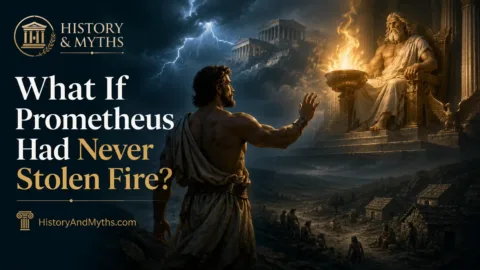
In Hesiod’s version, the conflict begins when Prometheus tricks Zeus during the division of sacrifice at Mecone. Zeus responds by withholding fire from humanity. Prometheus then steals it back, hiding the flame in a fennel stalk and giving mortals access to something Zeus had deliberately denied them.
That act changes several relationships at once. Prometheus moves from clever rival to open defier of Zeus. Humanity gains a tool that supports cooking, craft, metalworking, and a more independent way of life. Zeus, in turn, answers the theft with punishment directed at both Prometheus and mortals.
If Prometheus refuses to steal the fire, that chain breaks at its most important point. Zeus still has reason to distrust him, but the conflict does not escalate in the same way. Humanity remains dependent on divine permission, and the later punishment cycle involving Pandora may never develop in its familiar form.
This is the point where the alternate scenario truly begins.
This is a hypothetical scenario, not an original ancient Greek myth. It assumes that Prometheus chooses not to steal fire after Zeus withholds it from humanity.
It does not assume that humans remain helpless forever or that every later myth disappears. Other gods can still intervene, fire may eventually reach mortals by another route, and conflict between Zeus and Prometheus can continue for different reasons.
The analysis follows the consequences most directly tied to the missing theft: slower human development, a different fate for Prometheus, the possible absence of Pandora’s familiar punishment, and a much stronger divine monopoly over the tools of civilization.
What Happens to Humanity Without Fire?
Without Prometheus’s theft, humans would lose far more than a source of warmth. Fire made cooking, metalworking, pottery, and many forms of craft possible, so its absence would keep mortal life closer to basic survival.
That does not mean humanity would simply stop developing. People could still build shelters, make stone tools, organize communities, and rely on natural resources. What they would lack is the transformative technology that allows raw materials to be changed on a much larger scale.
The mythic effect would be just as important. Humans would remain visibly dependent on the gods for something essential to civilization, reinforcing the distance between mortal and divine power.
So the immediate result would be slower progress, greater dependence on nature, and a much weaker sense that humanity could shape its own world without divine permission.
Would Civilization Still Develop?
Civilization would probably still emerge, but by a slower and more dependent route. Greek myth does not require every human skill to come from Prometheus, and other gods were already associated with agriculture, craft, building, and organized society.
Without stolen fire, however, several advances would remain limited. Metalworking, large-scale pottery, and other heat-dependent crafts could not develop in the same way until humans gained controlled fire from another source.
That makes the key issue access, not permanent deprivation. Humanity might eventually receive fire through divine permission, discovery, or another mythic intermediary. If that happened, civilization could continue—but without Prometheus’s act of rebellion at its foundation.
The result would be a human world that still advances, yet remains more clearly dependent on the gods for the tools that make advanced society possible.
Would Pandora Ever Be Created?
Pandora is one of the biggest consequences of removing the theft of fire. In Hesiod’s account, Zeus orders her creation as part of his punishment after Prometheus gives fire back to humanity.
If that theft never happens, the immediate reason for sending Pandora disappears. She might still exist in another tradition or be created for a different purpose, but the familiar story in which she becomes part of Zeus’s answer to Prometheus would no longer follow naturally.
That would also change the mythic explanation for human suffering. Pandora’s arrival is tied to the introduction of hardship into mortal life, so removing her from this chain would weaken one of Greek mythology’s best-known attempts to explain why human existence includes labor, illness, and misfortune.
The safest conclusion is not that Pandora could never exist, but that without Prometheus stealing fire, her role—and perhaps the entire story built around her—would need a different cause.
What Happens to Prometheus?
If Prometheus never steals fire, he probably avoids the punishment for which he is best known. Zeus would still remember the deception at Mecone, but there would be no second act of open defiance demanding the same level of retaliation.
Prometheus might remain a troublesome but useful figure rather than becoming the chained rebel. His intelligence, foresight, and sympathy for humanity could still place him at odds with Zeus, yet the conflict would be less absolute.
That change also affects his later reputation. Without the theft, Prometheus would no longer stand so clearly as the divine champion who suffers for giving humans forbidden power. He might still represent cunning and resistance to authority, but the image of the great benefactor of humanity would be much weaker.
His survival without punishment would therefore make the myth less about heroic rebellion and more about an unresolved tension between wisdom, authority, and the limits imposed on mortals.
Would Zeus Keep Greater Control Over Humanity?
Yes, at least for a time. By keeping fire out of human hands, Zeus would preserve a clear boundary between divine power and mortal capability.
Humans could still worship, farm, build communities, and develop skills, but they would remain dependent on the gods for one of the most important tools of advanced life. That dependence would strengthen Zeus’s position not only as ruler of Olympus, but as the authority who decides how far mortal power is allowed to grow.
The relationship would also become less confrontational. Without Prometheus successfully breaking Zeus’s restriction, humanity would have no famous example of gaining divine power through defiance.
Zeus’s control, however, would not have to remain permanent. Another god could intervene, or Zeus himself could eventually grant fire under conditions that preserved divine authority.
Could Humans Receive Fire Another Way?
Probably. The absence of Prometheus’s theft does not mean fire must remain permanently beyond human reach.
Greek mythology already connects fire and craft with other divine figures, especially Hephaestus. A later myth could therefore present fire as something granted through divine permission, ritual exchange, or another god’s intervention rather than stolen in defiance of Zeus.
That distinction would change its meaning. Fire would no longer symbolize humanity gaining forbidden power through rebellion. It would become a controlled gift, given on terms set by the gods.
Human progress could still continue, but the story behind it would reinforce divine authority instead of celebrating Prometheus as the figure who crossed the boundary between gods and mortals.
How the Relationship Between Gods and Mortals Would Change
Without Prometheus’s theft, the boundary between gods and humans would remain much harder to cross. Mortals could still pray, sacrifice, and receive divine favor, but they would possess less power to act independently of Olympus.
That would make the relationship more hierarchical. The gods would remain the source of essential knowledge and resources, while humanity’s progress depended more clearly on divine approval.
The symbolic loss would be just as important. Prometheus’s theft gives mortals a rare mythic example of benefiting from resistance to divine authority. Without it, Greek mythology would place greater emphasis on obedience, dependence, and negotiated gifts rather than successful defiance.
The gods would not necessarily become kinder, but the balance of power between Olympus and humanity would remain more firmly in their favor.
What Would Probably Not Change
Greek mythology would not lose its wider structure simply because Prometheus refused to steal fire. Zeus would still rule Olympus, the Olympian gods would retain their separate domains, and mortals would continue to depend on sacrifice, divine favor, and ritual relationships with the gods.
Conflict would also remain part of the mythic world. Prometheus could still oppose Zeus in other ways, while humans would continue to face hardship, mortality, and divine punishment for reasons unrelated to Pandora.
Fire itself would remain important in divine craft, sacrifice, and sacred ritual even if humans did not possess it freely.
The most realistic change is therefore not a completely different Greek religion, but a world in which human independence develops more slowly and the famous chain linking Prometheus, stolen fire, Pandora, and punishment never unfolds in the same form.
Most Likely
Prometheus never steals fire, so humanity remains dependent on the gods for longer and advances more slowly in crafts that require controlled heat.
Zeus avoids the direct challenge that triggered the familiar punishment cycle. Prometheus is therefore unlikely to suffer the same fate, while Pandora may never be created for the same purpose or enter the myth in the form preserved by Hesiod.
Fire eventually reaches humanity through another divine decision or intermediary, but as a permitted gift rather than a stolen power.
The broad result is a Greek mythic world in which civilization still develops, yet the relationship between mortals and the gods remains more controlled and less shaped by Prometheus’s rebellion.
Plausible but Uncertain
Humanity might gain fire from another god, perhaps through Hephaestus or a later divine agreement, allowing civilization to develop without Prometheus becoming the great rebel of the myth.
Pandora could still appear, but for a different reason and with a different symbolic role. Likewise, Prometheus might eventually clash with Zeus over another issue even if the theft of fire never occurs.
In that version, the main change is not the permanent loss of fire, but the disappearance of the specific chain that links Prometheus’s defiance, Zeus’s punishment, Pandora, and the expansion of human suffering.
Highly Unlikely
It is highly unlikely that humanity would remain permanently without fire. Greek mythology contains too many divine sources of craft, flame, and sacred power for Prometheus to be the only possible route.
It is also unlikely that removing the theft would erase human suffering, conflict, or mortality. Those themes existed far beyond the Pandora story and were built into the wider Greek view of mortal life.
The least plausible outcome is therefore a world frozen in permanent primitiveness. Prometheus’s refusal would delay and reshape human progress, but not end it.
Final Verdict: Prometheus Without the Theft of Fire
If Prometheus had never stolen fire, humanity would probably remain dependent on the gods for longer, while several heat-based crafts and technologies developed more slowly or through a different divine source.
The deeper change would be mythological. Prometheus might avoid his famous punishment, Pandora would lose the immediate reason for her creation in Hesiod’s version, and Zeus would preserve a stronger boundary between mortal and divine power.
Humanity would still progress eventually, and suffering would not disappear. But the meaning of that progress would change. Instead of civilization beginning with a forbidden gift taken in defiance of Zeus, fire might arrive later as something granted, negotiated, or controlled by the gods.
Prometheus’s refusal would therefore change more than one invention. It would remove one of Greek mythology’s clearest stories about rebellion, punishment, and humanity gaining power beyond the limits set by Olympus.
Frequently Asked Questions
What if Prometheus had never stolen fire?
Humanity would probably remain dependent on the gods for longer, while technologies and crafts requiring controlled fire developed more slowly or reached mortals through another divine source.
Would humans remain without fire forever?
Probably not. Greek mythology includes other divine figures connected with fire and craft, so humans could eventually receive it through permission, exchange, or another god’s intervention.
Would Pandora still be created?
Not necessarily in the same way. In Hesiod’s tradition, Pandora is connected to Zeus’s punishment after the theft of fire, so removing that event weakens the original reason for her creation.
Would Prometheus still be punished by Zeus?
He could still clash with Zeus over other issues, but without stealing fire he would probably avoid the famous punishment of being chained while an eagle repeatedly devoured his liver.
Would Greek civilization still develop without Prometheus?
Yes, but probably through a different mythic path. Agriculture, building, social organization, and other skills could continue, while fire-dependent technologies remained limited until another source of fire appeared.
What would change most in Greek mythology?
The largest change would be the loss of the familiar chain connecting Prometheus’s rebellion, stolen fire, Zeus’s retaliation, Pandora, and the idea that human progress comes from crossing a boundary set by the gods.
Sources and Further Reading
This article is an alternate-mythology analysis grounded in surviving Greek literary traditions, modern classical scholarship, and archaeological evidence. The hypothetical outcomes are interpretive; the underlying myths, characters, and religious themes are drawn from the sources below.
Ancient Greek Sources
1. Hesiod, Theogony, lines 507–616
One of the earliest surviving accounts of Prometheus, the sacrifice at Mecone, Zeus withholding fire, Prometheus stealing it in a fennel stalk, Pandora, and Prometheus’s punishment.
Perseus Digital Library — Tufts University
2. Hesiod, Works and Days, lines 42–105
Essential for the connection between stolen fire, Zeus’s retaliation, the creation of Pandora, and the arrival of hardship in human life.
Perseus Digital Library — Tufts University
3. Prometheus Bound, traditionally attributed to Aeschylus
Presents Prometheus as the benefactor of humanity and connects fire with the arts, knowledge, technology, and the development of civilized life.
Perseus Digital Library — Tufts University
4. Apollodorus, Library, Book 1, Chapter 7
A later mythographic account connecting Prometheus’s gift of fire directly with Zeus’s punishment and the eagle that consumes his regenerating liver.
Perseus Digital Library — Tufts University
5. Plato, Protagoras, 320c–322d
Retells the Prometheus and Epimetheus story as an explanation of human vulnerability, technical skill, fire, and the later development of organized political life.
Perseus Digital Library — Tufts University
Modern Classical Scholarship
6. Oxford Classical Dictionary — “Prometheus”
Scholarly overview of Prometheus as trickster, bringer of fire, figure of civilization, and subject of changing literary and religious traditions in ancient Greece.
Oxford Academic
7. Ian Ruffell — “Prometheus”
A research guide examining Prometheus across Greek myth, literature, religion, fire mythology, sacrifice, and later reinterpretations.
Oxford Bibliographies in Classics
8. Esther Eidinow, “Fire” in Metamorphosis, Landscape, and Trauma in Greco-Roman Myth
Modern analysis of fire in Greco-Roman myth, including Pandora as Zeus’s response to Prometheus’s theft and the wider cycle of deception, exchange, and punishment.
Oxford Academic
9. Lilah-Grace Fraser, “A Woman of Consequence: Pandora in Hesiod’s Works and Days”
Detailed scholarly study of Pandora’s role in Works and Days and its relationship with the version preserved in Hesiod’s Theogony.
Cambridge University Press
10. Bernardo Ballesteros Petrella, “Fashioning Pandora”
Examines the construction of the Pandora story within early Greek mythology and places it within a wider Eastern Mediterranean mythological context.
Cambridge University Press
11. David Potter — “Theodicy”
Discusses ancient explanations for divine anger and human suffering, including Hesiod’s Pandora story as a response to Prometheus’s deception of Zeus.
Oxford Classical Dictionary
Archaeological and Artistic Evidence
12. Attic Red-Figure Calyx-Krater: The Creation of Pandora
Ancient Greek vase depicting Pandora among the gods, providing material evidence for how her creation was represented beyond surviving literary texts.
The British Museum
13. Attic White-Ground Cup: The Making of Pandora
A Greek vessel showing Pandora with Athena and Hephaestus, important visual evidence for the ancient artistic tradition surrounding her creation.
The British Museum
14. Roman Lamp Depicting Prometheus the Fire-Stealer
Later material evidence showing the continuing importance of Prometheus’s theft of fire as a recognizable mythological image in the Greco-Roman world.
The British Museum
© Copyright Notice
Copyright Notice: This article is an original alternate-mythology analysis published by History and Myths. It draws on surviving Greek mythological traditions, ancient literary sources, archaeological evidence, and modern classical scholarship to explore a hypothetical scenario.
The alternate outcomes presented in this article are interpretive and should not be treated as part of the original ancient Greek myths or as a historical record.
Copying, republishing, translating, adapting, or substantially reproducing this content, in whole or in part, without prior written permission is prohibited.
Written by H. Moses
All rights reserved ©
History and Myths