What If Persephone Had Stayed in the Underworld? Alternate Scenario
Persephone’s return from the Underworld was not simply the end of a family tragedy. In the Homeric Hymn to Demeter, it was the compromise that allowed the earth to become fertile again after Demeter withheld its crops and brought humanity close to starvation.
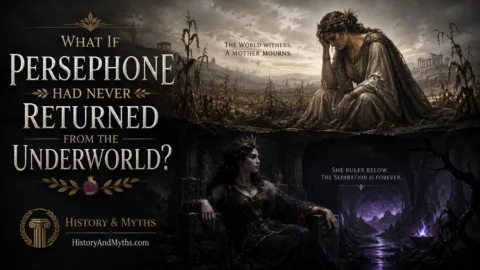
But what if Persephone had never returned?
The immediate consequence would not necessarily be an endless frozen winter. The greater danger would be the continued failure of agriculture. If Demeter refused to restore the earth, mortals would lose their food supply, while the Olympian gods would also lose the sacrifices and honors they received from human communities.
Persephone herself would change as well. Instead of dividing her existence between her mother and Hades, she could become a permanent queen of the Underworld, with a stronger identity tied to death and chthonic power rather than seasonal return.
That would leave Zeus with a crisis he could not simply ignore. Demeter controlled the fertility on which human life depended, Hades would have little reason to surrender his queen, and Persephone might gradually develop authority of her own below.
The real question, then, is larger than whether the seasons would disappear. Could the Olympian order survive if the compromise between Demeter, Hades, and Persephone never happened?
The Mythological Turning Point
The crisis begins when Hades takes Persephone into the Underworld with the approval of Zeus. Demeter, unaware at first of what has happened, searches for her daughter and eventually learns that the arrangement was made without her consent.
Her response threatens far more than the relationship between mother and daughter.
Demeter withdraws from the gods and prevents the earth from producing crops. As the famine worsens, humanity approaches destruction, and the Olympians face another problem: without mortals, they would lose the sacrifices and honors that sustained their relationship with the human world.
Zeus therefore sends Hermes to the Underworld to bring Persephone back. Hades agrees to release her, but Persephone has eaten pomegranate seed and cannot remain permanently above. A compromise follows. In the Homeric Hymn to Demeter, she spends one third of the year below and the remaining two thirds with Demeter and the other gods.
Only after that settlement does Demeter restore fertility to the earth.
This is the point the alternate scenario changes. Persephone never returns from the Underworld, and the compromise that ended Demeter’s famine never takes place.
The immediate problem is not simply that the seasons would change. It is that the divine order would lose the agreement that kept Demeter willing to sustain human life.
The Scenario Used in This Article
This is a hypothetical scenario, not a claim about what actually happened.
This article assumes that Persephone remains permanently in the Underworld. Hermes does not succeed in bringing her back, and no agreement is reached that allows her to divide the year between Hades and Demeter.
Persephone survives and continues as queen beside Hades. Demeter keeps her divine power, Zeus remains ruler of Olympus, and the other gods retain their usual domains. The scenario also does not assume that the earth instantly freezes or that humanity disappears overnight.
The crucial change is that Demeter never receives the return she demanded before restoring fertility to the land.
That leaves gods and mortals trapped in a crisis with no original compromise to resolve it.
The central question is therefore:
Can the divine order survive if Persephone remains below and Demeter refuses to restore the earth?
Would Demeter Let Humanity Starve?
The Homeric Hymn to Demeter suggests that she might, at least until the other gods gave her a reason to stop.
Demeter does not merely grieve after losing Persephone. She deliberately prevents the earth from producing grain. Plowing becomes useless, seed fails in the ground, and the famine grows severe enough to threaten the survival of humanity.
That gives her enormous leverage over Zeus.
Her refusal also creates a second crisis. If mortals disappear, the Olympian gods lose the sacrifices and honors they receive from the human world. Demeter is therefore pressuring Olympus as much as she is punishing humanity.
In this scenario, Persephone never returns, so the condition Demeter set for ending the famine is never fulfilled. She would have little reason to restore fertility simply because Zeus ordered her to do so. The hymn shows that messages, promises, and gifts from the other gods initially fail to change her mind.
That does not mean Demeter necessarily wants humanity extinct. Mortals are caught inside a divine dispute rather than being her true target. But unless another settlement replaced Persephone’s return, she could continue withholding the harvest long enough to make survival itself uncertain.
The first major consequence of Persephone remaining below would therefore be famine, not endless winter. And that famine would become Demeter’s strongest weapon against both Hades and Olympus.
Could Zeus Force Demeter to Restore the Earth?
Zeus could command Demeter, but the Homeric Hymn makes clear that command alone was not enough.
He first sends Iris to summon her back to Olympus. Demeter refuses. Zeus then sends the other gods with gifts and offers of new honors, but she rejects them as well. Her condition remains unchanged: she will not return to Olympus or allow the earth to produce until she sees Persephone again.
That matters because Demeter’s power cannot simply be replaced by decree. Zeus rules the Olympian order, but he does not personally control the grain that sustains human life. As long as Demeter withholds fertility, his authority cannot solve the crisis without addressing her demand.
The myth therefore presents Zeus as a ruler who must negotiate with another god whose domain gives her real leverage. He ultimately sends Hermes to recover Persephone because persuasion has failed and the famine is becoming dangerous to both mortals and gods.
If Persephone could not return in this scenario, Zeus would need a different settlement. He might offer Demeter greater honors, pressure Hades, or seek another arrangement that restored some contact between mother and daughter.
What the surviving story does not support is the simplest solution: Zeus ordering Demeter to end the famine and expecting obedience.
His kingship gives him authority over Olympus. It does not make every other divine power irrelevant.
Would the World Be Trapped in Eternal Winter?
Not necessarily. “Eternal winter” is the familiar modern shorthand, but the Homeric Hymn to Demeter describes a more specific disaster: the earth stops producing grain and humanity moves toward famine.
Demeter’s power is agricultural fertility, not simply control over cold weather. If Persephone never returned, the immediate danger would be barren fields, failed harvests, and the collapse of the food supply rather than a planet permanently covered in snow.
The seasonal interpretation developed naturally because Persephone’s absence and return became associated with the yearly death and renewal of vegetation. But in the hymn itself, the crisis ends only when Demeter is reunited with her daughter and allows the earth to bear fruit again.
So if Persephone remained below, the world above could become trapped in something worse than a long winter: a prolonged agricultural failure with no guaranteed end.
The real threat is not cold. It is a world in which the land no longer feeds the people who depend on it.
Would Persephone Become the Permanent Queen of the Underworld?
Yes. Persephone was already queen of the Underworld in Greek tradition, but remaining there permanently would make that identity far more dominant.
Ancient sources do not portray her as a powerless captive forever. She appears beside Hades as a ruler of the dead, receives visitors to the Underworld, and is invoked as a divine authority in her own right. Her return to Demeter gives her a second identity connected with the world above, but permanent residence below would remove that balance.
Over time, Persephone might become less closely associated with seasonal return and more strongly defined by death, transition, judgment, and the authority of the Underworld. Her older identity as Kore, the maiden connected with Demeter and growth, would still survive in myth and cult, but it would no longer be reinforced by an annual return.
That change would also strengthen her political position beside Hades. A goddess who never leaves his realm would not be a temporary seasonal presence. She would become a permanent part of its government and religious identity.
Persephone would therefore lose something important by never returning, but she would also gain something: a more complete and independent identity as queen of the dead.
Would Persephone Become More Powerful Than Hades Expected?
Possibly. Permanent residence in the Underworld would give Persephone far more time to develop authority there.
Even in the Homeric Hymn to Demeter, Hades does not describe her as a decorative consort. He promises that she will rule beside him and receive great honors among the gods. Later Greek tradition also presents Persephone as a figure whom heroes and the dead must confront or persuade, which suggests real authority rather than simple dependence on Hades.
If she never returned to the surface, that authority could become more independent. She would gain her own religious identity, cult expectations, and influence over those entering or leaving the realm of the dead.
That does not mean she would replace Hades. He would still remain lord of the Underworld. But their relationship could become more balanced than he originally expected.
By keeping Persephone permanently below, Hades might gain a queen. He could also create a second center of power inside his own kingdom.
What Would Happen to Hades?
Hades would gain what he wanted, but the victory could create a problem larger than the marriage itself.
Persephone’s permanent presence would strengthen his household and give the Underworld a queen with growing authority. Yet keeping her below would also leave Demeter’s anger unresolved and place Hades at the center of a crisis affecting both mortals and Olympus.
That matters because Hades does not rule in isolation from the wider divine order. In the Homeric Hymn to Demeter, he ultimately obeys Zeus’s demand to release Persephone, even while ensuring that she remains tied to his realm through the pomegranate. The surviving myth therefore presents him as powerful, but still part of a larger balance among the gods.
If Persephone never returned, that balance would break. Hades might face pressure from Zeus, hostility from Demeter, and a growing dependence on Persephone as a political partner inside the Underworld.
His apparent victory could therefore become a strategic burden.
Hades would keep his queen, but he would also inherit responsibility for a conflict capable of destabilizing the world above.
Could the Olympian Gods Survive Without Human Offerings?
The gods would not simply cease to exist, but Demeter’s famine threatened something central to their relationship with mortals: sacrifice, worship, and divine honor.
The Homeric Hymn to Demeter states that if humanity perished, the Olympians would lose the gifts and sacrifices offered by humans. That is one reason Zeus cannot treat Demeter’s refusal as a private family dispute. Her control over agriculture gives her the power to disrupt the religious system that connects gods and mortals.
If Persephone never returned and the famine continued, temples and rituals might survive for a time, but shrinking populations and failed harvests would eventually reduce the offerings available to the gods. The crisis would therefore weaken not only human society but also the honors through which divine status was expressed.
This does not mean the Olympians depend on sacrifice for physical survival. The hymn presents the threat as a loss of honor and worship, not divine death.
Demeter’s leverage is therefore larger than hunger alone. By withholding the harvest, she can make the entire Olympian order pay for Persephone’s absence.
Would Zeus Lose Authority Over the Gods?
Probably not, but Persephone’s permanent absence would expose a real limit to his power.
Zeus remains king of the Olympians in the Homeric Hymn to Demeter, yet he cannot simply command the crisis away. Demeter ignores his summons, rejects the gifts offered by the gods, and refuses to restore the harvest until Persephone is returned. Zeus ultimately changes strategy and sends Hermes to Hades.
If that solution failed, Zeus would face a prolonged challenge from within his own divine family. The problem would not be open rebellion against his kingship. It would be that another goddess controlled something his authority could not replace: the fertility of the earth.
That could weaken the image of Zeus as an unquestioned ruler, especially if famine continued while he remained unable to satisfy Demeter or compel Hades to surrender Persephone.
His throne would probably survive. His authority, however, would look more dependent on negotiation and balance than absolute command.
What Would Happen to the Eleusinian Mysteries?
They might still emerge, but probably not in the form known from Greek tradition.
The Homeric Hymn to Demeter closely links Eleusis with Demeter’s loss of Persephone, the famine, their reunion, and the establishment of Demeter’s sacred rites. At the end of the hymn, after Persephone returns and fertility is restored, Demeter teaches the Eleusinian leaders the rites that later tradition associated with the Mysteries.
If Persephone never returned, that theological foundation would change dramatically. A cult centered on Demeter and Persephone could still develop at Eleusis, but its central message might emphasize separation, mourning, and contact with the Underworld rather than reunion and restored fertility.
That could also alter the promise of the Mysteries themselves. Historically, they became closely associated with Demeter, Persephone, initiation, and hopes connected with the afterlife.
Without Persephone’s return, Eleusis might become the religious center of an unresolved loss rather than a sacred story in which death, absence, and restoration are ultimately held in balance.
Would Persephone Still Represent Rebirth?
Her connection with rebirth would probably weaken, because the most powerful symbol behind it is movement between two worlds.
Persephone belongs to both the Underworld and the world of Demeter. Her return allows separation to end, fertility to resume, and life above ground to continue. That cycle made her especially suited to ideas of renewal after absence and life emerging after apparent death.
If she never returned, the pattern would lose its second half.
Persephone could still be associated with transition and the fate of the dead, but her identity would become more strongly chthonic. Instead of representing a figure who crosses the boundary and comes back, she would represent someone who entered the realm of death and remained there as its queen.
This would not erase every association with renewal. Greek religion was flexible, and Demeter’s fertility remained a separate divine power. But Persephone herself would offer a different religious image.
Her myth would no longer promise return through her own movement between worlds. It would emphasize permanence below, making her a stronger symbol of death’s realm than of the cycle that leads back from it.
Could Another God Restore Fertility?
Not easily.
Greek religion included several gods connected with vegetation, rain, growth, and agriculture, but Demeter’s role in the Homeric Hymn is not treated as a replaceable office. When she withholds the grain, Zeus does not appoint another deity to restore the harvest. Instead, the crisis continues until her demand over Persephone is addressed.
Other gods might help create a temporary solution. Zeus could provide rain, Dionysian cults could preserve other ideas of vegetation and renewal, and local traditions might adapt around different divine powers. But none of that guarantees the return of the grain on which Greek communities depended.
The most plausible solution would therefore be political rather than agricultural. Zeus would need to reach a new agreement with Demeter, perhaps granting her greater honors or finding another way for mother and daughter to maintain contact.
If Persephone remained below, replacing Demeter would be far less likely than persuading her to make the earth fertile again.
What Would Probably Not Change
Persephone’s permanent absence would disrupt the balance between Demeter, Hades, and Olympus, but it would not overturn every part of Greek religion.
Hades would still rule the dead, Zeus would remain king of the Olympians, and Demeter would retain her power over agriculture. Mortals would still depend on the harvest, while the gods continued to rely on worship, sacrifice, and divine honor.
The Underworld itself would also remain necessary. Death would not disappear simply because Persephone never returned.
The largest changes would be concentrated in fertility, divine authority, Persephone’s identity, and the religious meaning of her separation from Demeter.
Read More
Most Likely
The most likely outcome is a prolonged divine crisis that eventually forces a new compromise.
Demeter would continue using the harvest as leverage, while Zeus tried to protect both humanity and the authority of Olympus. Hades would resist losing Persephone completely, and Persephone herself would become more firmly established as queen of the Underworld.
A permanent stalemate would be difficult to sustain because famine threatened mortals and weakened the system of sacrifice that honored the gods.
The most plausible solution would therefore be some new form of contact or agreement between Demeter and Persephone, even if Persephone never physically returned to the world above.
Plausible but Uncertain
Several deeper changes are possible, but none can be treated as inevitable.
Persephone might develop a more independent identity as permanent queen of the Underworld, while Demeter gained greater political leverage among the Olympians. The Eleusinian Mysteries could also evolve around permanent separation rather than reunion and return.
Greek religion might eventually create a new symbolic system for fertility that did not depend on Persephone physically leaving Hades each year.
These outcomes fit the flexibility of Greek myth and cult, but the surviving sources cannot tell us which path would have become dominant.
Highly Unlikely
The least credible outcome is a world that simply freezes forever while the gods do nothing.
Persephone remaining below would create a severe agricultural and religious crisis, but Greek mythology rarely treats divine conflicts as permanently static. Zeus, Demeter, Hades, and the other gods would all have reasons to seek a new balance before humanity disappeared entirely.
It is also unlikely that Hades would take control of Olympus, that Demeter would lose her agricultural power, or that Persephone would become a goddess of evil simply because she never returned.
The stronger scenario is prolonged instability followed by adaptation, not the total collapse of the divine order.
Final Verdict: Persephone Could Stay Below, but the Gods Would Need a New Balance
If Persephone never returned from the Underworld, the greatest danger would not be eternal winter. It would be the collapse of the agreement that allowed Demeter to restore fertility and Olympus to preserve its relationship with humanity.
Persephone could become a more permanent and powerful queen beside Hades, while Demeter gained extraordinary leverage over Zeus through control of the harvest. But neither famine nor divine conflict could continue indefinitely without threatening the entire system.
The most likely result is therefore a new compromise, not total destruction.
Persephone might remain below, but the gods would still have to find another way to restore life above.
Frequently Asked Questions
What would happen if Persephone never returned from the Underworld?
The immediate danger would be a prolonged agricultural crisis. In the Homeric Hymn to Demeter, Demeter refuses to restore fertility until Persephone returns, so her permanent absence could threaten harvests, human survival, and the sacrifices offered to the gods.
Would the world be trapped in eternal winter?
Not necessarily. The ancient story focuses more directly on failed crops and famine than on permanent cold or snow. The greater threat would be land that no longer produces enough food to sustain humanity.
Would Demeter allow humanity to starve?
The myth suggests that she was willing to continue withholding the harvest until her demand was met. Humans were not her true enemy, but their suffering gave her powerful leverage over Zeus and the other Olympians.
Would Persephone become more powerful if she stayed in the Underworld?
Possibly. Persephone was already queen beside Hades, but permanent residence could strengthen her identity and authority as a ruler of the dead while weakening her connection with seasonal return and the world of Demeter.
Could Zeus force Demeter to restore fertility?
The surviving myth suggests that simple commands were not enough. Demeter rejects summons, gifts, and honors until the Persephone crisis is addressed, showing that Zeus would probably need another compromise rather than relying on authority alone.
Would the Eleusinian Mysteries still exist without Persephone’s return?
They might still develop, but their meaning could be very different. Instead of emphasizing separation followed by reunion and renewed fertility, they might focus more heavily on loss, the Underworld, and the permanent boundary between the living and the dead.
Sources & Further Reading
This article is grounded in ancient Greek literary sources and modern scholarship on Demeter, Persephone, the Underworld, agricultural fertility, and the Eleusinian Mysteries. The alternate scenario itself is hypothetical.
PRIMARY MYTHOLOGICAL SOURCE
Homeric Hymn to Demeter:
Hymn 2 to Demeter, Perseus Digital Library
The central ancient source for Persephone’s abduction, Demeter’s withdrawal, the agricultural famine, Zeus’s intervention, Hermes’s mission to Hades, Persephone’s return, and the restoration of fertility.
Thomas W. Allen and E. E. Sikes:
Commentary on the Homeric Hymn to Demeter
Scholarly commentary on the hymn, its relationship with agriculture and Eleusis, and the tradition in which Persephone spends one third of the year in the Underworld.
OTHER ANCIENT GREEK SOURCES
Hesiod, Theogony:
Persephone, Demeter, Zeus, and Hades
An early genealogical tradition identifying Persephone as the daughter of Zeus and Demeter and describing her removal by Hades with Zeus’s approval.
Hesiod, Theogony:
The House of Hades and Persephone
Presents Hades and Persephone together as divine authorities within the realm of the dead.
Homer, Odyssey, Book 11:
Odysseus in the Underworld
An early literary witness to Persephone’s formidable authority in the realm of the dead alongside Hades.
Apollodorus, Library 1.5:
Demeter and Persephone
A later ancient account preserving the main outline of Persephone’s abduction, Demeter’s search, and the settlement that returns Persephone for part of the year.
PERSEPHONE AS QUEEN OF THE UNDERWORLD
Center for Hellenic Studies, Harvard University:
Persephone, Underworld Authority, and the Gold Tablets
Discusses ancient evidence in which Persephone appears explicitly as Queen of the Underworld and as a divine authority approached by the dead.
ELEUSIS & THE AFTERLIFE
Cambridge University Press:
Ancient Mysteries and the Eleusinian Mysteries
Academic discussion of the mysteries at Eleusis as a major cult of Demeter and Persephone and their connection with initiation and the afterlife.
J. Paul Getty Museum:
Underworld: Imagining the Afterlife
Explores Hades, Persephone, Greek beliefs about the Underworld, and the connection between the myth of Demeter and Persephone and the Eleusinian Mysteries.
MODERN SCHOLARSHIP
Helene P. Foley, ed.
The Homeric Hymn to Demeter: Translation, Commentary, and Interpretive Essays
. Princeton University Press.
Diane J. Rayor.
The Homeric Hymns: A Translation, with Introduction and Notes
. University of California Press.
Walter Burkert. Greek Religion. Harvard University Press.
Walter Burkert. Ancient Mystery Cults. Harvard University Press.
Research note: The ancient sources do not describe a historical alternate outcome in which Persephone remains permanently in the Underworld. The consequences explored in this article are analytical possibilities based on the roles assigned to Demeter, Persephone, Hades, and Zeus in Greek myth. The Homeric Hymn emphasizes failed crops and famine rather than a literal permanent winter, and its surviving version places Persephone in the Underworld for one third of the year rather than the commonly repeated six-month division.
Copyright & Use
Written by H. Moses
This article is original content published by History & Myths. Its alternate-history analysis, structure, and written interpretation may not be reproduced, republished, or redistributed in full without permission.
Short quotations may be used for reference or discussion when accompanied by clear attribution and a link to the original article on HistoryAndMyths.com.