Greek Mythology vs Greek Religion: What’s the Difference?
Many people use the terms Greek mythology and Greek religion as if they mean the same thing, but in ancient Greece they were closely connected without being identical. Myths told stories about gods, heroes, and the origins of the world, while religion focused on worship, rituals, sacrifices, and maintaining relationships with divine powers. A person could participate in religious ceremonies without knowing every version of a myth, just as different myths could exist without changing how the gods were worshipped.
Understanding the difference between myth and religion helps explain how Greek society viewed its gods and why Greek mythology developed into a vast collection of stories rather than a single sacred doctrine. It also reveals how myths and religious practices worked together to shape one of the most influential belief systems of the ancient world.
Why Myth and Religion Were Not the Same Thing
In ancient Greece, myth and religion operated together but served different purposes. Religion centered on worship: sacrifices, prayers, festivals, temple rituals, and maintaining favor with the gods. Myth, by contrast, consisted of stories that explained the origins, relationships, actions, and characteristics of divine beings and heroes.
This distinction is important because Greek religion did not depend on a single sacred text or an official version of every story. People honored Zeus, Athena, Demeter, or Apollo through established rituals regardless of the many different myths told about them. A community could worship the same god while preserving local traditions and alternative narratives about that deity.
As a result, mythology provided meaning, symbolism, and cultural memory, while religion provided practices through which people interacted with the divine. The two were closely connected, but they were not identical parts of Greek life.
Myth vs Religion in Ancient Greece
| Greek Mythology | Greek Religion |
|---|---|
| Told stories about gods, heroes, and the cosmos. | Focused on worship, sacrifice, and ritual practice. |
| Had multiple versions of the same narrative. | Relied on established traditions and ceremonies. |
| Explained divine actions and sacred history. | Maintained relationships between humans and gods. |
| Preserved through poets, storytellers, and literature. | Expressed through temples, festivals, and cult activities. |
| Could vary between regions and authors. | Provided continuity through shared communal practices. |
| Survived as cultural and literary heritage. | Gradually disappeared with the decline of ancient pagan worship. |
Religion Focused on Worship, Not Stories
For most ancient Greeks, religion was primarily a matter of practice rather than belief in a fixed set of narratives. Participation in sacrifices, festivals, processions, and prayers was far more important than knowing every myth associated with a particular god. Religious life revolved around honoring divine powers and maintaining proper relationships with them.
This practical focus helps explain why Greek religion remained relatively stable even when myths varied from one region to another. A worshipper visiting a temple of Athena or Apollo was expected to participate in rituals and respect sacred traditions, not to follow a single official version of the god’s story.
As a result, religious identity was shaped largely through communal acts of worship. Myths provided cultural context and meaning, but ritual practice formed the foundation of everyday religious life in ancient Greece.
Myths Explained the Gods, Religion Honored Them
Myths and religious practices often focused on the same gods, but they approached them in different ways. Mythology sought to explain who the gods were, how they gained power, how they interacted with one another, and why certain aspects of the world existed. These stories gave divine figures personalities, histories, and symbolic meaning.
Religion, on the other hand, was concerned with honoring those gods through ritual action. Worshippers did not sacrifice to Athena because they knew every myth about her. They sacrificed to Athena because she was believed to protect the city, offer guidance, or grant favor. The relationship was practical and devotional rather than narrative.
This distinction helps explain why mythology and religion could support each other without serving the same function. Myths provided stories that shaped cultural understanding of the gods, while religion created the rituals through which people sought divine assistance and protection.
Why Different Versions of Myths Could Exist
One of the clearest differences between Greek mythology and Greek religion is that myths were not fixed in a single authoritative form. Different poets, cities, and traditions could tell the same story in different ways without creating a religious crisis. Multiple versions of a myth often existed side by side, and audiences generally accepted this variation.
This flexibility was possible because mythology was not governed by a sacred scripture comparable to those found in some later religious traditions. The purpose of a myth was not to establish an official doctrine but to preserve cultural memory, explain the gods, and explore moral or symbolic ideas. As a result, storytellers could adapt myths for different audiences and circumstances.
Religious practice, however, tended to be more stable. Local rituals, festivals, and sacrificial traditions were often preserved for generations even when myths evolved. This distinction allowed Greek mythology to remain creative and diverse while Greek religion maintained continuity through shared acts of worship.
The Core Difference
Ancient Greek mythology and Greek religion were closely connected but served different purposes. Mythology provided stories that explained the gods and the world, while religion consisted of the rituals, sacrifices, festivals, and acts of worship through which Greeks interacted with divine powers.
Mystery Cults Blurred the Boundary Between Myth and Religion
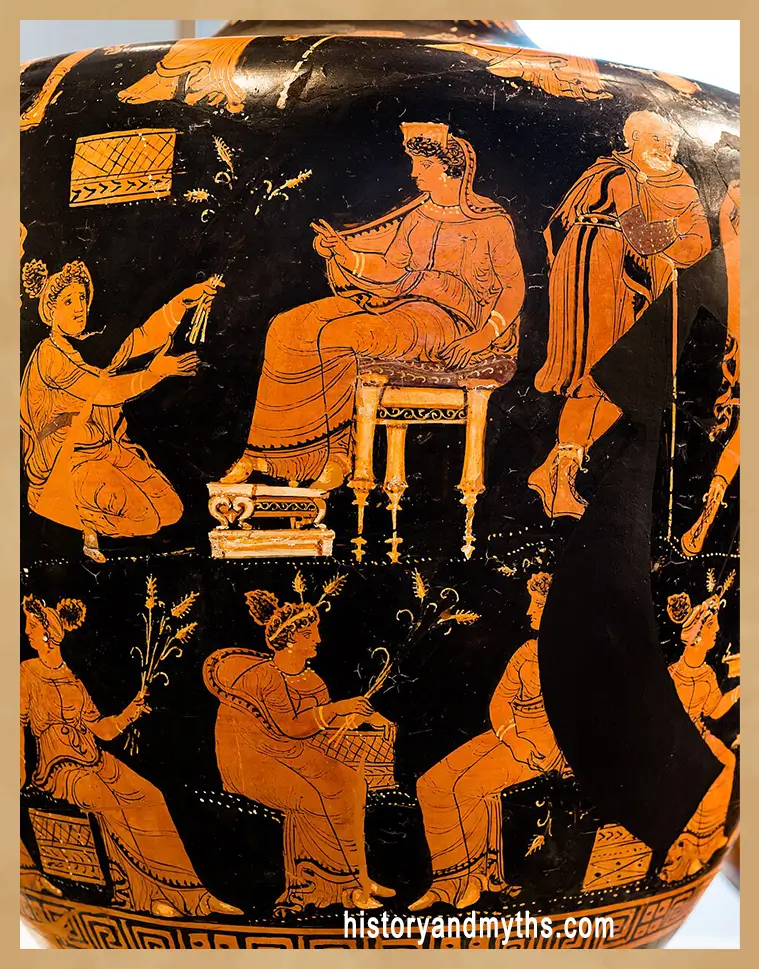
Although myth and religion often served different functions, some Greek religious movements brought the two much closer together. Mystery cults such as the Eleusinian Mysteries and Orphism based important religious experiences on mythological narratives. Their rituals were connected to stories about divine figures, sacred journeys, death, and rebirth.
In these traditions, myths were not simply stories about the gods. They became part of the religious experience itself, helping initiates understand the meaning of ceremonies and the promises associated with them. Myth provided the framework through which participants interpreted sacred rituals and expectations about the afterlife.
Even so, the distinction never disappeared completely. The myths offered symbolic explanations, while the rituals remained the means through which believers sought spiritual benefits. Mystery cults therefore illustrate how closely mythology and religion could interact without becoming identical.
Why Modern People Often Confuse Myth and Religion
Modern discussions frequently blur the distinction between mythology and religion because many ancient religions are known primarily through their surviving myths. Greek mythology has become far more familiar to modern audiences than the everyday religious practices that once accompanied it. As a result, the stories are often mistaken for the religion itself.
This misunderstanding is reinforced by the fact that the myths survived in literature, while many rituals existed only through practice. People today can easily read Homer, Hesiod, or later mythological accounts, but they cannot directly experience the festivals, sacrifices, and civic ceremonies that formed the core of Greek religious life.
Understanding this difference helps place Greek mythology in its proper context. The myths preserved cultural ideas about the gods, while religion consisted of the social and ritual activities through which communities expressed devotion and sought divine favor. One helped explain the sacred world; the other helped people participate in it.
What the Difference Reveals About Ancient Greek Society
The distinction between myth and religion reveals that ancient Greek society was not organized around a single set of religious doctrines. Instead, it combined shared rituals with a diverse body of stories that could be interpreted, adapted, and retold across generations. This gave Greek culture a level of religious flexibility that was unusual in many later traditions.
Myths allowed Greeks to explore questions about power, justice, fate, morality, and the nature of the gods, while religion provided the ceremonies and social structures that connected communities to the divine. The two systems supported one another, but each fulfilled a different role within society.
Understanding this relationship helps explain why Greek mythology survived long after ancient Greek religion disappeared. Religious practices eventually faded, but the stories continued to be copied, studied, and reinterpreted because they addressed ideas that extended beyond ritual worship and remained meaningful in different historical periods.
Greek mythology and Greek religion were deeply connected, yet they were not the same thing. Mythology provided stories that explained the gods, the origins of the world, and the meaning of human experience, while religion focused on worship, ritual practice, and maintaining relationships with divine powers. The Greeks did not need a single official version of a myth in order to participate in religious life, nor did religious practice depend entirely on mythological narratives.
Recognizing this distinction offers a clearer understanding of how ancient Greek society functioned and why its myths achieved such lasting influence. Religion shaped the daily interaction between humans and the gods, while mythology preserved the stories that continued to inspire literature, philosophy, art, and culture long after the ancient rituals themselves had disappeared.
Key Takeaways
- Greek mythology and Greek religion were related but not identical.
- Religion focused primarily on ritual practice rather than mythological knowledge.
- Myths explained the gods, while religion honored them through worship.
- Different versions of myths could coexist without affecting religious practice.
- Mystery cults brought mythology and religious experience closer together.
- Modern audiences often confuse mythology with religion because myths survived more completely than rituals.
- The distinction helps explain both the flexibility of Greek mythology and the stability of Greek religious traditions.
Frequently Asked Questions
What is the difference between Greek mythology and Greek religion?
Greek mythology consists of stories about gods, heroes, and the cosmos, while Greek religion focused on worship, rituals, sacrifices, and festivals.
Did ancient Greeks believe their myths?
Many Greeks accepted myths as meaningful traditions, but religious life was centered more on ritual practice than on strict belief in every mythological detail.
Was Greek mythology a religion?
Greek mythology was part of Greek religion, but it was not identical to it. Myths explained the gods, while religion involved worshipping them.
Why were there different versions of Greek myths?
Greek mythology had no single sacred scripture, allowing poets, regions, and communities to preserve different versions of the same stories.
Did religious rituals depend on myths?
Some rituals were connected to mythological narratives, but many religious practices continued regardless of variations in the stories.
How did mystery cults connect myth and religion?
Mystery cults used mythological narratives to give meaning to sacred rituals and beliefs about spiritual transformation and the afterlife.
Why do modern people confuse mythology and religion?
Because myths survived in literature while many religious practices disappeared, modern audiences often encounter the stories without their original ritual context.
Why is this distinction important?
Understanding the difference helps explain how Greek society functioned and why Greek mythology survived long after ancient Greek religion declined.
SOURCES
- Burkert, Walter. Greek Religion. Harvard University Press, 1985.
- Mikalson, Jon D. Ancient Greek Religion. Wiley-Blackwell, 2010.
- Larson, Jennifer. Ancient Greek Cults: A Guide. Routledge, 2007.
- Graf, Fritz. Greek Mythology: An Introduction. Johns Hopkins University Press, 1993.
- Buxton, Richard. The Complete World of Greek Mythology. Thames & Hudson, 2004.
- Kirk, G. S. The Nature of Greek Myths. Penguin Books, 1974.
- Vernant, Jean-Pierre. Myth and Thought Among the Greeks. Routledge, 1983.
- Dowden, Ken. The Uses of Greek Mythology. Routledge, 1992.
- Gantz, Timothy. Early Greek Myth: A Guide to Literary and Artistic Sources. Johns Hopkins University Press, 1993.
- Hard, Robin. The Routledge Handbook of Greek Mythology. Routledge, 2004.
- Hesiod. Theogony. Translated by Glenn W. Most. Harvard University Press, 2006.
- Homer. Iliad. Loeb Classical Library. Harvard University Press.
- Homer. Odyssey. Loeb Classical Library. Harvard University Press.
- Apollodorus. The Library of Greek Mythology. Oxford University Press, 1997.
- Parker, Robert. On Greek Religion. Cornell University Press, 2011.
- Bremmer, Jan N. Greek Religion and Culture, the Bible, and the Ancient Near East. Brill, 2008.
- Price, Simon. Religions of the Ancient Greeks. Cambridge University Press, 1999.
- Nilsson, Martin P. A History of Greek Religion. Oxford University Press, 1964.
- Edmonds, Radcliffe G. Redefining Ancient Orphism. Cambridge University Press, 2013.
- Clinton, Kevin. The Eleusinian Mysteries. Archaeological Society at Athens, 2003.
Written by H. Moses — All rights reserved © Mythology and History