Greek Cosmology Explained: Structure of the Mythological Universe
The structure of the Greek cosmos was far more complex than a simple division between heaven, earth, and the underworld. Ancient Greek mythology imagined the universe as a layered system of connected realms that included Olympus, the mortal world, Oceanus, Hades, Tartarus, and the distant boundaries separating gods, humans, and primordial forces. Each region occupied a specific place within the cosmic order and helped define how the mythological universe functioned.
In Greek thought, Olympus was not a separate paradise outside creation, but part of the cosmos itself. Beneath the world of mortals lay darker and deeper realms such as Hades and Tartarus, while Oceanus surrounded the known world like a cosmic boundary at the edge of existence. Greek myths repeatedly described gates, rivers, chasms, and distant frontiers that separated one realm from another, creating a universe organized through layers, limits, and unstable balances rather than infinite space.
This structure mattered because Greek mythology did not treat the cosmos as static or completely secure. Wars between gods, imprisoned primordial powers, and recurring threats rising from beneath the earth all reflected a universe that remained vulnerable to disorder even after the Olympians established their rule.
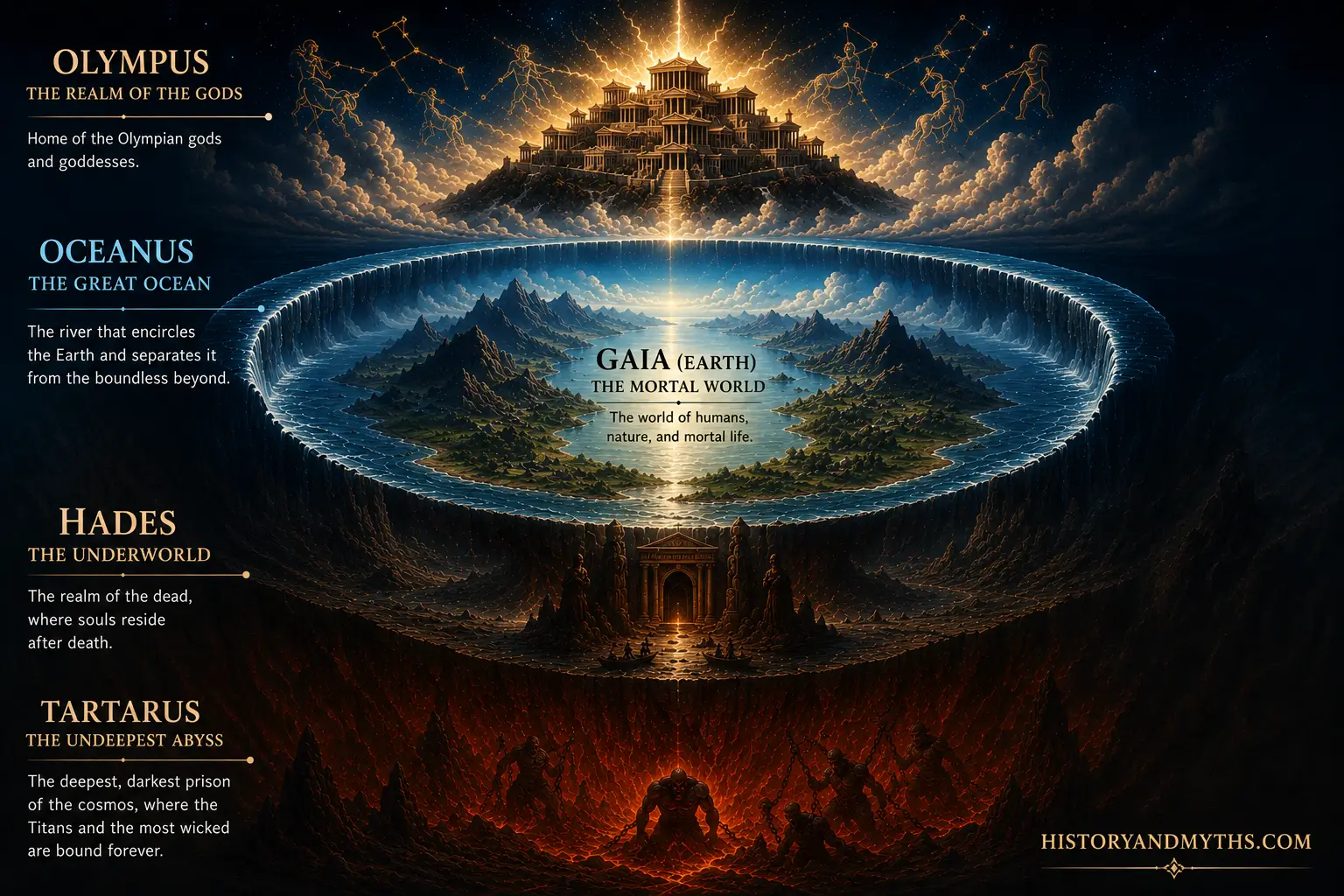
How the Greeks Imagined the Structure of the Cosmos
Ancient Greek mythology imagined the cosmos as a layered universe divided into separate realms with clear boundaries and different forms of power. The world was not seen as infinite space. Gods, mortals, monsters, primordial beings, and the dead each occupied their own place within a larger cosmic structure.
The mortal world stood between higher and lower regions of existence. Above it lay the sky, Olympus, and the upper divine realm associated with the Olympian gods. Beneath the earth stretched darker spaces connected to death, imprisonment, and ancient powers, especially Tartarus deep below the underworld. Greek myths repeatedly describe movement between these levels through falling, descent, ascent, or journeys across divine barriers.
The cosmos also extended outward toward distant edges beyond ordinary human space. Oceanus surrounded the world as a vast cosmic boundary, while remote regions beyond it became associated with night, monsters, or primordial forces separated from the ordered world of gods and mortals.
Boundaries played a central role in maintaining cosmic stability. Rivers, gates, chasms, and divine barriers separated one realm from another and restricted dangerous powers from crossing freely through the universe. Many Greek myths begin when those boundaries fail, allowing disorder to return into the structure of the cosmos itself.
| Cosmic Region | Role in Greek Mythology |
|---|---|
| Olympus | Center of Olympian authority and divine governance |
| Aether | Upper divine atmosphere associated with celestial light |
| Mortal World | Central realm inhabited by humans and influenced by gods |
| Oceanus | Cosmic boundary surrounding the known world |
| Hades | Primary realm of the dead beneath the earth |
| Erebus | Primordial darkness linked to the lower cosmos |
| Tartarus | Deep cosmic prison for Titans and destructive forces |
The Upper World: Olympus, Sky, and Aether
Greek mythology separated the upper cosmos into different regions rather than treating the sky as a single realm. Mount Olympus stood at the center of Olympian authority, but it was not the highest or most distant layer of existence. The myths distinguish between the physical sky visible to mortals, the divine atmosphere associated with the gods, and higher cosmic regions linked to light and celestial forces.
Olympus functioned as the political and symbolic center of the divine world. The Olympian gods ruled from the mountain, held assemblies there, and governed the structure of the cosmos from its heights. Yet Olympus still remained part of the universe itself. The gods could descend from it, interact with mortals, or travel across other cosmic regions without leaving creation behind.
Above the ordinary sky existed Aether, a brighter and purer upper realm associated with divine light. Greek mythology often treated Aether as different from the lower atmosphere inhabited by humans. This distinction helped separate mortal existence from the clearer and more elevated space connected to the gods and celestial order.
The upper cosmos was therefore not imagined as a distant paradise disconnected from the world below. Olympus, sky, stars, storms, and celestial movement all belonged to the same larger structure. Divine power remained closely tied to the visible universe rather than existing outside it.
Earth as the Center of the Greek Cosmos
In Greek mythology, the mortal world occupied the middle region of the cosmos between the upper divine realms and the darker spaces below the earth. Human life existed at the center of larger cosmic forces, exposed to the influence of gods, fate, monsters, storms, and powers rising from beneath the world itself.
Gaia, the primordial earth, was more than land or soil. She represented the foundational ground from which many cosmic powers emerged, including the Titans, Giants, and other ancient beings tied to the structure of the universe. Because of this, the earth in Greek mythology was never fully stable or passive. It could produce life, divine authority, rebellion, or destructive forces depending on the balance of the cosmos.
The mortal world also functioned as a meeting point between realms that were normally separated. Gods descended into human space, heroes entered the underworld, monsters crossed distant boundaries, and divine punishments often appeared directly within the visible world. Greek myths repeatedly blur the line between cosmic and human events by placing both inside the same connected structure.
This central position made the mortal world vulnerable. Wars among gods, ruptures in cosmic boundaries, or the release of imprisoned powers rarely remained isolated in distant realms. Their effects spread upward, downward, and across the human world at the same time.
Oceanus and the Edge of the World
Greek mythology imagined Oceanus as a vast cosmic river surrounding the known world at its outer limits. It was not simply an ocean in the modern sense, but a boundary marking the edge of ordinary human space and the transition into distant mythological regions.
Many remote places in Greek myth were located near or beyond this outer border. Lands connected to darkness, monsters, divine cattle, or sunset journeys often appear close to the stream of Oceanus because the edge of the world represented separation from the ordered center of the cosmos. These regions existed within creation, yet remained distant from the familiar world of cities, temples, and mortal life.
Oceanus also helped organize movement through the universe. The sun was sometimes described as traveling around the edges of the world, while gods, heroes, and mythical beings crossed remote waters to reach hidden or forbidden regions. The boundary therefore functioned both geographically and symbolically, separating stability from uncertainty and known space from cosmic distance.
Unlike later ideas of infinite space, Greek cosmology imagined clear outer limits. Oceanus marked one of the largest and most important of those limits, defining where the structured world ended and where unfamiliar forces began.
How Greek Mythology Organized the Universe
Greek mythology imagined the cosmos as a structured system of separate but connected realms. Divine authority, mortal existence, primordial forces, and the dead all occupied different regions within the same cosmic framework.
- Olympus functioned as the center of Olympian rule.
- The mortal world occupied the middle layer of the cosmos.
- Oceanus marked the outer boundary of the known world.
- Hades, Erebus, and Tartarus represented different levels of the lower cosmos.
- Gates, rivers, and chasms separated dangerous forces from the ordered universe.
- Greek myths repeatedly portrayed cosmic stability as vulnerable to collapse.
© historyandmyths.com
Hades, Erebus, and Tartarus: Different Cosmic Realms
Greek mythology did not treat the underworld as a single undivided space. Hades, Erebus, and Tartarus referred to different regions with separate functions inside the lower cosmos, even though later retellings often merge them together.
Hades was the primary realm of the dead, ruled by Hades beneath the earth. It functioned as the destination of mortal souls after death and formed part of the normal structure of the cosmos rather than a place reserved only for punishment. Greek myths usually describe it as distant, shadowed, and difficult to escape, but still connected to the wider universe through rivers, gates, and divine journeys.
Erebus occupied a darker and more primordial role. Ancient Greek sources associate it with deep darkness and obscurity rather than the organized realm of the dead itself. In some traditions, Erebus appears as both a primordial force and a region within the lower cosmos, reflecting the older layers of existence that existed before Olympian order fully emerged.
Tartarus stood even deeper than Hades and carried a different function altogether. It was not simply another part of the underworld, but a cosmic prison associated with divine punishment and confinement. Greek mythology places defeated Titans, monstrous beings, and dangerous primordial forces there because Tartarus existed at the furthest limits of cosmic separation beneath the ordinary world of both gods and mortals.
These distinctions mattered because Greek cosmology organized the lower universe through depth and hierarchy rather than a single realm of death. The deeper a force was confined beneath the cosmos, the more dangerous and destabilizing it was believed to be.
Gates, Boundaries, and Cosmic Separation
Greek mythology repeatedly uses gates, rivers, walls, and chasms to separate one cosmic region from another. These boundaries were not decorative details. They controlled movement between realms and helped maintain the balance of the universe by limiting contact between gods, mortals, monsters, and imprisoned powers.
Several myths describe specific entry points between worlds. The gates of the underworld marked the transition between mortal life and the realm of the dead, while rivers such as Styx functioned as dividing lines that even gods respected. Tartarus itself was often portrayed as sealed behind barriers deep beneath the earth to prevent dangerous forces from escaping back into the cosmos.
These separations also shaped heroic journeys in Greek mythology. Heroes who crossed cosmic boundaries rarely did so safely or permanently. Descents into the underworld, encounters with primordial beings, or travel toward the edge of the world usually involved risk because movement across realms threatened the normal order of the universe.
Greek cosmology therefore depended on controlled separation as much as divine authority. The stability of the cosmos relied not only on who ruled it, but on keeping its different regions from collapsing into one another.
Continue Reading
- Titanomachy: The War That Created the Olympian Order
- Gigantomachy: The Ancient Greek War Between Olympian Gods and Giants
- The Greek Underworld: Hades, Tartarus, and the Afterlife
- Greek Creation Myth: Chaos, Titans, and the Rise of Zeus
- Greek Mythology: Origins of Humanity, Prometheus, and the Five Ages
Why the Greek Cosmos Was Never Completely Stable
Greek mythology presents the cosmos as organized, but never fully secure. Even after the Olympian gods established their rule, older powers continued to exist beneath, beyond, or outside the ordered world. Titans remained imprisoned in Tartarus, monstrous beings survived at the edges of the cosmos, and primordial forces connected to chaos never disappeared completely.
Many major myths begin when something crosses a cosmic boundary that should have remained closed. The Titanomachy, Gigantomachy, and battles against figures such as Typhon all reflect the same underlying fear: order could still be challenged from below, from the margins of the world, or from forces older than Olympus itself.
This instability shaped the structure of Greek cosmology. The universe was not imagined as permanently perfect or eternally balanced. Divine authority had to be defended continuously against rebellion, disorder, and the return of destructive powers confined within the cosmos.
That tension gave Greek mythology much of its movement and conflict. The cosmos remained alive, vulnerable, and constantly exposed to forces capable of disrupting the boundaries that held the universe together.
Greek mythology imagined the cosmos as a connected structure built from layers, boundaries, and unequal forms of power. Olympus, the mortal world, Oceanus, Hades, and Tartarus were not isolated settings created for separate myths. Together, they formed a single universe organized through distance, hierarchy, and controlled separation between realms.
This cosmic structure also explains why Greek myths constantly return to rebellion, descent, imprisonment, and the threat of chaos. The universe remained ordered, but never entirely secure. Boundaries could weaken, ancient forces could rise again, and conflicts between divine and primordial powers could disrupt the balance of the cosmos itself.
Rather than presenting the universe as abstract space, Greek mythology treated it as a living structure shaped by movement, tension, and unstable equilibrium between order and disorder.
Key Takeaways
- Greek mythology described the cosmos as a layered and structured universe.
- Olympus existed within the cosmos rather than outside creation.
- The mortal world stood between upper divine realms and lower cosmic regions.
- Oceanus functioned as a boundary surrounding the known world.
- Hades, Erebus, and Tartarus were separate regions with different roles.
- Cosmic boundaries helped maintain order by separating dangerous forces.
- Greek myths portrayed the universe as organized but never completely stable.
Frequently Asked Questions
How did Greek mythology describe the structure of the universe?
Greek mythology described the cosmos as a layered structure divided into separate realms such as Olympus, the mortal world, Oceanus, Hades, and Tartarus.
Was Mount Olympus considered heaven in Greek mythology?
No. Olympus was the home of the Olympian gods, but it remained part of the cosmos rather than a separate heavenly realm outside creation.
What was Oceanus in Greek mythology?
Oceanus was a vast cosmic river believed to surround the known world and mark its outer boundary.
What is the difference between Hades and Tartarus?
Hades was the primary realm of the dead, while Tartarus functioned as a much deeper cosmic prison for Titans and dangerous primordial beings.
What was Aether in Greek mythology?
Aether referred to a higher and purer upper realm associated with divine light and the celestial atmosphere above the mortal sky.
Why were cosmic boundaries important in Greek mythology?
Boundaries separated different realms of existence and prevented destructive forces from disrupting the balance of the cosmos.
Why was the Greek cosmos considered unstable?
Greek myths often portray ancient powers, monsters, and imprisoned beings as ongoing threats capable of breaking cosmic order and returning chaos to the universe.
Sources & Rights
- Hesiod. Theogony. Translated by M. L. West. Oxford University Press.
- Homer. Iliad. Translated by Richmond Lattimore. University of Chicago Press.
- Homer. Odyssey. Translated by Robert Fagles. Penguin Classics.
- Apollodorus. The Library of Greek Mythology. Oxford University Press.
- Pausanias. Description of Greece. Harvard University Press.
- Burkert, Walter. Greek Religion. Harvard University Press.
- Graf, Fritz. Greek Mythology: An Introduction. Johns Hopkins University Press.
- Hard, Robin. The Routledge Handbook of Greek Mythology. Routledge.
- Kirk, G. S. The Nature of Greek Myths. Penguin Books.
- West, M. L. The East Face of Helicon: West Asiatic Elements in Greek Poetry and Myth. Oxford University Press.
- Buxton, Richard. The Complete World of Greek Mythology. Thames & Hudson.
- Nilsson, Martin P. A History of Greek Religion. Oxford University Press.
- Vernant, Jean-Pierre. Myth and Society in Ancient Greece. Zone Books.
- Detienne, Marcel. The Creation of Mythology. University of Chicago Press.
- Dowden, Ken. The Uses of Greek Mythology. Routledge.
- Morford, Mark, and Robert Lenardon. Classical Mythology. Oxford University Press.
- Rose, H. J. A Handbook of Greek Mythology. Routledge.
- Gantz, Timothy. Early Greek Myth: A Guide to Literary and Artistic Sources. Johns Hopkins University Press.
- Segal, Robert A. Myth: A Very Short Introduction. Oxford University Press.
- Edmonds, Radcliffe G. Greek Myth. Routledge.
- Csapo, Eric. Theories of Mythology. Wiley-Blackwell.
- Eliade, Mircea. Myth and Reality. Harper & Row.
- Boardman, John. Greek Art. Thames & Hudson.
- Pollitt, J. J. Art and Experience in Classical Greece. Cambridge University Press.
- Hurwit, Jeffrey M. The Art and Culture of Early Greece. Cornell University Press.
- Hamilton, Edith. Mythology. Little, Brown and Company.
- Calasso, Roberto. The Marriage of Cadmus and Harmony. Vintage Books.
- Graves, Robert. The Greek Myths. Penguin Books.
- West, M. L. Hesiod: Theogony and Works and Days. Oxford University Press.
- Jaeger, Werner. The Theology of the Early Greek Philosophers. Oxford University Press.
Written by H. Moses — All rights reserved © Mythology and History