Why the Unburied Dead Were Feared in Greek Mythology
In ancient Greece, few fates were considered more frightening than dying without burial. The fear was not simply about leaving a body exposed or denying someone a proper funeral. Greeks believed that burial played a crucial role in the soul’s journey after death, and a person who remained unburied could face a deeply uncertain fate.
This belief appears throughout Greek mythology, epic poetry, and tragedy. Unburied individuals are often portrayed as restless, trapped, or unable to complete the transition from the world of the living to the world of the dead. As a result, providing funeral rites was viewed not only as an act of respect but also as a religious obligation that protected both the deceased and the community left behind.
Understanding why the Greeks feared an unburied dead reveals far more than their funeral customs. It sheds light on how they understood the soul, the afterlife, family duty, and the fragile boundary that separated life from death. At the center of this belief was a simple but powerful question: what happens when a soul cannot complete its final journey?
Why Burial Was Essential in Greek Belief
For the ancient Greeks, burial was not merely a way of disposing of the dead. It was a necessary step in the transition from life to death. A person’s existence did not end at the moment of death; the soul still had a journey to complete, and funeral rites helped make that journey possible.
This belief explains why burial carried such religious importance. The dead required recognition, ritual, and proper treatment before they could take their place among the departed. Without these acts, death remained incomplete. The individual was physically dead, but the process that moved the soul into its proper state had not been fully accomplished.
Burial also protected the relationship between the living and the dead. By performing funeral rites, families fulfilled their obligations and ensured that the deceased received the respect expected by both human society and divine order. Ignoring those duties was not simply a personal failure—it risked disrupting a balance that Greek religion considered essential.
As a result, burial became one of the most important responsibilities in Greek life. It was not performed because the body mattered more than the soul. It was performed because the soul’s future was believed to depend upon it.
| Belief | Properly Buried Dead | Unburied Dead |
|---|---|---|
| Status of the Soul | Transition completed | Transition remains uncertain |
| Funeral Rites | Performed according to custom | Missing or denied |
| Relationship to the Living | Duties fulfilled | Obligations unresolved |
| Religious Meaning | Order restored | Natural order disrupted |
| Cultural Perception | Honored and remembered | Feared and pitied |
What Happened to an Unburied Soul?
Greek sources do not always describe the fate of an unburied soul in exactly the same way, but they consistently treat the situation as deeply troubling. The central fear was not that the soul ceased to exist, but that it could not complete the transition that death was supposed to bring.
An unburied person occupied an uncertain position. The individual no longer belonged among the living, yet the rites that marked entry into the world of the dead had not been performed. This created a condition that many Greeks viewed as unnatural and potentially dangerous. The soul remained associated with a problem that had not been resolved.
Because of this belief, burial was often portrayed as an urgent necessity rather than a matter that could be delayed indefinitely. Families and communities were expected to act quickly, not only out of respect for the deceased but also to ensure that the proper order of life and death was restored.
The fear of the unburied dead therefore came from uncertainty. Greeks could accept death as part of the natural order, but a soul left without the rites required to complete its journey represented something unfinished. That unfinished state lay at the heart of their anxiety about dying without burial.
The Fear of Being Trapped Between Worlds
One reason the unburied dead inspired such fear was the belief that they existed in a state between two worlds. They were no longer part of human society, yet they had not fully entered the realm of the dead. This condition represented a disruption of the natural order that Greek religion sought to maintain.
Greek mythology frequently emphasizes clear boundaries. The living belonged to one world, while the dead belonged to another. Proper funeral rites helped move a person from one state to the next. Without those rites, that transition remained incomplete, creating uncertainty about where the soul truly belonged.
This idea helps explain why stories about unburied individuals often carry a sense of urgency. The problem was not merely that a corpse remained unattended. The deeper concern was that a soul had been left without a proper place. Until the situation was corrected, the separation between life and death remained unresolved.
For the Greeks, few conditions were more troubling than being caught between categories that should remain distinct. An unburied soul represented exactly that kind of disorder—a person who had died but had not yet achieved the status that death was supposed to provide.
Antigone and the Right to Burial
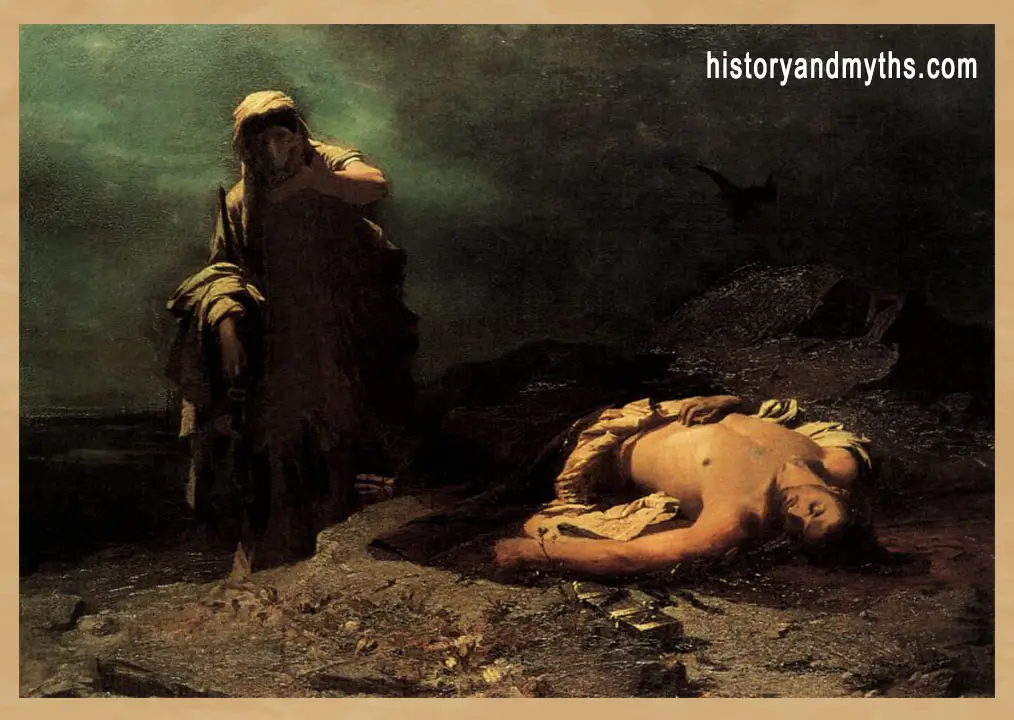
Few stories illustrate Greek attitudes toward burial more clearly than the tragedy of Antigone. After a civil war in Thebes, King Creon ordered that Polyneices, whom he considered a traitor, should be left unburied. Antigone refused to accept this decree and chose to bury her brother despite knowing that the punishment would be death.
What makes this story important is that the conflict is not primarily about politics. Antigone believes that denying burial violates a duty that stands above human law. In her view, every person deserves the funeral rites necessary for a proper transition into death, regardless of what they may have done in life.
The tragedy shows how seriously the Greeks regarded the issue. Leaving a body unburied was not merely an insult to the deceased. It threatened the religious and moral order that connected the living, the dead, and the gods. Antigone is willing to sacrifice her own life because she considers burial an obligation that cannot be ignored.
For this reason, the story became one of the most powerful expressions of Greek belief about the dead. It demonstrates that the fear of an unburied soul was strong enough to challenge kings, laws, and even the threat of death itself.
Why Funeral Rites Mattered More Than the Body
Modern readers often focus on the physical body when thinking about burial, but Greek beliefs placed greater importance on the rites themselves. The crucial issue was not simply where a body rested but whether the actions required by tradition had been performed. Burial ceremonies marked the transition from one state of existence to another.
This helps explain why funeral rituals appear so frequently in Greek literature. Washing the body, mourning the deceased, carrying out the burial, and honoring the dead were not viewed as empty customs. They formed part of a process that acknowledged death and helped establish the proper relationship between the living and the departed.
The emphasis on ritual also meant that even a recovered body was not enough if the necessary ceremonies were ignored. What mattered was recognition and completion. The dead needed to be formally received into their new condition, and the living had a responsibility to ensure that happened.
For the Greeks, funeral rites gave death structure and meaning. Without them, the passage from life to death remained unfinished, which is why the absence of burial inspired such deep concern.
Why the Unburied Dead Inspired Fear
Ancient Greeks did not fear the unburied dead because of the body itself. They feared what happened when the soul’s passage into death remained incomplete. Proper burial was believed to restore order between the living and the dead, while its absence created uncertainty for everyone involved.
- Burial helped complete the soul’s transition into the afterlife.
- An unburied soul could remain in an unresolved condition.
- Funeral rites were considered a religious obligation.
- Families were responsible for honoring the dead.
- Greek myths often portray unburied spirits as restless.
- Burial protected both memory and social order.
© historyandmyths.com
The Unburied Dead as Restless Spirits
Greek myths and religious traditions often associate the unburied dead with restlessness. A person who had not received the rites expected after death could become a figure caught in an unresolved condition, unable to achieve the peace that burial was meant to provide.
This idea helps explain why stories about the dead frequently involve requests for burial. The spirit’s problem is rarely revenge or hostility. More often, it seeks completion. Something necessary has been left undone, and the living are expected to correct it. Once the obligation is fulfilled, the disturbance usually ends.
The concept of restless spirits also reinforced the importance of family responsibility. Relatives were expected to care for the dead because neglecting those duties could leave a loved one in an uncertain state. The fear was not simply that the dead would be forgotten, but that they would remain unable to reach their proper place.
For the Greeks, these stories served as a reminder that death required more than physical separation from life. It required a successful transition. When burial failed to occur, the soul’s condition remained unresolved, giving rise to the enduring image of the restless dead.
Continue Reading
- How the Dead Communicated Through Dreams in Greek Mythology
- Charon in Greek Mythology: Why the Dead Paid for Passage
- Judgment of Souls in Greek Mythology: How Fate Was Decided After Death
- Reincarnation in Greek Mythology: Could the Soul Be Reborn?
- Elysium in Greek Mythology: The Greek Vision of Paradise
Could an Unburied Soul Reach the Underworld?
Greek sources offer different answers to this question, but many suggest that burial played an important role in allowing the dead to complete their journey. This belief appears clearly in the Odyssey through the story of Elpenor, one of Odysseus’s companions. After dying accidentally and remaining unburied, his spirit appears and asks that proper funeral rites be performed before his fate can be fully resolved.
The story does not present burial as a symbolic gesture. For Elpenor, it is a practical necessity. His request reflects the wider Greek belief that the dead depended on the living to carry out certain obligations that death itself could not accomplish.
This uncertainty helps explain why the Greeks feared dying far from home, being lost at sea, or remaining on a battlefield without burial. Such situations threatened to interrupt the normal process through which a person entered the world of the dead.
Rather than focusing on a precise rule about who could or could not enter the underworld, Greek tradition emphasizes a broader principle: a soul without burial had not completed the transition that death required. The journey might begin, but it remained unfinished until the proper rites were performed.
Burial, Memory, and Family Duty
The fear of an unburied dead was not based solely on concerns about the afterlife. It was also connected to memory and family responsibility. In Greek society, burial ensured that a person remained part of the community’s collective remembrance. Funeral rites acknowledged a life that had ended and confirmed that the deceased would not simply disappear without recognition.
Families played a central role in this process. Caring for the dead was considered one of the most important obligations relatives owed to one another. Performing burial rites demonstrated loyalty, respect, and continuity between generations. Failing to do so suggested a breakdown in those responsibilities.
This connection between burial and memory explains why so many Greek stories treat the denial of burial as a severe punishment. It deprived a person not only of religious rites but also of the honor that came from being remembered by family and community. The dead risked becoming isolated from both worlds.
For the Greeks, a proper burial achieved two goals at once. It helped the soul complete its transition and ensured that the deceased continued to occupy a respected place in human memory. Both outcomes were considered essential, which is why the prospect of remaining unburied inspired such deep anxiety.
What the Fear of the Unburied Dead Reveals About Greek Religion
The Greek fear of the unburied dead reveals a religion deeply concerned with order, transition, and obligation. Death was not viewed as a single event but as a process that required cooperation between the living and the dead. When that process was interrupted, the consequences extended beyond the individual and affected the wider balance that Greek society sought to maintain.
This belief also shows that Greek religion focused less on abstract doctrines and more on relationships. The living owed duties to the dead, families owed duties to relatives, and communities owed duties to their members. Burial became one of the clearest expressions of those responsibilities because it connected all of these relationships at once.
The fear was therefore not simply about ghosts, punishment, or superstition. It reflected a broader concern that every person should occupy their proper place within the natural order. Life, death, memory, and ritual were all expected to function together. An unburied soul represented a breakdown in that system.
By examining these beliefs, we gain a clearer understanding of how the Greeks viewed death itself. The greatest danger was not death alone but an incomplete passage into death. Proper burial ensured that the journey reached its intended conclusion, while the absence of burial left both the soul and the living world facing an uncertainty that Greek religion found deeply troubling.
For the ancient Greeks, the fear of an unburied dead was rooted in far more than concern for a physical body. Burial represented the final step in a process that allowed the deceased to move from the world of the living to the world of the dead. Without that transition, the fate of the soul became uncertain, creating a condition that Greek religion regarded with deep unease.
Stories such as those of Antigone and Elpenor reveal how seriously this belief was taken. Burial was viewed as a religious duty, a family obligation, and a safeguard for the proper order of life and death. Denying those rites threatened not only the deceased but also the moral responsibilities that connected communities across generations.
The fear of the unburied dead therefore reflects one of the central themes of Greek religion: every journey has a proper conclusion. Just as birth, adulthood, and citizenship required recognized rituals, death also demanded a formal passage. Burial ensured that the transition was completed, while its absence left both the soul and the living world facing an unsettling state of incompletion.
By understanding why the Greeks feared an unburied dead, we gain a deeper appreciation of how they viewed mortality—not simply as the end of life, but as a journey that required care, memory, and ritual to reach its rightful destination.
Key Takeaways
- Greeks viewed burial as essential to the soul’s journey after death.
- The greatest fear was not death itself but an incomplete transition into death.
- Unburied souls were often associated with uncertainty and restlessness.
- Funeral rites mattered because they fulfilled religious and family obligations.
- Antigone’s story reflects the sacred right to burial.
- Elpenor’s story illustrates the anxiety surrounding an unburied soul.
- Burial preserved both memory and cosmic order.
Frequently Asked Questions
Why did the Greeks fear an unburied dead?
They believed burial was necessary for the soul’s proper transition into the afterlife. Without it, the soul’s fate could remain uncertain.
What happened to an unburied soul in Greek belief?
Many traditions suggested that the soul remained in an unresolved state until proper funeral rites were performed.
Why was burial considered a religious duty?
Burial helped maintain the proper order between the living and the dead and fulfilled obligations owed to the deceased.
Who was Polyneices and why was his burial important?
In Sophocles’ Antigone, Polyneices was denied burial by King Creon, leading Antigone to defy the law to perform funeral rites.
Who was Elpenor in the Odyssey?
Elpenor was one of Odysseus’s companions who died unburied and later asked for funeral rites to be completed.
Did Greeks believe unburied spirits became restless?
Many myths and traditions associate unburied dead with unrest because their transition into death remained incomplete.
Why did family members have responsibility for burial?
Funeral rites were considered a fundamental duty that honored the deceased and preserved family obligations.
Was burial more important than the body itself?
Greek belief placed special importance on the rites and obligations surrounding burial rather than the physical body alone.
Sources & Rights
- Homer. Odyssey. Translated by Robert Fagles. Penguin Classics.
- Sophocles. Antigone. Loeb Classical Library.
- Garland, Robert. The Greek Way of Death. Cornell University Press.
- Johnston, Sarah Iles. Restless Dead. University of California Press.
- Burkert, Walter. Greek Religion. Harvard University Press.
- Bremmer, Jan N. The Early Greek Concept of the Soul. Princeton University Press.
- Rohde, Erwin. Psyche: The Cult of Souls and Belief in Immortality Among the Greeks. Routledge.
- Nilsson, Martin P. A History of Greek Religion. Oxford University Press.
- Dodds, E. R. The Greeks and the Irrational. University of California Press.
- Mikalson, Jon D. Ancient Greek Religion. Wiley-Blackwell.
- Buxton, Richard. The Complete World of Greek Mythology. Thames & Hudson.
- Edmonds, Radcliffe G. Myths of the Underworld Journey. Cambridge University Press.
- Vermeule, Emily. Aspects of Death in Early Greek Art and Poetry. University of California Press.
- Parker, Robert. On Greek Religion. Cornell University Press.
- Alexiou, Margaret. The Ritual Lament in Greek Tradition. Cambridge University Press.
Written by H. Moses — All rights reserved © Mythology and History