Divine Succession Myths in Greek Mythology: From Uranus to Zeus
In Greek mythology, power was never permanent. The rulers of the cosmos lived under a constant fear shared by gods, Titans, and primordial beings alike: the fear of being overthrown by the next generation. From Uranus and Cronus to Zeus himself, divine authority passed through cycles of rebellion, prophecy, violence, and succession, shaping the structure of the mythological universe long before the Olympian order became stable.
These succession myths were not simply stories about family conflict among the gods. They explained how cosmic order emerged through repeated struggles over control of the universe. Each ruler attempted to prevent the rise of a successor, yet every attempt to stop fate ultimately helped bring that downfall closer. Greek mythology therefore treated power as unstable by nature, constantly threatened by prophecy, fear, and the possibility of replacement.
The rise of Zeus marked the most important turning point in this cycle. Unlike earlier rulers, he established a more balanced form of divine authority built on alliances, hierarchy, and shared rule among the Olympians. Yet even under Zeus, the memory of succession and cosmic rebellion never fully disappeared from the Greek imagination.
Why Power Was Never Permanent in Greek Mythology
Greek mythology repeatedly presents cosmic authority as temporary rather than eternal. No ruler fully trusted the stability of his own power, because every generation feared the rise of a successor capable of overturning the existing order. This pattern appears long before the Olympian gods and continues throughout the mythological history of the cosmos.
The fear of replacement shaped the behavior of divine rulers themselves. Uranus imprisoned his children beneath the earth to prevent future threats. Cronus swallowed his own offspring after learning that one of them was destined to overthrow him. In both cases, attempts to preserve authority through control and violence only accelerated the collapse they were trying to avoid.
These myths reflect a broader Greek idea about power: authority naturally creates insecurity. The more absolute a ruler became, the more he feared losing control of the cosmos. Succession myths therefore treated instability not as an accident, but as an unavoidable consequence of concentrated power.
This cycle also explains why rebellion appears so frequently in Greek cosmology. Conflicts between generations were not isolated family disputes. They represented structural transitions between different cosmic orders, where each new ruler attempted to establish a more stable balance than the one before.
| Ruler | Method of Control | Cause of Downfall |
|---|---|---|
| Uranus | Suppression and imprisonment | Fear of future rebellion |
| Cronus | Control through prophecy avoidance | Paranoia and repetition of Uranus’s mistakes |
| Zeus | Alliance, hierarchy, shared authority | Constant need to maintain balance and order |
Uranus and the Fear of Replacement
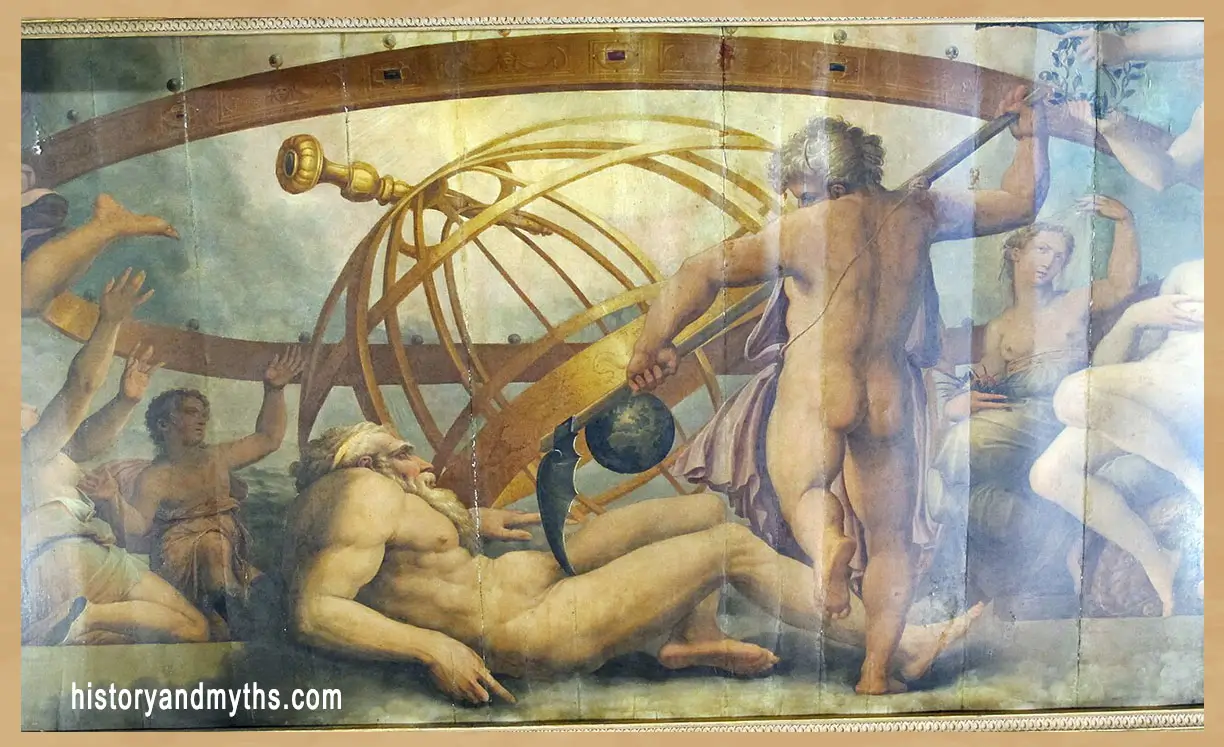
The first major succession myth in Greek mythology begins with Uranus, the primordial sky god, whose rule depended on keeping potential rivals powerless. According to the myth, he forced several of his children deep within Gaia, preventing them from rising into the world above. His actions were driven less by cruelty alone than by fear. The possibility that one of his descendants might replace him threatened the stability of his authority from the beginning.
Gaia eventually turned against Uranus and helped the Titan Cronus overthrow him. The rebellion did not emerge from chaos without cause. It grew from repression, imbalance, and the attempt to stop the natural movement of succession inside the cosmos. Greek mythology repeatedly suggests that power becomes unstable when rulers try to freeze it permanently.
The fall of Uranus established a pattern that would define later divine conflicts. A ruler fears succession, uses force to prevent it, and creates the conditions for rebellion at the same time. This structure becomes one of the central political ideas inside Greek mythology, shaping the rise and collapse of later cosmic rulers.
Cronus Repeated the Same Cycle
After overthrowing Uranus, Cronus became ruler of the cosmos, but his reign quickly followed the same pattern as the one before it. A prophecy warned him that one of his own children would eventually replace him, and instead of changing the structure of his rule, he tried to eliminate the threat directly by swallowing each child at birth.
The myth shows how fear transforms power into paranoia. Cronus already possessed control over the universe, yet the possibility of losing it shaped every decision he made. Greek mythology often presents prophecy this way — not as a distant prediction, but as a force that changes behavior in the present and drives rulers toward destructive choices.
Rhea eventually hid Zeus from Cronus, allowing the future rebellion to grow in secret. What makes the story important is not simply that Zeus survived, but that Cronus repeated the same mistake as Uranus. Both rulers believed power could remain permanent if they controlled the next generation strongly enough. Both failed because Greek mythology treats succession as part of the natural movement of cosmic order rather than a problem that can be stopped forever.
Why Zeus Finally Stabilized Olympian Rule
Zeus inherited the same dangerous universe that had destroyed earlier rulers, but he governed it differently. Instead of trying to eliminate every possible rival, he built alliances with other gods and divided responsibilities across the Olympian order. Poseidon ruled the sea, Hades governed the underworld, Athena became associated with wisdom and strategy, while other gods controlled different parts of the cosmos.
This distribution of power helped reduce the instability that marked earlier generations. Uranus and Cronus tried to protect authority through isolation and control. Zeus maintained authority by creating a structured hierarchy where other divine powers still had recognized places within the system.
Greek mythology also presents Zeus as more adaptable than his predecessors. He relies on negotiation, political marriages, councils of gods, and strategic cooperation in ways earlier rulers rarely did. During the Titanomachy and later conflicts such as the Gigantomachy, victory depends on alliances rather than individual domination alone.
Even so, Greek myths never portray Olympian rule as completely free from danger. Prophecies, rebellions, and cosmic threats continue to appear throughout Zeus’s reign. The difference is that the Olympian system proves more flexible and resilient than the rigid forms of power that came before it.
Divine Succession in Greek Mythology
Greek mythology treated cosmic authority as unstable by nature. Each divine ruler feared replacement, and every attempt to prevent succession eventually helped create rebellion instead.
- Uranus feared his children and imprisoned them beneath the earth.
- Cronus swallowed his offspring after hearing a prophecy of overthrow.
- Zeus created a broader Olympian system built on hierarchy and alliances.
- Succession myths reflected ancient Greek concerns about tyranny and instability.
- Prophecy often became self-fulfilling because rulers reacted to fear.
- The Olympian order survived because it adapted instead of relying only on force.
© historyandmyths.com
Divine Succession as a Myth of Political Order
Greek succession myths were not only about gods fighting for power. They also reflected how the ancient Greeks understood leadership, authority, and political stability in the human world. A ruler who governed through fear eventually created resistance beneath the surface, while systems built on balance and cooperation lasted longer.
This idea becomes clearer when comparing the different generations of rulers. Uranus relied on suppression. Cronus relied on control and isolation. Zeus, despite his flaws, ruled through a broader structure that included alliances, laws, assemblies, punishments, and shared responsibilities among the Olympians. Greek mythology presents this transition almost like the evolution of political order inside the cosmos itself.
The myths also suggest that authority becomes dangerous when it loses limits. Earlier rulers treated power as personal possession, something to be defended at any cost. Olympian rule appears more stable because it turns authority into a system rather than the will of a single figure acting alone.
For ancient audiences, these stories carried meaning beyond mythology. They reflected fears about tyranny, rebellion, inheritance, and the fragile balance required to keep any system — divine or human — from collapsing into violence.
Continue Reading
Why Greek Mythology Linked Power to Fear and Prophecy
Prophecy plays a central role in nearly every Greek succession myth because knowledge of the future changes how rulers behave. Uranus feared his children before they challenged him. Cronus feared a son who had not yet grown up. The threat alone was enough to shape their decisions long before rebellion actually began.
Greek mythology often treats prophecy less as magical prediction and more as psychological pressure. Once rulers learn that their power has limits, they begin acting defensively. That fear pushes them toward isolation, violence, and mistrust, which eventually weakens their rule from within.
This is why many prophecies in Greek myth become self-fulfilling. Attempts to avoid fate frequently help create it. Cronus swallowed his children to prevent succession, yet those actions forced Rhea to hide Zeus and prepare the conditions for rebellion. The prophecy succeeds partly because the ruler reacts to it.
The connection between power and fear becomes one of the defining themes of Greek cosmology. Authority never feels fully secure because every ruler understands that another generation may eventually rise beneath them. Prophecy simply reveals what already exists inside the structure of power itself: the possibility of replacement.
The Difference Between Chaos and Stable Authority
Greek succession myths do not present all forms of power as equally dangerous. The real threat is not authority itself, but unstable authority — rule built on fear, repression, or permanent conflict between generations. Chaos enters the cosmos when rulers try to dominate through force alone and refuse to accept limits on their power.
This is why Zeus’s reign matters so much in Greek mythology. Earlier rulers controlled the universe through isolation and suppression, while the Olympian system introduced hierarchy, shared roles, and clearer boundaries between cosmic forces. The gods still argued and competed, but the structure itself became more durable than the unstable orders that existed before.
Greek mythology therefore treats stability as something that must be maintained rather than guaranteed forever. Titans remain imprisoned beneath the earth, monsters continue to appear at the edges of the world, and prophecies never disappear completely. Order survives because the Olympian system can absorb tension without collapsing immediately into another cosmic war.
The result is a universe that remains balanced, but never fully safe. Greek myths constantly remind their audience that power can create order, yet unchecked fear inside that power can slowly return the cosmos to instability again.
Divine succession myths helped the ancient Greeks explain why cosmic power could never remain completely secure. Every ruler feared replacement, every attempt to prevent change created new conflict, and each generation inherited the instability left behind by the one before it. Uranus, Cronus, and Zeus were not simply separate rulers in different myths. Together, they formed a continuous pattern showing how authority rises, hardens, and eventually faces resistance.
These stories also reveal that Greek mythology viewed order as something fragile rather than permanent. Stability required balance, limits, and cooperation between different powers inside the cosmos. When rulers relied only on fear or control, the system around them slowly became unstable.
The Olympian order survived longer than earlier cosmic regimes because it adapted instead of trying to freeze the universe completely. Yet Greek mythology never suggests that conflict disappears forever. Beneath every stable order remains the possibility of rebellion, prophecy, and the rise of another force waiting to challenge the structure of power again.
Key Takeaways
- Greek succession myths explained how cosmic power repeatedly changed between generations.
- Uranus and Cronus both tried to stop succession through fear and control.
- Attempts to avoid prophecy often helped bring prophecy into reality.
- Greek mythology portrayed authority as unstable when concentrated in one ruler alone.
- Zeus stabilized Olympian rule through alliances and shared cosmic hierarchy.
- Succession myths reflected larger Greek concerns about tyranny, rebellion, and political order.
- The Greek cosmos remained balanced, but never completely free from future threats.
Frequently Asked Questions
What are divine succession myths in Greek mythology?
Divine succession myths are stories describing how cosmic power passed from one generation of gods to another through rebellion, prophecy, and conflict.
Why did Uranus fear his children?
Uranus feared that his offspring might overthrow him, so he imprisoned several of them beneath the earth to prevent future rebellion.
Why did Cronus swallow his children?
Cronus swallowed his children after learning a prophecy that one of them would eventually overthrow him and take control of the cosmos.
How did Zeus succeed where earlier rulers failed?
Zeus created a more stable Olympian system based on alliances, hierarchy, and shared responsibilities among the gods instead of relying only on suppression.
What role did prophecy play in succession myths?
Prophecy created fear inside ruling powers and often became self-fulfilling because rulers reacted violently in attempts to prevent their own downfall.
Why are succession myths important in Greek mythology?
They explain how cosmic order evolved over time and reflect Greek ideas about power, instability, tyranny, and political balance.
Did Greek mythology consider cosmic order permanent?
No. Greek mythology consistently portrays order as fragile and vulnerable to rebellion, prophecy, and future conflict.
Sources & Rights
- Hesiod. Theogony. Translated by M. L. West. Oxford University Press.
- Apollodorus. The Library of Greek Mythology. Oxford University Press.
- Homer. Iliad. Translated by Richmond Lattimore. University of Chicago Press.
- Pausanias. Description of Greece. Harvard University Press.
- Burkert, Walter. Greek Religion. Harvard University Press.
- Graf, Fritz. Greek Mythology: An Introduction. Johns Hopkins University Press.
- Hard, Robin. The Routledge Handbook of Greek Mythology. Routledge.
- West, M. L. The East Face of Helicon: West Asiatic Elements in Greek Poetry and Myth. Oxford University Press.
- Vernant, Jean-Pierre. Myth and Society in Ancient Greece. Zone Books.
- Detienne, Marcel. The Creation of Mythology. University of Chicago Press.
- Dowden, Ken. The Uses of Greek Mythology. Routledge.
- Gantz, Timothy. Early Greek Myth: A Guide to Literary and Artistic Sources. Johns Hopkins University Press.
- Rose, H. J. A Handbook of Greek Mythology. Routledge.
- Segal, Robert A. Myth: A Very Short Introduction. Oxford University Press.
- Morford, Mark, and Robert Lenardon. Classical Mythology. Oxford University Press.
- Csapo, Eric. Theories of Mythology. Wiley-Blackwell.
- Eliade, Mircea. Myth and Reality. Harper & Row.
- Jaeger, Werner. The Theology of the Early Greek Philosophers. Oxford University Press.
- Nilsson, Martin P. A History of Greek Religion. Oxford University Press.
- Hamilton, Edith. Mythology. Little, Brown and Company.
- Graves, Robert. The Greek Myths. Penguin Books.
- Kirk, G. S. The Nature of Greek Myths. Penguin Books.
- Boardman, John. Greek Art. Thames & Hudson.
- Hurwit, Jeffrey M. The Art and Culture of Early Greece. Cornell University Press.
- Calasso, Roberto. The Marriage of Cadmus and Harmony. Vintage Books.
- Otto, Walter F. The Homeric Gods. Thames & Hudson.
- Dodds, E. R. The Greeks and the Irrational. University of California Press.
- Lefkowitz, Mary. Greek Gods, Human Lives. Yale University Press.
- Buxton, Richard. The Complete World of Greek Mythology. Thames & Hudson.
- Edmonds, Radcliffe G. Greek Myth. Routledge.
Written by H. Moses — All rights reserved © Mythology and History