Was Conscription Mandatory in Ancient Egypt? How Recruitment Worked
Military conscription in Ancient Egypt was not a permanent “draft” system like modern states. Instead, the government mobilized men through selective levies when campaigns required manpower, while relying on trained soldiers and officials for core military roles. Service could be temporary, regional, and closely tied to state needs.
Ancient Egypt did not build its power through endless armies. It built control through mobilization: when the state needed bodies, it knew how to call them in, organize them, and move them whether for war, frontier security, or large state operations that demanded discipline and logistics.
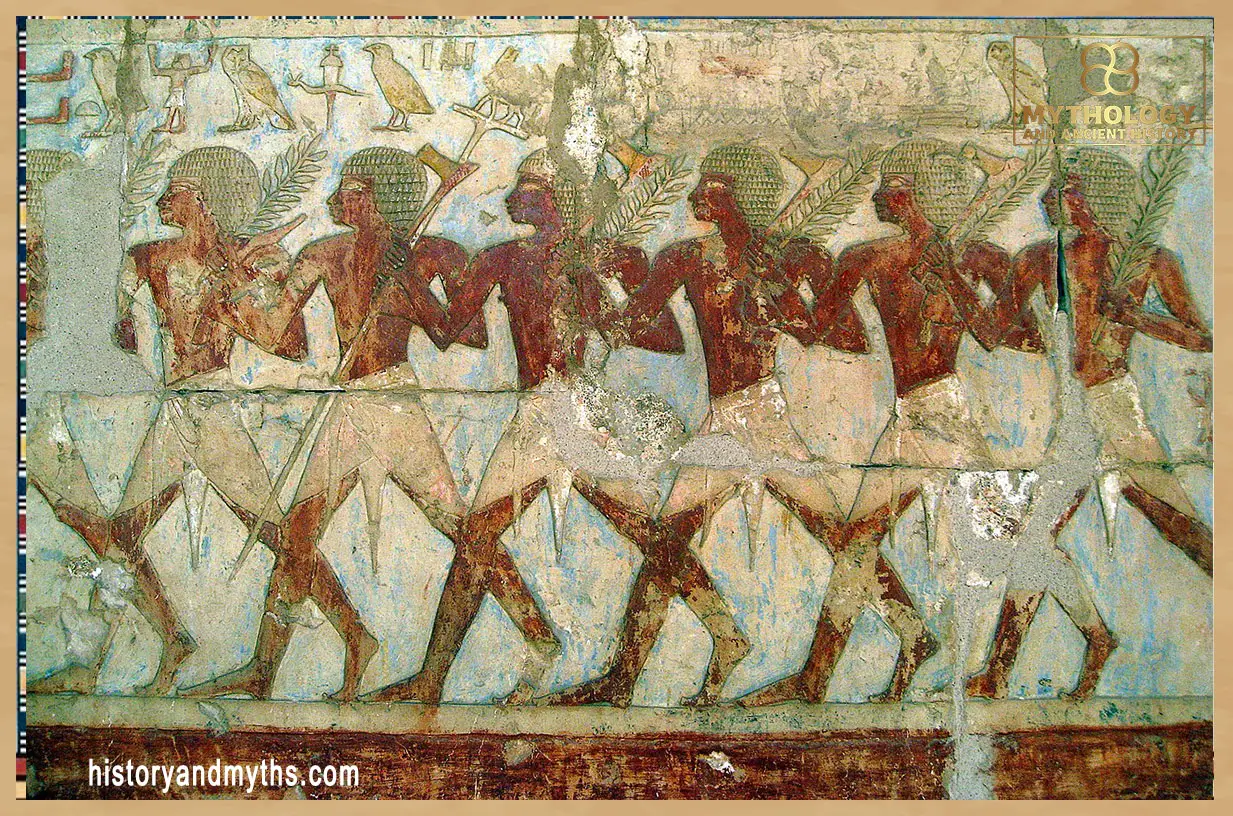
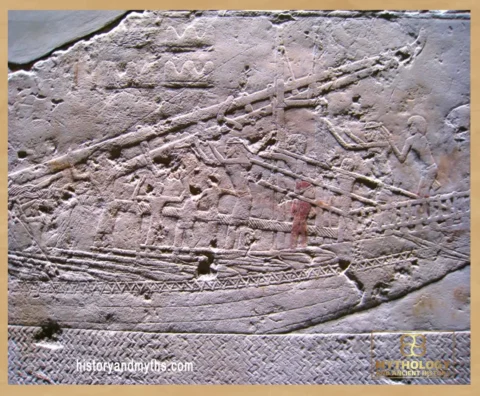
Image: Relief of Hatshepsut’s trading expedition to Punt (Deir el-Bahari), photo by Σταύρος, 11 September 2008 — Source: Wikimedia Commons (CC BY 2.0)
What “Conscription” Meant in Ancient Egypt (And What It Didn’t)
Modern readers hear “conscription” and imagine a fixed national draft where every young man must serve. Ancient Egypt did not operate like that. There was no stable nationwide system that continuously pulled entire age groups into military service year after year. The state was capable of mass mobilization, but it used it strategically rather than permanently.
In Egyptian terms, “conscription” is best understood as a levy system: the government could demand manpower when conditions required it. That demand could rise suddenly during major wars or political expansion, and it could shrink when the state returned to routine stability. This flexible model fits how Egypt functioned as an agricultural society. Taking too many workers at the wrong time could threaten harvests, taxes, and local survival, so manpower extraction had to stay practical.
Egypt had a strong ability to recruit people quickly, but that does not automatically equal a modern draft. The state relied on a mix of experienced military personnel, organized command structures, and temporary manpower pulled in when numbers mattered more than long-term training.
By defining conscription properly from the start, the rest of the article becomes clear. The real question is not “Did Egypt have conscription?” but “How did Egypt mobilize people without breaking its own economy?”
Military Conscription in Ancient Egypt (Quick Framework)
| Element | How It Worked | Why It Mattered | Common Misunderstanding |
|---|---|---|---|
| Selective levies | Men mobilized when campaigns required manpower | Allowed rapid scaling without permanent draft | Assuming a modern universal draft |
| Core military force | Trained soldiers and officers provided continuity | Made discipline and command stable | Thinking all soldiers were temporary recruits |
| Local administration | Officials implemented recruitment and assembly | Turned orders into real manpower | Ignoring bureaucracy’s role in recruitment |
| State labor vs military service | Both mobilized bodies, but for different purposes | Prevents false conclusions about “constant draft” | Confusing corvée work with warfare service |
| Social impact | Households lost labor and stability during service | Shows conscription as pressure and integration | Treating service as purely heroic or purely forced |
How Recruitment Actually Worked: Levies, Selection, and Control
Recruitment in Ancient Egypt worked less like a uniform national draft and more like targeted mobilization. The state did not need every man to become a soldier. It needed enough manpower at the right moment, drawn from the right places, and placed under control quickly enough to be useful.
Selection was typically shaped by practical constraints. Agricultural communities could not spare unlimited workers, especially during harvest and flood cycles. So recruitment had to be balanced against the state’s real priority: keeping production stable while extracting resources for campaigns. That reality pushed Egypt toward levies that could expand when necessary and shrink when pressure eased.
Local administration mattered because recruitment was not done in a vacuum. A central order still had to be implemented in villages and towns through officials who knew the population, controlled records, and could enforce compliance. That meant recruitment was as much an administrative act as a military one. A levy is only effective if men can be identified, assembled, supplied, and moved before the moment passes.
Control was the central problem. Pulling manpower is easy on paper. Keeping it disciplined, fed, and directed is harder. That is why recruitment was tied to the same tools the Egyptian state used elsewhere: documentation, supervision, and predictable chains of command. Once men entered state service, they entered a controlled system where schedules, supply distribution, and penalties could be applied.
This model also explains why conscription could feel coercive without being universal. For the individual, being called up was still an obligation. But for the state, it was a selective instrument used to meet a specific need, not a permanent social institution that consumed the whole male population.
Temporary Levies vs Professional Soldiers: Who Fought Egypt’s Wars?
Ancient Egyptian military power came from a layered system. Not everyone who wore a weapon was a career soldier, and not every campaign depended on temporary recruits. Egypt worked best when a trained core handled command and discipline, while additional manpower was added when scale demanded it.
Professional soldiers and experienced officers provided continuity. They carried tactical knowledge, knew how to march and organize supplies, and understood how to operate under authority. This core gave the army stability across seasons and reigns. Without it, every new campaign would have started from zero.
Temporary levies served a different function. They increased numbers fast, filled out ranks, and made large operations possible when the state needed force beyond its regular capacity. These recruits were useful because they could be mobilized quickly, but they were not automatically reliable in skill. Their effectiveness depended on leadership, training time, and how well the state could supply and control them.
This separation explains a pattern that appears across many pre-modern states. The “army” is not one uniform body. It is a system that combines permanent capability with expandable manpower. Egypt’s strength was not just that it could field troops, but that it could scale up without turning the entire economy into a military machine.
It also explains why conscription should not be treated as the whole story. Campaign success relied on logistics, administration, and the core structure that could integrate recruits into disciplined units. Conscription provided mass, but organization provided power.
Who Was Exempt from Military Service?
Military mobilization in Ancient Egypt was selective, which means not everyone was equally likely to be called into service. The state depended on agriculture, administration, and religion as much as warfare, so removing essential workers indiscriminately would have weakened the kingdom itself.
Although surviving records do not describe a formal exemption system comparable to modern military laws, practical considerations almost certainly influenced recruitment. Senior officials, specialized craftsmen, priests serving major temples, and workers performing critical state functions were less likely to be mobilized than ordinary agricultural laborers during routine campaigns.
Exemptions therefore reflected administrative necessity rather than legal privilege. Egypt’s goal was to raise enough manpower for military operations while preserving the economic and institutional systems that made those operations possible.
Conscription and State Labor: The Line People Confuse
One reason “military conscription” gets misunderstood in Ancient Egypt is that state mobilization was not limited to fighting. The same government that could raise troops could also mobilize labor for large projects, transport, and organized work that required discipline and supervision.
From the state’s perspective, both systems solve the same problem. You need bodies, you need order, you need timing, and you need compliance. Whether the task is marching into foreign territory or moving stone and supplies, the state must identify manpower, assemble it, control it, and feed it. That administrative logic is why military recruitment and state labor can look similar in practice.
For the individual, the experience could also feel similar. Both meant removal from normal life, obligation to the state, and exposure to enforcement. That is why people often merge the two into one story of forced service. But analytically, they are not the same. Military conscription produces armed units under command for security and war. State labor produces crews for infrastructure and logistical work, even if it uses military-style organization.
Egypt’s ability to mobilize workers is part of why its state lasted so long, but it should not be misread as proof of a constant universal military draft. The state extracted service in multiple forms, choosing the tool that matched the problem it had to solve.
Continue Reading
What Conscription Cost Ordinary People (and Why Some Tried to Avoid It)
Conscription was a state demand that landed on real households. When a man was taken into service, the loss was not abstract. It meant fewer hands for farming, less protection for family property, and more pressure on those left behind to keep production stable. In a society built on seasonal agricultural labor, disruption had consequences that could last beyond the period of service.
The costs were not only economic. Service meant exposure to discipline, risk, and uncertainty. Even when military duty was temporary, it could pull men into long campaigns, harsh conditions, and unfamiliar regions. For many, the state’s promise was not glory but obligation, and the reward was not guaranteed. That reality explains why avoidance, delay, or negotiation could become part of the social landscape when recruitment pressure increased.
At the same time, conscription could open paths upward. Military service offered status, access to state networks, and sometimes material benefits. A trained soldier could become part of a system that provided rations, recognition, and a stronger link to the center than ordinary village life allowed. This dual nature is important. Conscription was a burden for many, but it also functioned as a channel of state integration, pulling people into structures that could reshape their identity and future prospects.
Conscription was neither a heroic civic duty nor simple oppression. It was a practical tool of state power, felt as pressure at the local level, and justified by rulers as necessary for security and order.
The Real Answer in One Line
Ancient Egypt did not run a permanent universal draft, but it could mobilize men quickly through selective levies, using bureaucracy and logistics to scale military power when the state demanded it.
The Key Point: Egypt Mobilized Men Without Creating a Permanent Draft State
The most accurate way to describe conscription in Ancient Egypt is selective mobilization. The state could call men up when it needed them, scale forces for campaigns, and enforce service through administration. But it did not run a constant universal draft that absorbed whole age groups as a normal annual mechanism.
This matters because it explains why Egypt could expand militarily without destroying its own agricultural base. The government extracted service when necessary, then released manpower back into production when pressure eased. That flexibility was not weakness. It was a survival strategy for a state that depended on harvest stability and predictable taxation.
It also explains why military strength in Egypt should never be treated as a purely military story. Recruitment was an administrative process. Success depended on records, officials, supply chains, and discipline. The battlefield was only the endpoint. The real engine of power was the state’s ability to mobilize people at scale, on demand, and keep them organized long enough to matter.
Key Takeaways
- Conscription in Egypt was selective mobilization, not a permanent modern draft.
- Professional soldiers and officers provided continuity and discipline.
- Local administration was essential for recruitment and enforcement.
- Military service and state labor were organized similarly but were not the same system.
- Conscription pressured households but could also create status and mobility.
FAQ
Was every Egyptian man forced to serve in the army?
No. Egypt relied on selective levies when campaigns needed manpower, rather than a permanent universal draft.
How were men chosen for recruitment?
Recruitment depended on state demand and local administration, with levies organized through provincial records and enforcement.
Was conscription seasonal or long-term?
It could be temporary and campaign-based, but some service lasted longer depending on the military operation and logistics.
Did conscription harm farming and family life?
Yes. Taking men from villages reduced household labor and could create economic stress, especially during key agricultural periods.
What is the difference between military service and corvée labor?
Military service created armed units for war and security, while corvée labor mobilized crews for state work and infrastructure.
Could military service improve a man’s status?
In some cases, yes. Soldiers could gain pay, rations, recognition, and stronger ties to state networks.
Why is conscription often misunderstood in Ancient Egypt?
Because people confuse military levies with state labor mobilization and assume Egypt operated like modern draft states.
Sources
- Allen, James P. Middle Egyptian: An Introduction to the Language and Culture of Hieroglyphs. 3rd ed. Cambridge: Cambridge University Press, 2014.
- Bard, Kathryn A. An Introduction to the Archaeology of Ancient Egypt. 2nd ed. Hoboken, NJ: Wiley-Blackwell, 2015.
- Breasted, James Henry. Ancient Records of Egypt. 5 vols. Chicago: University of Chicago Press, 1906.
- Gabriel, Richard A. The Great Armies of Antiquity. Westport, CT: Praeger, 2002.
- Grajetzki, Wolfram. The Army of the Pharaohs. Barnsley: Pen & Sword Military, 2006.
- Kemp, Barry J. Ancient Egypt: Anatomy of a Civilization. 2nd ed. London: Routledge, 2006.
- Lloyd, Alan B., ed. A Companion to Ancient Egypt. 2 vols. Chichester: Wiley-Blackwell, 2010.
- Morkot, Robert G. The Egyptians: An Introduction. London: Routledge, 2005.
- O’Connor, David, and Stephen Quirke, eds. Mysterious Lands. London: UCL Press, 2003.
- Redford, Donald B., ed. The Oxford Encyclopedia of Ancient Egypt. 3 vols. Oxford: Oxford University Press, 2001.
- Shaw, Ian, ed. The Oxford History of Ancient Egypt. Oxford: Oxford University Press, 2000.
- Shaw, Ian. Ancient Egyptian Warfare. Oxford: Shire Publications, 1991.
- Spalinger, Anthony J. War in Ancient Egypt: The New Kingdom. Malden, MA: Blackwell Publishing, 2005.
- Strudwick, Nigel. The Administration of Egypt in the Old Kingdom. London: KPI, 1985.
- Van De Mieroop, Marc. A History of Ancient Egypt. Malden, MA: Wiley-Blackwell, 2011.
- Wilkinson, Toby. The Rise and Fall of Ancient Egypt. New York: Random House, 2010.
- Wilkinson, Richard H. The Complete Temples of Ancient Egypt. London: Thames & Hudson, 2000.
- UCLA Encyclopedia of Egyptology. “Military Organization.”
- UCLA Encyclopedia of Egyptology. “Warfare.”
- UCLA Encyclopedia of Egyptology. “New Kingdom.”
- UCLA Encyclopedia of Egyptology. “Administration.”
- British Museum. “Ancient Egyptian Army.”
- The Metropolitan Museum of Art. “Ancient Egyptian Military.”
- World History Encyclopedia. “Ancient Egyptian Warfare.”
- Encyclopaedia Britannica. “Ancient Egypt: Military Organization.”