Legal Rights of Foreigners in Ancient Egypt: What Was Allowed
Foreigners in ancient Egypt could have legal rights, but those rights depended on status. A resident trader, hired worker, or military recruit could use contracts, property rules, and local courts, while prisoners and enslaved foreigners had far fewer protections. Surviving administrative lists and legal practices show foreigners inside Egypt’s legal system, not outside it.
This article explains what “foreigner” meant in Egyptian records, what rights foreigners could realistically claim, where restrictions began, and how surviving documents reveal a legal world built on status, registration, and official access rather than modern citizenship.
Who Counted as a “Foreigner” in Ancient Egypt?
In ancient Egypt, a “foreigner” was not a single legal category with one fixed set of rights. It was a practical label for people whose origin placed them outside the Egyptian community, but their real legal position depended on what the state and local administration considered them to be: a resident, a worker, a soldier, a dependent, or a captive. That difference matters because Egyptian legal life was built around registration, obligations, and institutional access, not around modern ideas of citizenship.
A foreign trader living under state oversight could be treated as a lawful participant in economic life, because the state wanted trade to function and wanted transactions to be legible through contracts and records. A foreign soldier or recruit could be integrated into the machinery of power, which gave him protection through usefulness and hierarchy. In contrast, a captive foreigner taken in war might be absorbed into the labor system with minimal autonomy, because the state’s priority there was control and extraction, not rights in the modern sense.
What survives in the evidence supports that layered reality. Administrative sources show foreigners not as invisible outsiders, but as people listed, counted, and managed by institutions. The Brooklyn Papyrus is a good example of this kind of evidence: it preserves a bureaucratic picture in which individuals of foreign background appear inside a documented household and labor framework, meaning they existed within systems that could define duties and, in some cases, enforce claims.
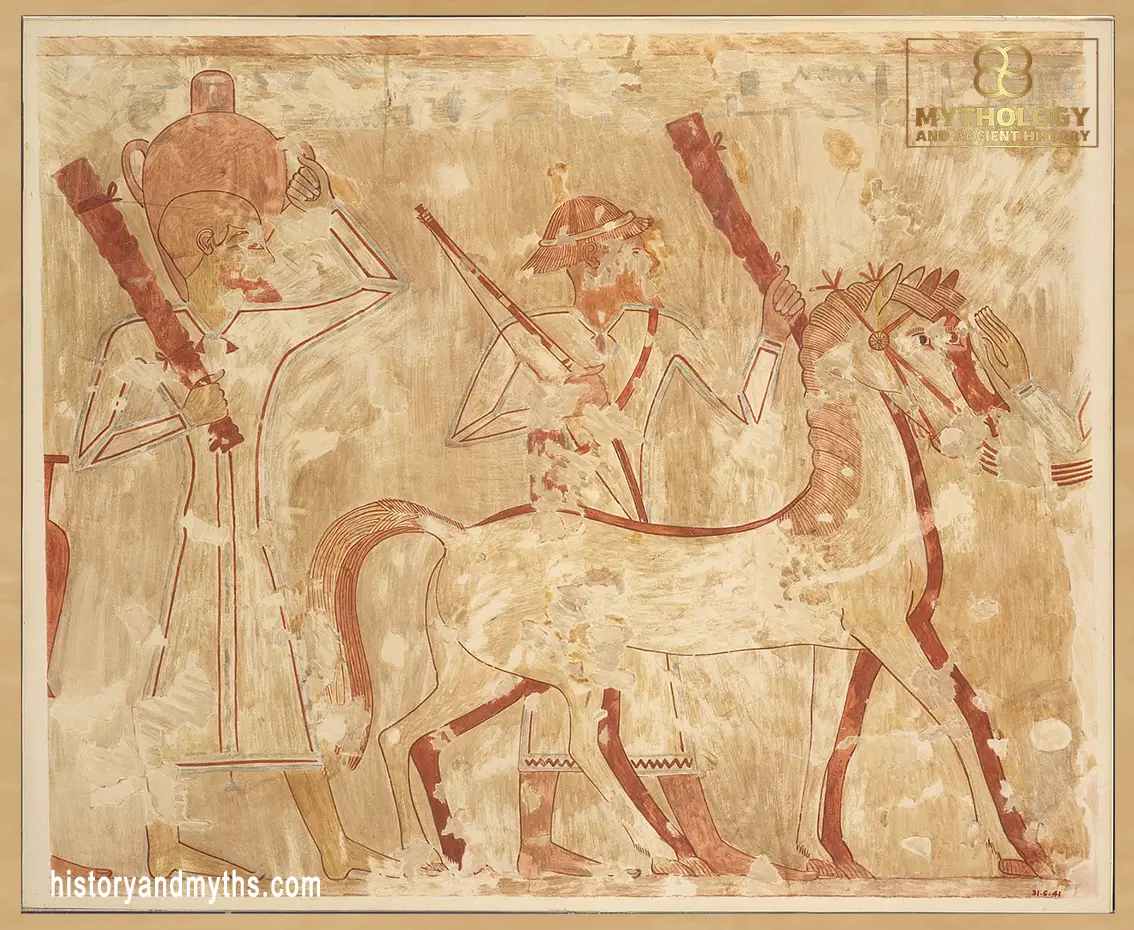
Image: Syrians Bringing Horses, Tomb of Rekhmire (TT100), MET 31.6.41 — cropped detail — Artist: Nina M. Davies — Source: Wikimedia Commons (CC0 1.0)
| Foreigner Status | What Was Usually Possible | Main Limit | How Rights Were Enforced |
|---|---|---|---|
| Resident worker or artisan | Work agreements, rations, documented obligations | Dependent on supervisors and institutional control | Registration and local administration |
| Resident trader | Contracts, commerce under oversight, disputes handled locally | Access still controlled by officials and patrons | Contracts and court procedures |
| Foreign soldier or recruit | Protection through hierarchy, predictable duties and benefits | Rights tied to service and command structure | Military institutions |
| Unregistered outsider | Limited practical protection | Easily excluded from enforceable claims | Weak or inconsistent enforcement |
| Captive or enslaved foreigner | Survival under institutional rules | Minimal autonomy; treated as controlled dependents | Management rather than legal equality |
Did Foreigners Have Legal Standing in Egyptian Courts?
Foreigners in ancient Egypt were not automatically “outside the law.” If they lived inside Egyptian-controlled spaces—towns, estates, garrisons, or temple economies—the state could treat them as legally visible people whose obligations and disputes could be managed through the same tools used for Egyptians: written agreements, recorded transfers, and official adjudication. What mattered most was not ethnicity but status and registration—whether a person was recognized by an institution that could record duties, enforce claims, and summon individuals when a conflict escalated.
That legal visibility is why contracts and property transfers are so central to Egyptian law in general. Surviving legal practice shows transactions were formalized and documented, with parties defining restrictions and guarantees—meaning the system was built to make relationships “legible” and enforceable, not purely informal.
For foreigners, the key issue was whether they could operate as a contracting person or were treated as dependents with limited autonomy. Evidence like the Brooklyn Papyrus demonstrates that foreigners could appear inside administrative frameworks where people were counted, transferred, and legally recognized as part of a household economy. This doesn’t prove equal rights, but it proves inclusion in mechanisms that create enforceable status in the first place.
Contracts, Property, and Daily Rights: What Was Actually Possible
For foreigners who were living in Egypt as residents—especially those tied to estates, temples, workshops, or the army—everyday rights were mainly expressed through practical legality, not political membership. If a foreigner could be named in a document, attached to an institution, and recognized by local officials, then he could function inside the same legal machinery that organized Egyptian life: obligations could be assigned, services demanded, payments recorded, and disputes brought forward.
This meant that a foreign resident could often participate in economic life through agreements that defined work, delivery duties, repayment, and responsibility. In many cases, “rights” were not announced as a special privilege for foreigners; they appeared indirectly as the ability to operate through the normal tools of the state—especially written documentation and official oversight. The closer a foreigner was to an established administrative environment, the more his position became predictable and defensible.
But the limits were equally real. The system did not treat all foreigners as equal legal actors, because status always shaped what a person could control. A foreign captive, an enslaved person, or someone without stable registration could be managed more as property than as a contracting individual. So the sharp line was not “Egyptian versus foreign,” but recognized person versus controlled dependent—and that single difference determined whether a foreigner’s daily life involved enforceable agreements or enforced obedience.
Restrictions and Vulnerabilities: When Rights Disappeared
Foreigners in ancient Egypt could lose practical protections the moment their status shifted from “useful resident” to “controlled outsider.” The same administrative system that could recognize a person through contracts and records could also restrict that person through dependency, forced labor, or institutional ownership. In other words, rights were not guaranteed by identity; they were conditional on how securely someone was positioned inside the state’s framework.
The biggest vulnerability was dependence on a patron, employer, or authority figure. A foreigner without family networks, local allies, or community leverage could be pressured more easily, because challenging abuse risked retaliation, expulsion, or reclassification into a harsher category. Even when a foreigner had legal visibility, the path to justice still passed through local officials, which meant access could be delayed, controlled, or quietly denied.
War and political instability made everything worse. Captives and displaced populations could be absorbed into labor systems where choice was minimal and enforcement was one-sided. In those situations, the law functioned less as a shield and more as a tool of management: assigning work, controlling movement, and turning people into counted resources. That is why any serious discussion of foreigners’ rights in Egypt must stay realistic: the system could allow legal participation, but it could also erase autonomy quickly when the state prioritized security and control over fairness.
In ancient Egypt, foreigners could have legal rights, but not as an automatic guarantee. Rights depended on status, registration, and access to officials who could enforce agreements. A resident foreigner attached to an estate, temple, or military unit could be legally “visible,” while captives and unregistered outsiders had far fewer protections.
What the Evidence Actually Shows: Foreigners Inside the System
The strongest point we can make, without exaggeration, is that foreigners were not invisible to Egyptian administration. When a foreigner appears in an official list, a household register, or a controlled labor framework, that person becomes part of a system that can assign duties, recognize relationships, and impose consequences. That is the foundation of legal life in any bureaucratic state: the law works best on people who are recorded, categorized, and reachable.
This matters because it shifts the discussion away from stereotypes. The question is not whether Egyptians “liked” foreigners, but whether the state could treat them as legally manageable persons. Some foreigners clearly were, especially when they lived under stable institutions such as estates, temples, or military units. Their lives were shaped by obligations and supervision, but also by a form of predictability—because predictable systems create the possibility of claims, complaints, and recorded agreements.
At the same time, the evidence also warns us against romanticizing equality. Being inside the system did not mean having the same leverage as an Egyptian household head with land, family ties, and local influence. Foreigners could be documented and still be dependent, controlled, or easily overridden. The key historical reality is simple: in ancient Egypt, legal standing existed on a spectrum, and foreigners could occupy many points on it—from active participants in economic life to tightly managed dependents with little autonomy.
Bottom Line: Foreigners Had Rights, But Status Was Everything
Foreigners in ancient Egypt were not automatically excluded from law, contracts, or court processes. Many could live and work within systems that recognized duties, agreements, and disputes in a formal way. But those rights were never universal, and they were never protected by a modern idea of equal citizenship.
What determined legal reality was status: whether a foreigner was registered, attached to an institution, protected by a patron, or reduced to dependency through captivity and control. The state could integrate foreigners when it benefited administration and the economy, and it could restrict them when security, labor, or hierarchy mattered more. So the most accurate conclusion is not that foreigners had no rights, and not that they were fully equal, but that ancient Egyptian law could include them—so long as their place in the system was recognized and enforceable.
FAQ
Did foreigners have legal rights in ancient Egypt?
Yes, but rights depended on status. Foreign residents attached to institutions could have enforceable obligations and protections, while captives and enslaved foreigners had far fewer rights.
Could foreigners go to court in ancient Egypt?
In many cases, yes. If a foreigner was legally “visible” through registration and local oversight, disputes could be handled through the same administrative procedures used for Egyptians.
Could foreigners own property in ancient Egypt?
Some foreign residents could participate in documented economic life, but property-related rights depended on their status, institutional protection, and access to enforcement.
Were all foreigners treated as slaves?
No. Some foreigners were captives or enslaved, but others lived in Egypt as workers, traders, or soldiers with recognized roles inside the system.
What mattered more than ethnicity in Egyptian legal life?
Status. Registration, institutional ties, and patronage shaped whether a foreigner could make claims, enforce agreements, or resist pressure.
Why were foreigners more vulnerable to abuse?
Because legal access depended on officials and local gatekeepers, and foreigners often lacked family networks and local influence.
Did ancient Egypt have “citizenship” like modern states?
No. Rights were practical and conditional, built around administrative control rather than a universal concept of equal citizenship.
Sources & Rights
- Allam, Schafik. Egyptian Law Courts in Pharaonic and Hellenistic Times. London: Routledge, 1991.
- Cooney, Kara. The Woman Who Would Be King: Hatshepsut’s Rise to Power in Ancient Egypt. New York: Crown, 2014.
- Gardiner, Alan H. Egypt of the Pharaohs: An Introduction. Oxford: Oxford University Press, 1961.
- Janssen, Jac. J. Village Varia: Ten Studies on the History and Administration of Deir el-Medina. Leiden: Nederlands Instituut voor het Nabije Oosten, 1997.
- Katary, Sally L. D., and Paul John Frandsen, eds. The Petrovich Collection of Ancient Egyptian Papyri. Copenhagen: Museum Tusculanum Press, 2012.
- McDowell, Andrea G. Village Life in Ancient Egypt: Laundry Lists and Love Songs. Oxford: Oxford University Press, 1999.
- Menu, Bernadette. Egyptian Law. Cairo: The American University in Cairo Press, 2012.
- Morris, Ellen F. The Architecture of Imperialism: Military Bases and the Evolution of Foreign Policy in Egypt’s New Kingdom. Leiden: Brill, 2005.
- Ritner, Robert K. The Mechanics of Ancient Egyptian Magical Practice. Chicago: Oriental Institute of the University of Chicago, 1993.
- Trigger, Bruce G., Barry J. Kemp, David O’Connor, and Alan B. Lloyd. Ancient Egypt: A Social History. Cambridge: Cambridge University Press, 1983.