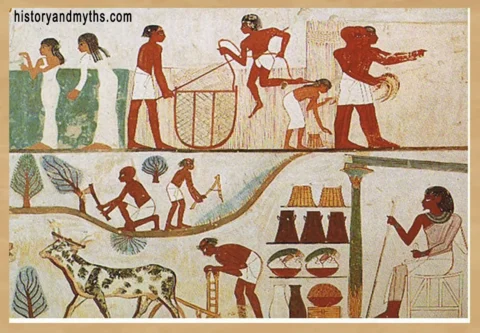
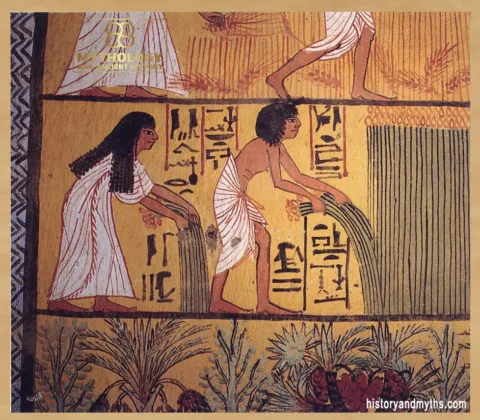
How Did Ancient Egyptians Manage Water and Irrigation?
How did ancient Egyptians control the Nile instead of simply depending on it? How were fields irrigated before modern pumps and dams, and why did Egyptian agriculture remain productive for thousands of years despite living in one of the world’s driest environments?
Ancient Egypt developed a sophisticated water management system based on basin irrigation, canals, dikes, nilometers, and carefully organized labor. Rather than leaving agriculture to the annual flood alone, Egyptian engineers and administrators measured water levels, directed floodwaters, maintained irrigation networks, and coordinated large-scale public works that transformed the Nile into a reliable source of food and economic stability.
This article explains how water management and irrigation systems worked in ancient Egypt, how floods were controlled and water distributed across the Nile Valley, and why hydraulic engineering became the foundation of agriculture, state administration, taxation, and the long-term survival of one of history’s greatest civilizations.
Why Water Management Was Central to Egyptian Civilization
Water management in ancient Egypt was not a secondary technological achievement it was the foundation upon which the entire civilization rested. Unlike societies that relied on rainfall, Egypt depended almost entirely on the annual flooding of the Nile. This dependence transformed water control from a practical necessity into a matter of survival, governance, and cosmic order.
The Nile flood was both a blessing and a threat. When properly managed, it deposited fertile silt that sustained agriculture and supported population growth. When mismanaged or when floods failed it could lead to famine, social instability, and political collapse. Egyptian water systems were therefore designed not to dominate nature, but to cooperate with it through prediction, timing, and regulation.
At the heart of this system was precise observation. Egyptian administrators closely monitored the height and timing of the flood using measuring devices such as nilometers. These measurements were not merely technical data; they influenced taxation levels, grain storage policies, and state planning. Accurate water assessment allowed the state to anticipate surplus or shortage and respond accordingly, reinforcing its authority over both land and people.
Irrigation networks extended the benefits of the flood beyond the riverbanks. Canals, basins, and dikes distributed water across fields in a controlled manner, ensuring even saturation and minimizing waste. This basin irrigation system required coordination on a regional scale, linking villages, estates, and temples into a shared hydraulic network. Managing water, therefore, meant managing society itself.
Crucially, water control was also ideological. The successful regulation of the Nile symbolized the triumph of order over chaos. Pharaohs presented themselves as guarantors of fertility and stability by maintaining irrigation systems and preventing destructive floods. In religious thought, the Nile’s behavior reflected divine favor, while effective water management demonstrated the ruler’s alignment with Ma’at.
In this context, Egyptian irrigation was not primitive or passive. It was a sophisticated system combining environmental knowledge, administrative planning, and collective labor. By mastering the rhythms of the Nile, ancient Egypt transformed a volatile natural force into a predictable engine of civilization one that sustained the state for more than three millennia.
| Aspect | Role in Ancient Egypt |
|---|---|
| Primary Water Source | The Nile River, regulated through controlled flooding and irrigation networks |
| Main Irrigation Method | Basin irrigation using embankments, canals, and controlled drainage |
| Engineering Structures | Canals, dikes, sluices, reservoirs, and flood-control embankments |
| Measurement Tools | Nilometers used to record flood levels and predict agricultural output |
| Water-Lifting Devices | Shaduf and later mechanical aids for raising water to higher fields |
| Administrative Control | Centralized oversight by royal officials and regional administrators |
| Labor Organization | Seasonal corvée labor mobilized during the flood period |
| Economic Impact | Stable food production, surplus storage, taxation, and state revenue |
| Political Significance | Water control reinforced royal authority and administrative power |
| Religious Dimension | Irrigation linked to Ma’at, divine order, and the king’s cosmic role |
How Water Management Shaped the Egyptian Landscape
Water management in ancient Egypt was not limited to agriculture; it reshaped the entire physical and social landscape of the civilization. The Nile’s annual flood deposited fertile silt, but without control, it could also destroy settlements, wash away fields, and disrupt food supply. Egyptian irrigation systems transformed a naturally unpredictable river into a stable engine of civilization.
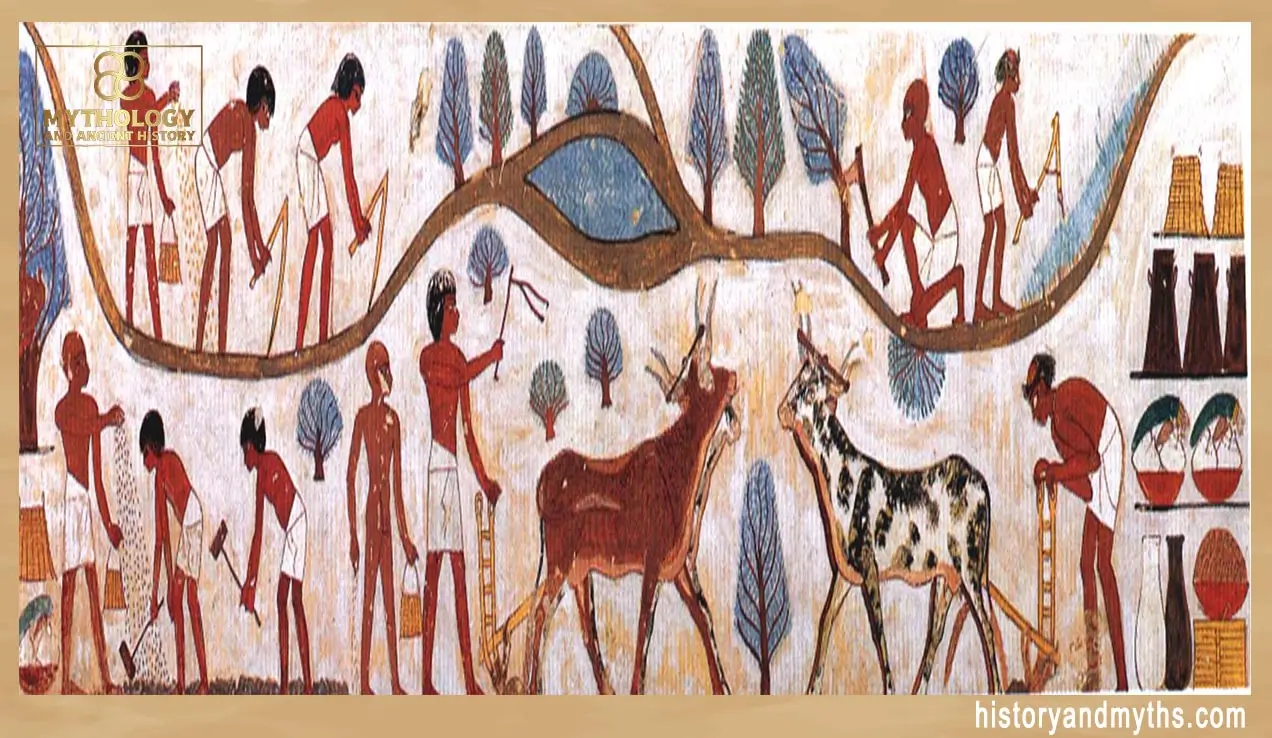
Engineers and administrators divided land into carefully measured basins surrounded by low earthen embankments. During the inundation season, these basins were deliberately flooded, allowing water to stand long enough for silt to settle before being drained in a controlled manner. This system maximized soil fertility while preventing long-term waterlogging. It was simple in principle, yet required precise timing, maintenance, and coordination across entire regions.
Canals extended the reach of the Nile beyond its natural banks. These channels supplied water to distant fields, connected agricultural zones, and sometimes served as transport routes. Their construction demanded advanced surveying skills, particularly in maintaining gentle gradients that allowed water to flow without eroding the banks. Even minor miscalculations could render a canal useless or destructive.
Water management also shaped settlement patterns. Villages, storage facilities, and administrative centers were positioned in relation to irrigation networks. Control points such as sluices, dikes, and canal junctions became strategic locations overseen by officials. In this way, hydraulic infrastructure structured not only the landscape, but also governance and labor organization.
Crucially, these systems required constant upkeep. Canals silted up, embankments eroded, and flood patterns shifted over time. Maintenance was a communal obligation enforced by the state, often organized through corvée labor. Successful irrigation depended less on monumental construction and more on sustained administrative discipline.
By mastering water at a landscape scale, ancient Egypt converted a narrow river valley into one of the most productive agricultural regions of the ancient world. Irrigation systems were the invisible architecture of the civilization less visually dramatic than temples or pyramids, yet far more essential to its long-term survival.
The Nile as an Engineered System, Not a Natural Gift
The success of ancient Egyptian civilization is often attributed to the Nile as a “natural blessing.” This description, while common, is misleading. The Nile did not automatically create prosperity. Its annual flood was unpredictable, uneven, and potentially destructive. What transformed the river into a stable foundation for civilization was not nature alone, but systematic human intervention. Water management in ancient Egypt was a deliberate engineering achievement.
Egyptian irrigation was based on controlled flooding rather than passive reliance on rainfall. Engineers studied the rhythm of the river, measured flood levels, and developed techniques to retain, redirect, and distribute water with precision. Without these systems, agricultural surplus the backbone of the state would not have been possible. Water management was therefore not an auxiliary activity, but a core function of governance.
At the heart of this system stood basin irrigation. Fields were divided into basins surrounded by earthen dikes. When the Nile rose, sluices were opened to allow floodwater to enter these basins. The water was held long enough for fertile silt to settle before being drained away. This process required accurate timing, careful maintenance, and coordinated labor. A failure in one section could affect entire districts.
Crucially, irrigation was not uniform across Egypt. Engineers adapted techniques to local conditions soil type, elevation, and proximity to the river. In Upper Egypt, where the valley was narrow, control structures focused on channeling water efficiently. In Lower Egypt, with its wide delta, systems emphasized distribution and drainage. This regional adaptability demonstrates that Egyptian water management was flexible, not primitive.
Measurement played a decisive role. Nilometers were used to record flood levels, allowing officials to anticipate agricultural yields and adjust taxation accordingly. These measurements were not symbolic they were operational data guiding economic planning. In this way, water management linked engineering directly to administration and fiscal policy.
Rather than viewing irrigation as a simple agricultural practice, it should be understood as a nationwide infrastructure system. Canals, basins, dikes, and measuring stations formed an interconnected network maintained by the state. Through this network, Egyptian engineers converted a volatile river into a predictable engine of stability, surplus, and political power.
Continue Reading
Irrigation Systems and Agricultural Engineering
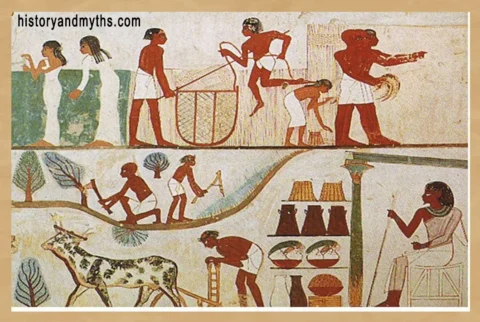
The core of Egyptian irrigation was the basin system. Fields were divided by earthen embankments into large basins that could be deliberately flooded when the Nile rose. Engineers controlled the flow through openings and channels, allowing water rich in silt to settle before being drained. This process fertilized the soil naturally and reduced the need for artificial inputs. The success of the system depended on correct elevation, slope calculation, and structural integrity clear indicators of advanced engineering knowledge.
Canals extended this system beyond floodplains. Long channels transported water to distant fields, storage areas, and urban centers. Their construction required surveying over large distances, careful gradient control, and an understanding of erosion. A poorly calculated canal could stagnate or destroy surrounding land. Egyptian engineers minimized these risks through conservative design and repeated use of proven layouts.
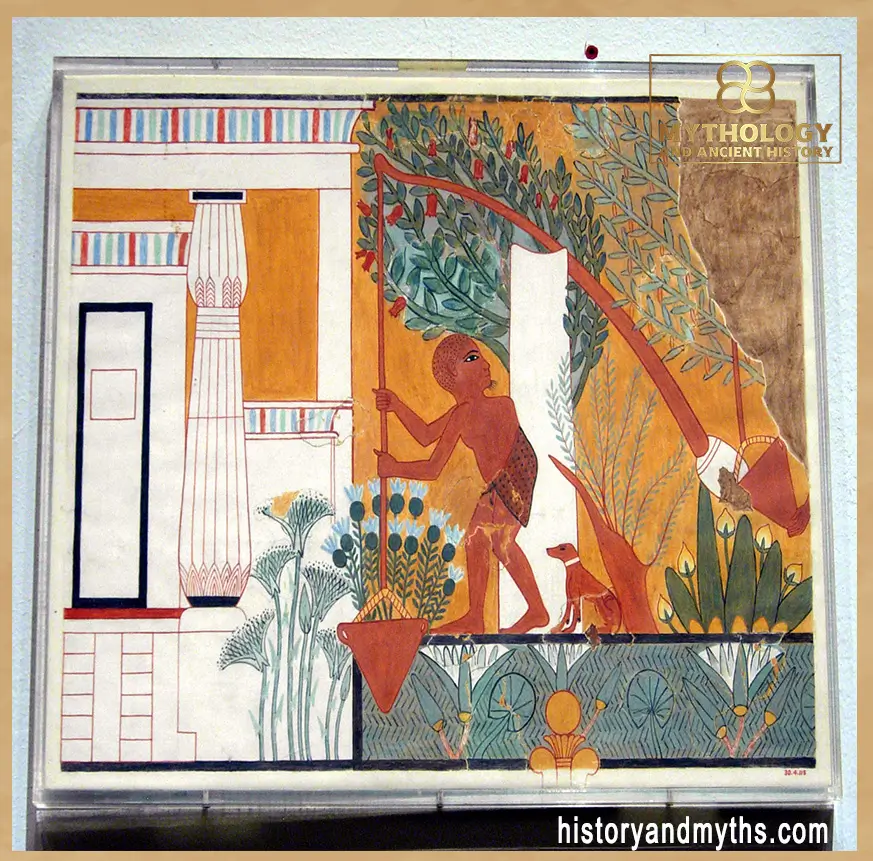
Equally important was water-lifting technology. Devices such as the shaduf, introduced in the New Kingdom, allowed farmers to raise water from canals to higher ground. While simple in appearance, its widespread adoption reflects intelligent mechanical design suited to local conditions. Engineers prioritized efficiency, durability, and ease of repair over complexity.
Maintenance was constant. Canals had to be cleared, embankments repaired, and measuring points recalibrated every year after the flood. This work was not optional; failure meant crop loss and social instability. Engineers supervised these efforts, translating environmental observation into practical intervention.
Irrigation engineering demonstrates a defining feature of Egyptian technology: adaptability without disruption. Systems evolved slowly, integrating new tools while preserving foundational principles. Through this approach, ancient Egypt sustained agricultural productivity for millennia, proving that engineering success lay not in innovation alone, but in disciplined environmental management.
Administration, Labor, and State Control
Water management in ancient Egypt was never a local or purely agricultural matter. It was a centralized system controlled by the state, administered through a hierarchy of officials who ensured that irrigation served both economic stability and political authority. Managing water meant managing people, land, and surplus and this placed irrigation at the heart of governance.
At the top of this system stood royal administrators operating under the vizier. Their responsibility was to oversee canals, basins, dikes, and flood defenses across entire regions. These officials coordinated seasonal labor, organized maintenance schedules, and ensured that irrigation infrastructure aligned with the agricultural calendar. Water control was therefore inseparable from taxation, as crop yields determined the redistribution of grain and resources.
Local officials often overseers of fields or village administrators played a crucial intermediary role. They supervised day-to-day maintenance, mobilized workers during flood season, and reported conditions upstream and downstream. Communication between regions was essential, since the behavior of the Nile River varied annually. A strong flood promised abundance; a weak or excessive flood required rapid administrative response.
Labor for irrigation projects was not permanent or specialized in the modern sense. Instead, it relied on seasonal corvée labor drawn from farming communities during the inundation period, when fields lay underwater. This system allowed the state to maintain vast hydraulic networks without removing peasants permanently from agricultural production. Engineers and supervisors directed this labor, ensuring standardized techniques and consistent results.
Record-keeping was critical. Measurements of water levels, land boundaries, and canal dimensions were documented by scribes, linking irrigation directly to taxation and legal ownership. Water distribution disputes could threaten social stability, so administrative oversight ensured that irrigation remained predictable and equitable at least in principle.
Through this structure, irrigation became an extension of state power. The ability to control water meant the ability to regulate food supply, labor obligations, and economic security. Engineering expertise alone was not enough; irrigation succeeded because it was embedded in a disciplined administrative system that transformed natural flooding into a managed resource.
Water Management in Ancient Egypt — Key Insights
- Irrigation was a state-controlled system, not a local or private activity.
- Engineering focused on regulation and prediction, not domination of nature.
- Accurate measurement of floods shaped taxation and economic planning.
- Hydraulic infrastructure structured settlement patterns and labor organization.
- Maintenance and administrative discipline mattered more than innovation.
- Control of water reinforced royal authority and cosmic order.
© historyandmyths.com — Educational use
Water Management, Religion, and Cosmic Order
In ancient Egypt, water management was not viewed as a purely technical achievement. It was deeply embedded in religious thought and cosmic ideology. The Nile was understood as a manifestation of divine order, and its successful regulation symbolized harmony between the gods, the king, and the natural world. Irrigation, therefore, carried religious significance beyond its economic function.
The annual flood was interpreted as a renewal of creation itself. When the Nile rose at the proper time and level, it confirmed that Ma’at the universal principle of balance was intact. Engineers and administrators who managed water systems were, in this sense, participants in maintaining cosmic stability. Their work ensured that chaos, represented by uncontrolled flooding or drought, did not prevail.
Pharaohs played a central symbolic role in this process. Royal inscriptions and temple reliefs often associated the king with fertility, abundance, and the regulation of the Nile. By overseeing irrigation infrastructure, the ruler demonstrated divine favor and legitimacy. Successful water management reinforced the idea that the pharaoh acted as an intermediary between the gods and humanity.
Religious institutions were also deeply involved. Temples owned large agricultural estates and depended on irrigation for their economic power. Priests participated in rituals intended to ensure a favorable flood, while temple administrators helped manage canals and basins. This integration blurred the line between sacred duty and practical governance.
In Egyptian thought, controlling water was not an act of domination over nature but an act of alignment with divine order. Engineering skill and religious belief reinforced one another. The success of irrigation systems was seen as proof that human society, under proper leadership, could function in harmony with the cosmic design established by the gods.
Limits, Risks, and Failures of the System
Despite its sophistication, Egyptian water management was not infallible. The entire system depended on environmental stability and administrative effectiveness. When either failed, the consequences could be severe. Droughts, excessively high floods, or breakdowns in maintenance challenged the limits of even the most carefully engineered irrigation networks.
Low Nile floods posed the greatest threat. Insufficient inundation reduced soil fertility, lowered crop yields, and strained grain reserves. In such years, the state’s ability to redistribute food was tested, and social tension increased. Historical evidence suggests that prolonged periods of weak flooding contributed to political instability, especially during intermediate periods.
Excessive floods were equally dangerous. Overwhelming water levels could breach embankments, destroy canals, and damage settlements. Repairing such damage required massive labor and resources, placing additional strain on the state. Failures in one region could cascade through interconnected irrigation networks.
Administrative failure also played a role. Irrigation required constant coordination, accurate measurement, and disciplined labor mobilization. Corruption, poor oversight, or political fragmentation weakened the system. Without centralized authority, maintenance declined, canals silted up, and water distribution became uneven.
These vulnerabilities reveal an important truth: Egyptian irrigation succeeded not because it was technologically invincible, but because it was socially and politically supported. When the state weakened, water management weakened with it. The system’s limits highlight how closely engineering success was tied to governance and institutional continuity.
Legacy and Long-Term Impact
The water management systems of ancient Egypt represent one of the most enduring examples of large-scale environmental engineering in human history. For over three thousand years, Egyptians sustained agricultural productivity in a challenging landscape through disciplined planning, administrative control, and ecological understanding.
Egyptian irrigation principles influenced later civilizations in the Mediterranean and Near East. Concepts such as basin irrigation, flood measurement, and centralized water administration informed Roman, Islamic, and medieval hydraulic practices. Even today, modern irrigation in the Nile Valley reflects adaptations of ancient foundations.
- Ancient Egypt survived because it engineered water, not because the Nile existed.
- Irrigation systems transformed unpredictable floods into stable agriculture.
- Water management linked engineering, administration, and state power.
- Measurement and maintenance were more critical than technological complexity.
- Control of water meant control of food, labor, and political stability.
FAQ: Water Management and Irrigation in Ancient Egypt
How did ancient Egyptians irrigate their fields?
They relied mainly on basin irrigation—flooding embanked fields during inundation, then draining them in a controlled way so silt could settle and crops could grow.
What was basin irrigation, and why was it effective?
Basin irrigation divided land into large basins that could be filled and drained on schedule, maximizing fertility while reducing long-term waterlogging.
What did canals do in ancient Egypt?
Canals distributed water beyond riverbanks, connected basins, and extended cultivation into areas the flood could not reach naturally.
What is a nilometer, and how was it used?
A nilometer measured flood levels. Officials used its readings to anticipate agricultural outcomes and support planning tied to state administration.
How did Egyptians lift water to higher fields?
They used devices like the shaduf (a counterweighted lever). Later, animal-driven waterwheels such as the saqiya increased lifting capacity.
Who maintained irrigation systems in ancient Egypt?
Maintenance was organized through state oversight and local officials, using seasonal labor obligations to clear canals and repair embankments after the flood.
Why was water management connected to royal power?
Because controlling water controlled food surplus, taxation, and stability. Successful irrigation reinforced the state’s authority and legitimacy.
Did Egypt’s irrigation system ever fail?
Yes. Extreme floods, low inundations, political instability, or neglected maintenance could reduce yields, trigger disputes, and weaken state control.
Sources & Rights
- Bard, Kathryn A. An Introduction to the Archaeology of Ancient Egypt. 2nd ed. Malden, MA: Wiley-Blackwell, 2015.
- Butzer, Karl W. Early Hydraulic Civilization in Egypt: A Study in Cultural Ecology. Chicago: University of Chicago Press, 1976.
- Cooper, John P. The Medieval Nile: Route, Navigation, and Landscape in Islamic Egypt. Cairo: American University in Cairo Press, 2014.
- Fagan, Brian. Floods, Famines, and Emperors: El Niño and the Fate of Civilizations. New York: Basic Books, 1999.
- Fagan, Brian. The Great Warming: Climate Change and the Rise and Fall of Civilizations. New York: Bloomsbury, 2008.
- Hassan, Fekri A. “Nile Floods and Political Disorder in Early Egypt.” In Human Impact on Ancient Environments, edited volumes and collected studies. Tucson: University of Arizona Press, various years.
- Kemp, Barry J. Ancient Egypt: Anatomy of a Civilization. 3rd ed. London: Routledge, 2018.
- Manning, Joseph G. The Last Pharaohs: Egypt under the Ptolemies, 305–30 BC. Princeton: Princeton University Press, 2010.
- Moeller, Nadine. The Archaeology of Urbanism in Ancient Egypt: From the Predynastic Period to the End of the Middle Kingdom. Cambridge: Cambridge University Press, 2016.
- Oleson, John Peter. Handbook of Ancient Water Technology. Leiden: Brill, 2000.
- Quirke, Stephen. Exploring Religion in Ancient Egypt. Chichester: Wiley-Blackwell, 2014.
- Shaw, Ian, ed. The Oxford History of Ancient Egypt. Oxford: Oxford University Press, 2000.
- Strouhal, Eugen. Life of the Ancient Egyptians. Norman: University of Oklahoma Press, 1992.
- Trigger, Bruce G., Barry J. Kemp, David O’Connor, and Alan B. Lloyd. Ancient Egypt: A Social History. Cambridge: Cambridge University Press, 1983.
- Wilkinson, Toby A. H. Early Dynastic Egypt. London: Routledge, 1999.
- Wilkinson, Richard H. The Complete Temples of Ancient Egypt. London: Thames & Hudson, 2000.
- Wendrich, Willeke, ed. UCLA Encyclopedia of Egyptology. Los Angeles: UCLA, ongoing publication.
- Baines, John, and Jaromír Málek. Atlas of Ancient Egypt. New York: Facts On File, 1980.
Written by H. Moses — All rights reserved © Mythology and History