What Was Anubis’s Role in the Egyptian Judgment?
In the weighing of the heart, the central judgment scene of the Egyptian afterlife, Anubis was neither judge nor executioner. His role was quieter and more precise. He stood beside the scale not to decide fate, but to protect the process itself. Where truth was tested, Anubis ensured that the test was fair.
This article does not retell who Anubis was or recount the weighing of the heart. Instead, it focuses on why Anubis was placed at the scale, what kind of authority he held, and why Egyptian justice required a figure whose power stopped short of judgment. Understanding Anubis here means understanding how the Egyptians separated procedure from verdict, and neutrality from rule.
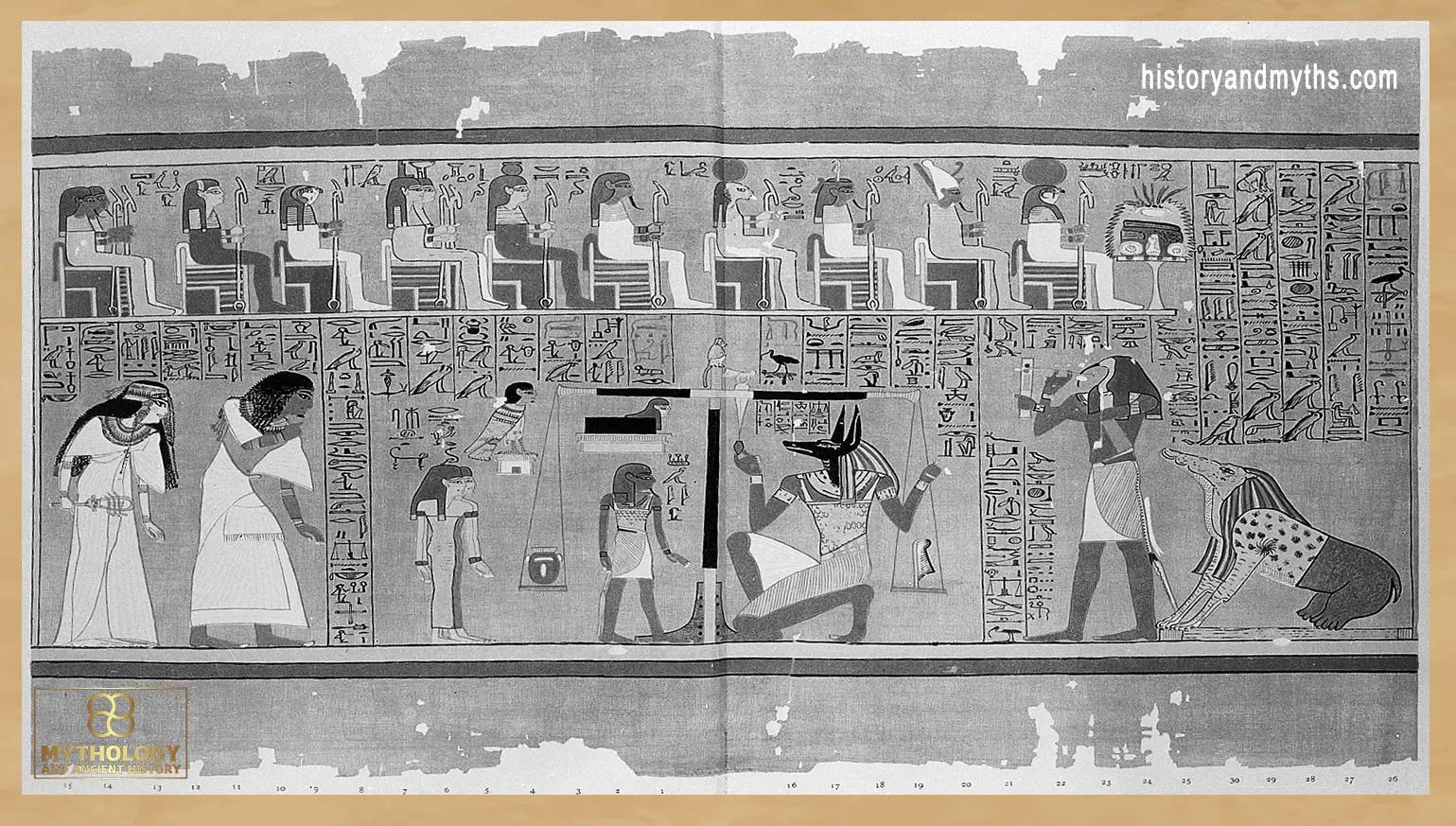
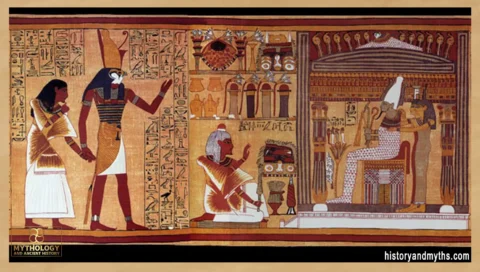
Source: Wellcome Collection, London.
Credit: Wellcome Collection, image L0005449.
License: Creative Commons Attribution 4.0 International (CC BY 4.0).
Anubis as an Overseer, Not a Judge
Anubis’s position beside the scale was defined by oversight, not authority. He did not pronounce guilt, interpret morality, or influence outcomes. His responsibility was to ensure that the weighing occurred correctly and without interference. In a system where truth depended on balance, precision mattered more than power.
This distinction explains why Anubis never delivers a verdict. Judgment belonged elsewhere to Osiris and the divine court. Anubis’s task ended the moment the scale settled. He guarded the integrity of the test, not the destiny of the soul.
By assigning Anubis this role, Egyptian belief separated process from judgment. Justice required a neutral figure whose duty was accuracy alone. Anubis embodied that neutrality, standing at the boundary between evaluation and decision without crossing it.
| Aspect | Anubis’s Judicial Role |
|---|---|
| Primary Function | Oversees the weighing process without judging the soul |
| Authority Level | Limited — procedural, not judicial |
| Relation to Judgment | Ensures fairness and accuracy before the verdict |
| Relation to the Soul | No advocacy, protection, or intervention |
| Relation to Osiris | Subordinate — does not pronounce judgment |
| Relation to Thoth | Complementary — oversight vs. record-keeping |
| Core Principle | Neutrality and procedural integrity |
Why Neutrality Mattered in Egyptian Judgment
For the Egyptians, judgment could not be trusted to power alone it required neutrality. The weighing of the heart was meant to reveal truth, not to create it. Any hint of bias would have undermined the entire system of justice in the afterlife.
Anubis represented this neutrality. He was involved in the process but detached from its outcome. Unlike Osiris, who embodied lawful authority, or the demons who enforced consequences, Anubis had no stake in the verdict. His presence guaranteed that the test measured what it claimed to measure.
This separation protected the credibility of judgment. By placing a neutral overseer at the scale, Egyptian belief asserted that truth emerged from procedure, not from divine preference. Justice worked because it followed rules and Anubis existed to make sure those rules were followed exactly.
Anubis and the Mechanics of the Scale
The scale itself was not symbolic decoration it was a mechanism that required supervision. In Egyptian thought, balance was fragile. Even divine processes needed guardianship to function correctly, and Anubis fulfilled that technical role.
Texts and images consistently show Anubis adjusting, steadying, or watching the scale. This was not ritual drama. It signaled responsibility for accuracy. The heart had to be weighed without disturbance, delay, or manipulation. Anubis ensured that nothing divine or otherwise interfered with the measurement.
By focusing Anubis’s role on the mechanics of the test, Egyptian belief emphasized that truth was not declared by authority alone. It had to be measured properly. The scale did the judging; Anubis made sure it worked.
The Limits of Anubis’s Authority
Despite his central position at the scale, Anubis’s authority was strictly limited. He could not alter the weight of the heart, reinterpret the result, or delay what followed. His role ended the instant the balance revealed its truth.
This limitation was intentional. Egyptian justice depended on clear boundaries between roles. If Anubis had been allowed to judge, oversee, and influence outcomes, the system would have collapsed into personal power. Instead, authority was divided: Anubis ensured fairness, Thoth recorded fact, and Osiris recognized judgment.
By restricting Anubis’s power, Egyptian belief protected the legitimacy of the verdict. The overseer could not become a ruler. His task was complete once truth was revealed nothing more, nothing less.
Anubis in Judgment — His True Function
- Not a judge: Anubis never decides guilt or innocence.
- A neutral overseer: He ensures the weighing is accurate and fair.
- Guardian of procedure: His role protects the integrity of judgment.
- Limited authority: His power ends once the scale settles.
- No intervention: He does not defend or condemn the soul.
- Separate from punishment: Demons enforce the verdict, not Anubis.
- Justice through balance: Anubis safeguards truth by protecting the process.
© historyandmyths.com — Educational use
Why Egyptian Judgment Divided Authority Among Different Gods
The judgment scene in ancient Egypt was not centered on one all-powerful god. Its authority was deliberately divided. Anubis supervised the weighing, Thoth recorded the result, Osiris presided over the court, and Ammit embodied the consequence of failure. Each figure controlled one part of the process, but none controlled everything.
This division mattered because Egyptian justice depended on balance rather than personal will. If one deity had measured the heart, recorded the verdict, judged the soul, and enforced punishment, judgment would have appeared arbitrary. By separating these roles, Egyptian belief made the afterlife court look orderly, accountable, and resistant to bias.
Anubis’s limited role therefore was not a weakness. It was part of a larger judicial structure. His neutrality protected the weighing, while Thoth’s record protected memory, Osiris’s authority protected legitimacy, and Ammit’s presence protected consequence. Together, these roles created a system in which truth was measured, witnessed, recorded, and enforced.
This structure reveals something important about Egyptian thought: justice was not imagined as a single command from divine power. It was imagined as a controlled process. Anubis stood at the scale because the Egyptians believed that even divine judgment needed procedure, boundaries, and visible fairness.
How Anubis Protected the Process, Not the Soul
Anubis’s final function in judgment was procedural protection, not salvation. He did not defend the soul, argue its case, or soften the outcome. His responsibility was to protect the integrity of the process that determined fate.
By standing at the scale, Anubis ensured that judgment remained impersonal. The soul succeeded or failed on its own moral weight, not through intervention. This made justice predictable and credible: no favor, no mercy, no manipulation.
In this way, Anubis safeguarded something more important than individual souls he safeguarded trust in the system. Egyptian belief held that order survived only if truth was measured fairly. Anubis existed to guarantee that fairness, even when the result was final.
The Egyptian afterlife court was therefore designed as a system rather than the expression of one god’s personal authority. Anubis’s limited role demonstrates that Egyptian justice depended on procedural balance, where supervision, judgment, record-keeping, and punishment remained separate responsibilities. This structure reflects one of the most sophisticated concepts of divine justice in the ancient world.
Key Takeaways — The Role of Anubis in Judgment
- Anubis functioned as an overseer, not a judge, in the afterlife court.
- His authority was procedural and ended once the scale revealed the truth.
- Neutrality was essential to Egyptian concepts of justice.
- Anubis protected the fairness of judgment, not the fate of the soul.
- Judgment, record, and punishment were deliberately separated roles.
- The scale itself determined truth; Anubis ensured it worked correctly.
- By limiting his power, Egyptian belief preserved trust in divine justice.
Frequently Asked Questions About Anubis and Judgment
Was Anubis a judge in the Egyptian afterlife?
No. Anubis did not judge souls; he oversaw the weighing process to ensure fairness and accuracy.
Why was Anubis placed beside the scale?
His role was to supervise the mechanics of the scale and protect the integrity of the judgment process.
Did Anubis influence the outcome of the judgment?
No. He had no authority to alter the result or intervene once the scale revealed the truth.
How was Anubis different from Osiris in judgment?
Osiris presided over judgment as final authority, while Anubis acted only as a neutral overseer.
What role did Anubis play compared to Thoth?
Anubis ensured the weighing was correct, while Thoth recorded the outcome permanently.
Did Anubis protect the soul during judgment?
No. He protected the process, not the individual soul or its fate.
Why was neutrality important in Anubis’s role?
Neutrality ensured that judgment reflected truth and balance, not divine preference or emotion.
What happened once Anubis’s role was complete?
Once the scale settled, Anubis’s authority ended and the verdict proceeded without his involvement.
Sources & Rights
- Allen, James P. Middle Egyptian: An Introduction to the Language and Culture of Hieroglyphs. 2nd ed. Cambridge: Cambridge University Press, 2010.
- Assmann, Jan. Death and Salvation in Ancient Egypt. Ithaca: Cornell University Press, 2005.
- Faulkner, Raymond O. The Egyptian Book of the Dead: The Book of Going Forth by Day. San Francisco: Chronicle Books, 1994.
- Hornung, Erik. The Ancient Egyptian Books of the Afterlife. Translated by David Lorton. Ithaca: Cornell University Press, 1999.
- Pinch, Geraldine. Egyptian Mythology: A Guide to the Gods, Goddesses, and Traditions of Ancient Egypt. Oxford: Oxford University Press, 2004.
- Quirke, Stephen. Exploring Religion in Ancient Egypt. Chichester: Wiley-Blackwell, 2015.
- Taylor, John H. Journey through the Afterlife: Ancient Egyptian Book of the Dead. London: British Museum Press, 2010.
- Teeter, Emily. Religion and Ritual in Ancient Egypt. Cambridge: Cambridge University Press, 2011.
- Wilkinson, Richard H. The Complete Gods and Goddesses of Ancient Egypt. London: Thames & Hudson, 2003.
- British Museum. Papyrus of Hunefer: Judgment Scene from the Book of the Dead.
- Smarthistory. Hunefer’s Judgement in the Presence of Osiris.
Written by H. Moses — All rights reserved © Mythology and History