Demons of Punishment — Justice in Ancient Egypt Afterlife
In the Egyptian vision of the afterlife, punishment was never random, emotional, or driven by anger. It followed judgment. Only after the heart was weighed and the verdict delivered did punishment begin—and it was carried out by a specific class of beings known today as the Demons of Punishment. These entities were not monsters lurking in dark passages, nor gods deciding fate. They were executors.
Ancient Egyptian texts describe punishment as a process, not a spectacle. Demons of punishment acted within a strict framework of order, carrying out sentences already determined by divine judgment. They did not debate, tempt, or threaten. Their role was functional and final. Once judgment ended, their work began.
This article explains who the Demons of Punishment were, how they differed from monsters and guardians, and why they existed within the Egyptian afterlife system. It focuses on punishment as an organized mechanism—designed to preserve cosmic balance—rather than a realm of chaos or fear.
What Were the Demons of Punishment?
The Demons of Punishment were official enforcers within the Egyptian afterlife system. They did not judge souls, and they did not decide guilt. Their sole purpose was to execute sentences that had already been passed during judgment. In other words, they belonged to administration, not chaos.
These demons operated only after the weighing of the heart. Until judgment occurred, they had no authority. Once a verdict was declared, however, their role was absolute. They carried out confinement, destruction, or erasure according to the outcome, without negotiation or emotion.
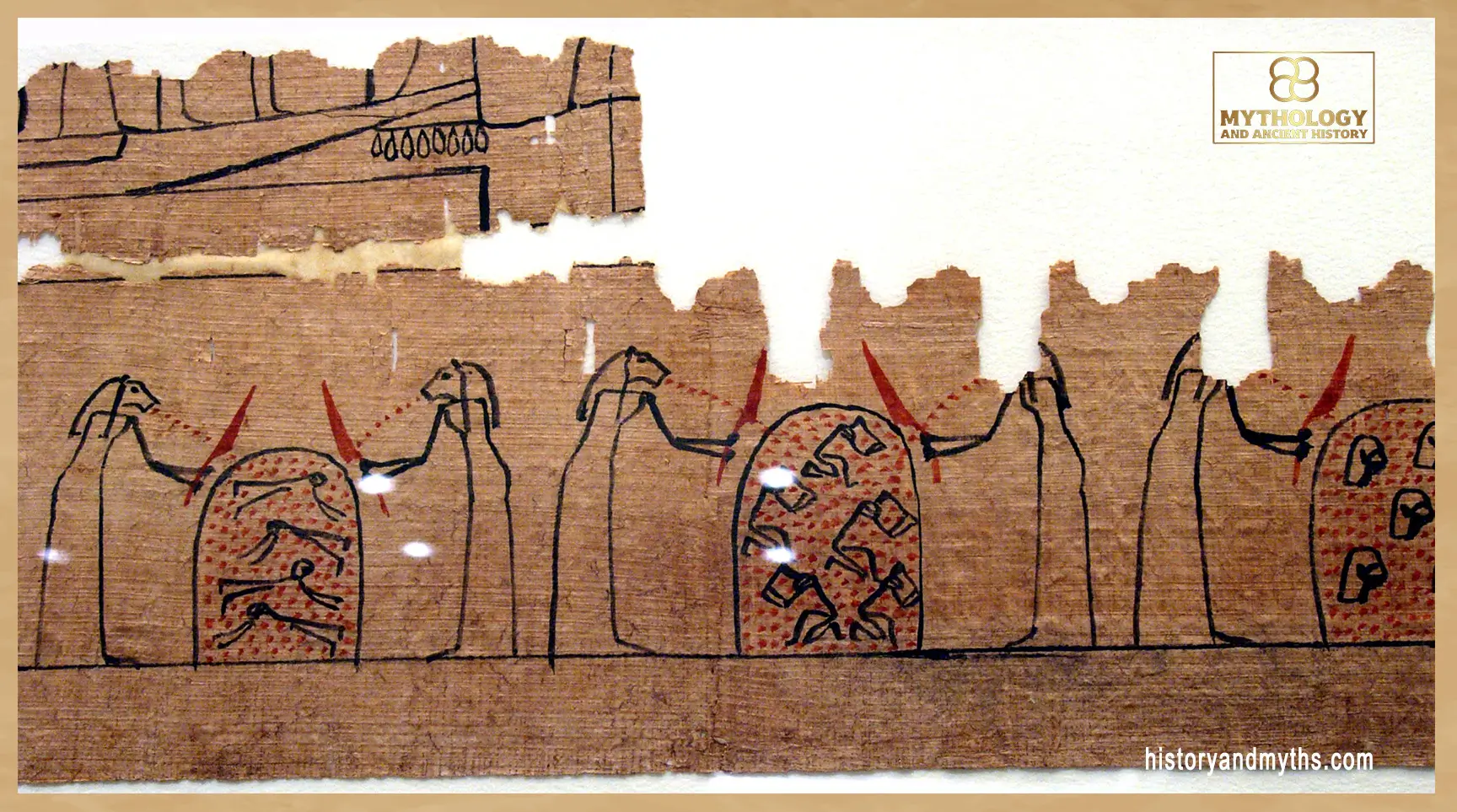
Unlike monsters, demons of punishment were part of the system. They appeared in organized spaces—chambers of punishment, lakes of fire, or designated zones of restraint. Their actions preserved order by removing what threatened balance, not by spreading fear.
This distinction mattered deeply to the Egyptians. Punishment was not vengeance. It was a necessary function to maintain ma’at—cosmic order—after judgment had revealed a soul’s failure to uphold it.
| Aspect | Demons of Punishment |
|---|---|
| Primary Role | Execution of punishment after judgment |
| Authority | Act under divine law and judicial verdicts |
| Stage of Appearance | After the Weighing of the Heart |
| Decision-Making | None — they do not judge or debate |
| Forms | Often hybrid, sometimes unnamed, defined by function |
| Methods | Burning, binding, cutting, erasure |
| Worship | None — never worshipped or appeased |
| Cosmic Purpose | Preserve ma’at by removing imbalance |
Judgment vs Punishment in the Duat
In ancient Egyptian belief, judgment and punishment were separate stages with different authorities. Judgment determined truth; punishment enforced the result. Confusing the two collapses the logic of the afterlife.
Judgment occurred in a formal setting, governed by rules and declarations. The heart was weighed, testimony was given, and a verdict was reached. Only after this process ended did punishment become relevant. Demons of punishment did not attend judgment, speak during it, or influence its outcome.
Once the verdict was final, punishment followed as procedure, not spectacle. Demons acted automatically, carrying out what judgment required. There was no appeal, debate, or persuasion at this stage. The transition from judgment to punishment marked a shift from evaluation to execution.
This separation protected order. It ensured that truth was established before force was applied—and that force was never arbitrary. Punishment existed to finalize judgment, not to replace it.
Who Commanded the Demons of Punishment?
Demons of punishment did not act independently. They operated under authority, carrying out sentences issued by the divine order of the afterlife. Their power came from command, not from personal will.
In texts, this authority is implicit rather than dramatic. The verdict of judgment—established before Osiris and the divine court—was enough. Once ma’at had been violated and confirmed, the demons acted as instruments of that order. They did not need to be addressed, persuaded, or restrained.
This chain of command mattered. It meant punishment was lawful, not chaotic. Demons were tools of enforcement within a hierarchy, ensuring that consequences followed truth. By removing agency from the demons themselves, Egyptian belief emphasized that punishment served balance, not cruelty.
Named vs Functional Demons
Not all Demons of Punishment were known by personal names. Egyptian texts often distinguish between named entities and functional figures defined by what they do rather than who they are.
Some demons appear with specific names, usually when their role was repeated or symbolically important within the punishment process. Naming fixed their function and placed limits on their authority. A named demon belonged clearly within the system and performed a defined task.
More commonly, however, demons are described by function alone—“he who burns,” “he who cuts,” “he who binds,” or “those who restrain.” These figures were not meant to be individualized. Their lack of personal identity emphasized that punishment was procedural, not personal. They were extensions of the sentence itself.
This functional approach reinforces a key idea: punishment in the Duat was not carried out by emotional beings, but by mechanisms of order. Whether named or unnamed, demons existed to complete judgment efficiently and without deviation.
Methods of Punishment in the Duat
Punishment in the Duat was described through clear methods, not vague suffering. Texts focus on actions rather than emotions, showing punishment as a controlled process with defined outcomes.
The most common methods included burning, binding, cutting, and confinement. Lakes of fire appear as zones of final destruction, while restraints and knives symbolize the removal of a soul’s ability to act. These methods were not meant to torment endlessly, but to neutralize what threatened order.
Importantly, punishment was often terminal or transformative, not prolonged. Some souls were destroyed, others rendered powerless, erased, or prevented from continuing their journey. The goal was resolution, not spectacle.
By describing punishment through tools and actions, Egyptian belief framed it as enforcement, not cruelty—an end to imbalance rather than an ongoing display of suffering.
Demons of Punishment — How They Worked
- They acted after judgment: punishment began only once the verdict was final.
- They did not decide guilt: demons enforced sentences; they did not weigh the heart.
- They followed authority: their power came from divine law, not personal will.
- Many were functional: “burners,” “binders,” and “cutters” defined by tasks, not identity.
- Methods were concrete: fire, restraint, cutting, and erasure neutralized imbalance.
- No worship or bargains: they were instruments of order, not gods of devotion.
- The purpose was ma’at: punishment protected cosmic balance by removing disorder.
© historyandmyths.com — Educational use
Why Demons of Punishment Were Not Worshipped
Unlike gods or protective spirits, Demons of Punishment were never objects of worship. They had no temples, cults, or offerings, because their role was not to grant favor or protection. They existed only to carry out consequences.
Worship implies relationship. Demons of punishment allowed none. They did not listen to prayers, accept gifts, or respond to devotion. Once judgment was complete, their actions were automatic. Appealing to them would have been meaningless.
This absence of worship reinforces their function. They were not moral authorities or cosmic powers in their own right. They were instruments, activated only when balance had already been violated. By denying them cult status, Egyptian belief kept punishment firmly within the realm of law, not religion.
Their silence and impersonality reminded the living that justice in the afterlife could not be bargained with—only upheld or failed.
How Punishment Preserved Cosmic Order
For the ancient Egyptians, punishment in the Duat was never about revenge or fear. Its purpose was restoration. Once judgment revealed imbalance, punishment removed what could no longer exist within order.
Demons of punishment ensured that chaos did not spread beyond its limits. By destroying, restraining, or erasing failed souls, they prevented disorder from re-entering the cosmic cycle. In this way, punishment protected both the gods and the living world.
This final stage completed the journey of justice. Judgment established truth; punishment enforced consequence. Together, they upheld ma’at—the principle that kept the universe stable. Without demons of punishment, judgment would have been incomplete, and order fragile.
In Egyptian belief, balance survived not because mercy always prevailed, but because consequences were certain once truth was known.
Key Takeaways — Demons of Punishment
- Demons of punishment acted only after judgment was complete.
- They enforced sentences but never decided guilt or innocence.
- Punishment was procedural, not emotional or vengeful.
- Many demons were defined by function rather than personal identity.
- They carried out destruction, restraint, or erasure to restore balance.
- Demons of punishment were never worshipped or negotiated with.
- Their role was essential to preserving ma’at in the afterlife.
Frequently Asked Questions About Demons of Punishment
What were the Demons of Punishment in ancient Egyptian belief?
They were enforcers who carried out punishment only after judgment was complete.
Did Demons of Punishment judge the dead?
No. Judgment was separate; demons enforced sentences without deciding guilt.
How were demons different from monsters in the Duat?
Monsters embodied danger within the landscape, while demons executed punishment under authority.
When did Demons of Punishment act?
They acted only after the Weighing of the Heart and the final verdict.
Were Demons of Punishment worshipped?
No. They had no cults or offerings and could not be appeased.
Were these demons named?
Some were named, but many were defined by function, such as burning or binding.
What methods of punishment did they use?
Texts describe fire, restraint, cutting, confinement, and erasure.
Why were Demons of Punishment necessary?
They preserved ma’at by enforcing consequences once judgment revealed imbalance.
Sources & Rights
- Hornung, Erik. The Ancient Egyptian Books of the Afterlife. Translated by David Lorton. Ithaca: Cornell University Press, 1999.
- Assmann, Jan. Death and Salvation in Ancient Egypt. Ithaca: Cornell University Press, 2005.
- Taylor, John H. Journey through the Afterlife: Ancient Egyptian Book of the Dead. London: British Museum Press, 2010.
- Faulkner, Raymond O. The Ancient Egyptian Coffin Texts. 3 vols. Warminster: Aris & Phillips, 1973–1978.
- Allen, James P. The Ancient Egyptian Pyramid Texts. Atlanta: Society of Biblical Literature, 2005.
- Quirke, Stephen. Exploring Religion in Ancient Egypt. Chichester: Wiley-Blackwell, 2015.
Written by H. Moses — All rights reserved © Mythology and History