Khnum: The Ram-Headed Creator God of Ancient Egypt
Khnum was one of ancient Egypt’s oldest creator gods, usually shown as a ram-headed deity who shaped human beings on a potter’s wheel. To the Egyptians, he was not only a maker of bodies, but also a giver of life, health, fertility, and spiritual force.
His importance came from two connected ideas: creation and water. Khnum was linked with the Nile’s life-giving flood, the fertile black silt left on the fields, and the birth of every human child. This made him a god of both cosmic creation and everyday survival.
Although later Egyptian religion gave greater prominence to gods such as Ra, Atum, Amun, and Ptah, Khnum remained important in places such as Elephantine and Esna. There, he was worshiped as a divine craftsman, a guardian of the Nile’s source, and a protector of life from birth to the afterlife.

Khnum as a Water God and Source of Fertility
Khnum was originally a god of water, believed to govern all bodies of water, including the rivers and lakes of the underworld.
He was associated with the source of the Nile and was responsible for ensuring that the annual flood deposited enough precious black silt onto the riverbanks to make them fertile.
This silt also provided the raw material for pottery, linking Khnum closely with the art of pottery.
According to one creation myth, Khnum molded everything on his potter’s wheel, including both people and other gods.
Why Was Khnum Depicted as a Ram?
The ram was one of the most powerful fertility symbols in ancient Egypt, admired for its strength, vitality, and ability to reproduce. Because Khnum was associated with creation, fertility, and the life-giving waters of the Nile, the ram became the perfect symbol for his divine power.
Egyptians believed that Khnum’s creative force extended to both nature and humanity. His ram-headed form emphasized his role as a god who generated life, renewed the land through the Nile flood, and sustained the prosperity of Egypt. Different artistic traditions portrayed him with different types of ram horns, reflecting changes in religious symbolism over time, but the connection between Khnum and creative power remained constant.
| Aspect | Description |
|---|---|
| Creator Role | Molds humans (and even gods) on his potter’s wheel; giver of life and renewal. |
| Water & Nile | Linked to the Nile’s source and fertile silt; governs waters and abundance. |
| Symbols | Ram-headed deity; potter’s wheel; water jar with flowing streams. |
| Cult Centers | Elephantine (Abu) and Esna (Iunyt) as principal sites of worship. |
| Family | Often paired with Satet and Anuket; associations with Menhet, Nebtu, Heqet. |
| Mythic Links | Creates the “First Egg” at Esna; aids Ra’s nightly voyage; aspects as Khnum-Ra. |

Khnum’s Role in Creation and the Birth of the Sun
In Iunyt (Esna, in Upper Egypt), it was believed that Khnum also created the “First Egg” from which the sun was born (as Nefertum, Atum, or Ra).
Besides creating the body and the “ka” (spirit) of each newborn child, he could also bless the child.
The Westcar Papyrus from the Second Intermediate Period includes the story of Khufu and the Magician, in which the births of three pharaohs are attended by the goddess Isis, Nephthys, Meskhenet, Heqet, and Khnum.
After each child was born, Khnum bestowed the gift of “health” upon them. Pharaoh Hatshepsut also claimed that Khnum had formed her “ka” and granted her the blessing of health at the request of her “father,” Amun-Ra.
How Khnum Differed from Other Egyptian Creator Gods
Unlike Atum, who brought creation into existence through his own divine power, or Ptah, who created through thought and speech, Khnum was imagined as a craftsman. Egyptian texts often describe him molding humans and their spiritual essence on a potter’s wheel. This unique image made Khnum one of the most personal creator gods in Egyptian religion, as he was believed to shape each individual before birth and grant them life, health, and destiny.
Khnum as a Protector of the Dead
Khnum was also a protective deity of the dead. Spells invoking Khnum’s assistance can be found in the Book of the Dead and on many of the heart-scarabs buried with the deceased, as it was believed that he would help the deceased obtain a favorable judgment in the Halls of Ma’at.
Khnum’s Connection to Fertility
The ram was considered a very potent animal, and thus Khnum was associated with fertility. He is featured on the “Famine Stele” found on Sehel Island.
The stele (allegedly inscribed during the reign of Djoser) tells the story of a dream where the pharaoh saw that the god would end a terrible famine if a temple was built in his honor.
The pharaoh immediately consecrated a temple to Khnum, and as promised, the famine ended.
Related article
Khnum’s Contributions to Ra’s Nightly Journey
Khnum was one of the gods believed to assist Ra in his perilous nightly journey through the underworld.
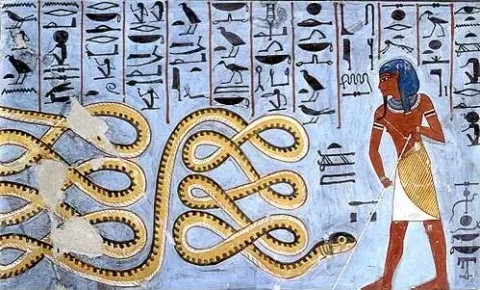
It is also believed that Khnum created the boat that carried Ra and helped defend the sun god against the serpent Apep (Apophis).
Moreover, Khnum was sometimes considered the “ba” (soul) of Ra, because the word for “ram” in Egyptian also meant “ba”.
When Khnum merged with Ra to form the composite deity Khnum-Ra, this deity became associated with Nun (who represented the primeval waters) and was given the epithet Hap-ur (“Great Nile” or “Nile of Heaven”).
Centers of Khnum’s Worship and His Family
Khnum’s cult was centered on the island of Abu (Elephantine in Upper Egypt), where he had been worshiped since the Early Dynastic Period.
During the New Kingdom, he was worshiped there as the head of a triad with his wife, Satet, and his daughter, Anuket.
He was also worshiped in Esna (Iunyt), where he was thought to be married to both Menhet and Nebtu (a local goddess) and was considered the father of Heka (the god of magic known as “He Who Activates the Ka”).
He was also believed to be the husband of Neith at Esna. In Antinoe (Herwer), Khnum was married to Heqet, the frog goddess associated with childbirth and conception.
He was associated with Hershef at Herakleopolis Magna and was often linked to Osiris.
Occasionally, Khnum was associated with Isis to represent Upper Egypt, just as Ptah was associated with Nephthys in representing Lower Egypt.
Infographic: Khnum in Ancient Egyptian Mythology
The Symbolism and Depictions of Khnum
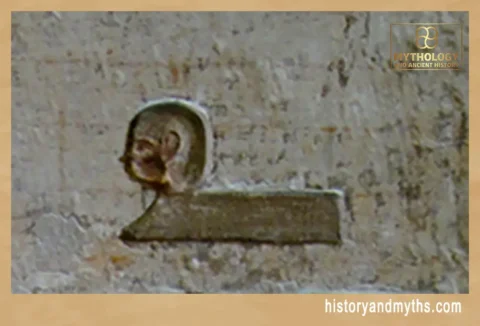
Khnum’s name derives from the root “khnem,” meaning “to join, to unite,” and also “to build”.
Astronomically, the name refers to the “conjunction” of the sun and moon at specific seasons of the year.
Khnum was considered the “Father of Fathers and the Mother of Mothers” of the pharaohs. As a water god, he was sometimes called “KebH,” meaning “purify.”
Khnum was depicted either as a ram, a man with the head of a ram, or a man with ram horns.
He was very rarely depicted with the head of a hawk, indicating his solar connections.
He often wore the plumed white crown of Upper Egypt and was sometimes shown holding a jar with water flowing out of it, symbolizing his link with the source of the Nile.
During the early period, Khnum was depicted with the early type of domesticated ram (with long corkscrew horns growing horizontally outwards from his head), but in later times he was represented by the same type of ram as Amun (with horns curving inward).
Occasionally, he was depicted with four ram heads, representing the sun god Ra, the air god Shu, the earth god Geb, and the underworld god Osiris. In this form, he was known as “Sheft-hat.
Frequently Asked Questions about Khnum
Why did Khnum create humans on a potter’s wheel?
Khnum was imagined as a divine craftsman because pottery was closely connected with clay, water, and creation in ancient Egypt. By shaping humans on a potter’s wheel, Khnum represented the idea that every body and life-force was carefully formed before birth.
Why was Khnum associated with the Nile River?
Khnum was linked with the Nile because he was believed to control its life-giving waters, especially around Elephantine near the First Cataract. The annual flood brought fertile black silt to Egypt’s fields, making Khnum a god of water, fertility, and renewal.
Sources
- Assmann, Jan. Egyptian Solar Religion in the New Kingdom: Re, Amun and the Crisis of Polytheism. London: Routledge, 2012.
- Faulkner, Raymond O. The Ancient Egyptian Pyramid Texts. Oxford: Clarendon Press, 1969.
- Hornung, Erik. Conceptions of God in Ancient Egypt: The One and the Many. Ithaca: Cornell University Press, 1982.
- Leitz, Christian, ed. Lexikon der ägyptischen Götter und Götterbezeichnungen. Leuven: Peeters, 2002.
- Lichtheim, Miriam. Ancient Egyptian Literature, Volume I: The Old and Middle Kingdoms. Berkeley: University of California Press, 1973.
- Pinch, Geraldine. Egyptian Mythology: A Guide to the Gods, Goddesses, and Traditions of Ancient Egypt. Oxford: Oxford University Press, 2002.
- Quirke, Stephen. Ancient Egyptian Religion. London: British Museum Press, 1992.
- Redford, Donald B., ed. The Oxford Encyclopedia of Ancient Egypt. Oxford: Oxford University Press, 2001.
- Shaw, Ian, and Paul Nicholson. The Dictionary of Ancient Egypt. London: British Museum Press, 1995.
- Te Velde, Herman. “Khnum.” In The Oxford Encyclopedia of Ancient Egypt, edited by Donald B. Redford. Oxford: Oxford University Press, 2001.
- Wilkinson, Richard H. The Complete Gods and Goddesses of Ancient Egypt. London: Thames & Hudson, 2003.
Written by H. Moses — All rights reserved © Mythology and History