Funeral Processions in Ancient Egypt: The Journey from Home to Tomb
Funeral processions in ancient Egypt were the public journey that moved a person from the household of the living to the landscape of the dead. The procession carried the body, offerings, and mourners toward the necropolis, often involving river transport, ritual performance, and structured roles that confirmed dignity, status, and proper burial.
This article breaks down what actually happened in an Egyptian funeral procession—where it started, who walked in it, what was carried, how the route worked by road or river, what rituals happened on arrival, and how elite processions differed from ordinary funerals without repeating embalming details.
What a Funeral Procession Was in Ancient Egypt
An Egyptian funeral procession was not simply a walk to the tomb. It was a public mechanism that turned a private death into an official transition. The moment the body moved through space in an organized way, death became visible, witnessed, and socially confirmed. That visibility mattered because burial was not only a family duty. It was a cultural requirement tied to dignity, memory, and legitimacy.
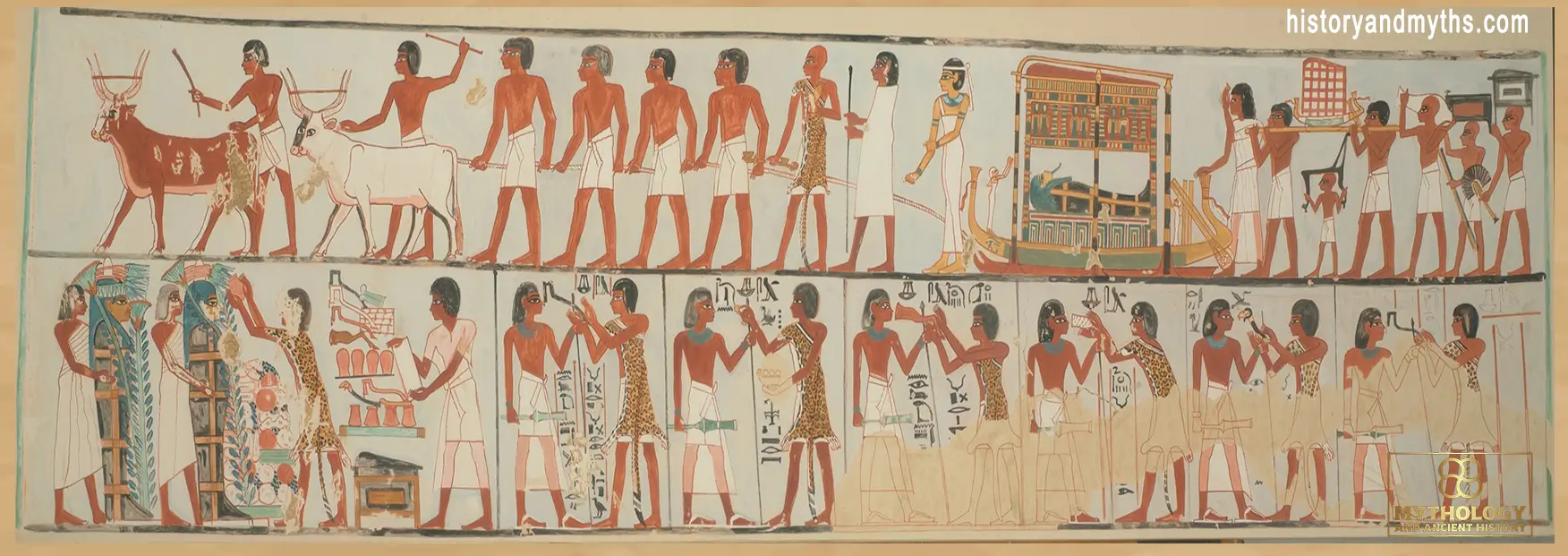
The procession also created structure around grief. Instead of leaving mourning as uncontrolled emotion, the movement itself disciplined it. Roles formed, order appeared, and the dead person’s identity was carried forward through objects, gestures, and attention. This is why processions appear so often in tomb imagery: they show the transformation from personal loss into a regulated event that society recognizes as “proper.”
Most importantly, the procession connected two worlds. It began in the human space of the household and ended at the boundary of the necropolis. That journey was not neutral geography. It marked a shift in status. The deceased stopped being a person within daily life and became a person under funerary protection, moving toward rituals that would define their afterlife identity.
| Element | What It Included | Main Function | What It Signaled |
|---|---|---|---|
| Starting point | Departure from the household into public space | Turns death into a visible event | The family is fulfilling obligations |
| Participants | Family, mourners, and sometimes priests/specialists | Creates hierarchy and social structure | Legitimacy and dignity are protected |
| What was carried | Body/coffin plus goods and offerings | Material proof of preparation | Status and care are publicly displayed |
| Route | By road, by river, or a mix of both | Moves the dead to the necropolis | Death crosses into burial space |
| Meaning | Public mourning and controlled movement | Turns grief into social recognition | Memory and honor are secured |
Where the Procession Started: From Home to the Public Road
Funeral processions began at the household level, because the home was the first stage of death management. Before any public movement, the family secured the body and initiated mourning. Once the decision to transfer the dead was made, the household stopped being only a private space and became the starting point of a public journey. That shift matters historically because it shows how quickly death moved from domestic reality into social display.
Leaving the home was a meaningful boundary. Inside the house, grief was intimate even when witnessed. Outside, grief became communal and observable. The moment the procession entered the road, the community could see that the family was performing its obligations correctly. The deceased was no longer only “ours.” The deceased became part of the shared cultural system of death, and the procession functioned as proof that this transition was being handled with dignity.
This starting phase also determined the tone of the entire event. A well-organized departure suggested control and respect. A disordered departure suggested weakness and social strain. In a society where reputation mattered, the opening moments of the funeral procession were not minor details. They were the public face of the household under pressure, and they set the framework for everything that followed on the route to the tomb.
Who Walked in the Procession (Roles and Hierarchy)
A funeral procession was defined by its participants, because the people in the line created the meaning of the event. It was not an unstructured crowd. It was a moving hierarchy. Family members were central because their presence established personal legitimacy. They were the ones who could claim the dead as part of their household and prove that obligations were being met. Their role was not only emotional; it was social authentication.
Mourners shaped the atmosphere of the procession. Their grief made the event visible and undeniable. In elite contexts, mourning could be intensified through formal performance, turning sorrow into a ritualized display that matched cultural expectations. This did not make the grief less real. It made it structured. The presence of mourners transformed the journey into an event that society could read instantly as a funeral, not an ordinary transport.
Priests or ritual specialists could also be involved, especially when a family had the means to connect the procession to formal religious authority. Their role was to create continuity between the movement and the rites that would follow near the tomb. They represented order and correctness. Even when the procession looked like a physical transport, the hierarchy of participants made it something more: a controlled transition where each role contributed to dignity, legitimacy, and the proper handling of death.
What Was Carried: Body, Coffin, Goods, and Offerings
What the procession carried was not only the body. It carried the dead person’s future. The physical transport of the corpse was the central purpose, but the objects moving with it mattered because they represented preparation, care, and status. A coffin or funerary container protected the body and displayed investment. Even without elaborate decoration, the act of enclosing and transporting the dead in a formal way signaled that the person was being treated according to cultural expectations.
Goods and offerings made the procession visible as a transfer of more than flesh. They represented the household’s attempt to equip the dead for what came next, whether through food, ritual objects, or symbolic supplies. The more visible the goods, the stronger the message of dignity and capability. This is why elite processions often appear in sources as larger, heavier, and more theatrical. The objects were part of the public statement: the family had the means and the will to honor the dead properly.
At the same time, it is important not to treat every procession as an elite spectacle. Ordinary families still carried what they could, even if it was minimal. The key point is not the quantity of objects. It is the logic behind them. The procession was a moving proof that the family was translating death into preparation, and that preparation had to be seen in material form—body secured, identity protected, and transition materially supported.
By River or By Road: How Funerals Reached the Necropolis
The route of a funeral procession was shaped by Egyptian geography. In many contexts, the Nile was not just a background feature. It was the main corridor of movement, and funerary transport often relied on water travel because it was efficient and culturally meaningful. A journey by river turned the procession into a controlled passage between spaces: from the inhabited world to the necropolis. Even when the body moved partly by road, the idea of crossing water remained an important framework for how the journey was imagined.
Transport by road created a different visibility. A procession moving through public paths exposed grief and ritual to the eyes of the living community. That exposure was not accidental. It made death socially legible. The public saw the household fulfilling its role, and the funeral became a community-recognized transition rather than a hidden movement. The road therefore served as a stage, where the event was performed in motion.
What matters historically is that Egyptians did not treat movement as neutral logistics. Whether by river or by road, the route itself carried meaning. It was a boundary-crossing act, and the procession was the mechanism that made this crossing orderly, witnessed, and socially accepted. The destination was the necropolis, but the journey was the public conversion of death into burial.
Mourning in Motion: Why Grief Was Performed Publicly
Public mourning during a funeral procession was not only emotion; it was communication. The community needed to recognize that a death had occurred and that the household was responding in the correct way. Grief expressed openly made the event unmistakable. It transformed the movement of a body into a funeral rather than a private transport. This is why mourners were not marginal figures. They were central to the procession’s meaning.
Mourning also created a moral atmosphere around the dead. It signaled that the deceased was valued and that the living understood the seriousness of the transition. In Egyptian culture, dignity after death depended on order and proper handling. Public mourning was part of that order. It contained grief within recognizable forms and prevented the event from appearing careless or socially empty. A household that did not mourn visibly risked looking indifferent, and indifference could damage both reputation and the perceived honor of the dead.
Finally, mourning in motion linked the beginning of death to its formal conclusion. The procession moved forward physically, but the community’s attention moved with it. That attention mattered because it created continuity: from the home, through the route, to the threshold of the tomb. The dead person was carried not only by hands, but by social recognition. In practical terms, mourning made the funeral procession a public proof that death was being transformed into proper burial.
Ordinary Funerals vs. Elite Processions: Two Different Scales
The basic logic of a funeral procession was shared across society, but its scale depended on resources. Ordinary funerals were often smaller, faster, and more constrained. Families still had to move the dead with dignity, but they could not always afford an extended public performance or a large amount of equipment and attendants. The procession might involve fewer participants, simpler transport, and more direct movement toward burial. The purpose remained the same: to carry the dead from household space to the necropolis under social recognition.
Elite processions could become large public events. More people were involved, roles were clearer, and the movement could be expanded into a visible demonstration of status and legitimacy. Objects, offerings, and professional participation made the procession more theatrical, but the theatrical quality was not meaningless decoration. It functioned as proof of capability and control. The elite could show that they managed death with order, resources, and formal correctness, and that visibility reinforced their social position even after loss.
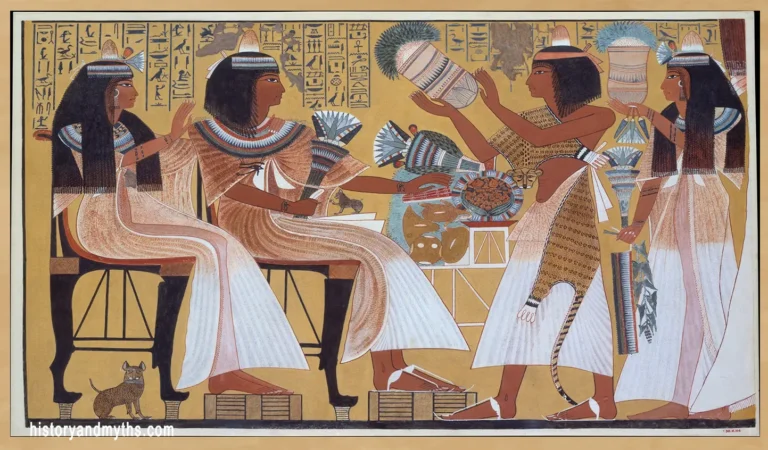
This distinction matters because much of the surviving visual evidence reflects elite ideals rather than everyday reality. A strong historical interpretation cannot assume that the largest processions represent normal practice. It must treat them as one end of the spectrum. The ordinary household still performed the essential transition, even if the procession was modest. The difference was not whether people processed. It was how much social and material weight the procession could carry.
In ancient Egypt, the funeral procession was the public journey that moved the dead from household space to the necropolis. It carried the body, mourners, and offerings through a structured hierarchy. More than transport, it confirmed dignity, legitimacy, and proper burial in the eyes of society.
Why the Procession Mattered: Memory, Legitimacy, and Social Order
The funeral procession mattered because it was the public moment when death became officially managed. Inside the home, grief could be private and chaotic. The procession converted that private rupture into a structured event that society could recognize as correct. The community saw that the household had taken responsibility, that the dead were being treated with dignity, and that the transition toward burial was happening under order rather than neglect.
This public structure also protected legitimacy. A proper procession signaled that the deceased belonged within a stable social world and that their departure was being handled according to expectations. For the living, it preserved reputation. For the dead, it preserved honor. The procession was therefore not only transport. It was social proof, a moving confirmation that the person’s identity and status were still being respected even as they were leaving daily life behind.
Most importantly, the procession shaped memory before the tomb did. It was the last time the dead person moved through the world of the living, surrounded by voices, presence, and witness. Once the procession ended, the dead entered a different kind of existence—defined by burial spaces and ritual protections. But the procession created the bridge. It carried the deceased across the boundary between life and burial, making that boundary crossing visible, legitimate, and socially secure.
Conclusion
Ancient Egyptian funeral processions were the public journey that turned private loss into proper burial. They organized roles, movement, mourning, and material preparation as the dead crossed from household space to the necropolis. More than transport, the procession protected dignity, confirmed legitimacy, and shaped how the dead would be remembered
- The funeral procession was the public conversion of death into proper burial.
- It began at the household and ended at the boundary of the necropolis.
- Participants formed a hierarchy that protected dignity and legitimacy.
- Goods and offerings made funerary preparation visible in material form.
- Elite processions were larger and more formal, while ordinary funerals were simpler and faster.
FAQ
What was a funeral procession in ancient Egypt?
It was the public journey that carried the dead from the household to the necropolis, combining transport, mourning, and social confirmation of proper burial.
Did Egyptian funerals travel by river?
Often, yes. The Nile was a major route of transport, and river movement also carried symbolic meaning linked to transition and passage.
Who took part in the procession?
Family members, mourners, and sometimes priests or ritual specialists, depending on the household’s resources and social rank.
What objects were carried during the procession?
The body or coffin was central, but offerings and goods could also be carried as visible proof of preparation and care.
Were elite funeral processions different from ordinary ones?
Yes. Elite processions could be larger and more formal, while ordinary funerals were often smaller and more direct.
Why was public mourning important during the procession?
Because it made death socially recognized, confirmed dignity, and turned grief into a structured event rather than private chaos.
Why did the funeral procession matter historically?
It shows how Egyptians made death public, legitimate, and controlled, turning loss into a socially accepted transition toward burial.
Sources & Rights
- Assmann, Jan. Death and Salvation in Ancient Egypt. Ithaca, NY: Cornell University Press, 2005.
- Ikram, Salima. Death and Burial in Ancient Egypt. Cairo: American University in Cairo Press, 2003.
- Taylor, John H. Death and the Afterlife in Ancient Egypt. Chicago: University of Chicago Press, 2001.
- Teeter, Emily. Religion and Ritual in Ancient Egypt. Cambridge: Cambridge University Press, 2011.
- Wilkinson, Richard H. The Complete Gods and Goddesses of Ancient Egypt. London: Thames & Hudson, 2003.