The Army in Daily Life of Ancient Egypt: Soldiers Beyond War
When we think of the ancient Egyptian army, we usually imagine battles, chariots, and famous campaigns. But for most Egyptians, the army was not something distant or exceptional-it was part of everyday life. Farmers became soldiers, soldiers became workers, and military service shaped how ordinary people lived, worked, and related to the state.
The Egyptian army was more than a fighting force. It functioned as a tool of administration, labor organization, internal security, and political control. Military service affected daily routines, economic obligations, social mobility, and even access to land and rewards. For many Egyptians, interaction with the army happened not on battlefields, but in villages, work crews, and state projects.
This article explains how the army operated within daily life in ancient Egypt. It answers who served, what military service looked like in practice, how soldiers lived, and how the army supported royal authority beyond warfare. By the end, the reader will understand the Egyptian army not as a distant institution, but as a central part of society itself.
Who Served in the Army?
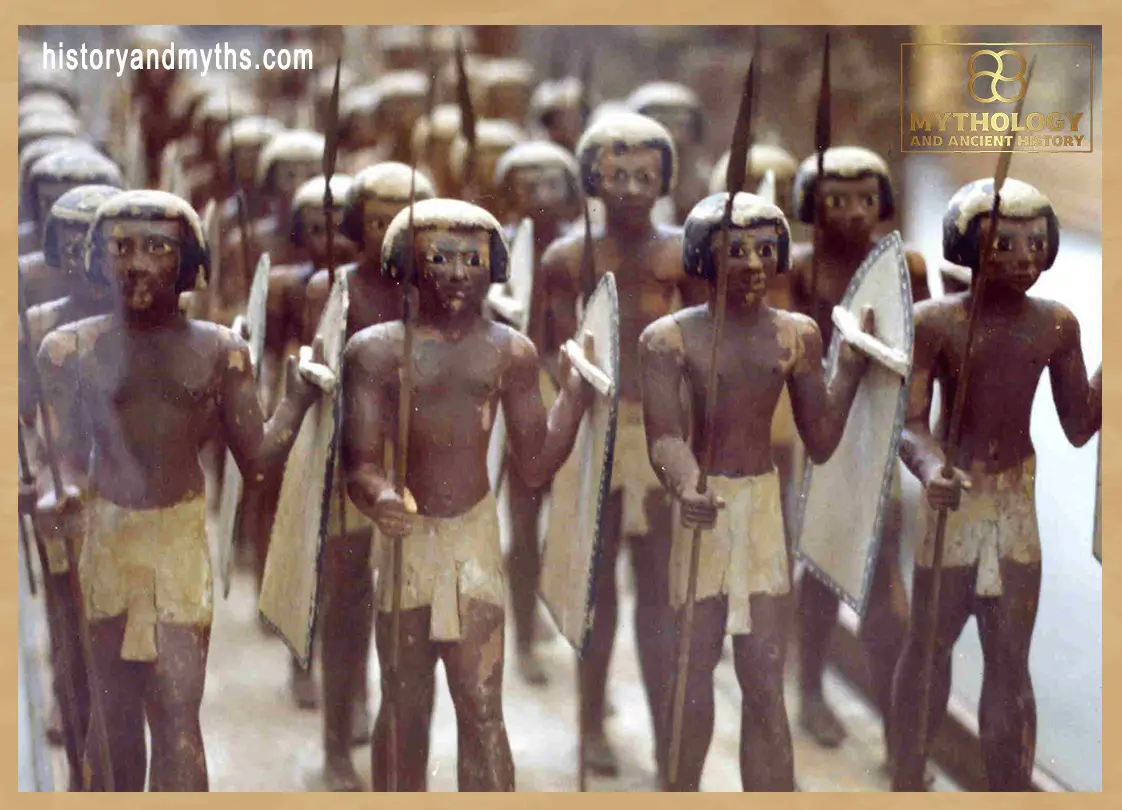
The ancient Egyptian army was not composed solely of full-time professional soldiers. Most recruits came from the general population, especially farmers. Military service was often seasonal, allowing men to serve during periods when agricultural work was limited, such as after the harvest.
This system benefited the state and society at the same time. The state gained manpower without maintaining a large standing army year-round, while communities fulfilled their obligations without losing their workforce permanently. For many Egyptians, serving in the army was a temporary duty rather than a lifelong career.
Over time, especially during the New Kingdom, a more professional core developed. Career soldiers, officers, and specialized units emerged, often rewarded with rations, land grants, or social status. However, even then, the army continued to draw heavily from ordinary citizens during major campaigns or state projects.
Understanding who served in the army shows that military life was closely tied to civilian life. Soldiers were not separate from society—they were society. This connection explains why the army played such a deep role in daily life beyond warfare.
| Aspect of Military Life | How It Worked | Impact on Daily Life |
|---|---|---|
| Recruitment | Mostly seasonal service drawn from farmers and civilians | Military duty blended with agricultural and family life |
| Type of Service | Temporary service with a smaller professional core | Soldiers often returned regularly to civilian routines |
| Daily Duties | Guarding, transport, construction, supervision | Army activity was visible in villages and work sites |
| Economic Role | Paid in rations, goods, and occasional land grants | Military service affected household stability and income |
| Political Function | Enforced royal authority and internal order | Strengthened state presence in everyday life |
| After Service | Veterans rewarded or recalled when needed | Military experience influenced social status and loyalty |
Military Service and Daily Life
Military service in ancient Egypt reshaped daily routines rather than suspending them. Soldiers did not live permanently on distant battlefields. Most spent long periods in camps near population centers or returned regularly to civilian life. This meant that military obligations blended with farming, family responsibilities, and local community life.
Daily life for a soldier involved training, labor duties, and discipline more than constant combat. Soldiers were assigned tasks such as guarding routes, transporting goods, supervising labor crews, or maintaining infrastructure. These activities tied the army directly to economic and administrative functions, not just defense.
Rations and compensation were also part of everyday experience. Soldiers received food, clothing, and sometimes land or shares of spoils, which affected household stability and social standing. Military service could provide security and opportunity, especially for men with limited prospects in civilian life.
By shaping work patterns, income, and obligations, the army became embedded in ordinary life. Serving the state militarily was not an interruption of daily existence—it was one of the ways daily life itself was organized.
The Army Beyond War
The Egyptian army played a major role far beyond the battlefield. In daily life, soldiers were regularly assigned to non-combat duties that supported the functioning of the state. These included protecting trade routes, guarding storage facilities, escorting officials, and maintaining order in sensitive regions.
The army was also deeply involved in state labor projects. Soldiers supervised work crews, transported materials, and participated directly in construction and logistics. Roads, fortresses, canals, and supply networks relied on military organization. In this sense, the army acted as a mobile workforce capable of enforcing discipline and efficiency.
Internally, the army helped maintain political stability. Its presence deterred rebellion, enforced royal decisions, and supported local administrators when civil authority was weak. This internal role made the army an essential tool of governance, not just defense.
By extending its reach into security, labor, and administration, the army became part of everyday governance. War was only one aspect of its function. In daily life, the army helped keep the state operating and authority visible.
The Army and the Pharaoh
The army was one of the most direct extensions of pharaonic power. While officials managed administration and justice, the army ensured that royal authority could be enforced when needed. Loyalty to the pharaoh was therefore not symbolic-it was practical and visible in daily governance.
Military leadership was closely tied to the crown. Senior officers were often appointed by the pharaoh and depended on royal favor for advancement, rewards, and land grants. This created a personal bond between military elites and the throne, strengthening political stability during strong reigns.
Public displays of military loyalty also reinforced royal authority. Parades, inspections, and ceremonial roles presented the army as a force aligned with the king, reminding the population that power was organized and supported by force if necessary. This visibility mattered as much as battlefield success.
At the same time, reliance on the army carried risk. During weak reigns, powerful military figures could gain influence beyond their intended role. This made control, supervision, and balance essential. The relationship between the pharaoh and the army was therefore one of mutual dependence-strengthening the state when aligned, and destabilizing it when strained.
The Egyptian Army in Daily Life — Core Insights
- The army was a social institution, not only a fighting force.
- Most soldiers were civilians who served seasonally rather than permanently.
- Military service blended with farming, labor, and family life.
- Soldiers performed daily duties such as guarding routes, supervising work, and maintaining order.
- The army supported royal authority inside Egypt, not just at the borders.
- Military service could improve social status and economic security after discharge.
© historyandmyths.com — Educational use
Soldiers After Service
Military service did not end a soldier’s role in society—it often reshaped it. After completing their service, many soldiers returned to civilian life with new skills, connections, and status. Experience in the army could improve social standing, especially for men from modest backgrounds.
Veteran soldiers were sometimes rewarded with land, rations, or administrative positions. These benefits were not guaranteed, but they created incentives for loyalty and service. In some cases, former soldiers became local officials, guards, or supervisors, extending military influence into civilian administration.
Service also carried long-term obligations. Veterans remained tied to the state and could be recalled during emergencies or assigned additional duties. This maintained a pool of experienced manpower while reinforcing the connection between military service and civic responsibility.
By shaping post-service life, the army influenced social mobility and state loyalty. Military service was not just a temporary duty—it was a pathway that linked ordinary Egyptians more closely to the structures of power and governance.
Key Takeaways
- The ancient Egyptian army was part of everyday life, not a distant wartime institution.
- Most soldiers were civilians who served seasonally alongside farming and family duties.
- Military service involved labor, security, and administration more than constant combat.
- The army supported internal order and helped enforce royal authority across Egypt.
- Service in the army could improve social status and provide economic rewards.
- Military experience tied ordinary Egyptians more closely to the state.
Frequently Asked Questions (FAQ)
What role did the army play in daily life in ancient Egypt?
The army was part of everyday life. Soldiers guarded routes, supervised labor, protected storage sites, and supported administration, not just warfare.
Were ancient Egyptian soldiers professional or civilians?
Most soldiers were civilians, especially farmers, who served seasonally. A smaller professional core existed, particularly during the New Kingdom.
Was military service mandatory in ancient Egypt?
Service was often expected as a state obligation, especially during campaigns or major projects, but it was not a permanent or universal draft.
How did military service affect ordinary Egyptians?
Military service shaped work routines, income, and social status. It could provide rations, rewards, and opportunities after service.
Did the army only fight wars?
No. The army also handled internal security, construction, transport, and enforcement of royal authority across the country.
How did the army support the pharaoh’s power?
The army enforced royal decisions, deterred unrest, and demonstrated organized force, making it a key instrument of political control.
What happened to soldiers after their service ended?
Many returned to civilian life with improved status. Some received land, rewards, or roles in local administration and could be recalled if needed.
Sources & Rights
- Breasted, James Henry. A History of Egypt: From the Earliest Times to the Persian Conquest. New York: Charles Scribner’s Sons, 1905.
- Davies, Norman de Garis. The Tomb of Rekh-mi-Rē at Thebes. New York: Metropolitan Museum of Art, 1943.
- Gabriel, Richard A. The Military History of Ancient Egypt. Westport, CT: Praeger, 2003.
- Grimal, Nicolas. A History of Ancient Egypt. Translated by Ian Shaw. Oxford: Blackwell Publishing, 1992.
- Harries, Lyndon. Soldiers and Society in Ancient Egypt. London: Routledge, 2011.
- Kemp, Barry J. Ancient Egypt: Anatomy of a Civilization. 2nd ed. London: Routledge, 2006.
- Moreno García, Juan Carlos. Ancient Egyptian Administration. Leiden: Brill, 2013.
- O’Connor, David. “The Nature of Tuthmosis III’s Military Campaigns.” In Ancient Egyptian Kingship, edited by David O’Connor and David P. Silverman. Leiden: Brill, 1995.
- Redford, Donald B. Egypt, Canaan, and Israel in Ancient Times. Princeton: Princeton University Press, 1992.
- Schulman, Alan R. Military Rank, Title, and Organization in the Egyptian New Kingdom. Berlin: Akademie-Verlag, 1964.
- Shaw, Ian, ed. The Oxford History of Ancient Egypt. Oxford: Oxford University Press, 2000.
- Spalinger, Anthony J. War in Ancient Egypt: The New Kingdom. Oxford: Blackwell, 2005.
- Strudwick, Nigel. The Administration of Egypt in the Old Kingdom. London: Kegan Paul International, 1985.
- Trigger, Bruce G., Barry J. Kemp, David O’Connor, and Alan B. Lloyd. Ancient Egypt: A Social History. Cambridge: Cambridge University Press, 1983.
- Van de Mieroop, Marc. A History of Ancient Egypt. Malden, MA: Wiley-Blackwell, 2011.
- Wilkinson, Toby A. H. The Rise and Fall of Ancient Egypt. New York: Random House, 2010.
Written by H. Moses — All rights reserved © Mythology and History