Capital Cities of Ancient Egypt: Why Power Kept Moving
Ancient Egypt did not rely on a single, permanent capital. Instead, its capitals shifted over time, reflecting changes in political priorities, administrative control, and the nature of royal power. Understanding these cities is not about memorizing names, but about seeing how the Egyptian state adapted to different challenges across centuries.
Each capital functioned as a political tool. Some centralized authority, others reinforced religious legitimacy, and a few represented short-lived ideological or military experiments. When power structures changed, the capital often changed with them. Geography mattered, but politics mattered more.
This article explains why ancient Egypt had multiple capitals, what role each one played, and what these shifts reveal about the way the state was governed. By the end, the reader should not only know where Egypt was ruled from, but also understand why those places mattered at specific moments in history.
The Capital as a Political Center
In ancient Egypt, a capital was not chosen for prestige or population size. It was chosen to serve power. The capital functioned as the place where decisions were made, resources were directed, and authority was enforced. In other words, it was the operational heart of the state.
Political control required proximity. Officials, scribes, military leaders, and royal institutions needed to operate near the throne to function efficiently. A capital concentrated these actors in one place, allowing the pharaoh to coordinate administration, taxation, justice, and labor without relying solely on distant local authorities.
This explains why Egypt could have more than one “capital” at the same time. A city might serve as an administrative center, while another functioned as a religious or symbolic seat of power. What mattered was not the title of capital, but its role within the political system at a given moment.
Understanding the capital as a political center shifts the focus away from geography and toward governance. When the needs of the state changed-whether due to expansion, internal crisis, or ideological reform-the capital often moved to reflect
| Capital City | Primary Role | What It Reveals About Power |
|---|---|---|
| Memphis | Administrative centralization | Early state power relied on bureaucracy and resource control |
| Thebes | Religious–political authority | Legitimacy was reinforced through powerful religious institutions |
| Amarna | Ideological experiment | Capitals tied to ideology fail without institutional support |
| Pi-Ramesses | Military and imperial command | Political centers shift toward strategic and military needs |
| Multiple Centers | Flexible governance | Power adapted by relocating authority rather than preserving tradition |
Memphis and Early Centralization
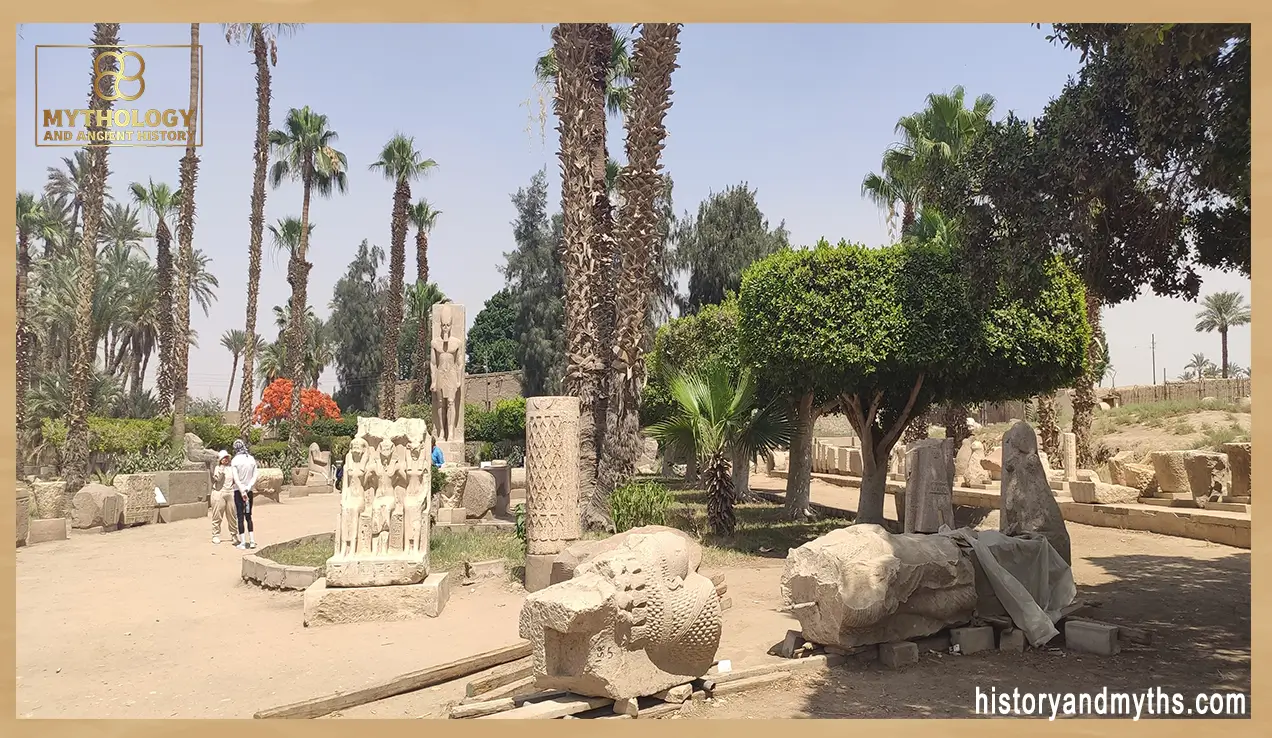
Memphis served as the political heart of early dynastic and Old Kingdom Egypt because it supported centralization. Its location near the apex of the Nile Delta allowed rulers to oversee both Upper and Lower Egypt, making it ideal for administering a newly unified state.
From Memphis, royal authority was translated into practical control. Taxation, labor organization, and legal administration were coordinated through a growing bureaucracy closely tied to the palace. This made Memphis less a ceremonial capital and more a working center of governance.
The city’s role reflects the priorities of the early Egyptian state: stability, continuity, and control over resources rather than ideological experimentation. Power flowed outward from the center, and Memphis enabled that flow efficiently.
When political needs later shifted-toward religious legitimacy or military expansion-Memphis gradually lost its primacy. Its decline does not signal failure, but a change in how power needed to be organized.
Thebes and Religious-Political Power
Thebes rose as a capital when political authority needed religious reinforcement. Unlike Memphis, which emphasized administrative centralization, Thebes derived its strength from its association with powerful cults, especially the cult of Amun. This made the city a center where political power and religious legitimacy reinforced each other.
Ruling from Thebes allowed kings to present themselves not only as administrators, but as divinely sanctioned leaders supported by influential priesthoods. This was particularly important during periods of reunification and recovery, when legitimacy mattered as much as control. Religious authority helped stabilize rule when political structures were under strain.
However, this model also introduced tension. As temples grew wealthier and more influential, they gained political weight of their own. The capital empowered the state, but it also strengthened institutions that could rival royal authority. Power in Thebes was therefore shared, negotiated, and sometimes contested.
Thebes shows that an Egyptian capital could function as more than an administrative hub. It could become a source of ideological power-one that supported the throne in times of strength, but complicated governance when institutional balance shifted.
Amarna: Ideology and Experiment
Amarna was not founded for administrative efficiency or strategic control. It was created to serve an ideological project. Akhenaten established the city as a new capital to separate political authority from traditional religious institutions, especially the powerful priesthoods centered elsewhere.
By ruling from Amarna, the king attempted to redesign the relationship between power, religion, and the state. The capital embodied this shift. Its location, urban layout, and religious focus all reflected a deliberate break from established political norms. Amarna was meant to centralize authority around the king’s ideology rather than inherited institutions.
This experiment failed because it weakened existing systems without replacing them effectively. Administration struggled, religious resistance grew, and political support eroded. When Akhenaten died, the capital lost its purpose. Without the ideology that justified it, Amarna became unnecessary.
Amarna demonstrates that a capital could not survive on ideology alone. In ancient Egypt, political centers endured only when they aligned with administrative reality and institutional cooperation. When that balance collapsed, the capital collapsed with it.
Pi-Ramesses and Imperial Rule
Pi-Ramesses emerged as a capital when Egypt’s priorities shifted toward military power and imperial control. Located in the eastern Delta, the city was strategically positioned to oversee trade routes, defend the northeastern frontier, and launch campaigns into the Levant. This was not a symbolic choice, but a practical one shaped by foreign policy.
Ruling from Pi-Ramesses allowed the state to integrate administration with military logistics. The presence of garrisons, supply depots, and workshops turned the capital into a command center rather than a ceremonial seat. Political authority here was expressed through mobility, rapid response, and external projection of power.
This model suited an expansionist state, but it was also dependent on strong leadership and constant resources. When Egypt’s imperial reach declined, Pi-Ramesses lost its strategic value. Environmental changes and reduced military activity made the location less viable, prompting another shift in political centers.
Pi-Ramesses shows that capitals were shaped by the state’s external ambitions as much as its internal needs. When empire mattered, the capital followed the army. When empire faded, so did the city’s political importance.
Capital Cities of Ancient Egypt — The Core Idea
- Ancient Egypt had multiple capitals because political power had different needs over time.
- A capital was chosen to control administration, legitimacy, or military strategy—not for prestige.
- Memphis reflects early centralization and bureaucratic control of resources.
- Thebes shows how religious authority could strengthen political legitimacy.
- Amarna proves that an ideological capital cannot survive without institutional support.
- Pi-Ramesses highlights a shift toward frontier control and imperial logistics.
© historyandmyths.com — Educational use
Why Capitals Changed in Ancient Egypt
Capitals in ancient Egypt changed because power itself was not static. Each shift reflected a change in how the state needed to govern, control resources, or project authority. When the priorities of rule evolved, the political center moved to match them.
Centralization favored cities like Memphis. Religious legitimacy elevated Thebes. Ideological reform created Amarna. Military expansion required Pi-Ramesses. None of these changes were random, and none were purely geographical. They were political responses recognized through urban choice.
A capital also changed when it stopped serving its purpose. Environmental decline, loss of strategic value, or the collapse of supporting institutions made some cities obsolete. When that happened, the state adapted rather than clinging to tradition. Flexibility, not permanence, was a strength of Egyptian governance.
This pattern reveals an important truth: ancient Egypt was not rigid or unchanging. Its ability to relocate power helped preserve the state across long periods of transformation. By following the capitals, we can trace how Egyptian political authority responded to stability, crisis, ambition, and reform.
Key Takeaways
- Ancient Egypt did not have a single permanent capital; capitals shifted with political needs.
- A capital functioned as a tool of governance—administrative, religious, or military.
- Memphis supported early state centralization and bureaucratic control.
- Thebes strengthened political legitimacy through powerful religious institutions.
- Amarna failed because ideology alone could not sustain administration.
- Pi-Ramesses reflects a capital designed for imperial strategy and military logistics.
Frequently Asked Questions (FAQ)
What was the capital of ancient Egypt?
Ancient Egypt did not have a single permanent capital. Different cities served as capitals at different times, depending on political, religious, and military priorities.
Did ancient Egypt have more than one capital at the same time?
Yes. Egypt could have multiple political centers simultaneously, such as an administrative capital alongside a religious or ceremonial center.
Why did ancient Egypt change its capital cities?
Capitals changed when political priorities shifted. Centralization, religious legitimacy, military expansion, or ideological reform often required a new political center.
Was Memphis always the capital of ancient Egypt?
No. Memphis dominated early state administration, but later periods favored other capitals as political and strategic needs evolved.
Why was Thebes important as a capital?
Thebes became influential because of its religious authority, especially its association with powerful priesthoods that reinforced political legitimacy.
Why was Amarna abandoned?
Amarna was tied to a specific ideological project under Akhenaten. When that ideology collapsed, the city lost its political purpose and was abandoned.
What does Pi-Ramesses reveal about Egyptian rule?
Pi-Ramesses shows how political power shifted toward military and imperial control, reflecting Egypt’s expansionist priorities during the New Kingdom.
Sources & Rights
- Assmann, Jan. The Mind of Egypt: History and Meaning in the Time of the Pharaohs. Cambridge, MA: Harvard University Press, 2002.
- Baines, John, and Jaromír Málek. Atlas of Ancient Egypt. Oxford: Phaidon Press, 1980.
- Breasted, James Henry. A History of Egypt: From the Earliest Times to the Persian Conquest. New York: Charles Scribner’s Sons, 1905.
- Grimal, Nicolas. A History of Ancient Egypt. Translated by Ian Shaw. Oxford: Blackwell Publishing, 1992.
- Kemp, Barry J. Ancient Egypt: Anatomy of a Civilization. 2nd ed. London: Routledge, 2006.
- Lehner, Mark. The Complete Pyramids. London: Thames & Hudson, 1997.
- Moreno García, Juan Carlos. Ancient Egyptian Administration. Leiden: Brill, 2013.
- O’Connor, David. “New Kingdom and Third Intermediate Period.” In The Oxford History of Ancient Egypt, edited by Ian Shaw. Oxford: Oxford University Press, 2000.
- Quirke, Stephen. The Cult of Ra: Sun-Worship in Ancient Egypt. London: Thames & Hudson, 2001.
- Redford, Donald B. Akhenaten: The Heretic King. Princeton: Princeton University Press, 1984.
- Redford, Donald B. Egypt, Canaan, and Israel in Ancient Times. Princeton: Princeton University Press, 1992.
- Shaw, Ian, ed. The Oxford History of Ancient Egypt. Oxford: Oxford University Press, 2000.
- Strudwick, Nigel. The Administration of Egypt in the Old Kingdom. London: Kegan Paul International, 1985.
- Trigger, Bruce G., Barry J. Kemp, David O’Connor, and Alan B. Lloyd. Ancient Egypt: A Social History. Cambridge: Cambridge University Press, 1983.
- Van de Mieroop, Marc. A History of Ancient Egypt. Malden, MA: Wiley-Blackwell, 2011.
- Wilkinson, Toby A. H. The Rise and Fall of Ancient Egypt. New York: Random House, 2010.
Written by H. Moses — All rights reserved © Mythology and History