The Psachna Mycenaean Tomb: Elite Power in Ancient Greece
A monumental Mycenaean tholos tomb near Psachna, on the Greek island of Euboea, came to public attention in November 2026 after its discovery during road construction. Preliminary reports date the monument to between 1400 and 1200 BCE and suggest that it may rank among the largest Mycenaean tombs in Greece. Its exact dimensions and the identity of those buried within it remain unknown.
The monument is particularly significant because no Mycenaean administrative palace has yet been identified on Euboea. Its construction suggests that local communities could command considerable resources, raising questions about the distribution of wealth and political authority beyond the major palatial centres of mainland Greece.
The Discovery of the Psachna Tomb
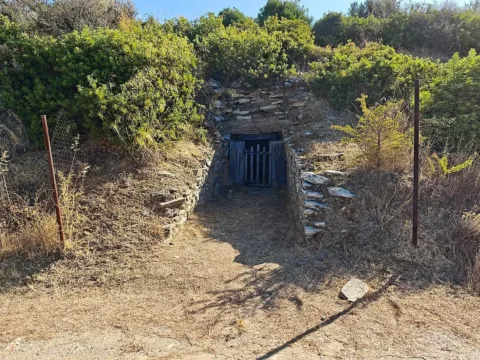
The tomb was uncovered at Agia Paraskevi, near Psachna in central Euboea, during construction of the Chalkida–Psachna bypass. Excavations conducted by the Ephorate of Antiquities of Euboea exposed a stone-lined entrance passage (dromos) and a monumental doorway leading towards the burial chamber.
The discovery became widely known following a visit by Greek parliamentarian Thanasis Zembilis on 23 November 2026. Photographs released after the visit revealed substantial masonry along the entrance passage, while subsequent reports suggested that the monument could rank among the twenty largest Mycenaean tholos tombs discovered in Greece.
Local reports provisionally date the tomb to between 1400 and 1200 BCE. No detailed excavation report has yet been published, and the monument’s exact dimensions, the condition of its burial chamber and the presence of human remains or grave goods remain unknown.
How Were Mycenaean Tholos Tombs Built?
Mycenaean tholos tombs consisted of three main architectural elements: a long entrance passage (dromos), a stone-built doorway (stomion) and a circular burial chamber (thalamos). The chamber was roofed by successive courses of stone, each projecting slightly inward until the opening at the top could be closed. This technique, known as corbelling, allowed builders to create large enclosed spaces without internal supporting columns.
The Treasury of Atreus at Mycenae, built around 1300 BCE, illustrates the scale such monuments could reach. Its burial chamber measures approximately 14.5 metres in diameter and 13.2 metres in height. A triangular opening above the doorway reduces the weight placed on the massive stone lintel.
Unlike most rock-cut chamber tombs, large tholos tombs required extensive masonry. Quarrying and transporting stone, employing skilled builders and maintaining a workforce demanded considerable resources and coordination.
Earlier Mycenaean Tombs in Euboea
The earliest documented excavations of Mycenaean tombs in Euboea date to the early twentieth century. At Velousia near Aliveri, archaeologists recovered pottery fragments, a button and human bones from a tholos tomb. Another tholos at nearby Katakalou survived in relatively good architectural condition despite having been robbed, while the contents of the tomb at Enoria near Kymi had already been lost to looting.
Rock-cut chamber tombs discovered at Trypa near Chalkis and Livadia near Aliveri reveal a broader range of burial practices. The coexistence of different tomb types suggests that communities across the island invested in funerary monuments on varying scales.
Once its dimensions are established, Psachna can be compared with the earlier tholos tombs to assess differences in the scale of funerary construction across Euboea.
Mycenaean Euboea Beyond the Palaces
During the Late Bronze Age, Euboea supported a network of settlements extending from Psachna and Chalkis to Lefkandi, Amarynthos and Aliveri. Despite this widespread occupation, no administrative palace comparable to those at Mycenae, Thebes or Pylos has been identified on the island.
Archaeologist Alex R. Knodell has examined Euboea as an example of nonpalatial political organization. Unlike mainland centres such as Thebes and Pylos, where Linear B tablets document administrative control over labour, commodities and production, Euboea’s political structure must be reconstructed largely from settlements, pottery distributions and funerary monuments. These sources reveal social differentiation but provide less direct evidence of how political authority was exercised.
Euboea’s position along Aegean maritime routes connected its communities with mainland Greece and wider exchange networks. Agricultural production, maritime exchange and access to local resources may have supported the emergence of influential families.
The political relationship between these communities remains uncertain. Central Euboea may have supported independent local authorities or communities connected to mainland palatial centres.
Was the Psachna Tomb a Royal Burial?
Early reports described the Psachna monument as a royal tomb, but monumental architecture alone cannot establish the political rank of those buried within it.
Mycenaean tholos tombs were often used for successive burials, potentially serving several generations of an elite family. At Mycenae itself, some tholos tombs were contemporary with one another, complicating their traditional interpretation as the successive burial places of a single royal dynasty. Moreover, certain chamber tombs contained richer grave goods than some tholos tombs.
Funerary monuments were also a means through which surviving relatives asserted their family’s status and maintained its social influence across generations. The scale of a tomb could therefore reflect collective family wealth rather than the authority of an individual ruler.
An elite family burial is therefore a plausible interpretation of the Psachna monument, but its association with royalty remains unproven.
Euboea at the End of the Mycenaean Palatial Age
Around 1200 BCE, the destruction of major Mycenaean centres, including Pylos and Mycenae, disrupted the palatial systems of mainland Greece. Some communities in Euboea nevertheless remained active during the following century.
At Xeropolis, the Bronze Age settlement of Lefkandi, twelfth-century BCE buildings, pottery and evidence of overseas exchange document continued occupation after the collapse of the mainland palaces.
Determining whether the Psachna tomb remained in use after 1200 BCE could help establish how funerary traditions and elite communities changed during this period.
Read More:
What Could Further Excavations Reveal?
Excavation of the burial chamber could establish whether the tomb accommodated one or multiple burials. Surviving pottery and grave goods could refine its chronology and reveal connections with other Aegean communities.
If human remains survive, radiocarbon dating could help establish the burial chronology. Osteological analysis could provide information about age, sex and health, while ancient DNA and stable isotope analyses could investigate biological kinship, diet and geographical mobility.
Surveys of the surrounding area could also help identify the settlement associated with the monument and establish its place within the archaeological landscape of central Euboea.
Preserving the Psachna Tomb
The discovery has complicated construction of the Chalkida–Psachna bypass. According to local reports published on 27 November 2026, roadworks were suspended within a designated archaeological protection area covering approximately 4,000 square metres.
One proposed solution involves constructing a bridge over the archaeological site, allowing the road project to proceed while preserving the monument in its original setting. The proposal remains subject to archaeological assessment and engineering approval.
Conclusion
The importance of the Psachna tomb lies not simply in its reported size, but in its potential to clarify the social organization of Mycenaean Euboea. Establishing its chronology, burial history and relationship with nearby settlements will be essential to understanding who built it and what position they occupied within the Late Bronze Age Aegean.
Sources & Archaeological Research
- Knodell, Alex R. (2021). Societies in Transition in Early Greece: An Archaeological History. University of California Press.
- Late Helladic Tombs at Khalkis (1952). The Annual of the British School at Athens.
- Archaeological Fieldwork and Research in Euboea: 2014–2024. Archaeological Reports.
- Fitzsimons, Rodney D. Monumental Architecture and the Construction of the Mycenaean State.
- Dartmouth College. Aegean Prehistoric Archaeology: Mycenaean Tholos and Chamber Tombs.
- University of Oxford. Lefkandi Archaeological Project.
Discovery Reports
- To Vima (27 November 2026). 3,200-Year-Old Mycenaean Tomb Discovered in Evia During Works.
- Anatolian Archaeology (26 November 2026). 3,200-Year-Old Monumental Mycenaean Tomb Discovered on Greek Island of Euboea.
- TV Star (27 November 2026). Report on the Suspension of Roadworks at the Mycenaean Tomb Site (in Greek).
Copyright Notice
© 2026 History & Myths. All rights reserved. This article was written by H. Moses for History & Myths. No part of this article may be reproduced or republished without prior written permission, except as permitted by applicable law. Third-party images remain subject to their respective licenses.