What If the Celtic Invasion of Greece Had Succeeded?
In 279 BC, a Celtic army led by Brennus advanced into Greece and threatened Delphi, home to Apollo’s celebrated oracle. Macedonia was already in turmoil after another Celtic force had defeated and killed King Ptolemy Ceraunus. Yet Brennus’s campaign ended in failure, and his army was forced to retreat.
What if reinforcements had reached Brennus before the attack and the Celts had captured Delphi? Such a victory could have brought substantial wealth and weakened Greek resistance, but it would not have placed Greece under Celtic rule. The Greek cities could still defend their territories, while competing Hellenistic rulers had their own ambitions in Macedonia.
The greater possibility was a lasting Celtic foothold in Macedonia or northern Greece. Whether Brennus could establish one would depend on his ability to maintain his army, secure local cooperation, and withstand opposition from Greek and Macedonian forces. Success might also have affected the Aetolian League, the rise of Antigonus Gonatas, and Celtic migration into Asia Minor.
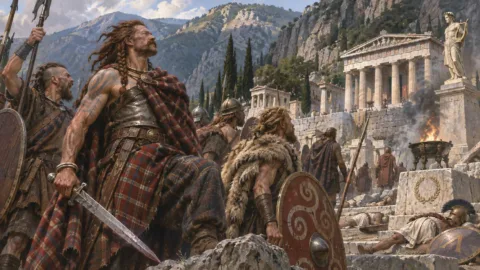
The Celtic Invasion of Greece in 279 BC
The Celtic invasions of 280–279 BC unfolded amid a succession crisis in Macedonia. Following the death of Lysimachus in 281 BC, rival claimants struggled for the throne. Celtic forces advancing through the Balkans took advantage of the disorder, although they operated under separate leaders rather than a single command. Pausanias describes expeditions into Thrace, Paeonia, and Macedonia. One of these, led by Bolgius, defeated and killed King Ptolemy Ceraunus in 279 BC.
Brennus then led a larger expedition into Greece, where wealthy sanctuaries offered opportunities for plunder. His army marched through Thessaly toward Thermopylae, defended by a coalition of Athenians, Boeotians, Phocians, Aetolians, and other Greek forces. The narrow pass favored the defenders, restricting Celtic cavalry and allowing Greek infantry and missile troops to hold their positions.
Unable to force a passage, Brennus sent part of his army into Aetolia, compelling Aetolian troops to return home. He then used a mountain route across Mount Oeta, guided by inhabitants of Heracleia and the territory of the Aenianians, to outflank the remaining defenders. Phocian troops guarding the route managed to warn their allies before the encirclement was complete. Athenian ships helped evacuate the Greek forces from Thermopylae.
Brennus pressed toward Delphi without waiting for Acichorius, whom he had left commanding the main army. Phocian troops, reinforcements from Amphissa, and Aetolian fighters assembled to defend the sanctuary. Meanwhile, Aetolian attacks delayed Acichorius’s advance, leaving Brennus to face the defenders without his full force.
Pausanias describes earthquakes, violent storms, and panic among the Celtic troops, interpreting these events as signs of Apollo’s intervention. His account reflects the religious significance later attached to the Greek victory, although the precise circumstances of the fighting remain uncertain. Brennus was wounded, his forces retreated under continued attack, and ancient sources report that he subsequently took his own life.
The Point of Divergence: Brennus Receives Reinforcements
The decisive change comes in 279 BC, when the Aetolian attacks fail to delay Acichorius’s march. His troops reach Brennus before the assault on Delphi, allowing the Celtic commanders to combine their forces rather than fight separately.
The reinforcements give Brennus more troops to confront the Greek defenders and protect his rear. Yet the mountainous terrain still favors the Greeks, and a larger army requires more food and room to maneuver. Brennus must overcome these difficulties before his numerical advantage can prove decisive.
In this alternative timeline, the combined Celtic force defeats the defenders and captures Delphi. Brennus survives with enough troops to organize a withdrawal northward, avoiding the disastrous losses of the historical campaign. This leaves him with something more useful than the sanctuary’s treasures: an army capable of exploiting Macedonia’s political instability.
The Alternate Scenario
Note: The following section is a counterfactual scenario based on the historical conditions discussed above. It is not a record of what actually happened, but a reasoned reconstruction of what might have followed if Brennus had succeeded at Delphi.
In the autumn of 279 BC, Brennus’s combined army defeats the Greek defenders at Delphi. Celtic warriors enter Apollo’s sanctuary and seize valuable offerings, but Brennus decides against remaining in central Greece. The surrounding mountains offer little security, and Greek forces could still threaten his route north.
Aetolian and Phocian troops pursue the withdrawing Celts. Acichorius organizes a rear guard to protect the baggage and hold off attacks, allowing the army to pass through Thessaly with most of its fighting strength intact.
By early 278 BC, Brennus reaches Macedonia, where rival claimants continue to struggle for power. Rather than besieging major cities, he concentrates on routes connecting Upper Macedonia with Paeonia. Armed detachments secure key passages, while nearby communities face demands for food and tribute. Some negotiate to avoid further raids; others resist, forcing Brennus to commit troops to protecting his new positions.
Holding these territories proves harder than seizing them. Brennus commands warriors with different ambitions. Some seek land and permanent settlements, while others expect further expeditions and plunder. Keeping them together requires a share of the captured wealth and a reliable supply of provisions. Agreements with local chiefs become essential, particularly where Celtic forces lack the numbers to maintain permanent garrisons.
Other Celtic groups continue eastward through Thrace, with some eventually crossing into Asia Minor. Their leaders pursue opportunities independently, and Brennus has little reason to expect their submission.
In 277 BC, Antigonus Gonatas defeats a Celtic force near Lysimacheia, as he did historically. The victory strengthens his claim to the Macedonian throne, but Brennus’s separate coalition remains active farther west. Antigonus must secure the kingdom’s principal cities while confronting raids and competing claims along its northern approaches.
By the early 270s BC, after further struggles involving Pyrrhus of Epirus, Antigonus has recovered Macedonia’s principal cities, although some northern districts remain contested. Celtic chiefs maintain influence through armed settlements, payments, and alliances with local communities. Their position is fragile: internal divisions threaten their cooperation, while a renewed Macedonian offensive could drive them from the territories they have occupied.
Could the Celts Hold Macedonia or Northern Greece?
Macedonia was not a kingdom Brennus could control simply by defeating its armies. Royal authority rested on fortified cities, established institutions, and relationships with local elites. Even if Celtic forces secured the northern approaches, they would need cooperation from Macedonian communities to obtain supplies, collect tribute, and maintain their positions. Brennus had no known administrative structure capable of replacing the kingdom’s existing institutions.
Local agreements offered an alternative to direct occupation. Chiefs in Paeonia and Upper Macedonia might accept Celtic protection or pay tribute to avoid attacks, but such arrangements could collapse when Macedonian forces returned. Brennus would need enough troops to defend strategic passages without weakening his main army, while local leaders might shift their allegiance whenever the balance of power changed.
The Celtic kingdom of Tylis in Thrace offers a historical comparison. Polybius records that its rulers forced Byzantium to make substantial payments, eventually imposing an annual tribute of eighty talents. This demonstrates that Celtic leaders could sustain political and economic pressure over time. Yet Tylis developed under different circumstances, its precise location remains disputed, and the kingdom eventually fell to the Thracians. Its history illustrates both the possibilities and the vulnerability of Celtic territorial power.
Extending control into Thessaly or central Greece would be harder still. Greek cities possessed defenses of their own and could seek military assistance from neighboring states or Hellenistic kings. Maintaining garrisons across such a broad area would stretch Celtic resources and expose the occupied territories to repeated counterattacks.
How Would the Greek Cities and Hellenistic Kings Respond?
The Greek cities would have had different reasons to resist or negotiate after the fall of Delphi. Athens and the Boeotian cities could support renewed defenses in central Greece, but their decisions would depend on local security, available resources, and relations with neighboring states. Communities exposed to Celtic raids might accept temporary payments or truces, while others could contribute forces to a new coalition.
The Aetolian League faced a more serious political setback. Historically, its resistance to the invasion helped strengthen its federal organization and expand its influence at Delphi. Without the prestige of that victory, the league might have struggled to establish the same authority over the sanctuary. Yet the devastation of Aetolian territory, particularly the destruction of Kallion, could still encourage closer cooperation. Recovering Delphi might even become a common political and military objective.
Read Also: Celtic Alternate History
For Antigonus Gonatas, a surviving Celtic force in northern Macedonia would complicate his efforts to secure the throne. His historical victory near Lysimacheia in 277 BC strengthened his claim to kingship, but he still faced rival contenders and, later, Pyrrhus of Epirus. In this alternative timeline, defending Macedonia’s northern approaches would demand troops and resources that Antigonus also needed to consolidate his authority. He might seek agreements with local communities to isolate Brennus rather than attempt an immediate campaign against every Celtic position.
Ptolemy II Philadelphus had different priorities. Egyptian influence in the Aegean depended heavily on naval power and diplomatic relationships with Greek cities. A prolonged struggle in Macedonia could give him opportunities to strengthen those ties, particularly where local rulers feared Antigonid expansion. Direct Egyptian military intervention against Brennus, however, would require a more immediate threat to Ptolemaic interests.
Antiochus I Soter was more directly concerned with Celtic activity in Asia Minor. Historically, he reached an agreement with Antigonus around 278 BC and subsequently fought the Galatians in Anatolia. His interests could therefore favor cooperation with the Macedonian king, but his own territorial problems would limit the resources available for intervention in the Balkans.
The Religious Consequences of a Celtic Victory at Delphi
Delphi’s importance extended far beyond its wealth. Greek cities and rulers consulted Apollo’s oracle and dedicated offerings at his sanctuary, giving it religious authority across the Greek world. Its capture by Brennus would have challenged the belief that Apollo protected his sacred precinct, particularly if Celtic warriors carried away treasures dedicated to the god.
The historical defeat of the Celts became part of Delphi’s religious identity. Pausanias attributed the invaders’ destruction to divine intervention, and The Greek victory was commemorated through the Soteria festival, which the Aetolian League later reorganized in honor of Zeus Soter and Pythian Apollo. Had Brennus succeeded, this celebration of divine deliverance would have lacked the victory on which it was founded.
Delphi had survived occupation before. During the Third Sacred War, the Phocians seized the sanctuary in 356 BC and used its wealth to finance their campaigns. After the war ended in 346 BC, work on Apollo’s temple resumed, and the sanctuary retained its religious importance. This precedent suggests that even a successful Celtic attack would not necessarily have destroyed the oracle’s authority.
The immediate consequences would depend on the damage inflicted and the duration of the Celtic presence. The loss of offerings could weaken the sanctuary’s finances, while insecurity might temporarily disrupt consultations and religious ceremonies. Once the Celts withdrew, Greek communities could restore the site and dedicate new offerings. Rather than celebrating Apollo’s defense of Delphi, they might commemorate its recovery, giving the sanctuary a different place in the religious memory of the invasion.
Would a Celtic Victory Change the Rise of Galatia?
The Celtic migration into Asia Minor was not dependent on Brennus’s defeat at Delphi. In 278–277 BC, groups led by Leonnorius and Lutarius crossed into Anatolia, where Nicomedes I of Bithynia enlisted Celtic warriors in his struggle for power. These leaders pursued opportunities independently of Brennus, so his victory in Greece would not necessarily have prevented their migration.
A surviving Celtic coalition in Macedonia could, however, have offered an alternative destination for groups seeking land and military opportunities. Some might have remained in the Balkans, while others continued east, attracted by conflicts among the Hellenistic kingdoms and the prospect of settlement in Anatolia. How many would have chosen either route remains impossible to determine.
In historical Anatolia, the Galatians eventually established themselves in the central highlands. Three major groups emerged: the Tolistobogii in the west, the Tectosages around Ancyra, and the Trocmi farther east. Their presence developed through warfare, settlement, and accommodation with existing populations. They also maintained distinct political identities rather than forming a single unified kingdom.
Brennus’s success might therefore have changed the distribution of Celtic communities between the Balkans and Anatolia without preventing the emergence of Galatia. Its early alliances, territorial boundaries, or population could have developed differently, but the political divisions among Celtic leaders would likely have remained.
Conclusion
A Celtic victory at Delphi in 279 BC might have prolonged Macedonia’s political instability and allowed Brennus to establish a foothold along its northern frontier. Yet his position would have depended on reliable supplies, cooperation with local communities, and the ability to withstand renewed Macedonian campaigns. Antigonus Gonatas and the Greek states would still have had strong reasons to resist Celtic expansion.
The consequences could have reached beyond the battlefield, changing the Aetolian League’s standing, the religious memory of Delphi, and the movement of Celtic groups into Anatolia. Brennus might have emerged as a regional power, but his victory would not have guaranteed a lasting kingdom. The decisive challenge was whether his followers could establish political authority in territories they had entered as raiders.
Academic Sources & Primary Texts
Ancient Sources
- Pausanias. Description of Greece, 10.19–23. Translated by W. H. S. Jones and H. A. Ormerod. The principal ancient account of the Celtic invasion, Thermopylae, Acichorius, and the fighting at Delphi.
Read Text. - Justin. Epitome of the Philippic History of Pompeius Trogus, Book 24, chapters 4–8. An alternative ancient narrative of the Macedonian crisis, Celtic invasion, and Brennus’s campaign.
Read Text. - Polybius. Histories, 4.46. Evidence for the Celtic kingdom of Tylis in Thrace and the tribute imposed upon Byzantium.
Read Text. - Strabo. Geography, 12.5.1. Translated by Horace Leonard Jones. An account of the Galatian groups, their settlement in Anatolia, and their political organization.
Read Text.
Modern Academic Studies
- Scholten, Joseph B. The Politics of Plunder: Aitolians and Their Koinon in the Early Hellenistic Era, 279–217 B.C. Berkeley: University of California Press, 2000.
Publisher. - Waterfield, Robin. The Making of a King: Antigonus Gonatas of Macedon and the Greeks. Oxford: Oxford University Press, 2021.
Oxford Academic. - Darbyshire, Gareth, Stephen Mitchell, and Levent Vardar. “The Galatian Settlement in Asia Minor.” Anatolian Studies 50 (2000): 75–98.
DOI. - Jameson, Michael H. “Soteria.” Oxford Classical Dictionary. Oxford University Press, 2016.
Oxford Academic.
Historical Note: These sources establish the historical background of the Celtic invasion and its aftermath. The alternative outcome presented in this article is a reasoned counterfactual scenario, not an account of documented events. Ancient narratives are evaluated with attention to their religious and political perspectives.
Copyright Notice
© 2026 History & Myths. All rights reserved. The original text, historical analysis, and counterfactual scenario in this article are protected by copyright. Unauthorized reproduction or republication is prohibited. Historical sources are cited for research and reference purposes. Images and third-party materials remain subject to their respective copyrights and licenses, with credits provided separately where applicable.