Demeter and Persephone: The Tragic Greek Myth of Seasons
Demeter and Persephone: A World Turned to Ice
Demeter had an only daughter, Persephone, the Maiden of Spring. She lost her and, in her grief, she withheld her gifts from the land, which turned into a frozen wasteland. The green cultivated land was covered in ice and devoid of life because Persephone had disappeared.
Persephone’s Kidnapping by Hades
The lord of the dark underworld, the king of the many dead, had kidnapped her, when she was seduced by the wondrous blooming of daffodils and strayed far from her companions.
In a chariot drawn by horses as black as coal, he climbed out of a hole in the ground and grabbed the maiden by the hand and placed her beside him. He carried her away crying into the underworld.
“Her cries echoed in the high hills and in the depths of the sea, and her mother heard her cries. She flew like a bird over sea and land in search of her daughter. But no one told her the truth, “neither man, nor God, nor a certain messenger of the birds.”
Demeter’s Grief and Relentless Search
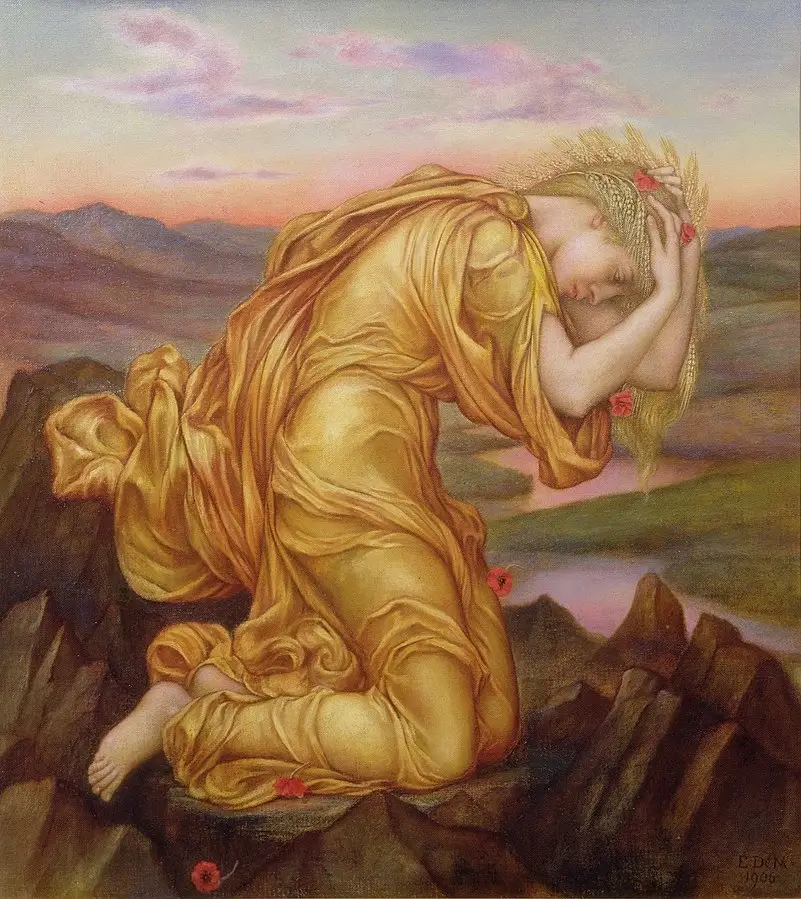
Demeter was lost for nine days, during which time she neither tasted good food nor put sweet nectar on her lips. Finally, she reached the sun and told her the whole story: Persephone was in an underground world, among the mysterious dead. Demeter’s heart was filled with great sorrow.
For more about: Ancient Greek Cults
Ancient Greek Cults: Eleusinian Mysteries and the Underworld
Disguise and Encounter in Eleusis
She left Olympus and dwelt on earth, but she was so incognito that no one recognized her, and indeed the gods are not easily recognized by mortal men. In her lonely wanderings she came to Eleusis and sat by the side of the road near a well.
I followed them, and when they crossed the threshold into the hall where the mother sat holding her little son, the doorway was filled with divine radiance and awe fell upon Metanira.
Demophon and the Gift of Immortality
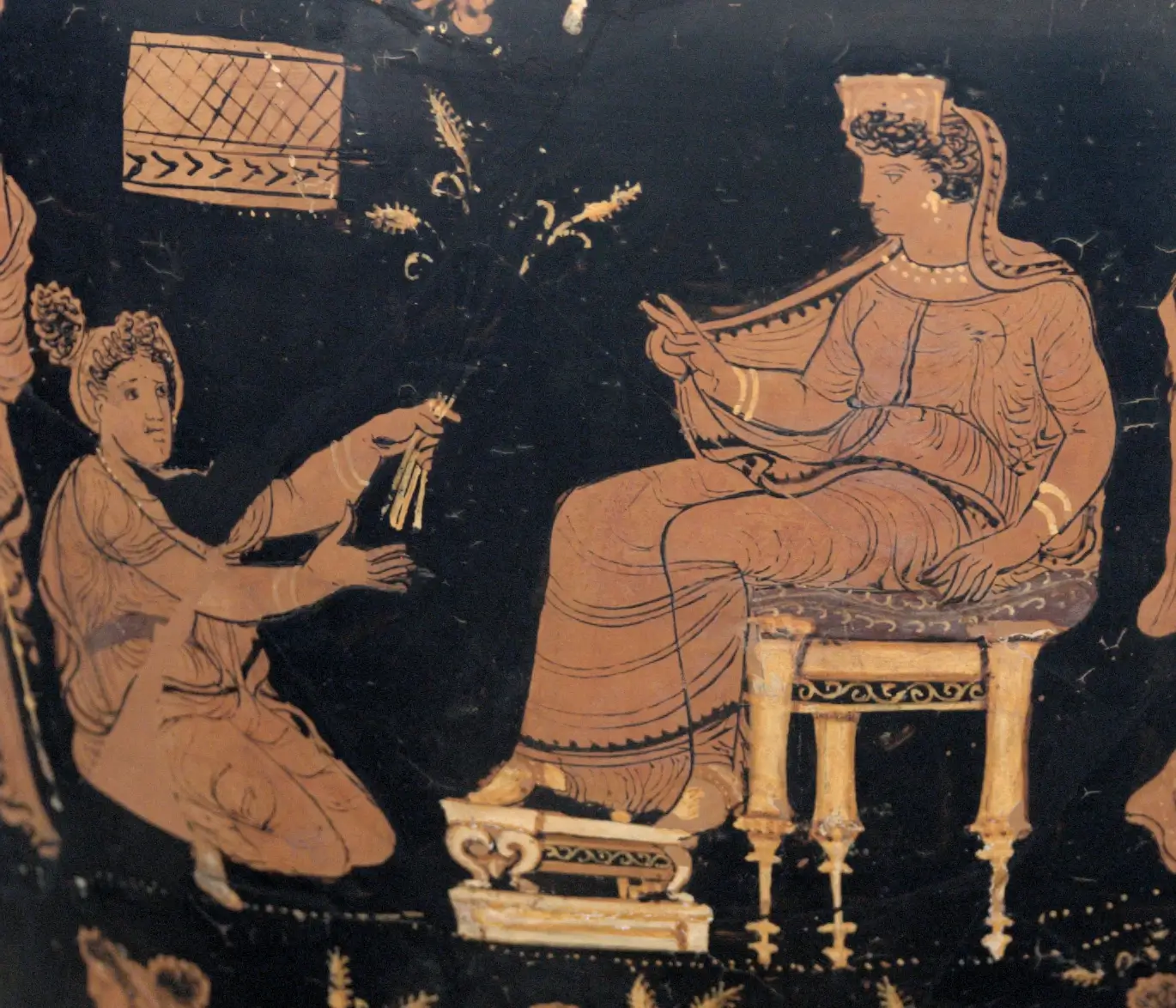
She asked Demeter to sit down and offered her honey-flavored sweet wine, but the goddess refused to taste it. Instead, she asked for mint-flavored barley water, the refreshing harvest drink at harvest time, as well as the Holy Grail offered to worshippers at Eleusis. Thus refreshed, she took the child and embraced him in her fragrant bosom, and his mother’s heart rejoiced. Thus, she nursed Demeter Demophon, the son whom Metanera had fathered with Silius the Wise. The child grew up like a little god, because Demeter anointed him daily with holy food, and at night she placed him in the heart of the red fire. Her goal was to give him immortal youth.
But something disturbed the mother, so that one night she watched and screamed in horror when she saw the child lying in the fire. The goddess became angry and grabbed the child and threw him to the ground. She intended to save him from old age and death, but that didn’t happen. However, he fell to her knees and fell asleep in her arms and thus should have been honored for the rest of his life.
Demeter Reveals Her Divine Identity
Then she showed herself as a goddess incarnate. Beauty breathed around her and gave her a beautiful fragrance, and light shone from her until the great house was filled with radiance. She told the astonished women that she was Demeter. They should build her a great temple near the city to win back the favor of her heart.
And so she left them, and Metanira fell to the ground wordlessly, and everyone there trembled with fear. In the morning, they told Silius what had happened, and he gathered the people together and revealed the goddess to them. They volunteered to build a temple for her, and when the work was finished, Demeter came to it and sat there – away from the gods on Olympus, alone and moaning with longing for her daughter.
A World in Famine and Zeus’s Concern
It was the most horrible and cruel year for humans all over the earth. Nothing grew, no seeds sprouted, and in vain did the oxen pull the plow across the fields. It looked as if the entire human race would starve to death.
| Character | Role in the Myth | Key Actions |
|---|---|---|
| Demeter | Goddess of harvest and fertility | Stops growth of crops until Persephone is returned |
| Persephone | Daughter of Demeter, abducted by Hades | Eats pomegranate seeds, binding her partly to the underworld |
| Hades | God of the underworld | Kidnaps Persephone and makes her his queen |
| Zeus | King of the gods | Sends Hermes and Rhea to negotiate Persephone’s return |
Hermes in the Underworld
Hermes found the two-sitting side by side, with Persephone shrinking and hesitating because she longed for her mother. “When Hermes heard her words, she rose with joy, eager to go. Her husband knew that he must carry out the word of Zeus and send her to earth far from him, but he prayed that she would think well of him as she left him and not grieve because she was the wife of a great immortal. He made her eat a pomegranate, knowing in his heart that if she did so, she must return to him.
Reunion of Mother and Daughter
He prepared his golden chariot, and Hermes took the reins and led the black horses straight to the temple where Demeter was. She ran to meet her daughter. Persephone jumped into her arms and hugged her tightly there. They spent the rest of the day talking about what had happened to them, and Demeter was saddened when she heard about the pomegranate, fearing that she wouldn’t be able to keep her daughter with her.
Read More
What If Persephone Had Stayed in the Underworld? Alternate Scenario
Rhea’s Message and the Sacred Compromise
Zeus then sent another messenger to her, a great figure, none other than his revered mother Rhea, the eldest of the gods. She quickly descended from the heights of Olympus to the barren, leafless land, stood at the door of the temple and spoke to Demeter
“Come, my daughter, for the far-sighted, thunderous Zeus commands you. Come again to the halls of the gods where you will be honored, where you will find your desire, my daughter, to console you in your sorrows as the year passes and the harsh winter ends. For only a third of the time, the Dark Kingdom will keep her. For the rest, she will be kept by you and the happy immortals. Peace now. Give men the life that only comes from your bounty.
Demeter’s Blessings and the Eleusinian Mysteries
Demeter did not refuse, despite the awful consolation of losing Persephone for four months every year and seeing her young beauty descend into the realm of the dead.
🌸 Symbolism at a Glance
- Demeter: The grieving mother, representing fertility and the cycles of agriculture.
- Persephone: The maiden of spring, embodying rebirth and the return of life after winter.
- Hades: Darkness and inevitability of death, yet also the keeper of balance.
- Seasonal Cycle: Persephone’s descent explains winter; her return brings spring.
- Eleusinian Mysteries: Promise of hope, renewal, and blessings in the afterlife.
The Sacred Rites and Eternal Promises
She taught him, Silius, and the others her sacred rituals, “secrets that no one may utter, for the deep awe binds the tongue. Blessed is he who has seen her, for his lot will be good in the world to come.”
O fragrant Queen of Eleusis, giver of the good gifts of the earth, grant me your grace, Demeter. You too, Persephone, most beautiful Persephone, most beautiful maiden, I offer you a song for your favor.
In the stories of both goddesses, Demeter and Persephone, the idea of grief was paramount. Demeter, the goddess of harvest wealth, was akin to the divine grieving mother who saw her daughter die every year. Persephone was the radiant maiden of spring and summer, and her light footsteps on the dry brown hill were enough to make it fresh and blooming.
🔑 Key Takeaways
- The abduction of Persephone explains the seasonal cycle of death and rebirth in nature.
- Demeter’s grief caused famine, highlighting the goddess’s power over human survival.
- The compromise—Persephone divided between worlds—symbolizes balance between life and death.
- Rituals at Eleusis celebrated Demeter’s mysteries, promising hope for the afterlife.
- The myth embodies universal themes of love, loss, and renewal.
❓ Frequently Asked Questions
Why did Hades kidnap Persephone?
He desired her as his queen, taking her into the underworld without Demeter’s consent.
Why did Demeter cause a famine?
In grief, she withheld fertility from the earth until her daughter was returned.
What does the pomegranate symbolize?
Eating its seeds bound Persephone to return to Hades for part of each year.
Why are Demeter and Persephone central to agriculture?
Their myth explains the seasonal cycle: barren winters and fertile springs.
What are the Eleusinian Mysteries?
Sacred rites in Eleusis honoring Demeter and Persephone, promising hope of renewal.
What role did Rhea play in the myth?
She mediated the divine compromise, ensuring Persephone split her time between worlds.
Sources & Further Reading
This article draws on ancient Greek and Roman literary sources, archaeological evidence, museum collections, and modern classical scholarship on Demeter, Persephone, agricultural fertility, Eleusis, and the Eleusinian Mysteries.
PRIMARY GREEK SOURCE
Homeric Hymn to Demeter:
Hymn 2 to Demeter, Perseus Digital Library
The principal surviving ancient source for Persephone’s abduction, Demeter’s search, her stay at Eleusis, the attempted immortalization of Demophon, the famine, Hermes’s journey to Hades, Persephone’s return, and the restoration of fertility.
Thomas W. Allen and E. E. Sikes:
Commentary on the Homeric Hymn to Demeter
Classical commentary on the poem, its narrative structure, the Demeter-Persephone myth, and its close relationship with the Eleusinian Mysteries.
OTHER ANCIENT ACCOUNTS
Apollodorus, Library 1.5:
Demeter and Persephone
A later Greek account preserving the abduction, Demeter’s search, her arrival at Eleusis, and the agreement governing Persephone’s return from the Underworld.
Ovid, Metamorphoses, Book 5:
Ceres and Proserpina
A major Roman retelling of the myth, including Pluto’s abduction of Proserpina, Ceres’s grief, the pomegranate, and the later tradition dividing Persephone’s year between the two realms.
Ovid, Metamorphoses, Book 5:
Proserpina as Queen of the Underworld
Continues the Roman version of the story and presents Proserpina as queen beside Pluto before Jupiter mediates between the competing claims of the two worlds.
DEMETER, PERSEPHONE & THE SEASONS
The Metropolitan Museum of Art:
Persephone Returning from the Underworld
A fifth-century BCE Attic vase showing Persephone rising from the earth with Hermes and Hekate while Demeter waits to receive her, providing ancient visual evidence for the myth of return and agricultural renewal.
The Metropolitan Museum of Art:
The Great Eleusinian Relief
Depicts Demeter and Persephone with Triptolemos and reflects their close association with grain cultivation, Eleusis, and the transmission of agriculture to humanity.
ELEUSIS & THE ELEUSINIAN MYSTERIES
The Metropolitan Museum of Art:
Mystery Cults in the Greek and Roman World
Discusses the Eleusinian Mysteries as the most celebrated ancient mystery cult, centered on Demeter and Persephone, agricultural cycles, initiation, and hopes concerning death and the afterlife.
Michael B. Cosmopoulos, Cambridge University Press:
Bronze Age Eleusis and the Origins of the Eleusinian Mysteries
Major archaeological study of Eleusis, the sanctuary of Demeter and Kore, and the origins and development of the Eleusinian Mysteries.
Kevin Clinton:
Myth and Cult: The Iconography of the Eleusinian Mysteries.
A specialist study of Eleusinian religious imagery, Demeter, Kore, Triptolemos, sacred space, and the relationship between myth and cult.
Karl Kerényi:
Eleusis: Archetypal Image of Mother and Daughter. Princeton University Press.
A classic interpretive study of Demeter, Persephone, the mother-daughter relationship, and the religious symbolism surrounding Eleusis.
MODERN CLASSICAL SCHOLARSHIP
Helene P. Foley, ed. The Homeric Hymn to Demeter: Translation, Commentary, and Interpretive Essays. Princeton University Press.
Nicholas Richardson. The Homeric Hymn to Demeter. Oxford University Press.
Nicholas Richardson.
The Homeric Hymn to Demeter: Some Central Questions Revisited
Reassesses the hymn’s narrative, language, gender conflict, and relationship with the cult of Demeter and Persephone at Eleusis.
Walter Burkert. Greek Religion. Harvard University Press.
Walter Burkert. Ancient Mystery Cults. Harvard University Press.
Research note: The myth of Demeter and Persephone survives in several ancient versions that do not agree on every detail. The Homeric Hymn to Demeter describes Demeter stopping the growth of crops and threatening humanity with famine rather than literally covering the world in ice. It also assigns Persephone one third of the year in the Underworld, while later traditions, including Ovid’s Roman retelling, use different divisions. Modern statements that the myth simply represents a fixed winter-and-spring calendar should therefore be understood as interpretations of a more complex ancient tradition.