Tartarus in Greek Mythology: The Cosmic Prison Below the Underworld
Tartarus in Greek mythology was far more than a place of punishment for the dead. Long before it became associated with condemned souls and eternal torment, Tartarus existed as one of the deepest and oldest regions of the cosmos itself — a primordial abyss beneath the world, feared even by the gods. Ancient Greek myths describe it not simply as part of the underworld, but as a cosmic prison built to contain forces too dangerous to remain within creation.
After the rise of Zeus and the Olympian order, Tartarus became the place where defeated cosmic enemies were buried and sealed away. Titans, monstrous beings, and threats to divine rule were imprisoned there beneath the foundations of the universe itself. Greek mythology therefore treated Tartarus as more than a location. It represented the boundary between ordered cosmos and destructive chaos.
Unlike Hades, which governed the realm of ordinary dead souls, Tartarus existed at a deeper level of Greek cosmology. It functioned as the lowest limit of reality, where rebellion, primordial violence, and anti-cosmic forces were confined to protect the stability of the universe above.
What Tartarus Originally Was in Greek Mythology
In the earliest layers of Greek mythology, Tartarus was not simply a prison beneath the underworld. Hesiod describes it as one of the primordial realities that existed near the beginning of creation itself, alongside Chaos, Gaia, and Eros. This made Tartarus older than the Olympian gods and older than the political order established by Zeus.
The Greeks imagined Tartarus as a vast cosmic depth located far below both the earth and Hades. Ancient sources emphasize distance and separation when describing it. In Hesiod’s Theogony, the gap between earth and Tartarus is portrayed as so immense that a falling anvil would take days to reach the bottom. The image was meant to communicate scale beyond ordinary geography. Tartarus existed at the extreme lower boundary of the cosmos.
This distinction matters because later traditions often reduced Tartarus to a version of “hell,” even though early Greek mythology treated it differently. Hades governed the dead, but Tartarus represented something deeper and more dangerous — a place connected to primordial disorder, cosmic imprisonment, and forces excluded from the normal structure of the universe.
The myths therefore portray Tartarus less as a kingdom and more as a containment zone beneath creation itself. It stood outside ordinary life, outside human society, and even outside much of divine authority, which is why the Greeks associated it with beings too destructive to remain within the ordered world above.
| Realm | Role in Greek Mythology |
|---|---|
| Olympus | Center of divine authority and Olympian rule |
| Earth (Gaia) | Realm of mortals and surface life |
| Hades | Realm of ordinary dead souls |
| Tartarus | Primordial abyss used to imprison cosmic enemies |
Tartarus as the Cosmic Abyss Beneath Creation
Greek mythology describes Tartarus as more than a dark place hidden underground. It functioned as the deepest layer of existence, positioned beneath the world of the living, beneath Hades, and even beneath many parts of the divine cosmos itself. The farther myths move away from Olympus and ordinary human life, the closer they come to Tartarus.
Unlike the structured world above, Tartarus is rarely described in precise physical detail. Ancient Greek writers focused instead on its atmosphere: darkness, distance, depth, isolation, and imprisonment. The lack of clear boundaries made it feel less like a normal location and more like a cosmic void where dangerous forces were removed from reality.
This idea explains why Tartarus became associated with beings that threatened universal order rather than ordinary human sinners alone. Titans, monstrous enemies, and primordial powers were cast there because the Olympian cosmos could not safely contain them elsewhere. Tartarus separated these forces from the organized structure created after the rise of Zeus.
The abyss also carried symbolic meaning within Greek cosmology. Olympus represented divine authority at the highest level of the universe, while Tartarus represented the opposite extreme — the lowest point where rejected powers, failed rebellions, and ancient chaos were buried beneath the foundations of creation itself.
Why the Titans Were Buried in Tartarus
After the Titanomachy, Zeus and the Olympian gods faced a problem larger than victory itself. Defeating the Titans was not enough if those ancient powers could rise again and restart the cosmic war. Greek mythology therefore presents Tartarus as a permanent solution — a place deep enough to remove dangerous forces from the structure of the universe entirely.
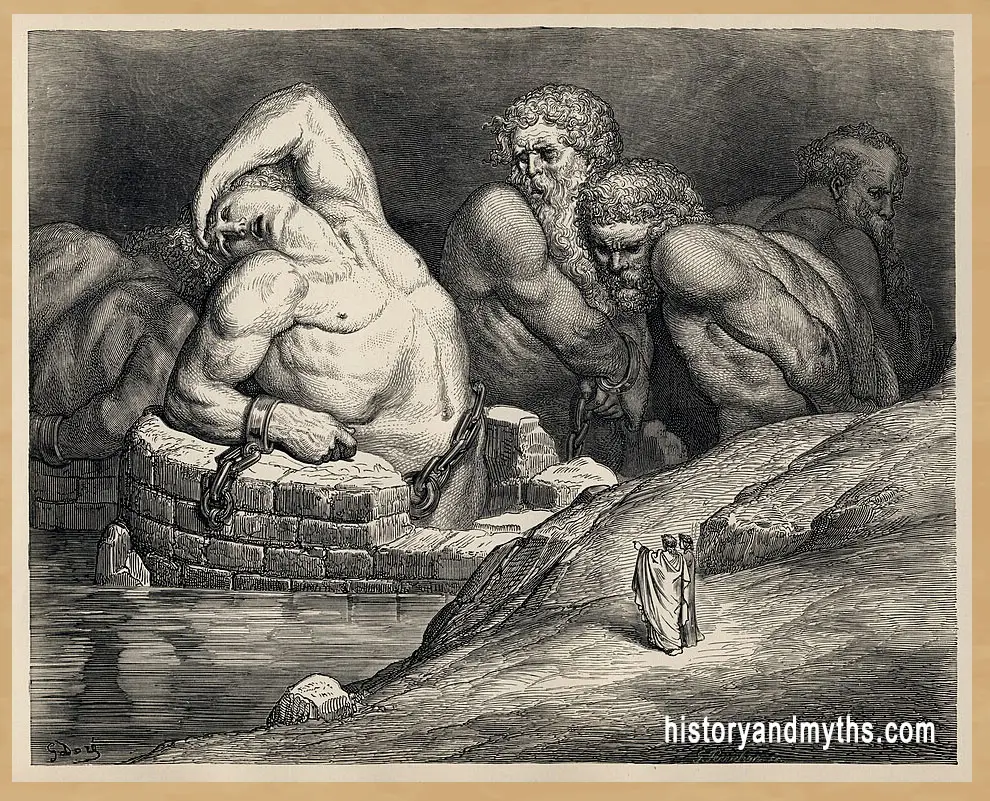
The Titans were chained beneath the earth and guarded inside Tartarus because they represented an earlier cosmic order that refused to disappear peacefully. Many of them were not evil in the modern sense. They were powerful primordial beings connected to an older age of the cosmos before Olympian rule existed. Their imprisonment symbolized the separation between the old world and the new divine order created by Zeus.
Greek myths also stress how heavily protected Tartarus was. In some traditions, the Hundred-Handers guarded the imprisoned Titans to ensure they could never escape. The message is clear: the Olympian gods viewed these enemies as an ongoing threat rather than a defeated memory.
This makes Tartarus different from an ordinary prison. Its purpose was not punishment alone, but containment. The abyss existed to keep ancient cosmic powers isolated from the world above and prevent chaos from returning to the center of creation again.
Tartarus and the Containment of Chaos
Greek mythology often treats chaos as something that can never be fully destroyed. Dangerous forces may be defeated, buried, or sealed away, but they continue to exist beneath the surface of the cosmos. Tartarus became the place where these forces were contained so the ordered world above could remain stable.
This idea appears clearly in myths connected to Typhon, one of the most destructive beings in Greek mythology. Even after Zeus defeated him, the threat did not simply vanish. Ancient traditions place Typhon beneath mountains or deep within Tartarus, showing that cosmic enemies were pushed downward and isolated rather than erased from existence completely.
The same pattern appears with the Titans. Their imprisonment represents more than the end of a war. It marks the separation between order and the primordial instability that existed before Olympian rule. Tartarus functioned as the barrier holding those older forces beneath the universe.
This helps explain why Greek mythology repeatedly describes the cosmos as balanced but never entirely safe. Monsters continue to emerge, rebellions remain possible, and ancient powers still exist below creation. Tartarus protects the universe not by eliminating chaos forever, but by keeping it confined at the furthest limits of reality.
Tartarus in Greek Cosmology
Tartarus was one of the deepest and oldest regions of the Greek cosmos. Ancient myths described it as a primordial abyss beneath the world, used to imprison Titans, monsters, and forces capable of threatening cosmic order itself.
- Tartarus existed before the Olympian gods established their rule.
- It was considered deeper and more dangerous than Hades.
- The Titans were imprisoned there after the Titanomachy.
- Typhon and other destructive beings were linked to Tartarus.
- The abyss functioned as a boundary separating order from chaos.
- Greek mythology treated Tartarus as a cosmic prison rather than a normal afterlife realm.
© historyandmyths.com
Why Zeus Needed a Cosmic Prison
The rise of Zeus did not automatically make the cosmos secure. After the Titanomachy, the Olympian gods controlled the universe, but many dangerous beings still existed beyond their authority. Greek mythology suggests that order could survive only if those threats were permanently separated from the world above.
Tartarus solved this problem. It allowed Zeus to isolate enemies too powerful to kill and too dangerous to leave free. Instead of destroying every cosmic rival completely, the Olympian system pushed them to the lowest edge of existence where they could no longer interfere with divine order.
This idea reveals something important about Greek mythology: victory alone was never considered permanent protection against chaos. The gods needed boundaries, prisons, guards, and divisions within the cosmos itself. Tartarus became part of the structure that kept the universe stable after the wars between divine generations ended.
The mythological role of Zeus therefore goes beyond defeating enemies in battle. He becomes the ruler responsible for maintaining cosmic balance. Tartarus was one of the tools that made this balance possible by keeping rebellion and primordial violence confined beneath the foundations of the world.
Tartarus vs Hades in Greek Mythology
Many modern retellings treat Tartarus and Hades as the same place, but Greek mythology usually separates them. Hades was the broader realm of the dead where ordinary souls traveled after death. Tartarus existed much deeper beneath it and served a very different purpose inside the cosmos.
The House of Hades belonged to the normal structure of the afterlife. Souls, judges, rivers, and underworld beings all formed part of that system. Tartarus, however, was associated with imprisonment, cosmic enemies, and forces removed from the world entirely. It was not designed for ordinary dead humans, but for beings considered dangerous to the balance of creation itself.
This distinction explains why ancient Greek writers described Tartarus with greater distance and fear than other parts of the underworld. Entering Hades meant crossing into the realm of death. Falling into Tartarus meant descending beyond the organized world into the deepest boundary of cosmic isolation.
Understanding this difference also changes how Greek mythology is interpreted today. Tartarus was never simply a Greek version of hell. It functioned more as a primordial abyss beneath reality — a place where the universe confined powers that threatened the survival of cosmic order itself.
Tartarus as the Lowest Boundary of the Cosmos
Greek mythology imagined the universe as a layered structure with clear boundaries separating order from danger. Olympus stood at the highest level as the center of divine authority, while Tartarus existed at the opposite extreme — the deepest point beneath creation where cosmic threats were locked away.
Ancient writers often emphasized this vertical structure to show how far Tartarus was removed from the normal world. It was not simply underground in a physical sense. It represented the final limit of the organized cosmos, a place so distant that even the gods treated it with fear and caution.
This position gave Tartarus an important symbolic role inside Greek cosmology. The farther a being was pushed toward Tartarus, the farther it moved away from order, civilization, and divine stability. Titans, Typhon, and other enemies of the Olympian system were buried there because they belonged outside the balanced structure Zeus tried to maintain.
The concept also reveals how the Greeks understood cosmic security. Order did not exist naturally or permanently. It depended on separation. Dangerous forces had to remain confined beneath the universe, while the world above continued to function under the authority of the gods. Tartarus therefore marked the edge where controlled cosmos ended and imprisoned chaos began.
Tartarus occupied a unique place in Greek mythology because it represented more than punishment or death. It was the deepest boundary of the cosmos, a primordial abyss created to isolate forces capable of threatening the structure of the universe itself. Titans, monsters, and enemies of divine order were buried there not simply to suffer, but to remain separated from the world above.
The myths surrounding Tartarus also reveal how the Greeks understood cosmic stability. Order could not survive through victory alone. Dangerous powers had to be contained, guarded, and pushed beyond the limits of normal existence. Tartarus became the space where chaos was confined so the Olympian cosmos could continue functioning.
Unlike Hades, which belonged to the ordinary cycle of death and the afterlife, Tartarus stood outside the normal human world entirely. It existed at the furthest edge of Greek cosmology, where rejected powers, failed rebellions, and primordial violence remained trapped beneath creation itself.
Key Takeaways
- Tartarus was originally a primordial abyss in early Greek cosmology.
- It existed beneath both the mortal world and the realm of Hades.
- The abyss was used to imprison Titans and cosmic enemies after divine wars.
- Greek mythology treated Tartarus as a containment zone for chaos.
- Hades governed ordinary dead souls, while Tartarus confined dangerous primordial forces.
- Zeus relied on Tartarus to maintain stability after the rise of Olympian order.
- Tartarus symbolized the lowest boundary between cosmic order and destructive chaos.
Frequently Asked Questions
What was Tartarus in Greek mythology?
Tartarus was a primordial abyss beneath the cosmos where Titans, monsters, and cosmic enemies were imprisoned after challenging divine order.
Was Tartarus the same as Hades?
No. Hades was the realm of the dead, while Tartarus existed much deeper beneath it as a prison for dangerous primordial forces.
Who was imprisoned in Tartarus?
The Titans, Typhon, and other enemies of the Olympian gods were associated with Tartarus in Greek mythology.
Did Tartarus exist before Zeus?
Yes. Early Greek myths describe Tartarus as a primordial region that existed before the Olympian order was established.
Why did Zeus use Tartarus?
Zeus used Tartarus to contain cosmic threats permanently and prevent chaos from returning to the universe after divine wars.
Was Tartarus considered hell by the Greeks?
Not exactly. Tartarus was primarily a cosmic abyss and prison rather than a general place for ordinary dead souls.
What did Tartarus symbolize in Greek cosmology?
Tartarus symbolized the deepest boundary of the cosmos where chaos and destructive forces were confined beneath divine order.
Sources & Rights
- Hesiod. Theogony. Translated by M. L. West. Oxford University Press.
- Homer. Iliad. Translated by Richmond Lattimore. University of Chicago Press.
- Apollodorus. The Library of Greek Mythology. Oxford University Press.
- Burkert, Walter. Greek Religion. Harvard University Press.
- Graf, Fritz. Greek Mythology: An Introduction. Johns Hopkins University Press.
- Hard, Robin. The Routledge Handbook of Greek Mythology. Routledge.
- West, M. L. The East Face of Helicon: West Asiatic Elements in Greek Poetry and Myth. Oxford University Press.
- Vernant, Jean-Pierre. Myth and Society in Ancient Greece. Zone Books.
- Gantz, Timothy. Early Greek Myth: A Guide to Literary and Artistic Sources. Johns Hopkins University Press.
- Rose, H. J. A Handbook of Greek Mythology. Routledge.
- Morford, Mark, and Robert Lenardon. Classical Mythology. Oxford University Press.
- Segal, Robert A. Myth: A Very Short Introduction. Oxford University Press.
- Dowden, Ken. The Uses of Greek Mythology. Routledge.
- Buxton, Richard. The Complete World of Greek Mythology. Thames & Hudson.
- Nilsson, Martin P. A History of Greek Religion. Oxford University Press.
- Detienne, Marcel. The Creation of Mythology. University of Chicago Press.
- Jaeger, Werner. The Theology of the Early Greek Philosophers. Oxford University Press.
- Dodds, E. R. The Greeks and the Irrational. University of California Press.
- Calasso, Roberto. The Marriage of Cadmus and Harmony. Vintage Books.
- Graves, Robert. The Greek Myths. Penguin Books.
- Hamilton, Edith. Mythology. Little, Brown and Company.
- Otto, Walter F. The Homeric Gods. Thames & Hudson.
- Edmonds, Radcliffe G. Greek Myth. Routledge.
- Kirk, G. S. The Nature of Greek Myths. Penguin Books.
- Hurwit, Jeffrey M. The Art and Culture of Early Greece. Cornell University Press.
- Boardman, John. Greek Art. Thames & Hudson.
- Eliade, Mircea. Myth and Reality. Harper & Row.
- Csapo, Eric. Theories of Mythology. Wiley-Blackwell.
- Lefkowitz, Mary. Greek Gods, Human Lives. Yale University Press.
- Pausanias. Description of Greece. Harvard University Press.
Written by H. Moses — All rights reserved © Mythology and History