The Lake of Fire Explained: Judgment and the Egyptian Afterlife
In ancient Egyptian belief, the Lake of Fire was not a place of endless torment. It was a controlled force within the afterlife, created to protect cosmic order. Fire here was not meant to punish through suffering, but to purify, neutralize, or eliminate what could not exist within Ma’at the principle that governed balance, truth, and continuity.
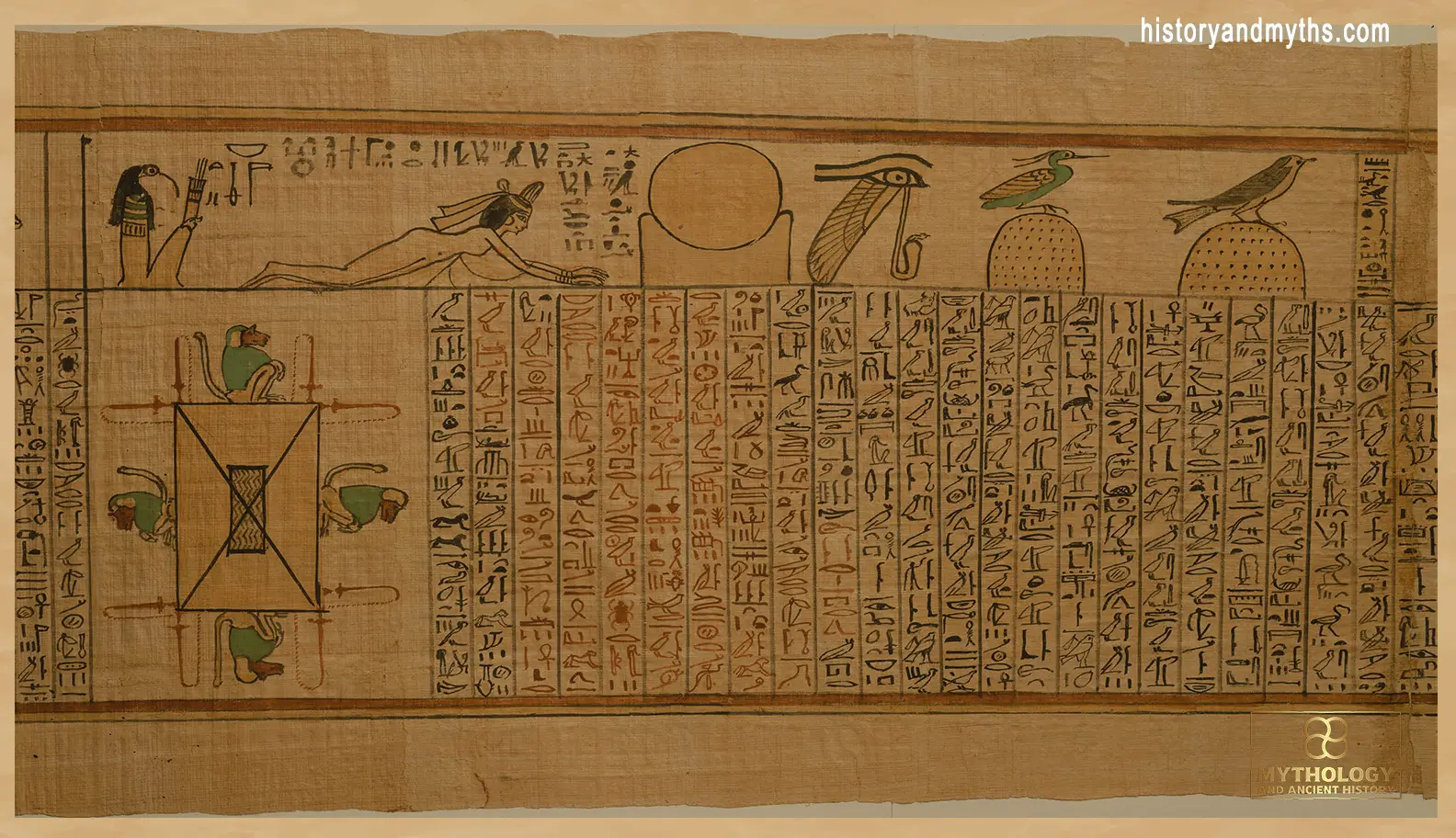
The Lake of Fire appears in funerary texts such as the Book of the Dead, most notably Spell 126, and always after judgment has already taken place. It does not decide guilt or innocence. Instead, it enforces the outcome. Souls that align with order may pass through or remain unharmed, while those that threaten balance are destroyed or rendered inactive.
This vision challenges later ideas of hell. The Egyptian Lake of Fire was not built for cruelty or fear, but for protection. It ensured that rebirth remained meaningful by preventing chaos from re-entering the cosmic cycle. Understanding this role is essential to grasp how punishment, purification, and justice functioned in the Egyptian afterlife.
What Was the Lake of Fire?
The Lake of Fire was a defined zone within the Duat, the Egyptian underworld, where fire operated as an instrument of order rather than chaos. It was not a trial, a court, or a place of moral debate. Its function was purely executive. Judgment had already occurred elsewhere. The lake existed to carry out the final consequence.
What makes this concept distinctive is its structure. The Egyptians described it as a lake, not a furnace or an abyss. A lake contains and controls what lies within it. Fire, by contrast, consumes and transforms. By combining both elements, the Lake of Fire represented a force that was powerful yet regulated. Nothing burned beyond its limits, and nothing entered without purpose.
In funerary texts, the lake appears guarded and supervised. It is never wild or uncontrolled. This reinforces its role as a cosmic mechanism rather than a place of vengeance. Fire here does not rage; it functions. Souls encounter it only when their status has already been determined.
For those aligned with Ma’at, the Lake of Fire poses no threat. Some texts suggest that the justified can pass safely or remain untouched. For others, the lake marks the end of existence. Destruction is not symbolic. It is final. The lake removes what cannot be integrated into order, ensuring that rebirth remains selective rather than automatic.
| Aspect | The Lake of Fire |
|---|---|
| Core Function | Executes judgment by purifying or eliminating beings incompatible with Ma’at. |
| Position in the Afterlife | Appears after judgment has already been decided, not as a place of trial. |
| Nature of Fire | A controlled force used for purification, protection, and final enforcement. |
| Meaning of the “Lake” | A contained zone that limits and regulates the destructive power of fire. |
| Effect on the Justified | The justified pass unharmed or remain unaffected by the fire. |
| Effect on the Condemned | The condemned are destroyed or removed from existence entirely. |
| Relation to Book of Caverns | Executes judgment, while the caverns preserve the final state of exclusion. |
| Theological Meaning | Protects cosmic order by ensuring that rebirth remains selective and meaningful. |
Why Fire Had a Sacred Role in the Afterlife
Fire held a complex and respected position in Egyptian thought. It was never treated as a purely destructive force. Fire illuminated the sun god’s path, protected sacred spaces, and repelled chaos. In temples and rituals, it purified offerings and guarded divine order. The same logic carried into the afterlife.
Within the Duat, fire became a defensive tool. Its role was not emotional or punitive, but functional. Fire identified what belonged within order and eliminated what threatened it. This explains why the Lake of Fire was closely associated with divine authority and supervision. It was not a random danger, but a controlled extension of cosmic law.
The Egyptians also understood fire as irreversible. Water could cleanse temporarily, and darkness could pass, but fire marked an endpoint. Once something was consumed by fire, it did not return in the same form. This made fire uniquely suited to enforce final outcomes after judgment.
Importantly, fire did not act independently. It served Ma’at. Its presence signaled that the system had moved beyond testing and correction. What remained was enforcement. By using fire, the afterlife ensured that renewal was protected from corruption and that rebirth was reserved only for those capable of sustaining order.
Why Could Fire Protect Order Instead of Destroying It?
To many modern readers, fire represents destruction. Egyptian religion understood it differently. Fire destroyed, but only under divine control. When governed by Ma’at, it became a force that protected existence rather than threatened it.
This reflects a broader Egyptian view of nature. No element was inherently good or evil. Water could sustain life or cause destruction through uncontrolled floods. Darkness could hide danger but also preserve the potential for creation. Fire followed the same principle. Its meaning depended on whether it served cosmic order or chaos.
The Lake of Fire therefore reveals an important feature of Egyptian theology. Creation was not protected by eliminating powerful forces, but by placing them within an ordered system. Fire remained dangerous, yet its danger became necessary because it defended the boundaries of existence itself.
Purification, Not Torture
A common mistake in modern interpretations is treating the Lake of Fire as a place of suffering. Egyptian texts do not support this view. Pain and torment are not the focus. The emphasis is on removal. Fire does not punish through agony; it purifies or eliminates.
In this framework, purification means restoring balance by stripping away what is incompatible with Ma’at. Some beings pass through the fire without harm, proving their alignment with order. Others are consumed, not as an act of cruelty, but because they cannot exist within the cosmic system. The fire reveals this difference rather than judging it.
This distinction is crucial. Torture implies duration and spectacle. The Lake of Fire offers neither. Its action is decisive and final. Once fire has acted, the process ends. There is no ongoing suffering, no repeated sentence. Existence itself is withdrawn.
For the Egyptians, this outcome was more severe than pain. To suffer was still to exist. To be destroyed by fire was to be removed from light, time, and memory. The Lake of Fire therefore represents the most absolute form of consequence in the afterlife not because it hurts, but because it ends.
The Lake of Fire After Judgment
The Lake of Fire is never the place where judgment occurs. Egyptian texts are consistent on this point. Judgment is decided elsewhere most famously in the Weighing of the Heart. Only after a soul’s status has been determined does the Lake of Fire appear.
This order matters. It shows that the lake is not a court, not a test, and not an opportunity for redemption. It is an instrument of enforcement. Once judgment is complete, the system moves from evaluation to execution. The Lake of Fire exists at that final stage.
Because it comes after judgment, the lake does not debate morality. It responds to outcome. Souls aligned with Ma’at are unaffected or protected. Souls found incompatible with order are neutralized. There is no appeal and no delay. The process is immediate.
This also explains why the lake is often shown guarded. Divine beings oversee it to ensure that its power is applied correctly. Fire does not act blindly. It acts under authority. The lake protects the afterlife from instability by preventing condemned beings from continuing into rebirth.
By placing the Lake of Fire after judgment, Egyptian theology made a clear statement: justice was not endless deliberation. At some point, balance required closure. The lake provided that closure by ensuring that judgment had real and irreversible consequences.
Who Passed and Who Was Destroyed
The Lake of Fire did not treat all beings equally. Egyptian texts make a clear distinction between those who could endure its presence and those who could not. Passage or destruction depended on compatibility with Ma’at, not on emotion, mercy, or divine favoritism.
Those who passed were already justified. Their hearts were balanced, their identities intact, and their place within order secure. For them, the fire posed no danger. It functioned as confirmation rather than threat. Some texts imply protection, while others suggest that the justified were simply unaffected. Fire revealed their fitness by failing to harm them.
Those who were destroyed had already failed judgment. They were not burned because they were evil in a moral sense, but because they were incompatible with cosmic order. Their continued existence posed a risk. The fire eliminated that risk by ending their participation in the cycle of life and rebirth.
This distinction reinforces the lake’s role as a filter rather than a punishment chamber. It did not test everyone equally. It acted selectively. The outcome was not pain versus relief, but continuation versus cessation. To pass meant to remain within the ordered universe. To be destroyed meant removal from it entirely.
For the ancient Egyptians, this separation carried a powerful lesson. Survival in the afterlife was not guaranteed by belief alone. It depended on one’s ability to remain aligned with balance, truth, and order. The Lake of Fire existed to enforce that boundary without hesitation.
The Lake of Fire — Core Insights
- The Lake of Fire is an executive mechanism that enforces judgment after it has been decided.
- Fire functions as a controlled force of purification and elimination, not as a tool of torture.
- The “lake” symbolizes containment, ensuring that destructive power remains regulated.
- The justified are unaffected by the fire, while incompatible beings are removed from existence.
- The lake operates after the Weighing of the Heart, not as a court or test.
- Its role is to protect Ma’at by preventing chaos from re-entering the cycle of rebirth.
- It precedes the final stillness described in the Book of Caverns.
Lake of Fire vs Book of Caverns
Although both the Lake of Fire and the Book of Caverns deal with punishment in the Egyptian afterlife, they serve different purposes within the system. Confusing them leads to misunderstanding how judgment was completed and enforced.
The Lake of Fire functions as an active instrument. It operates immediately after judgment and carries out its result. Fire purifies, confirms, or destroys based on compatibility with Ma’at. Movement is still possible at this stage. Some beings pass unharmed, while others are eliminated. The lake is dynamic and selective.
The Book of Caverns, by contrast, describes a state of final exclusion. Once beings are placed within the caverns, movement stops entirely. There is no further action, purification, or testing. The caverns are not tools of execution; they are endpoints. Existence is suspended or erased permanently.
Another key difference lies in symbolism. Fire represents action, energy, and enforcement. Caverns represent stillness, confinement, and absence. The Lake of Fire acts upon the condemned. The caverns contain what remains after action has been completed.
Together, they form consecutive stages. The Lake of Fire executes judgment. The Book of Caverns preserves the outcome. One is a process; the other is a condition. Understanding this distinction clarifies that Egyptian punishment was not repetitive or theatrical. It was efficient, final, and ordered.
What the Lake of Fire Meant for the Dead
For the ancient Egyptian, the Lake of Fire represented the moment when fate became irreversible. It marked the boundary between continuation and removal. Unlike earlier stages of the afterlife, where transformation or permission was still possible, the lake signaled that judgment now carried real consequences.
The presence of the Lake of Fire reshaped how the dead understood survival. Moral intention alone was not enough. One had to remain compatible with Ma’at in substance, not just in claim. The lake enforced that standard without negotiation. It ensured that rebirth was reserved only for those capable of sustaining order.
This belief also reinforced responsibility during life. Preparation for the afterlife was practical, not symbolic. Ritual knowledge, ethical conduct, and alignment with balance mattered because failure could not always be corrected. The Lake of Fire existed to prevent endless cycles of disorder.
For the Egyptians, this was not a vision of cruelty, but of protection. Cosmic order required limits. The lake protected renewal by denying it to what threatened stability. In doing so, it completed the system of judgment, purification, and exclusion that defined the Egyptian afterlife.
The Lake of Fire was therefore not a place to fear blindly. It was a final safeguard one that ensured the continuation of life, light, and balance by decisively ending what could not belong.
What Does the Lake of Fire Reveal About Egyptian Justice?
The Lake of Fire shows that Egyptian justice was never based on revenge. Once judgment had been completed, there was no purpose in prolonging punishment. The goal was to restore balance by preventing disorder from returning to the cosmos.
This idea distinguishes Egyptian religion from later traditions that emphasize endless torment. In Egyptian belief, justice reached a clear conclusion. Those who remained compatible with Ma’at continued into renewed existence, while those who threatened cosmic order simply ceased to participate in it.
The Lake of Fire therefore represents more than a place within the afterlife. It reveals an entire philosophy of justice in which order, permanence, and renewal mattered more than suffering. Punishment existed only because the continuation of creation required limits that could not be crossed.
Key Takeaways
- The Lake of Fire was not an Egyptian hell, but a controlled force within the afterlife.
- It appears only after judgment has been completed, acting as an instrument of enforcement.
- Fire served purification and cosmic protection, not prolonged suffering.
- The justified passed unharmed, while incompatible beings were destroyed or removed.
- The “lake” symbolized containment, ensuring fire remained regulated and purposeful.
- The Lake of Fire protected Ma’at by keeping chaos out of the cycle of rebirth.
Frequently Asked Questions
What was the Lake of Fire in ancient Egyptian belief?
The Lake of Fire was a controlled zone in the Egyptian afterlife where judgment was enforced through purification or destruction, not a place of eternal torment.
Was the Lake of Fire an Egyptian version of hell?
No. It was not designed for endless punishment but functioned as a tool to protect cosmic order by removing what could not exist within Ma’at.
When did souls encounter the Lake of Fire?
Souls encountered the Lake of Fire only after judgment had already been completed, most notably after the Weighing of the Heart.
Did everyone suffer in the Lake of Fire?
No. The justified passed unharmed, while only those incompatible with cosmic order were destroyed or neutralized.
Why was fire used in the Egyptian afterlife?
Fire was seen as a powerful but controlled force capable of purification, protection, and final enforcement of order.
What does the word “lake” symbolize in this context?
The lake represents containment and regulation, ensuring that fire remained controlled rather than chaotic.
How is the Lake of Fire different from the Book of Caverns?
The Lake of Fire executes judgment, while the Book of Caverns preserves the final state of exclusion after judgment is enforced.
Why was the Lake of Fire important to the ancient Egyptians?
It reinforced the idea that rebirth was selective and that cosmic order required limits and final consequences.
Sources & Rights
- Allen, James P. The Ancient Egyptian Book of the Dead. University of Chicago Press, 2015.
- Allen, James P. Middle Egyptian: An Introduction to the Language and Culture of Hieroglyphs. 3rd ed. Cambridge University Press, 2014.
- Assmann, Jan. Death and Salvation in Ancient Egypt. Cornell University Press, 2005.
- Faulkner, Raymond O. The Ancient Egyptian Book of the Dead. Revised ed. University of Texas Press, 2010.
- Hornung, Erik. The Ancient Egyptian Books of the Afterlife. Cornell University Press, 1999.
- Hornung, Erik. Conceptions of God in Ancient Egypt: The One and the Many. Cornell University Press, 1996.
- Pinch, Geraldine. Handbook of Egyptian Mythology. ABC-CLIO, 2002.
- Quirke, Stephen. Exploring Religion in Ancient Egypt. Wiley-Blackwell, 2015.
- Shafer, Byron E., ed. Religion in Ancient Egypt: Gods, Myths, and Personal Practice. Cornell University Press, 1991.
- Taylor, John H. Journey through the Afterlife: Ancient Egyptian Book of the Dead. British Museum Press, 2010.
- British Museum. Collection Online: Book of the Dead and Ancient Egyptian Afterlife.
- The Metropolitan Museum of Art. The Book of the Dead of the Priestess Nefer-ir-nebu and Egyptian Funerary Beliefs.
- UCLA Encyclopedia of Egyptology. Afterlife, Judgment, and Funerary Beliefs in Ancient Egypt.
- Digital Egypt for Universities (University College London). Death, Burial, and the Egyptian Afterlife.
- World History Encyclopedia. Egyptian Afterlife.
Written by H. Moses — All rights reserved © Mythology and History