Crowns of the Gods — Divine Symbols of Power in Ancient Egypt
In ancient Egyptian religion, a crown was never a decorative accessory. It was a statement of identity, authority, and function. When a god appeared wearing a specific crown, the image communicated precise information about that deity’s role within the cosmic order. To the Egyptian mind, power had to be visible, and crowns were one of the clearest ways to make divine authority instantly recognizable.
Unlike human rulers, gods were not limited to a single crown. Many deities appear wearing different crowns depending on context, ritual, or location. This was not inconsistency, but intention. Each crown expressed a different aspect of power—rule over land, control of cosmic forces, protection, renewal, or sovereignty beyond death. The crown told the viewer how a god ruled, not just that the god ruled.
Crowns also served as a visual bridge between kingship and divinity. Pharaohs wore crowns because they ruled on behalf of the gods; gods wore crowns because they embodied the ultimate source of authority. In temple reliefs and ritual scenes, this shared language of crowns reinforced a central belief: order survives only when power is clearly defined and correctly displayed.
To understand the crowns of the Egyptian gods is to understand how authority was imagined, structured, and maintained. Each crown was a symbol of jurisdiction, a marker of responsibility, and a reminder that divine power, like cosmic order itself, was never abstract—it was always seen, worn, and recognized.
What Did a Crown Represent in Ancient Egyptian Religion?
In ancient Egyptian religion, a crown functioned as a symbol of jurisdiction rather than ornament. It defined where authority applied, how it was exercised, and what kind of power was being expressed. To wear a crown was to make a claim—not of personal status, but of legitimate control within the cosmic order.
Each crown carried a specific meaning that went beyond rulership. Some crowns emphasized sovereignty over land, others protection, renewal, or dominion over the unseen world. When a god appeared crowned, the image told the viewer which aspect of divine power was active at that moment. The crown acted as a visual language, instantly communicating authority without the need for text.
Crowns also established boundaries. They marked who had the right to command and who did not. In a religious system where chaos was always a threat, clearly defined authority was essential. The crown signaled that order was present and recognized. It was a guarantee that power was being exercised within accepted limits, not arbitrarily.
Unlike weapons or gestures, crowns did not suggest force. They suggested recognized rule. Authority in Egyptian thought was effective only when it was acknowledged by gods, humans, and the cosmic system itself. The crown made that acknowledgment visible.
This is why crowns appear consistently in divine imagery. They were not interchangeable or decorative. Each crown expressed a specific role within the universe, allowing viewers to understand not just who a god was, but what that god was responsible for maintaining.
| Crown | Symbolic Meaning | Associated Ideas |
|---|---|---|
| White Crown (Hedjet) | Legitimate and orderly authority | Purity, rightful rule, balance |
| Red Crown (Deshret) | Protective and defensive power | Boundary control, restraint of chaos |
| Double Crown (Pschent) | Unified authority | Cosmic completeness, harmony |
| Atef Crown | Authority beyond death | Osiris, renewal, endurance |
| Feathered Crowns | Expanded cosmic power | Creation, elevation, universal reach |
| Solar Crowns and Discs | Radiant divine authority | Light, creation, eternal rule |
Major Divine Crowns and Their Meanings
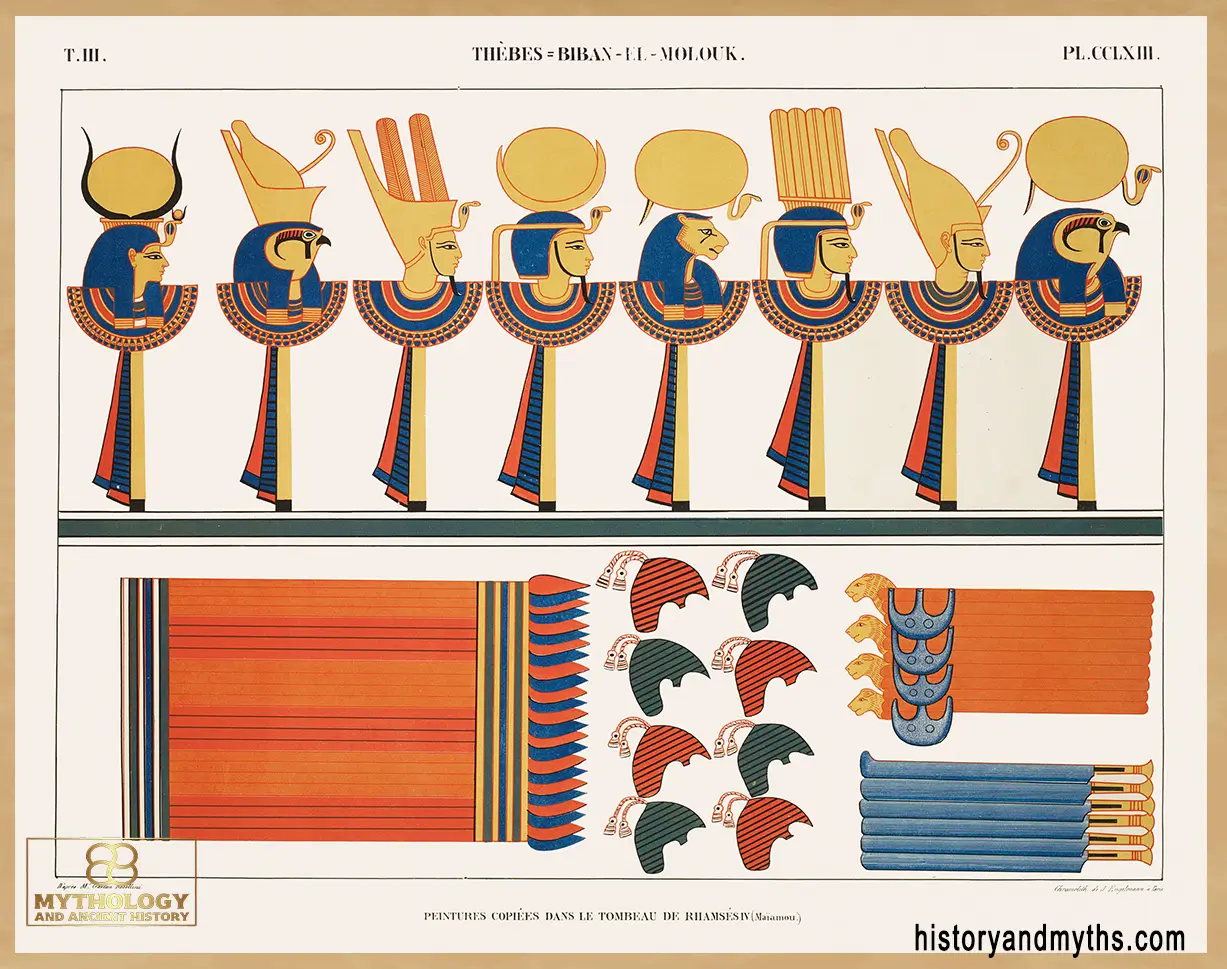
Egyptian gods were distinguished not only by their forms, but by the crowns they wore. Each crown conveyed a precise type of authority and a defined sphere of influence. These were not artistic variations; they were deliberate symbols that told the viewer how divine power operated.
The White Crown (Hedjet) symbolized sovereignty, purity, and rightful rule. When worn by a god, it expressed authority that was orderly and legitimate rather than aggressive. It often appears in contexts emphasizing control, balance, and continuity.
The Red Crown (Deshret) carried a more assertive meaning. It represented power that protected boundaries and restrained threats. Gods shown wearing the Red Crown were often linked to defense, guardianship, and the containment of chaos.
When combined, these crowns formed the Double Crown (Pschent). This crown symbolized unified authority—the power to rule without division. In divine imagery, it expressed cosmic completeness, signaling that order extended across all realms without fragmentation.
The Atef Crown, most closely associated with Osiris, carried a different message. It did not emphasize control over land, but authority beyond death. Its form communicated endurance, renewal, and rulership that continued after physical collapse.
Crowns with feathers or tall plumes extended these meanings further. They suggested expansion, elevation, and cosmic reach. Gods wearing such crowns were often connected to creation, air, or universal power rather than territorial rule.
Together, these crowns formed a visual system. By reading the crown, an ancient viewer could immediately understand the nature of a god’s authority—whether it was stabilizing, protective, unifying, or eternal.
Why Gods Wear Different Crowns
The fact that Egyptian gods appear wearing different crowns is not a contradiction. It reflects a core principle of Egyptian theology: divine power is contextual. A god did not express all forms of authority at once. Instead, power shifted according to place, ritual purpose, and cosmic moment.
When a god appears wearing one crown rather than another, the image signals which role is active. A crown associated with protection might appear in a context of defense or boundary control. A crown linked to renewal or unity would appear in scenes concerned with restoration or cosmic balance. The crown told the viewer what kind of authority was being exercised right now.
This flexibility also allowed gods to operate across different domains. A deity could rule the heavens, protect kingship, and oversee the afterlife—but not simultaneously in visual terms. Changing crowns allowed artists and priests to isolate and emphasize a single function without confusion.
Crowns also connected gods to specific cult centers. The same god might wear different crowns in different temples, reflecting local theology and ritual focus. This was not inconsistency, but adaptation. The crown acted as a visual bridge between universal divine power and local religious identity.
Ultimately, crowns allowed Egyptian art to communicate complexity with clarity. Rather than explaining divine roles through text, the image itself carried the message. By changing the crown, the god’s authority was redefined instantly—showing that power, in Egyptian belief, was not fixed, but precisely expressed through form.
Crowns of the Gods — At a Glance
- Symbols of jurisdiction: Crowns define the scope and nature of divine authority.
- Not decorative: Each crown communicates a specific role, not status alone.
- Contextual power: Gods wear different crowns to activate different functions.
- Link to kingship: Divine crowns set the model for royal authority on earth.
- Cosmic order: Crowns make Ma’at visible through clear, recognizable forms.
- Enduring language: Crown symbolism remained stable across centuries.
Crowns, Kingship, and the Visual Language of Power
In ancient Egypt, the crowns of the gods and the crowns of kings were part of the same visual system. This was not coincidence. Kings ruled because divine authority flowed through them, and crowns made that relationship visible. When a pharaoh wore a crown already associated with a god, the image declared continuity between human rule and cosmic order.
Crowns allowed authority to be recognized instantly. A viewer did not need inscriptions to understand who held power or why. The form of the crown communicated jurisdiction, responsibility, and legitimacy at a glance. This clarity was essential in a worldview where order depended on clear boundaries and recognized roles.
Divine crowns also set the standard for kingship. Gods embodied perfect authority; kings imitated it. By adopting the same crowns, rulers presented themselves as maintainers of Ma’at, not independent powers. The crown reminded both ruler and subject that authority was conditional—granted, defined, and supervised by the divine realm.
This shared language explains why crowns remained consistent across centuries. While artistic styles changed, crown symbolism endured. Stability in imagery reinforced stability in belief. As long as the crown was recognized, authority remained intelligible and trusted.
Through crowns, Egyptian art transformed abstract ideas into visible truth. Power was not hidden, debated, or implied. It was worn. The crown stood as a constant reminder that rule, whether divine or royal, existed to preserve order—and that order survived only when authority was clearly seen and correctly exercised.
Key Takeaways
- In ancient Egypt, crowns symbolized authority, jurisdiction, and divine function.
- Gods wore different crowns to express different aspects of power and responsibility.
- Each crown communicated meaning instantly through visual language.
- Divine crowns established the model for royal crowns and kingship.
- Crowns made cosmic order and legitimacy visible and recognizable.
- The symbolism of crowns remained stable across centuries of Egyptian belief.
Frequently Asked Questions About the Crowns of the Gods
What did crowns symbolize in ancient Egyptian religion?
Crowns symbolized authority, jurisdiction, and the specific role a god or king played within the cosmic order.
Why did Egyptian gods wear different crowns?
Gods wore different crowns to express different aspects of power depending on context, ritual purpose, or location.
Were divine crowns purely decorative?
No. Crowns were functional symbols that communicated authority, responsibility, and legitimacy.
What is the meaning of the Double Crown?
The Double Crown symbolized unified authority and complete control without division.
Which crown is most associated with Osiris?
The Atef Crown is most closely associated with Osiris and represents authority beyond death and renewal.
How are divine crowns connected to kingship?
Divine crowns established the visual model for royal authority, linking pharaohs to the gods.
Why were crowns important in Egyptian art?
Crowns allowed authority to be recognized instantly, making cosmic order visible through form.
Sources & Rights
- Wilkinson, Richard H. The Complete Gods and Goddesses of Ancient Egypt. Thames & Hudson, 2003.
- Pinch, Geraldine. Egyptian Mythology: A Guide to the Gods, Goddesses, and Traditions of Ancient Egypt. Oxford University Press, 2004.
- Assmann, Jan. The Mind of Egypt: History and Meaning in the Time of the Pharaohs. Harvard University Press, 2002.
- Hornung, Erik. Conceptions of God in Ancient Egypt: The One and the Many. Cornell University Press, 1982.
Written by H. Moses — All rights reserved © Mythology and History