Menhit, the Lion Goddess of Protection in Ancient Egypt
Menhit is one of those Egyptian goddesses whose presence is small in the written record but powerful in meaning. She does not appear in long myths, nor does she dominate temple walls the way Hathor or Sekhmet do. Yet her name survives as a reminder of the fierce protective force the Egyptians associated with the lioness a symbol of sharp vision, sudden strength, and unwavering guardianship.
Her identity seems to emerge from Egypt’s southern regions, where the desert meets the Nile and the kingdom’s borders needed both vigilance and divine protection. In these frontier zones, the lioness was not just an artistic motif; she was a living metaphor for defense. Menhit embodies this idea: a goddess whose presence signified readiness, clarity, and the instinct to shield what matters.
Although only a few inscriptions and statues mention her, each one points to the same core idea Menhit was the sharp edge of protection, a guardian spirit whose strength complemented the more famous warrior goddesses of Egypt. Her story isn’t preserved through narratives; it is preserved through purpose.
Origins and Meaning of Menhit’s Name
Menhit’s identity begins with her name, which is often translated as “She Who Slaughters,” “She Who Conquers,” or more broadly “The Powerful One.” These interpretations immediately place her within the world of protection and warfare. In ancient Egypt, names carried weight they were not labels, but reflections of function. Menhit’s name signals a goddess who stands at the threshold between threat and safety.
Her origins appear to be rooted in the southern regions of Egypt and Nubia, where borderlands required strong deities who could watch over the kingdom’s edges. This environment shaped her character: a guardian presence, alert and decisive, not a goddess of mythological drama but of practical, lived protection.
Menhit likely belonged to a constellation of lioness goddesses figures like Sekhmet, Pakhet, and Tefnut each embodying different shades of divine power. What distinguishes Menhit is the simplicity of her role. She is not tied to lengthy festivals or rich theological narratives; instead, she represents the pure, concentrated idea of protective force, the instinct to guard and to strike when danger nears.
Even in limited inscriptions, her name carries a clarity that makes her recognizable. Egyptians did not need elaborate stories to understand her her purpose was written directly into her identity.
| Aspect | Details |
|---|---|
| Name | Menhit (Menhet / Menhyt) |
| Primary Role | Lioness goddess of protection and frontier vigilance |
| Symbol | Lioness head; protective imagery |
| Domains | Warfare, defense, alertness, boundary protection |
| Cult Regions | Upper Egypt and Nubian border zones |
| Depictions | Lioness-headed woman, poised rather than aggressive |
| Associations | Linked with other protective lioness deities like Sekhmet and Pakhet |
| Legacy | A quiet guardian figure symbolizing readiness and protective clarity |
Menhit Among the Lioness Goddesses of Egypt
Lioness deities occupied a special place in Egyptian thought. They embodied precision, alertness, and the kind of defensive strength that appears only when needed. Menhit fits naturally within this tradition. While goddesses like Sekhmet represented overwhelming destructive force and Tefnut symbolized elemental balance, Menhit expressed a more direct and focused idea: the readiness to protect.
Her association with the lioness was not decorative. In the ancient world, lions were seen primarily in Upper Egypt and Nubia regions where the desert pressed closely against the Nile. It makes sense that Menhit’s character formed here, in a landscape where the boundary between safety and danger could shift suddenly.
What distinguishes Menhit is the grounded simplicity of her presence. She is not a cosmic force or a goddess with elaborate cult centers; she is the lioness at the frontier, a divine embodiment of alertness. Even when inscriptions mention her briefly, they place her in contexts tied to guarding, guiding, or standing beside other protective gods.
Within the broader pantheon, Menhit served as a reminder that protection was not only a royal ideal but a daily necessity. Her image carried reassurance: the kingdom’s edges were watched, and danger was never able to approach unnoticed.
Why Did Egypt Have So Many Lioness Goddesses?
The large number of lioness goddesses in Egyptian religion was not the result of repetition but specialization. Egyptian theology often expressed different aspects of the same divine force through separate deities, each emphasizing a particular role within the cosmic order.
Sekhmet embodied destructive power under divine control, Pakhet became associated with hunting and remote landscapes, while Menhit represented vigilance and the protection of vulnerable frontiers. Although they shared the same animal symbolism, each fulfilled a distinct religious purpose.
This approach reflects a broader Egyptian tendency to understand divine power through complementary functions rather than exclusive identities. The lioness became a shared symbol, while each goddess expressed a different way that protective force operated within the world.
A Protector of Frontiers and Warfare
Menhit’s strongest associations come from her connection to military imagery and the defense of Egypt’s southern borders. Unlike deities whose roles expanded into mythic storytelling, her presence remained practical and direct. She symbolized the sharp vigilance required in regions where threats could emerge from shifting tribes, desert routes, or political tensions along the Nile.
Texts that mention her often place her beside warriors or protective gods, suggesting that she embodied the spiritual force behind the act of guarding. She was not a goddess invoked for conquest, but for clarity in danger, the ability to see an approaching threat before it reached the heart of the kingdom.
Her role aligns with a larger Egyptian belief: protection was layered. Kings, soldiers, lioness goddesses, and boundary deities all formed part of a network that kept order intact. Menhit represented one of these layers a precise, focused aspect of divine defense, especially relevant in the landscapes of Upper Egypt and Nubia.
Even without grand temples or extensive inscriptions, her presence had meaning. In a civilization that valued stability above all else, a goddess who personified border vigilance held a quiet but essential place in the spiritual structure of daily life.
Menhit — The Lioness Guardian of Egypt’s Southern Frontier
Menhit is a lioness goddess whose presence reflects Egypt’s need for vigilance along its southern borders.
Though not widely represented in major temples or myths, she embodied sharp awareness, protective strength,
and the calm readiness associated with lioness deities. Her role was practical rather than ceremonial — a guardian
spirit watching the frontier where danger could appear without warning.
- Goddess of protection, warfare, and defensive clarity.
- Often depicted as a lioness-headed woman.
- Associated with Upper Egypt and Nubian border regions.
- Linked to other protective lioness deities like Sekhmet.
- Symbolizes focused vigilance rather than destructive force.
© historyandmyths.com — Educational use
What Does Menhit Reveal About Egyptian Ideas of Protection?
Menhit reveals that protection in ancient Egypt meant far more than military defense. Egyptians believed that every border, whether physical, political, or sacred, required constant vigilance to preserve Ma’at. A guardian’s role was not simply to defeat enemies but to prevent disorder from entering the ordered world.
This helps explain why lioness deities occupied such an important place in Egyptian religion. Their strength represented controlled power rather than uncontrolled violence. Menhit embodies this principle particularly well. Her association with frontier regions reflects the belief that civilization survived only when its boundaries were carefully maintained.
Rather than celebrating war itself, Menhit illustrates an Egyptian ideal in which strength existed to preserve stability. Her significance therefore lies not only in protecting Egypt’s borders but also in expressing a civilization that viewed vigilance as one of the foundations of order.
Iconography and the Few Traces Menhit Left Behind
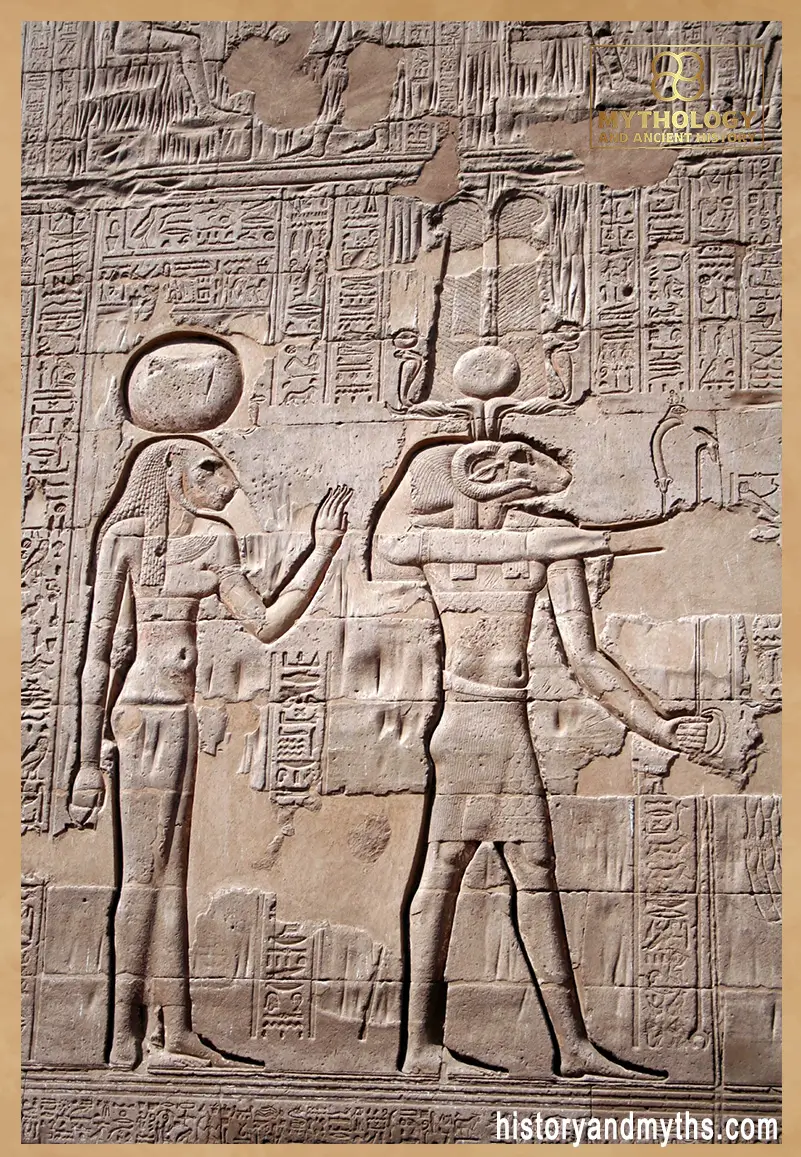
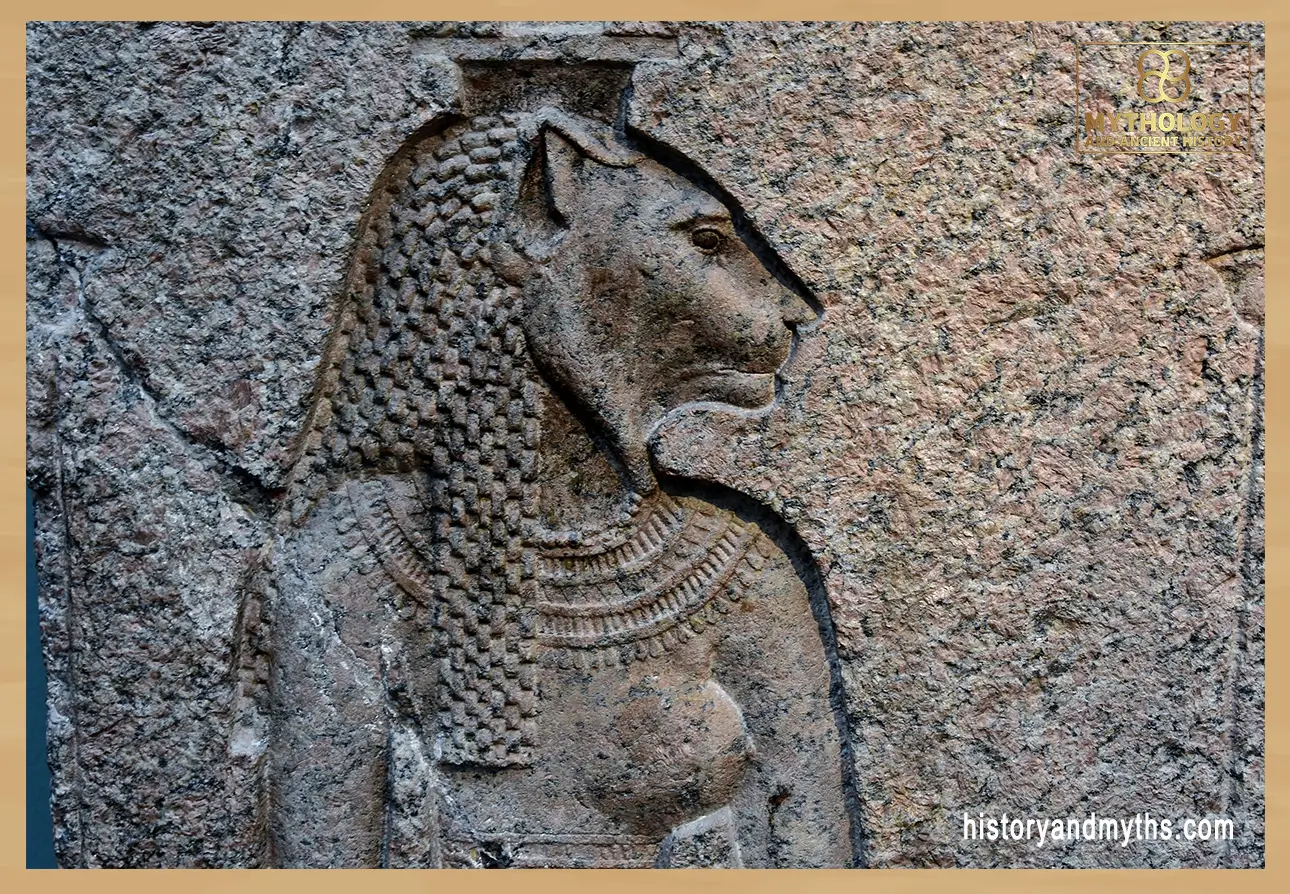
Menhit’s visual record is modest, but the little that survives is telling. She is usually shown as a lioness-headed woman, a form instantly associated with protection and controlled power in the Egyptian imagination. The lioness head is not an interchangeable symbol each goddess who bears it expresses a different facet of vigilance. Menhit’s expression, in the examples we have, tends to be serene rather than fierce, suggesting composure rather than rage.
One of the rare known depictions places her beside other deities tied to boundary regions and protective roles. These scenes reinforce how the Egyptians understood her: not as an isolated figure but as part of a network of guardians watching over vulnerable spaces.
Because her imagery is scarce, every attestation gains importance. The few statues and reliefs attributed to her carry the same qualities poise, alertness, and a grounded sense of strength. They reflect a goddess whose power did not rely on dramatic narratives but on presence. Her iconography shows that divine protection could be quiet, steady, and embodied in the simple symbolism of a lioness standing watch.
Through these small traces, Menhit’s character becomes clear. She was not a goddess of spectacle, but one of focus. A silent guardian whose form captured a very human desire: the comfort of knowing someone is watching the horizon.
Key Takeaways — Menhit
- Menhit is a lioness goddess tied to protection and frontier vigilance.
- Her name reflects strength and the ability to confront danger.
- She was associated with Egypt’s southern regions and border defense.
- Depicted as a lioness-headed woman with a calm, focused presence.
- Represents alertness, readiness, and the quiet strength of a guardian deity.
© historyandmyths.com — Educational use
Frequently Asked Questions about Menhit
1. Who is Menhit in Ancient Egyptian mythology?
Menhit is a lioness goddess associated with protection, warfare, and defensive vigilance, especially in Egypt’s southern regions.
2. What does the name Menhit mean?
Her name is often interpreted as “She Who Conquers” or “The Powerful One,” reflecting her protective and martial nature.
3. How is Menhit depicted in Egyptian art?
She is typically shown as a lioness-headed woman, symbolizing alertness, strength, and controlled divine power.
4. Was Menhit widely worshipped across Egypt?
No. Menhit was primarily associated with Upper Egypt and border regions rather than major national cult centers.
5. What role did Menhit play in Egyptian religion?
She represented vigilance at the frontier, serving as a guardian figure who protected the kingdom’s edges from danger.
6. Is Menhit related to other lioness goddesses?
Yes. She shares similarities with Sekhmet, Pakhet, and other lioness deities, but her role is more focused on border defense and readiness.
Sources & Rights
- Assmann, Jan. The Search for God in Ancient Egypt. Cornell University Press, 2001.
- Dunand, Françoise, and Christiane Zivie-Coche. Gods and Men in Egypt: 3000 BCE to 395 CE. Cornell University Press, 2004.
- Hart, George. A Dictionary of Egyptian Gods and Goddesses. Routledge, 2005.
- Hornung, Erik. Conceptions of God in Ancient Egypt: The One and the Many. Cornell University Press, 1996.
- Lesko, Barbara S. The Great Goddesses of Egypt. University of Oklahoma Press, 1999.
- Pinch, Geraldine. Handbook of Egyptian Mythology. ABC-CLIO, 2002.
- Quirke, Stephen. Exploring Religion in Ancient Egypt. Wiley-Blackwell, 2015.
- Teeter, Emily. Religion and Ritual in Ancient Egypt. Cambridge University Press, 2011.
- Wilkinson, Richard H. The Complete Gods and Goddesses of Ancient Egypt. Thames & Hudson, 2003.
- British Museum. Collection Online: Egyptian Lioness Deities and Divine Protection.
- The Metropolitan Museum of Art. Heilbrunn Timeline of Art History: Egyptian Gods and Goddesses.
- UCLA Encyclopedia of Egyptology. Lion Deities in Ancient Egypt.
- Digital Egypt for Universities (University College London). Religion in Ancient Egypt.
- Griffith Institute, University of Oxford. Topographical Bibliography of Ancient Egyptian Hieroglyphic Texts, Reliefs, and Paintings.
- World History Encyclopedia. Ancient Egyptian Religion.
Written by H. Moses — All rights reserved © Mythology and History