Life After Death in Babylonian Mythology and Religion
Death did not mark the end of existence in Babylonian religion, but neither did it lead to a paradise reserved for the righteous. The Babylonians believed that the dead continued to exist in an underworld where all people eventually gathered regardless of wealth, status, or achievement. This view of the afterlife was shaped less by ideas of reward and punishment and more by the belief that death was an unavoidable part of the human condition. Understanding how the Babylonians imagined life after death reveals not only their beliefs about the fate of the dead but also their broader views on mortality, divine order, family obligations, and the limits of human existence.
What Happened After Death?
Babylonians believed that death marked a transition rather than complete annihilation. After death, a person’s existence continued in another form within the realm of the dead. Although the physical body remained behind, the individual was thought to persist as a spirit that entered the underworld and joined the community of the deceased.
This belief reflected a fundamental distinction between life and death rather than a division between the morally good and morally evil. The fate awaiting the dead was generally understood as a shared destiny for humanity, not a reward granted to a select few. For this reason, Babylonian discussions of the afterlife focused less on judgment and more on the realities of existence beyond death.
The continuation of existence after death also explains why funerary practices and care for deceased relatives were considered important. The dead had not vanished completely; they remained part of a larger spiritual world that continued alongside the world of the living.
The Babylonian View of the Afterlife
| Belief | Babylonian View |
|---|---|
| Life After Death | Human existence continued after physical death. |
| Destination of the Dead | The underworld was the common destination of humanity. |
| Nature of the Afterlife | A diminished existence separated from ordinary life. |
| Reward and Punishment | Not emphasized as a system of eternal judgment. |
| Importance of Burial | Burial and offerings helped maintain ties with the dead. |
| Human Destiny | Death was viewed as an unavoidable part of the divine order. |
The Journey to the Underworld
Babylonian traditions described the underworld as the destination awaiting the dead after life ended. Although surviving texts do not always provide a single detailed account of the journey, they consistently portray death as a passage from the world of the living into a separate realm inhabited by the dead. Once this transition occurred, the deceased became part of a community that existed beyond ordinary human life.
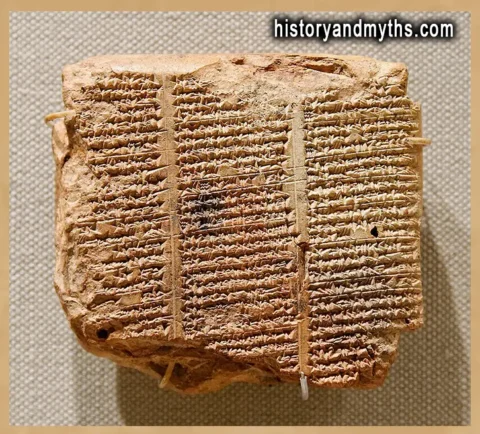
Literary works such as the Descent of Ishtar and other Mesopotamian texts helped shape the image of the underworld as a distant and difficult-to-leave domain governed by its own rules and divine authorities. Entry into this realm marked a permanent change in existence rather than a temporary stage before returning to the world above.
For the Babylonians, the significance of the journey lay less in the path itself and more in its destination. The real question was not how the dead reached the underworld, but what kind of existence awaited them once they arrived there.
What Life Was Like in the Afterlife
Babylonian sources generally describe the afterlife as a diminished form of existence rather than a place of happiness or reward. The dead continued to exist, but their condition was often portrayed as shadowy and lacking the vitality of life on earth. Literary texts frequently associate the realm of the dead with darkness, dust, and a separation from the activities that gave meaning to human life.
Unlike later religious traditions that emphasized eternal reward or punishment, Babylonian beliefs focused more on the fact that all people eventually shared the same destination. Kings, commoners, and heroes alike entered the world of the dead, where earthly distinctions lost much of their significance. The afterlife was therefore understood less as a judgment and more as the inevitable outcome of mortality.
This perspective helps explain why Babylonian literature often concentrates on the value of life rather than the hope of a better existence after death. Since the afterlife was not viewed as a place of fulfillment, attention remained focused on living well, maintaining family ties, and preserving one’s legacy among the living.
Did the Babylonians Believe in Reward and Punishment?
Babylonian beliefs about the afterlife generally did not center on a system of eternal reward and punishment. Unlike traditions that divide the dead into separate destinations based on moral behavior, Babylonian sources usually describe the underworld as the common fate of humanity. The emphasis was placed on the reality of death itself rather than on a final judgment that determined radically different outcomes for different individuals.
This does not mean that morality was unimportant in Babylonian religion. The gods were believed to reward or punish human actions during life, and people sought divine favor through proper conduct, worship, and respect for social and religious obligations. However, these consequences were typically expected to occur in the world of the living rather than after death.
As a result, Babylonian views of the afterlife focused less on justice after death and more on the universal nature of mortality. The fate awaiting the dead was largely shared, making the quality of one’s earthly life and relationship with the gods more significant than expectations of reward in the next world.
Babylonian Beliefs About the Afterlife
Babylonians believed that death did not end existence. The dead continued to exist in the underworld, a realm shared by humanity regardless of status or achievement. Rather than focusing on eternal reward or punishment, Babylonian beliefs emphasized mortality, family remembrance, burial obligations, and the enduring relationship between the living and the dead.
Why Proper Burial Mattered
Proper burial was considered important because the dead were believed to continue existing after death. Funerary rites and ongoing offerings helped maintain the connection between the living and their deceased relatives, ensuring that the dead received the care and remembrance expected within Babylonian society. A person who was properly buried remained part of the family even after entering the world of the dead.
This belief also explains why neglecting the dead was viewed with concern. Individuals who lacked descendants, proper burial, or regular offerings were sometimes thought to face a more difficult existence after death. The responsibility of caring for deceased family members therefore extended beyond mourning and became an ongoing religious obligation.
For the living, these practices reinforced family continuity across generations. For the dead, they represented one of the few ways in which support from the world above could continue after life had ended. As a result, burial customs occupied an important place in Babylonian religious life and in beliefs about the afterlife itself.
The Living and the Dead
Babylonians did not view the dead as completely separated from the living. Although the deceased had entered another realm, family members continued to acknowledge their existence through remembrance, offerings, and ritual obligations. These practices reflected the belief that the well-being of the dead remained connected, at least in part, to the actions of their descendants.
This ongoing relationship gave ancestor care an important place within family life. Providing offerings for deceased relatives was not simply an act of respect but also a way of fulfilling responsibilities that continued beyond death. Through these rituals, the living maintained ties with earlier generations and reinforced the continuity of the family across time.
The connection between the living and the dead reveals an important aspect of Babylonian religion. Death marked a separation, but it did not erase social and familial bonds. Instead, those bonds were transformed into new obligations that linked both worlds through memory, ritual, and tradition.
Could Anyone Escape the Fate of the Dead?
Babylonian mythology generally presents death as an unavoidable destiny shared by all humanity. Even powerful kings and legendary heroes were expected to face the same fate as ordinary people. This belief appears repeatedly in Mesopotamian literature, where the limits of human life are treated as a fundamental part of the divine order.
Some myths explore the possibility of escaping death, most famously in the Epic of Gilgamesh. After confronting the reality of mortality, Gilgamesh searches for a way to obtain eternal life but ultimately learns that immortality belongs to the gods rather than to human beings. Similar themes appear in other traditions, where exceptional individuals may briefly approach the possibility of transcending death yet never overturn the universal condition of humanity.
These stories were not primarily about achieving immortality. Instead, they emphasized the boundaries separating gods from humans and reinforced the idea that death was a reality that could be delayed, feared, or questioned, but not permanently avoided. In this sense, the search for eternal life served as a reminder of the limits that defined human existence.
What the Babylonian Afterlife Reveals About Their Religion
The Babylonian view of the afterlife reflects a broader understanding of humanity, the gods, and the limits of mortal existence. Rather than promising eternal reward or focusing on final judgment, Babylonian beliefs emphasized the certainty of death and the continuation of existence in a diminished form beyond it. This perspective encouraged people to concentrate on their responsibilities in life, their relationships with family, and their standing within the divine order that governed the world.
The importance of burial rites, ancestor care, and remembrance further demonstrates that death was not seen as complete separation. The dead remained connected to the living through ritual obligations and family memory, reinforcing social bonds across generations. At the same time, myths about heroes seeking immortality highlighted a central lesson of Babylonian thought: the boundary between gods and humans could be challenged, but it could not ultimately be erased.
By examining Babylonian beliefs about the afterlife, we gain a clearer understanding of a civilization that accepted mortality as an unavoidable part of the human condition. Their traditions reveal a worldview concerned less with escaping death and more with understanding how life, death, family, and divine order were woven together within a single cosmic framework.
Key Takeaways
- Babylonians believed that existence continued after death.
- The underworld was considered the common destination of the dead.
- The afterlife was generally viewed as a shadowy continuation of existence rather than a place of reward.
- Babylonian religion did not emphasize eternal heaven and hell concepts.
- Proper burial and funerary rituals were considered important religious duties.
- Family members maintained relationships with deceased relatives through remembrance and offerings.
- Stories such as the Epic of Gilgamesh emphasized the limits of human mortality.
- The Babylonian afterlife reflected broader beliefs about divine order and the human condition.
Frequently Asked Questions About the Babylonian Afterlife
What happened after death according to Babylonian beliefs?
Babylonians believed that the dead continued to exist in the underworld after physical death.
Did the Babylonians believe in an afterlife?
Yes. Death marked a transition into another form of existence rather than complete annihilation.
What was the Babylonian underworld?
It was the realm of the dead, where departed spirits were believed to reside after death.
Did the Babylonians believe in heaven and hell?
Babylonian religion generally did not emphasize eternal reward and punishment in the way many later traditions did.
Why was burial important in Babylonian religion?
Proper burial helped maintain the connection between the dead and their families and ensured fulfillment of religious obligations.
Did the living maintain relationships with the dead?
Yes. Families remembered deceased relatives through offerings, rituals, and ongoing acts of remembrance.
Could anyone escape death in Babylonian mythology?
Most myths present death as the common fate of humanity, even for kings and heroes.
What does the Epic of Gilgamesh teach about the afterlife?
It emphasizes the limits of human mortality and the impossibility of achieving immortality through ordinary means.
Sources
- Black, Jeremy, and Anthony Green. Gods, Demons and Symbols of Ancient Mesopotamia. London: British Museum Press, 1992.
- Bottéro, Jean. Religion in Ancient Mesopotamia. Chicago: University of Chicago Press, 2001.
- Dalley, Stephanie. Myths from Mesopotamia: Creation, the Flood, Gilgamesh, and Others. Oxford: Oxford University Press, 2000.
- Foster, Benjamin R. Before the Muses: An Anthology of Akkadian Literature. 3rd ed. Bethesda, MD: CDL Press, 2005.
- George, Andrew R. The Babylonian Gilgamesh Epic. Oxford: Oxford University Press, 2003.
- Jacobsen, Thorkild. The Treasures of Darkness: A History of Mesopotamian Religion. New Haven: Yale University Press, 1976.
- Katz, Dina. The Image of the Netherworld in the Sumerian Sources. Bethesda, MD: CDL Press, 2003.
- Lambert, W. G. Babylonian Creation Myths. Winona Lake: Eisenbrauns, 2013.
- Leick, Gwendolyn. A Dictionary of Ancient Near Eastern Mythology. London: Routledge, 1991.
- Leick, Gwendolyn. Mesopotamia: The Invention of the City. London: Penguin Books, 2002.
- Oppenheim, A. Leo. Ancient Mesopotamia: Portrait of a Dead Civilization. Chicago: University of Chicago Press, 1977.
- Penglase, Charles. Greek Myths and Mesopotamia: Parallels and Influence in the Homeric Hymns and Hesiod. London: Routledge, 1994.
- Roux, Georges. Ancient Iraq. London: Penguin Books, 1992.
- Scurlock, JoAnn, and Burton R. Andersen. Diagnoses in Assyrian and Babylonian Medicine. Urbana: University of Illinois Press, 2005.
- Snell, Daniel C. Religion in the Ancient Near East. Cambridge: Cambridge University Press, 2011.
- Van De Mieroop, Marc. A History of the Ancient Near East ca. 3000–323 BC. 4th ed. Oxford: Wiley-Blackwell, 2021.
- Beaulieu, Paul-Alain. A History of Babylon, 2200 BC–AD 75. Malden, MA: Wiley Blackwell, 2018.
- Kuhrt, Amélie. The Ancient Near East c. 3000–330 BC. London: Routledge, 1995.
- Zgoll, Annette. The Ancient Mesopotamian Gods and Their World. Münster: Ugarit-Verlag, 2018.
- Livingstone, Alasdair. Mystical and Mythological Explanatory Works of Assyrian and Babylonian Scholars. Oxford: Clarendon Press, 1986.
Written by H. Moses — All rights reserved © Mythology and History